

Key Takeaways
Power can rebalance a nation, but certainty can turn it dangerous.
A sudden transfer. At 2:15 a.m. on September 14, 1901, Theodore Roosevelt became president while bouncing through an Adirondack storm, still unaware that McKinley had died. He hurried toward Buffalo, grieving, furious at the assassin, and already thinking about the responsibilities ahead. The dramatic accession introduces the book’s central tension: Roosevelt could turn energy and conviction into government action, but those same traits could also outrun caution.
Courage by practice. Roosevelt had been a frail, timid child. He deliberately built physical strength and trained himself to act despite fear. His career then accelerated through politics, ranching, war, and the presidency. That self-made courage helps explain both his capacity for decisive action and his confidence that he knew when action was right.
What's striking is how the stormy journey makes temperament part of the political story. Roosevelt’s courage is neither effortless nor purely physical; it is a practiced response that becomes a governing style. That can be useful in a crisis, when hesitation has costs. It also creates a classic leadership hazard: confidence built through repeated success can make self-questioning feel like weakness. The distinction between acting boldly and judging accurately matters most when a leader has the power to make others bear the consequences.
Make corporations answer publicly when their size gives them power over markets.
Combination’s reach. By 1901, the book counts 185 major industrial trusts, compared with 20 in 1898, and attributes at least 65 percent of national wealth to trusts. Large firms could coordinate production and shipping efficiently, but their size also gave them leverage over competitors, workers, and customers. Roosevelt’s concern was not simply that companies were large. It was that government had too little information and authority to check abuses.
A landmark test. In 1902, Roosevelt’s Justice Department sued Northern Securities, a holding company joining competing railroads under the control of powerful financiers. The Supreme Court upheld the government’s case in 1904 by a narrow margin. The decision showed that federal antitrust law could reach a combination that concentrated control, even when its owners argued that the arrangement merely organized business more efficiently.
The case turns corporate transparency into a democratic question: who can see how private power operates, and who has authority to respond? That remains relevant wherever a small number of organizations control essential infrastructure. Yet scale alone is a poor measure of harm. The harder task is distinguishing productive coordination from exclusionary control, then designing oversight that can update its judgments as markets change. Roosevelt’s approach treats public scrutiny as a condition of legitimate corporate power, not as punishment for success.
Treat the public as a third party when labor and owners deadlock.
A national emergency. In 1902, 147,000 anthracite coal miners were on strike, demanding better terms and recognition of their union. Mine operators refused to negotiate. As winter approached, the stoppage threatened fuel supplies for millions of people. Roosevelt initially believed the dispute was private and beyond his legal authority, but concluded that a fuel famine would make it a public crisis.
A new role for government. He invited both sides to Washington and urged them to accept a presidential commission. The first meeting failed: the operators rejected arbitration, while the miners remained firm. Roosevelt persisted, using intermediaries and negotiation to construct a commission acceptable to both sides. Its investigation produced a settlement that raised miners’ wages by 10 percent and improved conditions. The episode established mediation as a way to protect the public without simply taking either side’s demands as law.
The intervention reframes labor disputes as conflicts with spillover costs. When a basic service is withheld, the public is not a distant spectator; it is exposed to the consequences of both sides’ choices. Roosevelt’s commission gives government a mediating function between private parties and collective need. Still, neutrality is difficult to claim when the initial invitations and terms are unequal. A credible mediator must not only convene the parties, but also make sure each can speak and bargain on meaningful terms.
Do not confuse strategic success with moral permission to override sovereignty.
The canal’s shortcut. After Colombia rejected a canal treaty, Roosevelt backed Panama’s separation from Colombia. U.S. forces blocked Colombian troops from crossing the Isthmus, helping the new republic survive its first days. The United States recognized Panama less than three days after the revolt began, then secured a treaty granting extensive authority over a ten-mile-wide Canal Zone.
A lasting contradiction. The canal promised immense commercial and strategic benefits, and Roosevelt believed Colombia had acted corruptly. But the method raised a harder question than engineering: how far could a powerful nation go to secure a project it considered essential? The resulting treaty gave the United States control in perpetuity, while Panama’s own representative later resented the terms. Roosevelt’s account frames the revolution as justified, but the sequence leaves room to see how self-determination and American advantage became entangled.
The canal is the clearest test of the gap between an outcome’s public value and the means used to obtain it. Infrastructure can benefit many countries while also enlarging the power of the state that controls it. Roosevelt regarded the canal as a project of global importance, but that belief made it easier to treat another country’s sovereignty as an obstacle. The episode invites a durable question for policy: who gets to define the common good, and what limits remain when a powerful state claims to serve it?
Build military strength to make diplomacy credible, then leave adversaries room to retreat.
Leverage without invasion. During the Venezuela crisis, Britain and Germany moved to collect debts by force. Roosevelt feared that a European power might seize territory in the Americas. He assembled a large naval presence and privately warned Germany that territorial acquisition could mean war. The crisis ended in arbitration, and the European powers withdrew without taking Venezuelan land.
A negotiated exit. In 1905, Roosevelt mediated between Russia and Japan after a war that had drained both countries. He urged Russia to accept peace and pressed Japan not to demand too much. The Treaty of Portsmouth divided Sakhalin and included payment for Russian prisoners, but no broad indemnity. The book presents military readiness and diplomatic tact as partners: strength made threats credible, while face-saving terms helped the parties stop fighting.
This is diplomacy backed by capability, not diplomacy as a substitute for it. Roosevelt’s leverage mattered because other governments believed the United States could act. But a show of strength can also create the very escalation it is meant to deter. The face-saving element is therefore essential: a settlement must let leaders return home without appearing simply defeated. The approach is powerful, but depends on the mediator’s ability to distinguish a genuine opening from a bluff, and to avoid treating every dispute as a test of prestige.
Manage natural resources as shared inheritance, not private loot.
An expanding definition. Roosevelt saw conservation as more than protecting scenery. It meant managing forests, water, minerals, and wildlife so that they remained available to the public and to future generations. The 1902 National Reclamation Act funded federal irrigation projects and aimed to give small farmers access to reclaimed land, rather than let private owners monopolize scarce water.
From places to a national policy. Roosevelt defended Yellowstone and the Grand Canyon, expanded forest reserves, and helped create parks, monuments, and bird refuges. At the 1908 White House Governors’ Conference, he argued that the country needed an inventory of its natural wealth and a shared plan for its use. His approach was practical and public-minded, though it often treated nature as something to manage for human benefit as well as something worth preserving in its own right.
The striking move is to connect conservation with democratic access and long-term planning. A forest or river is not merely scenery; it can support livelihoods, water supplies, and public health. That makes resource management a question of institutions and distribution, not just personal virtue. The tension is that stewardship can become another form of control. A policy that improves efficiency may still damage ecosystems or displace local communities. Conservation therefore requires both scientific management and clear limits on what managers may sacrifice.
Protect due process even when the accused are politically unpopular.
A grave misjudgment. After gunfire in Brownsville, Texas, killed one man and wounded a police officer, witnesses blamed Black soldiers of the Twenty-fifth Infantry. Investigations found spent Army cartridges and described the soldiers as withholding information, but no soldier was convicted. Roosevelt nevertheless ordered 167 men discharged without honor and barred them from future government service, treating the battalion’s silence as evidence of collective guilt.
The evidence problem. Later testimony showed that the cartridges could have come from target practice and had been stored in an accessible box. The case also rested on disputed eyewitness claims and racial assumptions about the soldiers’ character. Roosevelt had previously appointed Black officials and met with Booker T. Washington, but in Brownsville he let certainty replace a fair hearing. The decision damaged his standing among Black Americans and exposed the limits of his commitment to equal treatment.
Brownsville illustrates how procedural fairness matters most when public fear makes shortcuts popular. Collective punishment turns uncertainty into proof and makes an entire group carry the burden of an unsolved crime. The danger is heightened when investigators already interpret silence through racial stereotypes. Roosevelt’s earlier efforts toward Black appointments do not erase this failure; nor does the failure make those efforts meaningless. Together, the episodes show why a leader’s principles must be tested against procedure, especially when the accused have little power to defend themselves.
Pair publicity with evidence, or headlines can outrun the truth.
A president of the press age. Roosevelt used newspapers, public speeches, and carefully timed statements to build support for reform. His promise to continue McKinley’s policies helped calm markets after the assassination. Later, he used public attention to present trust regulation and the coal commission as matters of national interest. He understood that a forceful headline could reach people far beyond any speech he gave in person.
The risk of the megaphone. Roosevelt also benefited from investigative reporting, including accounts of corporate abuses and unsafe meatpacking. But he attacked some journalists as muckrakers when he thought they relied on sensationalism. The tension was real: he depended on publicity to make private power visible, while using leaks and framing to steer what the public noticed. His political skill shows how attention can move policy, and how easily it can blur the line between informing people and managing them.
Publicity is not just a channel for political ideas; it changes which problems seem urgent and which facts receive scrutiny. Roosevelt grasped this unusually well, and investigative journalists could supply evidence that officials ignored. Yet the same techniques can privilege dramatic narratives over careful verification. The standard cannot be whether a story helps reform or harms an opponent. It must be whether claims are testable, sources are accountable, and corrections are possible. Otherwise, the public square becomes a contest of framing rather than a way to discover what happened.
Keep your promise to leave office, even when reelection seems certain.
A chosen limit. After winning a landslide in 1904, Roosevelt announced that he would not seek another term. He enjoyed the presidency and believed he could accomplish more, but thought that breaking his promise would undermine the public’s trust in his stated principles. The decision became harder as supporters urged him to run again and his popularity remained high.
A reluctant handoff. Roosevelt backed William Howard Taft as his successor, helped secure Taft’s nomination, and presented him as committed to the administration’s policies. But Taft was not Roosevelt, and their relationship grew strained as the transition approached. Roosevelt left office in 1909, honoring his pledge while acknowledging that the next administration would have to establish its own authority. His exit preserved the principle of a chosen limit, without guaranteeing that his successor could carry his political momentum.
The refusal to seek a third term is more than personal restraint: it treats succession as part of democratic legitimacy. A leader who can win again may still have reason to stop, particularly if a clear promise has become a public commitment. Yet a voluntary limit does not settle the deeper question of influence. Roosevelt’s active role in choosing Taft shows that leaving office and relinquishing control are not identical. The episode asks leaders to distinguish a promise about tenure from a continuing claim over the movement they leave behind.
Analysis
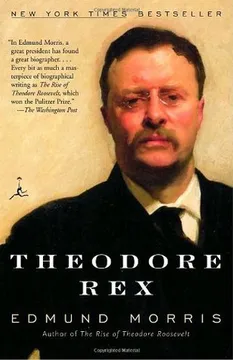
Theodore Rex is a biography of political capacity under pressure, but its deeper subject is the unstable boundary between energetic leadership and overreach. Roosevelt arrives at the presidency by accident of succession, yet quickly makes the office feel larger: he uses its visibility to steer Congress, its authority to regulate markets, its military power to shape diplomacy, and its symbolic force to define national priorities. Morris’s narrative makes that expansion vivid through scenes of motion, from the rain-dark ride to Buffalo to the fleet crossing oceans and the canal cutting a continent.
The structure also resists a clean heroic arc. Roosevelt’s reforms repeatedly depend on traits that can undermine them. Speed enables the coal settlement and effective crisis response, but also helps produce the Brownsville punishment before the evidence is secure. Publicity makes corporate power legible, yet gives the president tools to manage the public’s interpretation. Conservation expresses a long view of shared resources, while canal policy treats another nation’s sovereignty as negotiable. The same confidence animates both achievement and error.
That contradiction is not merely a flaw in character. It reflects the era’s institutional problem: markets, railroads, labor organizations, and international power had outgrown the existing scale of government. Roosevelt’s response is to make the presidency a coordinating center, sometimes through legislation, sometimes through negotiation, and sometimes through personal pressure. The question is whether this center represents the public or substitutes its own judgment for public consent. His self-image as a mediator is persuasive when he creates a commission or brings rivals to a peace table. It is less persuasive when he treats his certainty as sufficient evidence.
The book’s most useful lesson is therefore not that forceful leaders are good or dangerous, but that both claims can be true at once. Executive energy can make institutions responsive to problems they were built to ignore. Its legitimacy depends on evidence, process, and a willingness to accept limits. Roosevelt’s promise to leave office supplies one such limit; Brownsville shows how badly he could fail to impose limits on himself.
Review Summary
Reviewers largely praise Theodore Rex as a meticulously researched, beautifully written account of Roosevelt's presidency, highlighting his trust-busting, conservation efforts, Panama Canal construction, and Nobel Peace Prize-winning diplomacy. Many consider it slightly less compelling than its predecessor due to governance-focused content. Critics note Morris's reluctance to provide deeper historical analysis, his occasionally disjointed narrative style, and insufficient treatment of Roosevelt's racial record, particularly the Brownsville affair. Despite these shortcomings, most readers find it an essential, rewarding read for anyone interested in Roosevelt or the Progressive Era.
Glossary
Square Deal
Fairness across powerful interestsRoosevelt’s governing principle that workers, businesses, and the public should receive fair treatment under common rules. It did not mean equal outcomes or opposition to wealth. It meant that corporations and labor organizations could not use their power without regard for the wider public, and that government should restrain abuses while permitting productive enterprise.
big stick
Diplomacy backed by strengthRoosevelt’s approach to foreign policy, combining restrained public language with credible military readiness. The point was not constant threats or war, but to make peaceful negotiation more persuasive by showing that the United States could defend its interests. Its effectiveness depended on judgment and restraint, since the same display of power could provoke the conflict it was meant to prevent.
Roosevelt Corollary
U.S. policing claim in the AmericasRoosevelt’s extension of the Monroe Doctrine, under which the United States claimed a responsibility to intervene in Latin American countries when disorder or unpaid obligations might invite European intervention. It presented U.S. action as a way to keep European powers out of the hemisphere, while also expanding American authority over neighboring republics.
Conservation
Public stewardship of resourcesRoosevelt used conservation to mean more than preserving wilderness. It included planned management of forests, water, minerals, and wildlife, prevention of private monopolies over natural resources, and protection of resources for future generations. His approach joined federal administration with public access and productive use, though it could prioritize human development over nature’s independent value.
Great White Fleet
U.S. battleships on world tourThe fleet of sixteen American battleships Roosevelt sent from Hampton Roads in December 1907 on a round-the-world voyage. The cruise demonstrated the Navy’s reach, trained sailors and ships, and served as a highly visible signal of American power, particularly in the Pacific. Its journey also showcased Roosevelt’s preference for using military preparedness as a tool of diplomacy.
Man with the Muckrake
Reporter fixed on corruptionRoosevelt’s label for investigative journalists who concentrated on exposing corruption and wrongdoing. He recognized that their reporting could reveal abuses and build support for reform, but warned that fixation on scandal could become sensational and distort judgment. The phrase became a name for muckraking journalism, even though many reporters saw their work as necessary public investigation.
Gentlemen’s Agreement
Informal U.S.-Japan immigration accordThe understanding between the United States and Japan that Japan would restrict passports for laborers seeking entry to the United States, while Washington would address anti-Japanese discrimination, including the San Francisco school segregation dispute. It avoided a formal exclusion treaty and eased immediate diplomatic tensions, while leaving the underlying conflict over race and immigration unresolved.
About the Author
Other books by Edmund Morris


Download PDF
Download EPUB
.epub digital book format is ideal for reading ebooks on phones, tablets, and e-readers.








