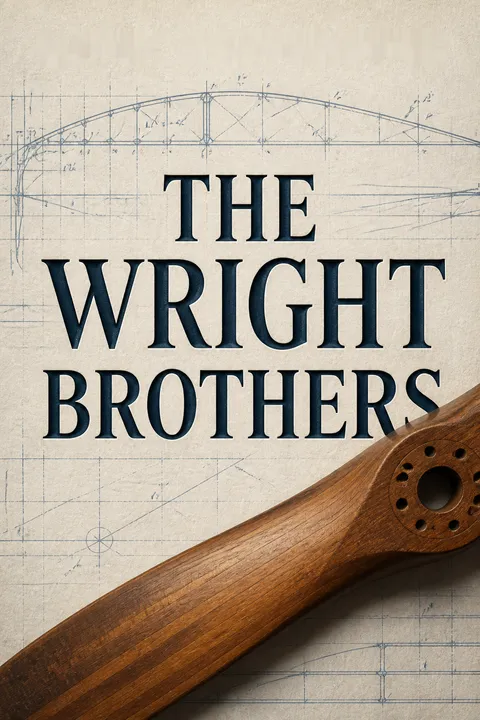


Key Takeaways
Start with curiosity, then give it a workshop and room to grow.
A household built for inquiry. The Wrights' father encouraged reading and independent thought. Their home held history, literature, science, and travel books, while their mother was remembered for making toys and other things by hand. As boys, Wilbur and Orville played with a small flying toy and imagined building a machine of their own. They later learned by running a print shop and a bicycle business, where designing, repairing, and making things became daily work.
Neither brother had formal technical training. But they had a family that supported intellectual curiosity, practical experience, and a partnership in which each could contribute different strengths. Their path began not with a grand laboratory, but with books, tools, and a small shop in Dayton.
What's striking is how the story complicates the familiar image of the lone, self-taught inventor. The brothers lacked formal engineering credentials, but they did not lack advantages: literacy, a supportive family, a working shop, and years of mechanical practice. That distinction matters. Skill often grows in environments that make curiosity usable, where a question can quickly become a sketch, a test, or a repaired part. The Wrights' example does not diminish their achievement. It shows that independence is often built from relationships and resources that are easy to overlook.
Solve control before chasing speed, altitude, or a stronger engine.
Balance came first. The brothers concluded that getting airborne was not the central challenge. A pilot had to keep an aircraft balanced and steer it in changing air. They called this problem equilibrium, meaning control of the machine's position and direction while flying. Otto Lilienthal had glided successfully, but the Wrights believed his reliance on shifting his body gave him too little control to recover from a sudden change.
Watching birds suggested another approach. Wilbur devised wing warping, a system that twisted the wings so one side gained more lift than the other, allowing the aircraft to bank and turn. The brothers tested the idea first on a small kite, then on gliders. Their bicycle experience helped: balancing in flight, like balancing on two wheels, required continuous correction, not a single clever design.
The Wrights' priority resembles a general principle in engineering: a system must be controllable before added power makes it useful. More force can amplify instability as readily as performance. Their attention to steering and balance also kept the pilot in the center of the design, rather than treating the aircraft as a machine that would fly itself. The approach has a limit: control depends on both equipment and trained skill. A design can make correction possible, but it cannot erase the need to practice under real conditions.
When trusted calculations fail, build an instrument that can answer directly.
Measure instead of guessing. In 1901, the brothers' glider performed badly despite being built around published calculations from respected aviation pioneers. Its wings were too curved, and its handling was unpredictable. The failure undermined their confidence in the data they had inherited. Rather than choosing another authority to trust, they began gathering their own measurements.
They built a six-foot wind tunnel in the bicycle shop and tested about 38 small wing shapes made from hacksaw blades. By changing their shape and angle in moving air, they compared lift, the force that raises a wing, and drag, the resistance it faces. The work was slow, but it gave them evidence they could use to design better wings. Their next aircraft reflected those tests, not merely accepted theory.
The key move is not simply skepticism. It is replacing borrowed certainty with a way to test the question. A useful instrument changes what can be known, and often changes the quality of the next decision. The wind tunnel also made the work repeatable: one design could be compared with another under similar conditions. Yet a model is still a model. Small wing sections inside a box cannot capture every condition of full flight, so measurement narrows uncertainty without making it disappear.
Use argument to find the weak point, then return to shared evidence.
Disagreement became a tool. Wilbur and Orville could argue loudly and at length over a design choice. Their colleague Charlie Taylor recalled that after an intense debate, one brother might reconsider and adopt the other's original position. The point was not to win the exchange. They used criticism to expose flaws, then moved on when their thinking had changed.
Their partnership combined complementary abilities. Wilbur was known for concentration, memory, writing, and analysis. Orville was more mechanically inventive and optimistic. They did not divide the work into sealed territories: both studied flight, tested machines, and discussed the problems. When Orville proposed making the rear rudder movable, Wilbur accepted the idea and suggested linking its control to the wing-warping mechanism, simplifying the pilot's task.
The useful distinction is between disagreement that tests an idea and conflict that merely protects status. The Wrights had shared evidence, a common goal, and enough familiarity to challenge one another without ending the partnership. Those conditions made debate productive. Their method should not be romanticized as proof that every argument is beneficial. In less trusting relationships, criticism can silence people or become a contest of authority. The practical lesson is to make disagreement answerable to a design, observation, or test, not to personal victory.
Make constraints part of the design, not excuses to postpone.
The field shaped the machine. At Kitty Hawk, steady winds and soft sand gave the Wrights a place to test gliders. Back near Dayton, Huffman Prairie offered less wind and less room, but it was cheaper and close to their workshop. They needed a way to launch without relying on a strong breeze. Their solution was a starting apparatus: a wooden tower, a rope, pulleys, and heavy weights that dropped to pull the aircraft down its launching track.
The device was simple and inexpensive. The brothers began with 200 pounds of weights, then increased the load as needed. It helped them take off in calmer conditions and practice turns in the limited pasture. Rather than insisting that the site match their ideal, they adapted the launch system to the place they could use.
Constraints can focus invention by making the missing capability unmistakable. At Huffman Prairie, the lack of wind was not a minor inconvenience; it prevented the kind of practice the brothers needed. The launch system addressed that specific bottleneck. This is a stronger form of adaptation than treating every obstacle as inspiration: it begins by identifying which constraint actually blocks progress. Some constraints should be accepted, while others signal unacceptable risk or inadequate resources. The skill lies in distinguishing a design problem from a reason to stop.
Persistence is a sequence of corrections, not stubborn repetition.
Each failure changed the next attempt. The 1901 glider's curved wings created serious handling problems. The brothers altered the curvature and saw improvement. During later trials, wing warping did not work as expected, so they redesigned the controls, adding a movable rear rudder and linking it to the wing controls. By 1902, they had made nearly a thousand glides and developed a machine they could steer reliably.
Adding an engine brought another set of problems. No suitable lightweight motor was available, so mechanic Charlie Taylor built one for them. The brothers also had to work out how propellers moved air, since reliable design information was lacking. Their experiments did not follow a straight line from insight to success. Progress meant identifying what went wrong, changing one or more parts, and testing again.
This history gives persistence a concrete meaning: the next attempt contains information from the last one. Repeating the same failed method would have been endurance without learning. The Wrights' progress depended on disciplined attention to specific causes, from wing curvature to propeller design. Their story also makes visible the costs of iteration: money, time, injury, and uncertainty. Not every failure pays for itself with insight. Experiment is productive when the result can alter a decision, not when failure is treated as valuable by definition.
Call a breakthrough real when skilled operators can repeat it.
The first flight was a beginning. On December 17, 1903, the Wrights made four powered flights at Kitty Hawk. Orville's first lasted about 12 seconds and covered 120 feet. The final flight, piloted by Wilbur, traveled 852 feet over the ground in 59 seconds. The damaged machine could not fly again that day, and the achievement attracted little immediate attention.
The brothers knew they still had to improve their aircraft and their flying. At Huffman Prairie in 1905, their Flyer III completed a flight of about 24 miles in just over 38 minutes. That sustained, controlled performance showed the difference between getting a machine into the air and building a practical airplane. In 1908, Wilbur's demonstrations in France allowed a skeptical public to see the aircraft's control for themselves.
The distinction between a first success and a reliable capability is essential to understanding invention. The 1903 flights established that powered, piloted flight was possible, but did not yet make the airplane practical. The later flights demonstrated endurance and control, while public demonstrations made the evidence visible to people who had not seen the private tests. This also explains why a true achievement can go unrecognized at first: evidence and credibility are separate problems. Still, public attention is not a scientific test by itself; performance must remain the measure.
Treat public attention as a pressure to manage, not proof of progress.
Attention changed the working conditions. For years, the Wrights tested their machines with few witnesses. Once demonstrations began, reporters and crowds wanted flights on demand. Wilbur found the constant visitors exhausting and warned Orville not to let officials or spectators rush him into flying before he was ready. The machine still had to be checked, the weather still mattered, and the pilots still needed rest.
The dangers were real, not theatrical. In 1908, one of Orville's propellers broke during a flight at Fort Myer, causing a crash that severely injured him and killed passenger Lieutenant Thomas Selfridge, the first person to die in a powered-aircraft accident. The investigation traced the crash to a broken propeller and a wire that disrupted the rudder. Public performance could confirm an invention, but it could not remove its hazards.
The episode shows how reputation can impose its own schedule on technical work. Spectators may interpret delay as evasion, while a cautious operator sees unresolved risk. The Wrights' insistence on preparation was not merely temperament; flight depended on weather, machinery, and practiced control. The crash also resists a triumphal account in which confidence guarantees safety. Their experience argues for boundaries around demonstrations and for treating accidents as evidence about system design, not as the inevitable price of spectacle.
Credit the network behind invention without erasing its central makers.
Independence was not isolation. Wilbur and Orville paid for their early experiments through their bicycle business, spending less than $1,000 in total from 1900 to 1903. But their work depended on other people. Charlie Taylor built the engine when manufacturers could not supply one. William Tate and other residents helped the brothers at Kitty Hawk. Octave Chanute offered advice and encouragement, while Amos Root gave the first accurate public account of their flights at Huffman Prairie.
Katharine supported the family, corresponded with her brothers, and cared for Orville after his 1908 crash. The Wrights remained the decisive designers and pilots, but their achievement emerged within a web of practical help, family labor, local knowledge, and technical exchange. Their modest budget makes the story more remarkable, not less collaborative.
A useful account of invention distinguishes authorship from contribution. The Wrights' originality and sustained work deserve clear credit, while the people who built, supported, witnessed, and publicized their work deserve recognition for their roles. This prevents two opposite distortions: the solitary-genius myth and the idea that individual achievement is impossible to identify within a network. The book makes the brothers' partnership central, but the surrounding cast reveals how much an invention depends on capabilities beyond its central designers.
Judge an invention by its uses, not only by its inventors' hopes.
The airplane exceeded its creators' intentions. Wilbur and Orville imagined useful flight and presented military scouting as one possible application. Orville later saw aviation transformed into a weapon of vast destruction, especially during the world wars. He did not disown the invention, but compared its mixed uses to fire: a powerful discovery can cause terrible harm and still serve many human needs.
The family's story also carries the physical cost of the work. Wilbur died of typhoid in 1912, aged 45. Orville lived until 1948, witnessing jet propulsion and the breaking of the sound barrier. Decades after the first flight, a piece of their aircraft's muslin traveled with Neil Armstrong to the Moon, a reminder that the first fragile machine had opened paths its builders could scarcely have imagined.
The Wrights' experience separates an inventor's motive from a technology's consequences. Good intentions do not govern every later use, especially once a tool becomes widely available and enters political or military systems. That does not make the original achievement morally meaningless, nor does it excuse harmful applications. It asks for a broader standard of judgment: examine what a technology enables, who controls it, and who bears its costs. The airplane's history contains both extraordinary reach and devastating force, and neither side cancels the other.
Analysis
The Wright brothers' achievement is often reduced to a dramatic instant: a machine lifts from the sand, and the modern age begins. McCullough's account makes that image the payoff of a longer, less tidy process. The essential invention was not one airframe or one engine, but a working method: study existing knowledge, test what it cannot explain, build measuring tools, revise the design, and acquire enough skill to control the result. The sequence from glider to wind tunnel to powered flight clarifies why the brothers succeeded where better-funded efforts failed. Their advantage was not simply mechanical cleverness. It was their willingness to treat flight as a problem of control, measurement, and practice.
The narrative also broadens the idea of invention beyond technical design. The bicycle shop financed the experiments; Taylor built the engine; Kitty Hawk residents supplied labor and hospitality; Katharine sustained the family and later cared for Orville. The brothers' achievement remains their own, but the conditions that made it possible were shared. That tension is central to a credible history of innovation: an individual or partnership can make the decisive leap while depending on a larger community of skills and support.
The book's documentary richness gives these claims unusual force. Letters, diaries, and eyewitness accounts show not just what the brothers accomplished, but how they thought, worked, doubted, and endured public skepticism. Yet the story's emotional arc can make success feel inevitable in retrospect. It was not. The crashes, flawed measurements, financial limits, and years of disbelief expose how contingent the result remained. The concluding history of aviation resists a simple victory lap: flight expanded human possibility, and also enlarged the reach of war. The lasting lesson is therefore double. Patient, evidence-led work can change the world, but its consequences are not controlled by the people who begin it.
Review Summary
Reviews of The Wright Brothers are overwhelmingly positive, averaging 4.18 out of 5. Readers praise McCullough's ability to bring the Wright family to life through meticulous research, personal letters, and diaries. Reviewers highlight the brothers' remarkable determination, intellectual curiosity, and humble origins as bicycle mechanics who revolutionized human history. Many appreciated learning about their sister Katharine's crucial supporting role. Some noted the book's relatively brief length left them wanting more biographical detail, and a few found the author's self-narration of the audiobook merely adequate rather than polished.
People Also Read






Glossary
wing warping
Twisting wings to steerA method of controlling an aircraft by changing the angle of its wings. Cables and a pilot-operated cradle twisted one wing relative to the other, creating unequal lift so the aircraft could bank and turn. The Wrights developed the approach from observations of birds and made it a central part of their early flying machines.
equilibrium
Balance and control in flightThe state of keeping an aircraft balanced and directed while it moves through changing air. For the Wrights, flight required controlling pitch, roll, and yaw rather than merely producing lift. They treated equilibrium as the central challenge because a pilot needed to correct the aircraft's motion continuously to remain safely aloft.
lift and drag
Forces on a moving wingLift is the upward force generated as air moves around a wing; drag is the resistance the wing encounters as it moves through air. The Wrights tested different wing shapes and angles in their wind tunnel to compare these forces. Their measurements helped them design wings based on evidence rather than unreliable published estimates.
wind tunnel
Device for testing wing shapesA box that directs moving air over small wing models so their behavior can be measured under controlled conditions. The Wrights built one in their bicycle shop and tested about 38 airfoil shapes, changing their angles and forms. Its measurements helped them improve wing design after earlier gliders performed poorly.
starting apparatus
Gravity-powered aircraft launcherThe Wrights' launch system at Huffman Prairie, where local winds were often too weak for takeoff. A tower, rope, pulleys, and heavy weights pulled the aircraft along a track. As the weights dropped, the Flyer gained the speed needed to lift off, allowing the brothers to practice without depending on a strong headwind.
Flyer III
First practical Wright airplaneThe Wrights' 1905 aircraft, redesigned through experiments and practice after their first powered flights. Improvements to its balance, steering, and structure made it capable of sustained, controlled flight. Wilbur flew it about 24 miles in a single flight, demonstrating that the brothers had moved beyond proving that powered flight was possible.
About the Author
Other books by David McCullough



Download PDF
Download EPUB
.epub digital book format is ideal for reading ebooks on phones, tablets, and e-readers.








