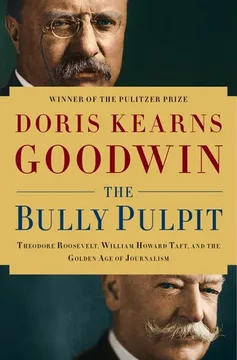


Key Takeaways
Make the presidency a bully pulpit by teaching the public what reform requires
Visibility needs substance. Roosevelt coined “bully pulpit” for the presidency’s power to shape public opinion. He used it not only to make speeches, but to cultivate reporters: he invited them to meals, answered questions during his shave, and created a room for them in the White House. On whistle-stop tours, he spoke plainly to crowds, while accompanying journalists carried his arguments to readers nationwide. The method mattered because Congress was resistant to reform and the public could pressure lawmakers who would otherwise ignore it.
Taft shows the limit. Taft shared many of Roosevelt’s goals, but trusted that sound decisions and legislation would speak for themselves. Afterward, he admitted that failing to explain his policies had been a serious weakness. A platform reaches further when citizens understand not just what a leader wants, but why it matters.
What's striking is that Roosevelt treats communication as part of governing, not decoration around it. Modern political science similarly distinguishes formal authority from agenda-setting power: leaders can make an issue visible, define its stakes, and help citizens coordinate pressure. Yet visibility alone is not democratic consent. A president who commands attention can also simplify evidence, personalize structural problems, or mistake applause for durable agreement. Roosevelt's approach is strongest when journalists can question him, verify claims, and report independently.
Fund reporters to follow evidence until hidden systems become visible
Investigation takes time. S. S. McClure built a magazine around extended reporting, paying writers salaries and expenses so they could pursue a subject for months or years. His editorial method began with research rather than a fixed verdict, then shaped findings into a readable story. Ida Tarbell’s investigation of Standard Oil traced how secret railroad rebates, surveillance of competitors, and price-cutting helped the company dominate the oil industry. Her series gave readers concrete evidence of how a trust grew, rather than asking them to trust a general accusation.
Reach followed rigor. The 1903 issue that paired Tarbell’s exposé with Lincoln Steffens’s account of municipal corruption and Ray Baker’s labor reporting sold out quickly. Other magazines adopted the approach. The journalism supplied politicians with a public able to recognize abuses that had previously seemed technical or obscure.
What's striking is the connection between institutional resources and the quality of public knowledge. Investigative journalism resembles scientific inquiry: it requires time, access to records, corroboration, and willingness to revise an initial theory. The narrative form then makes complex evidence memorable. But a compelling culprit can also make a system look like the product of one villain. Tarbell's reporting is powerful partly because it shows Rockefeller's decisions and the railroad arrangements that made them profitable.
Fight corruption with coalitions, not just righteous solo performances
Learn to work with imperfect partners. As a young New York assemblyman, Roosevelt initially relied on forceful speeches against corruption. He learned that theatrical attacks could leave him isolated and powerless. Real legislative progress required give-and-take with colleagues and pressure on the members who were neither committed reformers nor committed opponents.
Practice showed the trade-off. As governor, Roosevelt confronted Senator Thomas Platt over a tax on valuable corporate franchises. Rather than break with the Republican organization immediately, he accepted a delay, built support, and ultimately secured a modified bill. Reformers criticized the compromise, but Roosevelt argued that an imperfect law was better than a dramatic gesture that left the old arrangement untouched. His method joined public pressure to negotiation with insiders, though it required tolerating allies whose motives he distrusted.
The episode anticipates a familiar problem in coalition politics: purity can preserve a movement's identity while shrinking its ability to govern. Roosevelt's development is not a simple conversion from principle to pragmatism. He tests what the legislature will bear, then uses publicity and bargaining to move it. The limit is that compromise can normalize the very networks it is meant to reform. His approach works best when concessions are visible, bounded, and paired with measurable public gains.
Choose leaders whose temperament fits the office, not just its ideals
Taft excelled in institutions. A trained judge, he was patient with legal detail, careful in weighing evidence, and widely trusted by colleagues. His court rulings supported labor's right to organize while opposing a secondary boycott, and his decision against the Addyston pipe combination helped revive anti-trust enforcement. In the Philippines, he negotiated with local leaders and built schools, roads, hospitals, and courts, while advocating a gradual path toward self-government.
The presidency demanded another skill. Taft believed that correct decisions would explain themselves. He struggled to give speeches, absorb criticism, and present a coherent public account of his program. His colonial policy also carried a contradiction: he promised increasing self-rule while judging Filipinos not yet ready for independence and limiting political participation. Competence in administration did not automatically translate into public leadership.
The contrast is a useful corrective to the idea that the best deputy naturally becomes the best chief. Judicial habits favor consistency, procedural fairness, and restraint; political leadership also requires public explanation, coalition-building, and visible ownership of choices. Taft's strengths remain substantial, and his failures should not be reduced to temperament alone: party divisions, hostile institutions, and Nellie's debilitating stroke shaped his presidency. The book's sharper point is that governing and persuading are distinct forms of work.
Treat public leadership as a partnership, not a solo act
Private support shaped public work. Nellie Taft was more than a social companion: she edited speeches, advised her husband, built civic projects, helped found the Cincinnati Symphony Orchestra, and supported his work in the Philippines. Her confidence helped him accept difficult assignments. Edith Roosevelt, by contrast, valued privacy and family life, sometimes urging her restless husband toward a quieter course. Her restraint and management of the household gave Roosevelt a refuge from public conflict.
The partnership had limits. Nellie's stroke soon after the Tafts entered the White House left her unable to speak clearly and deprived Taft of a central adviser. Edith's influence could steady Roosevelt, but could not make her share his appetite for political combat. The book presents presidential achievement as sustained by domestic labor, counsel, and emotional support, even when those contributions remain outside the official record.
What's striking is how much political capacity is produced outside formal office. Partners can provide judgment, editing, social access, emotional regulation, and the practical labor that makes public work possible. This resembles modern research on invisible labor in professional households: one person's visible career often rests on another person's less visible coordination. The book also shows why partnership should not be romanticized. Support cannot erase unequal constraints, and a spouse's illness or competing ambitions can sharply alter a leader's options.
Judge labor and capital by the same standard, without pretending their power is equal
Baker reported both sides. During the 1902 coal strike, he investigated miners who kept working despite intimidation and violence from fellow union members. His account gave those men and their families individual stories, while acknowledging the dangerous conditions that drove the larger strike. In a later investigation, he traced how construction boss Sam Parks extorted contractors while receiving payments from the Fuller Company, a major builder. The evidence showed corruption within a union and an alliance with corporate power.
Fairness is not false equivalence. Roosevelt valued Baker's willingness to criticize both employers and labor leaders. The principle was equal accountability under law. But the two sides did not possess equal resources: a corporation could shape working conditions and influence lawmakers, while an individual worker risked wages, safety, and community ties. Honest reporting can hold both responsible while still distinguishing their power.
This is a more demanding form of balance than giving each side equal blame. It asks reporters to test claims against evidence while also examining who controls jobs, capital, and institutions. That distinction matters across fields: formal equality before a rule does not mean equal ability to shape the rule or withstand its consequences. Baker's method avoids turning unions into saints, but his cases also show why isolated misconduct should not erase the structural dependence of workers.
Turn public pressure into leverage before private disputes become public crises
The coal strike became everyone's problem. In 1902, about 140,000 anthracite miners had been out for months as winter approached and coal supplies dwindled. Mine owners refused to negotiate with union leader John Mitchell, even when he offered arbitration. Roosevelt invited both sides to Washington and arranged for a stenographer to record the meeting. When the transcript showed the operators rejecting compromise, public opinion turned against them.
Pressure opened a path. Roosevelt considered taking over the mines but preferred a less drastic settlement. Elihu Root persuaded J. P. Morgan, whose interests linked the coal operators, to support an arbitration commission. The strike ended with wage increases and shorter hours. The episode shows how the president used public attention to alter bargaining power, then relied on intermediaries to reach a settlement.
The strike reveals public opinion as a practical resource, not merely a measure of popularity. The transcript changed the political cost of refusal, while Morgan's intervention supplied a route the owners could accept without formally recognizing the union. That solution was effective but imperfect: the settlement depended on elite mediation, and the workers did not control the process. Roosevelt's restraint is notable, yet the near-use of federal force raises a lasting question about how far executive power should stretch in a national emergency.
Convert exposés into enforceable rules, then keep explaining the trade-offs
Reporting helped unlock legislation. Tarbell's work on Standard Oil clarified how railroad rebates advantaged large shippers. Public pressure helped Congress pass the Elkins Act, expedite anti-trust cases, and create the Department of Commerce and Labor with a Bureau of Corporations. Later, Ray Baker's reporting on railroad rate discrimination helped make federal regulation intelligible to the public. The Hepburn Act strengthened the Interstate Commerce Commission's authority to set reasonable maximum rates.
Reform was real but incomplete. In 1906, Congress also passed meat-inspection and food-and-drug laws after Upton Sinclair's novel exposed filthy packinghouse conditions. Roosevelt used Sinclair's reporting to press for action, though the novel's focus on meat safety differed from Sinclair's primary concern with workers. These laws expanded federal oversight, but compromises, court challenges, and enforcement choices shaped their reach.
The sequence links exposure to policy without assuming that information automatically produces justice. Stories can focus public attention; legislation can create authority; agencies must then investigate and enforce. The meatpacking episode also shows that audiences may respond to the danger they feel most directly, even when that differs from the writer's central argument. Effective reform therefore depends on clear rules and continuing public scrutiny, not a single burst of outrage.
Choose successors for shared judgment, not assumed political sameness
Friendship could not prevent a break. Roosevelt chose Taft as his successor, trusting him to carry forward progressive reform. Taft became president after a landslide victory in 1908, but his judicial temperament and reliance on Congress soon frustrated progressives. Roosevelt had promised not to seek a third term, then returned from Africa to find the party divided and Taft vulnerable to conservative pressure. By 1912, Roosevelt challenged the man he had once promoted.
The split changed the election. Roosevelt ran as a Progressive after losing control of the Republican convention; Taft remained the Republican nominee. Woodrow Wilson won, while the divided Republican vote helped end both men's immediate hopes. Their rupture was not simply personal: it exposed different beliefs about leadership, party loyalty, reform, and the legitimacy of breaking a promise for political power.
What's striking is that succession is not the transfer of a personality. Roosevelt mistook shared goals and deep affection for assurance that Taft would lead as he had. Taft, in turn, could not provide Roosevelt's public voice or appetite for confrontation. The rupture also complicates any easy moral verdict: Roosevelt's return challenged his pledge, while Taft's fidelity to party and procedure often constrained reform. Durable succession requires explicit agreement about methods, not just ideals.
Analysis
Goodwin builds this history around three interdependent forces: presidential character, investigative journalism, and public pressure. The central achievement is to make politics legible as a chain of relationships rather than a sequence of laws. Roosevelt's rapport with reporters, McClure's investment in long-form inquiry, and the public's response to stories about Standard Oil, city machines, labor violence, and unsafe food help explain how reform moved from scattered grievance to legislative agenda. Taft's contrasting judicial temperament then tests whether the same goals can survive without Roosevelt's rhetorical energy.
The narrative is strongest when it resists simple hero stories. Roosevelt learns that denunciation alone cannot govern; Taft's record includes meaningful anti-trust and labor decisions despite his weak public communication; investigative writers expose abuses on more than one side. The friendship between the men gives the political analysis emotional consequence. Its collapse is not merely a personal tragedy but a demonstration that shared intentions do not guarantee agreement on tactics, institutions, or the limits of executive power.
The book's argument also carries tensions worth retaining. The press can educate citizens, but vivid narratives can personalize systemic failures and reward sensationalism. Roosevelt's use of publicity expands democratic accountability while also making political attention dependent on one charismatic leader. His reforms often rely on compromise with party bosses and corporate interests, while his administrative reach sometimes tests constitutional limits. Taft's colonial administration similarly pairs public works and limited self-government with paternal assumptions and constrained political participation.
The result is not a tidy claim that journalism saved democracy or that one style of leadership was simply superior. It is a study of how reform becomes possible when evidence, political skill, institutional authority, and public demand briefly reinforce one another. That alignment is powerful, but fragile: it can produce landmark laws, and it can fracture when the people leading it disagree over who should control the movement and how far change should go.
Review Summary
Reviews of The Bully Pulpit are largely positive, averaging 4.16/5. Readers praise Goodwin's engaging storytelling, thorough research, and sympathetic portrait of the often-overlooked Taft. Many appreciated the exploration of the Roosevelt-Taft friendship and its tragic dissolution. Critics note the book feels like three separate narratives — Roosevelt, Taft, and muckraking journalism — awkwardly combined, resulting in an unfocused, overlong work. The excessive use of quotations also drew criticism. Most agree the biographical sections are compelling, even if the book lacks deeper analytical conclusions.
People Also Read


Glossary
bully pulpit
Presidential platform for persuasionThe national visibility and authority of the presidency, used to shape public sentiment and encourage action. Roosevelt used the phrase for the president's ability to address citizens directly, explain complex problems, and pressure Congress. In this account, the platform depends partly on relationships with journalists who carry presidential arguments beyond Washington.
muckraker
Investigative reform journalistA label Roosevelt used for reporters who exposed corruption and abuses in business, labor, and government. Writers at McClure's turned the term into a mark of distinction. Their work relied on extensive research and narrative reporting, making hidden practices understandable to a mass readership and helping generate public support for reform.
Square Deal
Fair treatment under public rulesRoosevelt's shorthand for a governing principle that no group should receive special privileges and that government should treat people fairly. He applied it to workers, corporations, and individuals. It did not mean identical outcomes or hostility to business; Roosevelt supported corporations when they acted lawfully and opposed abuses by either employers or labor leaders.
spoils system
Jobs awarded for party loyaltyA political arrangement in which public appointments, promotions, and dismissals depend on party affiliation and patronage rather than competence. Roosevelt's Civil Service Commission work sought to expand merit-based hiring and limit demands that government workers contribute part of their salaries to the party in power.
direct primary
Voters choose party candidatesA process that lets voters select a party's nominees directly instead of leaving nominations to conventions controlled by party leaders. Progressives supported direct primaries as a way to weaken political machines and give citizens more influence over candidate selection. Roosevelt later made the issue central to his challenge against party bosses.
About the Author
Other books by Doris Kearns Goodwin


Download PDF
Download EPUB
.epub digital book format is ideal for reading ebooks on phones, tablets, and e-readers.








