

Key Takeaways
Read your body as a record of cosmic and planetary history
A tooth opens a vast story. On a Greenland ridge, Neil Shubin and his colleagues found a tiny fossil tooth in rocks about 200 million years old. It belonged to an early mammal relative, whose teeth, ear bones, and limbs help explain features still used by people today. Finding it required more than luck: the team traced matching rock layers across eastern North America and Greenland, then searched the exposed outcrops. Rocks, fossils, and bodies are not separate subjects. Each preserves evidence of transformations that connect life to Earth’s changing surface and, further back, to the solar system and stars.
History hides in ordinary things. A tooth can preserve a family relationship; a rock layer can preserve an ancient landscape. The book follows these clues across billions of years, from the origin of matter to human anatomy.
The tooth is a useful model for historical science: researchers infer events that cannot be observed directly by combining clues that survive in different forms. Its power comes from convergence, not from one spectacular specimen. That method resembles forensic investigation, where context can matter as much as the object itself. The connection between bodies and cosmic history is also more than metaphorical: the claim depends on identifiable material and anatomical evidence. Still, a fossil is not a complete record. Preservation is selective, and every reconstruction remains open to revision as new evidence appears.
The atoms in you were forged by stars and scattered supernovae
Matter has a long biography. The simplest elements, including hydrogen, formed early in the universe. Stars fused lighter atoms into heavier ones, producing elements such as carbon and oxygen. When some stars exhausted their fuel, they exploded and dispersed material that could become part of new stars, planets, and eventually living bodies. Elements heavier than iron formed in especially energetic events such as supernovae.
New ways of seeing changed the map. Henrietta Leavitt found a relationship between the brightness cycles of certain stars and their true brightness, giving astronomers a way to estimate distance. Edwin Hubble used that method to show that Andromeda was another galaxy, not a nearby cloud. Later, Arno Penzias and Robert Wilson recognized persistent microwave signals as evidence predicted by the Big Bang model.
This account links the chemistry of life to the history of stars, while showing that scientific instruments extend perception rather than merely sharpen it. Leavitt’s mathematical relation transformed dim points into measurable distances; the radio dish’s unwanted static became evidence about the early universe. Together, these episodes illustrate how theory and observation correct one another. The stellar origin of many elements is well established, but the sequence is not a simple assembly line. Different elements have different cosmic origins, and the story of any particular atom depends on which element it is.
Treat habitability as a chain of lucky planetary conditions
Earth’s livability has a history. The solar system began forming about 4.6 billion years ago from a disk of gas and dust. Tiny zircon crystals from Australia suggest that liquid water existed on Earth by at least 4.1 billion years ago. The moon’s rocks resemble Earth’s in important chemical ways but lack many volatile elements, supporting the idea that a huge impact helped form the moon and altered Earth’s rotation and tilt.
Neighbors reveal alternatives. Venus, close to the sun, lost its water and developed an intense greenhouse climate. Mars, smaller and farther away, cooled and lost much of its geological activity. Jupiter’s mass also influenced the distribution of material from which the inner planets formed. Earth’s conditions are therefore not a default setting: they emerged from a particular history of distance, size, impacts, and planetary interactions.
The comparison among Earth, Venus, and Mars makes habitability concrete: a planet’s conditions arise from interacting physical processes, not from a single magic ingredient. This systems view is valuable because it resists explanations that isolate atmosphere, water, or orbit from everything else. It also encourages a distinction between necessary and sufficient conditions. Liquid water matters, but it alone does not guarantee life, and a planet’s past can differ from its present. The book’s account of Jupiter’s influence is a helpful reminder of contingency, though the exact consequences of alternate planetary arrangements remain model-dependent.
Use rocks and cells as clocks, but compare their answers
Time leaves multiple traces. Radioactive elements change at predictable rates, allowing scientists to estimate when minerals formed. DNA also changes over generations, so genetic differences can help estimate when species shared ancestors. When these independent clocks agree, confidence grows. When they disagree, the mismatch can point to a new discovery. DNA comparisons suggested that whales separated from their relatives tens of millions of years ago; fossil hunters then found ancient whale relatives with ankle bones resembling those of land mammals.
The planet keeps time too. Coral growth layers record days and seasons. Corals from about 400 million years ago show roughly 400 days in a year, implying shorter days than today. Earth’s rotation slows gradually through interactions with the moon and oceans. Human biological rhythms also respond to day and night, with light helping synchronize internal clocks.
The strongest insight here is methodological: independent clocks are more persuasive together than alone. A fossil date, a genetic estimate, and a physical model each have different sources of error, so agreement across them is a powerful check. Disagreement can be equally productive, as the whale example shows. This is a general lesson for complex science: uncertainty need not be concealed to be useful. It can guide the next test. Biological rhythms also show that time is not only measured externally; organisms embody environmental cycles in their physiology.
Oxygen unlocked large bodies, then made growth dangerous
Algae changed the atmosphere. Early Earth had little free oxygen. Photosynthetic microbes produced it for hundreds of millions of years, and iron-rich rocks preserve evidence of the atmospheric change. More oxygen made high-energy respiration possible, helping support the costly business of building and maintaining large, multicellular bodies. Large organisms need specialized systems to move oxygen and nutrients through tissues; simple diffusion works only over short distances.
Growth needs limits. The same cellular machinery that lets organs grow must also tell cells when to stop dividing or die. Research on unusually large fruit-fly eyes helped identify a growth-regulating pathway also found in mammals. When growth controls fail, organs can become abnormally large, and cells may form malignancies. Oxygen is similarly double-edged: it supports energy production but can also damage cells and DNA.
The story makes evolution a problem of energetic budgets. Bigger bodies offer new possibilities, but they require infrastructure, from circulation to growth control. That logic connects evolutionary biology to engineering: increasing scale changes what a system must do to remain stable. The oxygen story also avoids treating environmental change as automatically beneficial. A resource can expand the range of possible life while introducing new hazards. The transition was not a single switch, however. Atmospheric oxygen rose in stages, and the book’s broad account simplifies a complex history of biological production and geological consumption.
Follow matching rocks to see continents and climates move
The ocean floor overturned old maps. Fossils and rock layers on distant continents suggested that landmasses had once been joined, but early critics lacked a convincing mechanism. Marie Tharp’s maps revealed a long mountain chain and central rift on the Atlantic seafloor. Earthquake patterns, submarine mountains, and magnetic signals later supported the idea that new seafloor forms at ridges and is recycled at deep trenches. This moving, recycling crust is plate tectonics.
Moving continents reshape life’s conditions. The opening of the Atlantic created new coastlines. Shubin describes how erosion and the burial of organic-rich sediments may have helped raise atmospheric oxygen, enabling energy-intensive mammals. Later, India’s collision with Asia raised the Himalaya and Tibetan Plateau. Increased rock weathering could draw carbon dioxide from the atmosphere and contribute to global cooling, though the precise contribution remains debated.
Plate tectonics is compelling because it turns scattered clues into one mechanism: matching fossils, seafloor earthquakes, and magnetic patterns become parts of a coherent moving system. It also illustrates how a scientific idea can mature from suggestive pattern to testable explanation. The proposed links from continental breakup to oxygen, and from mountain uplift to cooling, extend that systems thinking across geology and biology. Such long causal chains deserve careful wording: evidence supports connections, but timing and relative importance can be difficult to establish. The book’s strength is presenting these links as hypotheses built from multiple records.
After mass extinctions, geographic spread beats ecological finesse
Extinction redraws the competition. William Smith and John Phillips used fossil-bearing rock layers to reveal that different eras held different worlds of life. Much later, fossil databases showed repeated crashes in biodiversity. The end-Cretaceous impact, marked by unusually high iridium in a thin layer of clay, offered a mechanism for the disappearance of dinosaurs and many other species. Another extinction, about 250 million years ago, eliminated more than 90 percent of marine species.
Where a species lives matters. Studies of fossil distributions suggest that species spread across many regions are more likely to survive catastrophic disruption than species confined to one place. The traits that help organisms compete in ordinary conditions may matter less when a rare disaster changes the rules. Survivors can then occupy ecological roles left vacant by the losses, as mammals did after the extinction of non-avian dinosaurs.
This is a striking distinction between everyday selection and survival during rare shocks. A finely adapted species can thrive for a long time yet remain vulnerable if its entire range is exposed to one event. Geographic spread functions as a form of risk diversification, much like distributing assets across markets. The analogy is useful, but not absolute: survival also depends on the kind of catastrophe, the organism’s biology, and the quality of the fossil record. The broader point stands: evolutionary success is context-dependent, and traits that win under stable conditions may not predict resilience under extreme change.
Climate shifts rewrite diets, migration routes, and human culture
Climate change alters the menu. Ice cores preserve atmospheric traces and seasonal layers, while chemical measurements in shells help reconstruct ancient temperatures. Earth’s orbital shape, tilt, and wobble contribute to long climate cycles, but ocean circulation and other processes can produce abrupt shifts. As climates cooled, forests changed and grasslands spread. Shubin describes evidence that color vision helped some primates distinguish nutritious leaves, an advantage in changing forests.
Human adaptation has several forms. African rifts and shifting rainfall fragmented habitats as early human relatives evolved. Walking upright became useful in more open landscapes, while tools and learning expanded adaptive options. In the Levant, Natufian communities lived through climate stress and developed more settled ways of life; plant remains point to early cultivation. The relationship between that climate change and agriculture is plausible, but not settled.
The important move is to treat adaptation as more than a change in genes. Organisms respond through bodies, behavior, movement, and culture, with each operating on a different timescale. Color vision, bipedalism, and cultivation illustrate distinct ways environmental pressure can shape possibilities. This perspective also guards against a simple story in which climate dictates human history. Climate creates constraints and opportunities, but people interpret and respond to them through social practices, technology, and local knowledge. The Natufian example is especially valuable when held as a debated explanation rather than a single-cause origin story.
Human inventions now evolve alongside genes and reshape the planet
Invention depends on its moment. Historian Robert Merton observed that important discoveries often arise independently in different places. Stephen Stigler named this pattern Stigler’s law, while acknowledging that the idea itself had predecessors. The point applies to biology as well: complex human traits depend on a long chain of earlier developments in organisms and environments. No single innovation appears from nowhere.
Culture now changes the evolutionary setting. Agriculture, medicine, clothing, and tools buffer people from some environmental pressures, while cultural practices affect diet, fertility, and survival. Genetic studies show adaptations related to foods such as milk and alcohol in populations with particular histories. Yet human change is no longer only genetic. Ideas and technologies can spread quickly, alter environments, and affect which traits matter. The book closes by asking how this increasingly fast cultural influence will interact with biology and Earth.
The closing argument expands evolution beyond the gene without dismissing genetic inheritance. Culture can alter selection pressures, transmit solutions rapidly, and transform habitats; biology, in turn, makes cultural innovation possible. This is a feedback system, not a clean handoff from nature to technology. The framework helps explain why a technology’s effects can outlast its inventors and why human agency carries ecological consequences. Still, insulation is uneven. Access to food, medicine, and technology differs sharply across societies, so there is no single human evolutionary trajectory. The book’s final question is therefore both biological and political: who shapes the conditions of change?
Analysis
The book’s central achievement is to make scale feel intimate. Its route from a tiny Greenland tooth to stellar nucleosynthesis, planetary formation, tectonic motion, climate, and human culture could easily become a parade of disconnected facts. Instead, Shubin repeatedly asks what traces remain, how they can be read, and which independent clues support a claim. That recurring method gives the narrative coherence: a fossil, a zircon, a coral layer, a genetic sequence, or a seafloor magnetic pattern becomes evidence about a past that cannot be observed directly.
The larger intellectual model is Earth as a coupled system. Life changes the atmosphere; atmosphere changes what forms of life are energetically possible. Continents move, altering erosion and ocean circulation; climate then changes habitats, diets, and evolutionary pressures. These loops resist simple explanations. The book is at its best when it shows how a chain of mechanisms can connect distant events without making any one event the sole cause.
Its wide sweep also creates a risk. Some links, especially those connecting tectonic events to oxygen levels or mountain uplift to global cooling, are presented as plausible explanatory narratives whose details remain uncertain. The most reliable reading distinguishes established observations from proposed causal interpretations. This does not weaken the book’s lesson. It clarifies how science advances: patterns generate hypotheses, hypotheses generate predictions, and new measurements refine or overturn the story.
The human implication is neither that people are insignificant nor that nature exists for human benefit. Bodies inherit deep material and evolutionary histories, while culture and technology increasingly alter the conditions under which life develops. Human distinctiveness lies partly in recognizing those connections and acting within them. The universe is not merely something outside us to inspect. Its history is present in our atoms, organs, rhythms, and choices.
Review Summary
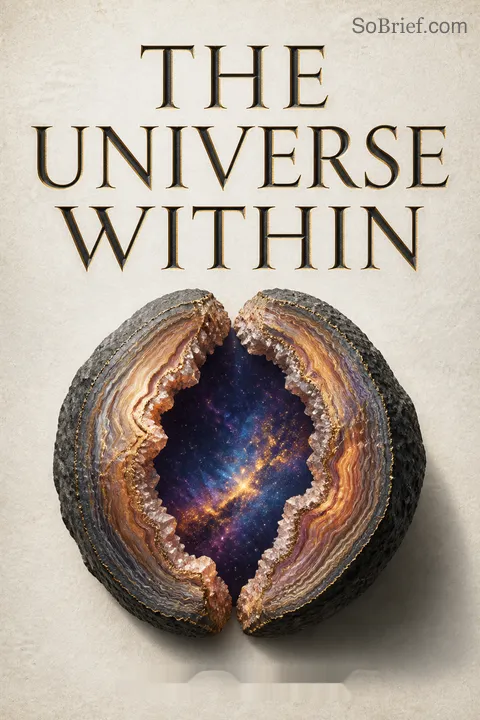
The Universe Within by Neil Shubin explores the interconnectedness of the cosmos, Earth, and life. Readers praise Shubin's accessible writing style and ability to connect complex scientific concepts. The book covers topics like the Big Bang, planetary formation, evolution, and climate change. Many find it fascinating and informative, though some felt it lacked depth in certain areas. Overall, reviewers appreciate Shubin's talent for explaining scientific discoveries and their significance, making the book an engaging read for science enthusiasts and laypeople alike.
People Also Read







Glossary
Big Bang
origin and expansion of the universeThe model describing the universe’s early history as an extremely hot, dense state followed by expansion and cooling. As the universe expanded, particles and atoms formed, and later stars and galaxies emerged. In the book, the model also connects cosmic history to the origins of the matter that makes planets and living bodies.
Plate tectonics
movement and recycling of crustThe theory that Earth’s outer shell consists of moving plates. New seafloor forms at mid-ocean ridges, spreads outward, and is recycled at deep trenches; plates can also collide or slide past one another. The theory explains the movement of continents and helps connect geological patterns to changes in oceans, mountains, climate, and life.
Milankovitch cycles
long-term changes in Earth’s orbitRecurring changes in the shape of Earth’s orbit, the tilt of its axis, and the direction of its wobble. These variations alter the timing and intensity of seasonal sunlight. The book describes cycles of roughly 100,000, 41,000, and 19,000 years and links their combined effects to patterns in ice-age climate records.
Circadian clock
internal daily timing systemA biological timing system that organizes daily patterns such as sleep, activity, and changes in body function. Molecular feedback processes within cells help generate rhythms near a day in length. Light entering the eyes helps synchronize the brain’s clock with the outside day-night cycle, which is why altered light schedules can disrupt sleep.
Carbon cycle
movement of carbon through EarthThe long-term movement of carbon among the atmosphere, water, living things, rocks, and Earth’s interior. Carbon dioxide can enter water and help weather rocks, then travel to the ocean and become incorporated into sediments. Tectonic processes and volcanoes return some carbon to the atmosphere, influencing Earth’s climate over geological time.
Geopoetry
a proposed model of Earth’s crustHarry Hess’s informal name for his early explanation of seafloor spreading and crustal recycling. It proposed that new ocean floor forms at mid-ocean ridges, moves outward, and sinks at deep-sea trenches. At first the idea was more compelling synthesis than confirmed theory; later measurements of seafloor age and magnetism helped establish the mechanism.
Stigler’s law
discoveries often have earlier discoverersA principle about scientific credit: discoveries named after one person often have earlier intellectual predecessors, and important ideas can arise independently in multiple places. Stephen Stigler named the principle after himself while crediting Robert Merton’s earlier work on the pattern, making the naming itself an example of the idea.
FAQ
What's The Universe Within about?
- Interconnected history: The book explores the connections between rocks, planets, and people, showing how our bodies are linked to the universe's history.
- Scientific journey: Neil Shubin shares his experiences as a paleontologist, uncovering fossils and understanding life's evolution on Earth.
- Time and transformation: It emphasizes the vast timescales involved in Earth's formation and life, illustrating how geological and biological processes shape our existence.
Why should I read The Universe Within?
- Unique perspective: Shubin offers a fresh viewpoint on the relationship between humans and the cosmos, making complex scientific concepts accessible.
- Interdisciplinary insights: The book combines geology, biology, and astronomy, providing a holistic understanding of our place in the universe.
- Inspiring storytelling: Through personal anecdotes and scientific discoveries, Shubin captivates readers, encouraging curiosity about the natural world.
What are the key takeaways of The Universe Within?
- Shared history: The book illustrates that our bodies contain over 3.5 billion years of life's history.
- Cosmic connections: It emphasizes that the elements in our bodies originated from stars, highlighting our deep ties to the universe.
- Evolutionary narrative: Shubin connects the evolution of life on Earth to geological changes, showing their intertwined roles in shaping existence.
How does Neil Shubin connect geology and biology in The Universe Within?
- Fossil discoveries: Shubin recounts finding fossils that link ancient species to modern organisms, illustrating the evolutionary process.
- Geological context: He explains how geological formations provide clues to the environmental conditions that shaped life's evolution.
- Interconnectedness of life: Understanding Earth's history is essential to grasping biological history, as both are deeply intertwined.
What role does time play in The Universe Within?
- Vast timescales: Shubin discusses the 13.7 billion-year history of the universe, crucial for understanding our existence.
- Evolutionary timeline: The book outlines the timeline of life on Earth, showing species' emergence and evolution over millions of years.
- Geological changes: Time is a key factor in geological transformations, influencing biological evolution and ecosystem development.
What are some significant scientific concepts discussed in The Universe Within?
- Continental drift: Shubin explains how the movement of continents has shaped species distribution and geological features.
- Photosynthesis and oxygen: The role of photosynthetic organisms in producing oxygen was crucial for evolving larger, complex life forms.
- Molecular clocks: These help scientists estimate evolutionary events' timing based on genetic changes.
How does The Universe Within address the concept of evolution?
- Evolutionary connections: Shubin illustrates how fossils serve as evidence of evolutionary transitions, linking modern species to ancient ancestors.
- Natural selection: The book discusses natural selection and adaptation mechanisms, showing species' evolution in response to environmental changes.
- Shared ancestry: Shubin emphasizes that all life on Earth shares a common ancestry, highlighting species' interconnectedness through evolutionary history.
What personal experiences does Neil Shubin share in The Universe Within?
- Fieldwork adventures: Shubin recounts expeditions to remote locations, like Greenland, where he searched for fossils and made significant discoveries.
- Scientific challenges: He shares difficulties faced during research, including physical challenges and complexities in interpreting evidence.
- Passion for discovery: Shubin's enthusiasm for paleontology and uncovering the past inspires readers to appreciate science's wonders.
How does The Universe Within relate human evolution to geological changes?
- Environmental influences: Shubin illustrates how shifts in climate and geography created new habitats influencing human ancestors' development.
- Adaptation and survival: The book discusses early hominins' adaptation to changing environments, leading to bipedalism and tool use.
- Interconnected history: Human evolution is viewed in the context of Earth's dynamic history, not in isolation.
What is the significance of fossils in The Universe Within?
- Fossils as time markers: Shubin explains that fossils help trace life's chronological order on Earth, marking transitions between geological eras.
- Evidence of extinction: Fossils provide evidence for mass extinction events, illustrating environmental changes' impact on biodiversity.
- Understanding evolution: Fossils are crucial for studying evolutionary processes, revealing species' adaptations over millions of years.
What are the best quotes from The Universe Within and what do they mean?
- "Written inside us is the birth of the stars.": This signifies that the elements forming our bodies were created in stars, emphasizing our cosmic origins.
- "Rocks and bodies are kinds of time capsules.": This highlights how geological formations and biological entities preserve Earth's and life's history.
- "Transformation is the order of the day for the world.": This reflects ongoing changes in the planet and organisms, underscoring existence's dynamic nature.
What methods does Neil Shubin use to convey complex scientific ideas in The Universe Within?
- Anecdotal storytelling: Shubin uses personal stories to make scientific concepts relatable and engaging.
- Clear explanations: He breaks down complex ideas into understandable segments, using analogies and examples.
- Visual imagery: The book includes vivid descriptions of landscapes and fossils, helping readers visualize the science behind the narrative.
About the Author
Other books by Neil Shubin

Download PDF
Download EPUB
.epub digital book format is ideal for reading ebooks on phones, tablets, and e-readers.








