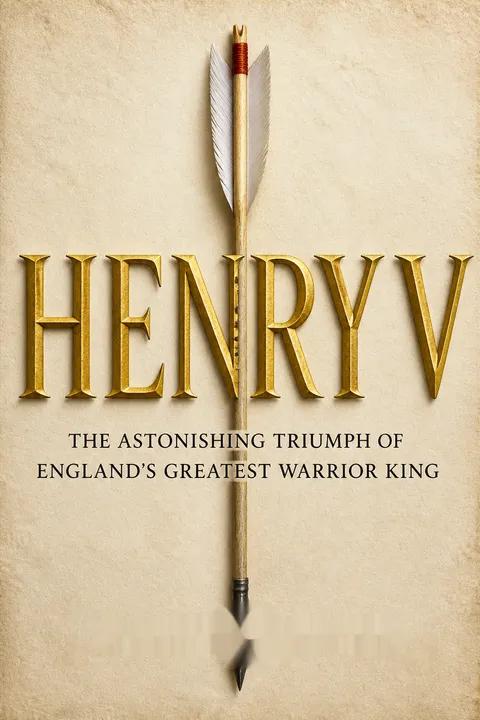


Key Takeaways
Read Henry V through his apprenticeship, not just the victory at Agincourt.
The prince matters. Henry was sixteen when an arrow struck his face at Shrewsbury, leaving a metal point buried deep in his skull. Surgeon John Bradmore removed it through a painstaking operation, and Henry survived. The episode opens a life story in which survival alone is not the explanation for greatness. Henry’s education began much earlier, through books, music, hunting, diplomacy, and proximity to unstable kings and dangerous politics.
A long preparation. Henry was politically active from his early teens and spent nearly half his life before becoming king. As Prince of Wales, he fought the Welsh rebellion, managed money, attended Parliament, and served on the royal council. Agincourt was a spectacular achievement, but the book argues that his years as prince taught him how to make such achievements possible.
The apprenticeship framing resists the familiar story in which a single battlefield victory creates a great ruler. It instead treats leadership as accumulated practice under rising stakes. That is persuasive, especially because Henry’s lessons came from both success and humiliation. Still, preparation should not be mistaken for destiny: the surviving record favors public actions over private uncertainty, and survival, political circumstance, and luck shaped his path as much as skill.
Wales taught Henry to pair battlefield command with budgets and negotiation.
A prince in command. Henry was fourteen when his father sent him to suppress Owain Glyndŵr’s Welsh revolt. The campaign was not a string of clean victories. English forces struggled to fund garrisons, hold castles, and find rebels who could vanish into the countryside. Henry learned that military authority meant responsibility for the resources and consequences of a campaign, not simply the right to issue orders.
Lessons at Conwy. When Welsh rebels seized Conwy Castle in 1401, Henry was responsible for recovering it. A negotiated settlement eventually secured the surrender of some rebels, while nine prisoners were executed. Later, improved funding helped Henry organize raids and sieges, including the recovery of Aberystwyth and Harlech. Wales gave him practical experience in command, bargaining, intelligence, and the slow work of sustaining an army.
This is a useful corrective to leadership stories that celebrate decisive personalities while hiding the machinery beneath them. Henry’s Welsh apprenticeship shows that command involves tradeoffs among force, money, intelligence, and local cooperation. It also reveals the moral price of that learning: his early competence included ordering executions. Skill grows through responsibility, but responsibility does not automatically make its methods humane.
Secure consent for authority, because inherited claims alone cannot stabilize rule.
A fragile dynasty. Henry’s father, Henry IV, took the throne from Richard II in 1399. Parliament helped legitimize the transfer, but the new dynasty remained vulnerable to rebellion, rumors that Richard was alive, and rival claims to succession. Henry grew up watching political leaders use force, law, public argument, and ceremony to defend or challenge a crown.
Consent has a price. As prince, Henry saw that Parliament controlled the taxes required for war. When his father’s health failed, a council governed under agreed rules, and Parliament publicly praised Henry’s judgment and willingness to hear advice. As king, Henry addressed domestic grievances and presented his French ambitions to Parliament before seeking major war funding. His authority rested not only on birth, but on persuading political allies that his rule served the realm.
The story highlights legitimacy as a relationship, not merely a family tree. In a system where rulers need taxation and cooperation, consent becomes practical capacity. Henry’s case also warns against equating formal approval with broad popular agreement. Parliamentary support came from a limited political community, and the wars imposed costs on people with little voice in policy. Legitimacy can be real and still unevenly shared.
Treat ceremony as governing infrastructure, not decorative theater.
A public persona. Henry watched Richard II turn kingship into spectacle, with elaborate ceremonies and a carefully cultivated image of majesty. He absorbed the lesson that how a ruler appears can shape how people understand authority. At his own coronation in 1413, Henry presented himself as grave, devout, and disciplined. The transformation was not simply a sudden change in private character. It was also a deliberate public performance suited to a king who needed to distinguish himself from faction and instability.
Ritual with a purpose. Henry used ceremonies to mark reconciliation, honor predecessors, thank God for victories, and make royal authority visible. His 1415 return to London after Agincourt became a carefully staged procession, but he directed praise toward God rather than himself. Such displays could reinforce shared political meaning, though they could not replace competent government or erase the violence behind a victory.
The book makes spectacle politically serious. Ritual can coordinate expectations: a coronation declares what a ruler promises, while a public procession makes victory legible to people far from the battlefield. Henry’s talent was to shape that meaning without abandoning the theatrical tools he learned from Richard. The limitation is equally important: skilled presentation can build trust, but it can also make coercion appear righteous.
Armies depend on money, logistics, and public consent as much as courage.
War has a supply chain. Henry’s Scottish campaign as a teenager taught him how much food, weapons, transport, and money even a brief expedition required. His later wars in France demanded ships, sailors, thousands of troops, horses, arrows, cannon, and months of wages. Before the 1415 invasion, the Crown borrowed from nobles, merchants, churchmen, and the City of London, even pawning royal treasures and household goods.
Finance is political. Henry had to convince Parliament to grant taxes and keep lenders confident that the Crown would repay them. He used traditional forms of taxation, met obligations to soldiers’ families, and made public order at home part of his case for support. This connection mattered: military success could produce revenue and political confidence, while a failed campaign could leave the king short of both.
The account treats military power as an institutional achievement rather than a commander’s personal possession. Logistics explain why administrative competence and political trust become strategic assets. The same logic makes the costs harder to overlook: borrowing and taxation transfer risk to subjects, while soldiers and civilians bear bodily losses. A well-run war is still a war, not a neutral exercise in operational efficiency.
Henry's discipline built order through mercy, intimidation, and often brutal punishment.
Order by example. Henry presented himself as a king who would enforce law and protect the realm. He intervened in disputes among powerful nobles and demanded that his army avoid unauthorized looting. He also offered prisoners and opponents chances to submit or recant. At John Badby’s execution for Lollard beliefs, Henry personally urged the condemned man to change his position and offered him support if he did.
The hard edge. Badby refused, and Henry allowed the execution to proceed. Henry also ordered the killing of Welsh prisoners, suppressed the Lollard rising, and, after Agincourt, ordered many French captives killed when he feared another attack. His rule joined clemency with severe punishment. The book shows this as part of his political method, not evidence that compassion or cruelty alone explains him.
Henry’s consistency helps explain why contemporaries could regard him as just even when his decisions were merciless. He applied a severe, public conception of order to rebels, heretics, and enemies. That standard should not be confused with impartiality in a modern sense: the law protected hierarchy and religious orthodoxy, and punishment could be spectacularly cruel. Understanding the logic of his rule does not require endorsing it.
Agincourt followed a 250-mile gamble by an exhausted, outnumbered army.
A dangerous march. After taking Harfleur in 1415, Henry had lost many men to disease. Rather than return to England or remain trapped through winter, he led perhaps six thousand to eight thousand fit troops on a march of roughly 250 miles toward Calais. French forces blocked the usual crossing of the Somme, forcing the English to search for another route while supplies dwindled and enemy armies closed in.
Preparation met circumstance. At Agincourt, English archers, sharpened stakes, and a narrow, muddy battlefield helped blunt the larger French force. Henry fought among his men and survived an axe blow to his helmet. The victory was remarkable, but not a pure demonstration of individual genius: the march, terrain, tactics, French command problems, and chance all mattered. Henry’s achievement was to keep a weakened army organized and willing to fight.
Agincourt becomes more interesting when treated as a chain of decisions rather than an isolated legend. Henry’s willingness to accept risk was paired with preparation, discipline, and adaptation, but the outcome also depended on conditions no commander fully controls. Celebrating the tactical achievement without noting the captives killed afterward would flatten the episode into patriotic myth.
Exploit a divided rival, but recognize when pressure unites it.
France divided against itself. The French kingdom was weakened by conflict between Burgundian and Armagnac factions, made worse by the recurring incapacity of Charles VI. Henry used this disorder to seize Harfleur, conquer Normandy, and negotiate from a position of strength. After John the Fearless was murdered in 1419, Henry judged that the political opening had widened and pressed for a far larger settlement.
A treaty and a costly war. The 1420 Treaty of Troyes named Henry regent and heir to France, disinheriting the dauphin, and arranged his marriage to Catherine of Valois. Yet the agreement did not end resistance. Henry continued campaigning to enforce it, while English resources and lives were stretched. Pressure helped secure extraordinary concessions, but his demands also pushed French rivals toward cooperation against him.
Henry’s strategy shows how internal division can create leverage for an outside power. But leverage is not the same as consent, and a settlement imposed on one faction can make resistance more coherent. The treaty’s formal elegance concealed a basic enforcement problem: Henry had to keep conquering what the agreement claimed he already possessed. Diplomatic gains become durable only when enough of the affected parties can live with them.
A conquest built around one ruler can collapse when he dies.
The limits of personal rule. Henry died in 1422, aged thirty-five, after a severe illness, leaving an infant son and an unfinished war. He had appointed his brother John, duke of Bedford, to manage the French campaign and tried to arrange a divided regency for his child. Bedford proved capable, but the English position depended heavily on the judgment and authority of a small group of exceptional leaders.
Victory did not endure. Henry’s conquests and the dual monarchy did not survive in the long term. After Bedford’s death, French resistance gathered strength, and English control of the mainland steadily receded. The epilogue leaves Henry’s reputation more durable than his empire: he was admired for administrative skill, discipline, piety, and military success, yet his wars brought immense suffering and achieved a political settlement that could not hold.
The ending separates two kinds of legacy: the land a ruler controls and the story people tell about him. Henry’s conquests depended on sustained force and unusually capable leadership, making succession a structural vulnerability rather than a mere personal tragedy. His case also complicates the usual equation of success with lasting value. A ruler can win decisively by his own standards while leaving behind an order that cannot reproduce itself.
Analysis
Dan Jones builds the biography around a correction to the familiar Agincourt-centered portrait: Henry’s years as prince were not an entertaining prelude, but an apprenticeship in warfare, finance, political legitimacy, and public performance. The opening image of a teenage heir surviving a devastating head wound establishes both the drama and the book’s central method. Henry’s life is shown through choices made under pressure, while the absence of a private diary limits claims about his inner motives.
The strongest interpretation is that Henry joined two kinds of kingship. From Richard II he learned the force of image, ceremony, and controlled public display. From Henry IV’s troubled reign he learned the practical necessities of governing through councils, Parliament, money, and alliances. His achievements therefore cannot be reduced to battlefield courage. The Welsh campaigns, the councils during his father’s illness, the preparation for invasion, and the continuing negotiation with Parliament all explain how military action became possible.
The biography also resists a clean hero’s arc. Henry could seek mercy for an individual and still enforce executions; he could present war as divine justice while starving cities and killing prisoners. These are not incidental blemishes on an otherwise simple character. They expose the political and religious assumptions that made his rule persuasive to many contemporaries, while also revealing its costs. The evidence supports a picture of disciplined, capable leadership, not moral innocence.
Finally, Henry’s triumph contains its own weakness. The Treaty of Troyes gave him a claim to France, but could not make that claim self-enforcing. His system depended on continued military success, reliable financing, and capable successors. His death left a child king and an unstable dual monarchy. The book thus offers neither uncomplicated celebration nor retrospective dismissal. It asks readers to understand why Henry seemed an exemplary ruler in his own world, then to measure that achievement against the suffering and fragility it produced.
Review Summary
Henry V receives overwhelmingly positive reviews for its engaging narrative and balanced portrayal of the king. Readers praise Dan Jones's accessible writing style, present-tense approach, and comprehensive coverage of Henry's life beyond just his reign. The book is lauded for its vivid storytelling, historical accuracy, and ability to bring medieval England to life. Some criticize the lack of new information or detail on certain aspects, but overall it's highly recommended for both history enthusiasts and general readers interested in this influential English monarch.
People Also Read


Glossary
Hundred Years War
Anglo-French dynastic conflictThe historians’ name for the long series of conflicts between the English and French crowns over territory and the French succession. The label was coined in the nineteenth century, not used by people living through the wars. Henry V entered a conflict already decades old, shaped by truces, renewed campaigns, competing territorial claims, and changes in both kingdoms’ politics.
Lollardy
English religious reform movementA diverse movement inspired by the teachings of Oxford theologian John Wyclif. Lollards challenged Church wealth and authority and rejected doctrines and practices including the belief that the Eucharistic bread becomes Christ’s body. Church and Crown treated some Lollard teaching as heresy and a threat to public order. Henry’s conflict with his friend John Oldcastle made the movement a political as well as religious issue.
chevauchée
Mounted raid through enemy territoryA fast military expedition that moves through an enemy region, damaging property, disrupting supplies, and exerting pressure without necessarily seeking a major battle or permanent occupation. The term describes a form of warfare used in the French campaigns, including the expedition led by Henry’s brother Thomas before the defeat at Baugé.
Treaty of Troyes
Anglo-French succession settlementThe 1420 agreement that made Henry V regent and heir to the French crown, arranged his marriage to Catherine of Valois, and excluded the dauphin from succession. It also preserved England and France as separate kingdoms under one future monarch. The treaty was a major diplomatic success for Henry, but it did not end the war or secure lasting acceptance of his claim.
Thirty-One Articles
Rules for governing through councilThe regulations used to govern England while Henry IV was seriously ill. They restricted misuse of royal funds and private influence, and required the council to consult the king regularly. Henry V served on this council as Prince of Wales, gaining direct experience in government during a constitutional crisis and learning how royal authority could be exercised through agreed procedures.
About the Author



Download PDF
Download EPUB
.epub digital book format is ideal for reading ebooks on phones, tablets, and e-readers.








