

Key Takeaways
Track power beyond thrones: climate, disease, migration, and trade remade the Middle Ages.
Power was never only political. Dan Jones follows kings and conquerors, but also the forces they could not command: shifting weather, migrating peoples, epidemic disease, technologies, and long-distance networks. Across four broad periods, the story moves from Rome’s inheritance through new empires and religious institutions to plague, renewal, exploration, and reform.
The ground kept moving. Roman Britain’s Hoxne Hoard, buried around 409 as its owners hoped to retrieve it, captures one family’s response to political uncertainty. Centuries later, plague and changing trade routes again altered who could work, rule, and travel. The book’s central lesson is to see medieval history as connected upheaval, not a thousand-year pause between antiquity and modernity.
What's striking is the book's choice to treat climate, disease, and commerce as historical actors without pretending they act alone. That resembles modern systems thinking: a shock becomes consequential when it meets vulnerable institutions, crowded populations, or political misjudgment. The frame also resists the familiar habit of explaining centuries through a succession of great men. Its limit is geographic by design: the story is chiefly western, so its global links are often viewed from Europe rather than from the societies Europe encounters.
Treat Rome’s fall as a long unravelling, not one barbarian blow.
Rome left more than ruins. The western empire had connected territories through armies, roads, law, Latin, urban life, and Christianity. Its political authority disappeared unevenly: Britain lost imperial administration around 410, while the western imperial title ended in 476. The Hoxne treasure shows wealthy Britons hiding valuable Roman goods amid uncertainty, not calmly observing a neat historical boundary.
Pressure accumulated. A severe drought on the Asian steppe helped drive the Huns west in the fourth century. Their movement displaced other peoples, including Goths seeking entry into Roman territory. Mismanagement and exploitation of those refugees helped turn a settlement crisis into war; the defeat and death of Emperor Valens at Adrianople in 378 damaged Roman prestige. Migration mattered, but so did brittle institutions and poor decisions.
This account is strongest when it treats migration as a chain of causes rather than a faceless invasion. Climate pressure can move one population, which displaces another, while a government’s response determines whether arrival becomes integration or conflict. That logic is useful well beyond the ancient world. It also guards against a misleading binary between Roman civilization and barbarian outsiders: many newcomers served Rome, adopted its practices, and eventually ruled its former territories.
Justinian rebuilt Roman law and Hagia Sophia, but plague drained his empire.
Reconstruction had limits. Justinian ordered Roman law gathered and clarified in a body of work known as the Justinianic Code, later influential in European legal study. After the Nika riots devastated central Constantinople in 532, he commissioned Hagia Sophia, whose vast dome made imperial authority visible in stone. His generals also recovered North Africa and much of Italy for the eastern empire.
Conquest became costly. Justinian’s wars, religious disputes, and building projects strained the state. A pandemic caused by Yersinia pestis spread through the Mediterranean world from 541, killing millions, although exact totals remain disputed. It disrupted trade, labor, taxation, and construction. Justinian’s achievements endured, especially his law code and monuments, but his attempt to restore Rome’s western reach proved too expensive to sustain.
The contrast between a durable legal code and fragile territorial gains reveals two different kinds of state power. Rules and texts can travel across generations at lower cost than armies can hold distant provinces. The pandemic also shows how public health shapes political capacity: a ruler may plan grandly, but a shrinking workforce and tax base change what the state can deliver. The story is not that plague single-handedly ended reconquest, but that it intensified existing fiscal and military strain.
Islam’s first empire fused conviction with pragmatic rule to expand astonishingly fast.
Faith became a political bond. Muhammad’s teachings united many Arabian followers in a community that could outlast his death in 632. Under the first caliphs, Arab armies defeated Byzantine forces in Syria and Egypt and broke the Sasanian Persian empire. Their rivals were exhausted by prolonged wars, while the new Muslim armies had momentum and a strong shared identity.
Conquest did not require instant conversion. Muslim rulers often allowed Christians and Jews to keep worshipping in return for the jizyah, a tax on non-Muslims, and maintained separate military settlements. Umayyad caliph Abd al-Malik later made Arabic the language of administration and issued distinctive Islamic coinage. Civil wars over succession, including the conflicts that shaped the Sunni-Shia divide, showed that unity had real limits.
The early caliphate combined ideological cohesion with practical accommodation. That combination helps explain how a relatively new movement could govern large populations without forcing immediate cultural uniformity. It also complicates a simple story of religious conquest: military expansion, taxation, local administration, and gradual conversion worked together. The arrangement was not modern religious equality, and its tolerance had conditions, but it could still be less disruptive than the sectarian conflicts that preceded it.
Charlemagne revived western empire, but inheritance and Viking pressure broke it apart.
A crown needed a sacred story. Pippin the Short replaced the last Merovingian king in 751 and secured papal approval for his new dynasty. His son Charlemagne expanded Frankish power across much of western Europe and was crowned emperor in 800. His rule joined military conquest, Christian authority, palace administration, and support for schools and manuscript copying.
Personal empire was hard to inherit. Charlemagne’s successors fought over the realm, which was divided at Verdun in 843. Viking fleets exploited the resulting political fractures, raiding river towns and monasteries, but also settling and trading. In 911, the Frankish king granted land around the Seine to the Viking leader Rollo, whose followers became the Normans. The old empire broke apart, while its fragments helped form later European kingdoms.
Charlemagne’s realm illustrates a recurring distinction between a ruler’s reach and an institution’s resilience. His personal authority could coordinate a vast territory, but inheritance customs and family rivalry weakened the arrangement once he was gone. The Vikings were not merely destroyers in this account: they became settlers, political negotiators, and eventually Christian rulers. That transformation shows how boundaries between invader and insider could shift within a few generations.
Monasteries made salvation a network, then universities made learning a profession.
Religious houses built influence. Founded in 910, Cluny became the hub of a far-reaching monastic network. Its monks prayed for patrons’ souls, managed estates, welcomed pilgrims, and developed elaborate liturgy. The Cistercians later offered a more austere alternative. Monasteries were not only retreats: they also supported education, literacy, hospitality, and care for the sick and poor.
Knowledge moved through new channels. Cathedral schools and monasteries preserved Latin learning; translators in places such as Toledo brought Arabic versions of Greek science and philosophy into western circulation. Universities at Bologna, Paris, and Oxford gathered scholars into communities devoted to teaching and debate. These institutions could also censor ideas: Paris condemned some Aristotelian arguments, and theologians were drawn into political cases such as the trial of the Templars.
The shift from monastery to university is not a clean replacement. Monastic institutions kept texts and trained readers, while universities organized advanced study into a more independent profession. The book also makes clear that scholarship was never fully outside power: patrons funded it, rulers recruited its graduates, and authorities tried to police it. That tension remains central to universities, whose social value depends partly on whether inquiry can challenge the institutions that support it.
Knightly honour dignified violence, while crusading made it a papal instrument.
Mounted warfare changed status. The couched lance, stirrup, and reinforced saddle helped heavily armed horsemen deliver forceful charges. Such equipment was costly, so rulers granted land and status to warriors in return for service. Chivalric stories then presented these fighters as models of courage and loyalty, even though medieval warfare remained brutal and often driven by plunder, ransom, and local power.
Holy war widened its targets. Pope Urban II’s call in 1095 helped launch the First Crusade, whose armies captured Jerusalem in 1099 after massacring inhabitants. Crusading also served other purposes: it targeted Muslims in Iberia, pagans around the Baltic, and Christian heretics in southern France. The Fourth Crusade even ended with the sack of Christian Constantinople in 1204. Crusading was a flexible tool of papal power, not simply a war between two faiths.
Chivalric literature did more than decorate violence. It offered elites a moral language for explaining why force could be honorable, even when actual campaigns involved extortion, massacres, and political opportunism. Crusading extended that logic by attaching spiritual reward to warfare. Its shifting targets matter: the movement could unite Christians against outsiders, but it could also authorize violence within Christian society. The ideal of restraint sat uneasily beside the institution’s capacity for coercion.
Mongol conquest killed millions, yet opened Eurasia to sustained exchange.
Conquest came with terror. Genghis Khan united Mongol groups through military organization, strict discipline, and promotion based on ability and loyalty. Resistance to Mongol armies could bring the destruction of entire cities; the conquest of Central Asian centers such as Merv and Samarkand killed vast numbers and displaced survivors. The Mongol empire became the largest connected land empire of its time.
The same power connected distant worlds. Mongol rule supported postal relays, trade routes, and travel across regions that had been difficult for Europeans to reach. Merchants such as the Polos and envoys like Giovanni da Pian del Carpine carried information between courts. This relative security is often called the Pax Mongolica. After the empire fragmented into khanates, its successor states adopted local religions and cultures, while the routes and exchanges it fostered continued to matter.
The Mongol case resists easy moral accounting. A regime could create safer long-distance exchange for some travelers while doing so through conquest, forced migration, and mass killing. That paradox resembles other empires whose infrastructure benefits are inseparable from coercive control. The term peace should therefore be used carefully: the routes were more secure for commerce, but security for merchants did not mean safety or justice for conquered populations.
Credit networks made merchants political actors, not merely traders.
Commerce acquired new machinery. From around 1000, population growth, improved farming, safer routes, fairs, and urban markets revived western trade. Italian city-states built commercial networks across the Mediterranean, while the Champagne fairs linked northern cloth makers with southern merchants. Bills of exchange let traders transfer credit without carrying sacks of coin; insurance and double-entry bookkeeping helped manage risk and track a company’s finances.
Money could bind a crown. Florentine firms such as the Bardi financed English kings and handled wool revenues. When Edward III borrowed heavily to fight France, his debts helped strain the banks that had lent to him. The merchant Richard Whittington later financed royal campaigns and civic projects. Commercial wealth could support governments, but dependence on credit also made rulers vulnerable to creditors and political shocks.
These developments show that financial innovation is a form of institutional power. Credit lets a state spend future revenue in the present, while accounting and contracts make distant transactions more legible. Yet the English case also exposes the danger: banks can become entangled in war finance and political risk until a royal default becomes their crisis too. The medieval story complicates any idea that capitalism emerged only after the Middle Ages; many of its essential tools were already in use.
Plague made labor scarce and exposed rulers who tried to freeze old hierarchies.
A demographic shock rewrote bargaining power. The Great Famine of 1315 to 1321 followed years of cold rain and failed harvests. Then the Black Death spread from 1347, killing perhaps half of Europe’s population, though mortality varied by place. With workers suddenly scarce, wages rose and rents fell. English rulers tried to cap wages and compel labor, but laws could not restore the pre-plague balance.
Protest took many forms. In France, the Jacquerie of 1358 challenged landlords amid war and political disorder. In England, the 1381 uprising demanded an end to serfdom and attacked royal officials. These rebellions were crushed, yet labor relations continued to change. The shock did not make society equal, but it made old arrangements harder to enforce and gave ordinary people greater leverage.
The Black Death demonstrates how a biological event can alter bargaining power by changing the supply of labor. Legal controls may delay adjustment, but they cannot recreate a lost population. The rebellions also warn against treating popular unrest as a single movement: local grievances, political factions, and religious language overlapped differently in each place. The book’s strongest point is that failed revolts can still mark structural change, even when rulers defeat their immediate demands.
Printing and Atlantic voyages shattered old monopolies on faith and geography.
The world grew harder to contain. Renaissance artists and scholars drew on classical learning, wealthy patrons, and new techniques. Meanwhile, Portuguese navigators explored the African coast and Vasco da Gama reached India by sea. Columbus crossed the Atlantic in 1492, opening sustained European contact with the Americas. Exploration brought new knowledge and wealth to Europe, alongside conquest, enslavement, and epidemic devastation for Indigenous peoples.
Printing accelerated religious conflict. Gutenberg’s press made written arguments cheaper to reproduce. In 1517 Martin Luther challenged indulgence-selling and papal authority; his theses spread widely in print, and the dispute grew into the Protestant Reformation. The 1527 sack of Rome by imperial troops further exposed the fragility of papal power. By the early sixteenth century, geography, religion, and political authority were being remade together.
Printing and navigation are not separate stories: both widened the reach of information, ambition, and conflict. A pamphlet could cross borders more cheaply than a manuscript, while a ship could link distant markets and empires. These technologies did not automatically produce progress; they also amplified propaganda and enabled colonial violence. The key shift is that authority over knowledge and space became harder for any single institution to monopolize.
Analysis
Powers and Thrones is most persuasive as a history of changing scales of power. It begins with Roman rule as an unusually integrated system of roads, law, military force, and shared cultural forms. It then follows authority outward and downward: to successor kingdoms, religious institutions, mounted elites, merchants, universities, and eventually print networks and oceanic empires. Throughout, the state is never the only actor. Climate can displace populations, disease can reorder labor markets, and technologies can make both control and resistance more scalable.
The book’s chronological sweep creates a valuable corrective to the idea that the Middle Ages were an inert bridge between Rome and modernity. Legal codification, credit instruments, universities, monumental engineering, and mass communication all have medieval histories. Yet continuity should not be confused with inevitable progress. Roman law surviving in later study did not mean Roman political unity returned; the commercial innovations of the fourteenth century did not make markets fair; printing widened debate while also multiplying propaganda and religious coercion. The same institution or technology can enable cooperation and domination.
The narrative is also attentive to the gap between ideals and practice. Chivalry made violence honorable, crusading attached spiritual reward to killing, and rulers often invoked religion while pursuing territory or revenue. Still, the book’s mostly western viewpoint has a cost. Asian, African, and American histories often enter when they affect European experience, and the category Middle Ages itself is rooted in western periodization. A complementary account centered elsewhere could rearrange which events seem central.
The broadest insight is that historical turning points are rarely singular. Rome’s western collapse, the spread of Islam, the Mongol conquests, the Black Death, and the Reformation each emerged from interacting pressures and choices. Individuals mattered, but their decisions operated within systems they did not fully control. That combination of contingency and structure makes the medieval past less like a finished prelude and more like a laboratory for understanding how societies adapt, fracture, and rebuild.
Review Summary
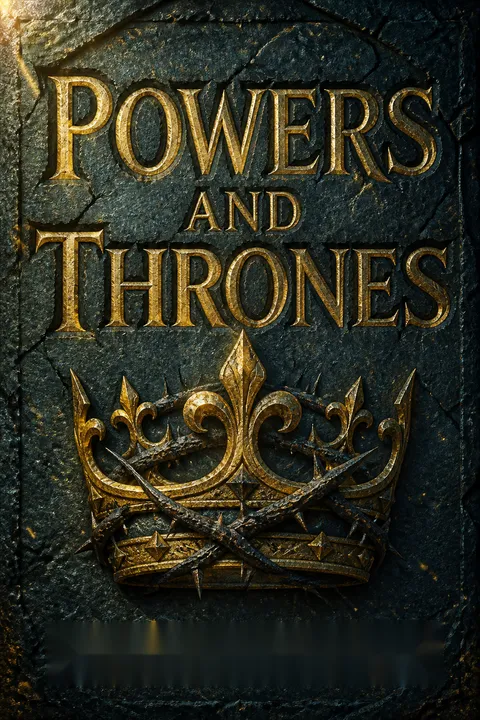
Powers and Thrones receives strong praise for Dan Jones's ability to make a millennium of medieval history engaging and accessible to general readers. Reviewers appreciate its thematic structure, vivid storytelling, and broad scope spanning 410–1527 AD. Common criticisms include an overly Eurocentric focus, insufficient coverage of women and marginalized groups, and occasionally overwhelming density of information. Most readers recommend it as an excellent introductory overview, though scholars may find it too superficial.
People Also Read

Glossary
Roman Climate Optimum
Warm, wet Roman-era climateA period of relatively warm and wet conditions in western Europe and the Mediterranean, roughly from 200 BC to AD 150. Favorable growing conditions supported cultivation farther north and stronger crop yields. The book uses it to show how environmental conditions could assist the expansion and prosperity of Roman civilization.
Romanization
Spread of Roman cultural practicesThe uneven adoption of Roman institutions, language, law, architecture, and values in territories governed by Rome. It was strongest among provincial elites and in cities, while rural communities often experienced less change. Romanization helped create cultural connections that survived the western empire’s political collapse.
Justinianic Code
Justinian’s organized Roman lawA sixth-century collection and reorganization of Roman imperial laws, commissioned by Emperor Justinian and produced by jurists led by Tribonian. Its related legal works clarified statutes and legal commentary for use across the empire. The compilation later influenced European legal education and codified legal systems.
jizyah
Tax on non-Muslim subjectsA tax paid by non-Muslims, especially Christians and Jews, under early Islamic rule. In return, these communities could generally continue their religious practices and were exempt from military service. Its application varied, but the tax formed part of the practical arrangements through which Muslim rulers governed conquered populations.
Rashidun
First four Muslim caliphsThe term, meaning the rightly guided, refers to Abu Bakr, Umar, Uthman, and Ali, the first four caliphs after Muhammad. Their rule saw the early Muslim community consolidate in Arabia and expand into Byzantine and Persian territories. The label is not accepted by all Muslim traditions, especially many Shia Muslims.
Pax Mongolica
Mongol-secured Eurasian tradeA term used for the relative security and connectivity across parts of Eurasia under Mongol rule. Postal relays and protected routes helped merchants, envoys, and travelers cross great distances. The phrase describes improved movement within an empire created through extreme violence, not a universal peace or equal safety for conquered peoples.
Commercial Revolution
Medieval expansion of commerceThe major growth in European trade and financial sophistication during the thirteenth and fourteenth centuries. Urban markets, fairs, merchant companies, bills of exchange, insurance, and double-entry bookkeeping helped business operate over longer distances. These changes gave merchants greater economic and political influence.
indulgence
Remission of temporal punishmentA grant recognized by the Roman Church that reduced temporal punishment for sin, traditionally connected to repentance and prescribed religious acts. By the later Middle Ages, indulgences were also sold for money, sometimes to fund church projects or crusading. The sale of indulgences became a central target of Protestant criticism.
Gothic
Soaring medieval architectural styleA major architectural style associated with pointed arches, tall spaces, slender supports, flying buttresses, and large stained-glass windows. From the twelfth century, Gothic building transformed cathedrals and churches across Europe. The style helped patrons express religious devotion, civic pride, wealth, and institutional authority.
About the Author

Download PDF
Download EPUB
.epub digital book format is ideal for reading ebooks on phones, tablets, and e-readers.








