

Key Takeaways
Trace Israel’s history as an unfinished settler-colonial project
A connecting framework. Pappé’s central claim is that Israel’s history is best understood as an unfinished settler-colonial project: a movement seeking lasting control of land already inhabited, rather than simply a temporary imperial administration. He connects Zionist settlement, the displacement of 1948, the occupation of 1967, the Oslo agreements, and Gaza’s isolation. In his account, a recurring objective is to secure as much territory as possible while limiting Palestinian presence and political power.
A pattern, not a synonym. Pappé compares this process with settler societies in the Americas, Australia, and South Africa. He describes two recurring mechanisms: removing native populations, and portraying them as undeserving of equal rights. This framework organizes the book, but remains an interpretive argument, not a neutral label accepted by every historian.
The framework’s strength is its ability to connect events that are often discussed separately. It asks readers to examine who controls land, movement, and political membership, rather than treating each crisis as an isolated episode. That shift makes long-term structures visible. Yet a framework is a guide to evidence, not evidence by itself. Comparisons across settler societies can illuminate recurring patterns, but they can also flatten differences in history, institutions, and political choice. The most productive use is to test the pattern against each event, not assume every event proves it.
Start Palestine’s modern story with the people already living there
A populated society. Pappé rejects the picture of late Ottoman Palestine as empty, barren, or awaiting cultivation. He cites Ottoman records for 1878 that count about 462,000 residents: roughly 87 percent Muslim, 10 percent Christian, and 3 percent Jewish. Most lived in villages, alongside urban centers, trade networks, and active agriculture. Nearly a thousand villages and towns such as Acre, Haifa, and Tiberias formed part of a wider eastern Mediterranean society.
A developing national identity. Pappé argues that Palestinian identity was taking shape before Zionist settlement began in 1882. Local customs, dialect, shared history, education, Arab political thought, and Ottoman administrative changes all contributed. This did not mean there was already a Palestinian nation-state. It means the absence of a state should not be confused with the absence of a society or a developing sense of belonging.
The key historical distinction is between a nation-state and a people with shared institutions, culture, and political aspirations. National identities often take shape through changing circumstances rather than emerging fully formed from ancient borders. That makes claims of belonging neither timeless nor imaginary. Pappé’s account is valuable because it restores local society to a narrative that can make it disappear. At the same time, identity in Ottoman Palestine was layered: local, religious, Arab, and imperial affiliations could coexist. A serious account needs room for that complexity.
Separate Jewish identity from the modern political program of Zionism
A movement, not a synonym. Pappé describes Zionism as a modern political movement that arose in nineteenth-century Europe, partly in response to antisemitism and the spread of nationalism. He stresses that many Jews initially rejected it. Reform Jews feared that a separate state would cast doubt on their civic loyalty; Bundist socialists favored political struggle where Jews lived; and many Orthodox Jews regarded Zionism as an improper attempt to hasten redemption.
Support from outside. Pappé also traces Christian restorationist ideas about a Jewish return to Palestine, including British religious and imperial interests, before the Balfour Declaration of 1917. He questions the political importance of proving a direct genealogical line between ancient and modern Jewish populations. For him, the decisive issue is how historical claims were used to justify sovereignty over an inhabited land, not whether Jewish attachment to it is real.
Distinguishing a religion, a people, and a political movement makes disagreement more precise. It allows criticism of state policy or nationalism without treating all Jewish identity as identical to either. It also prevents the reverse mistake of dismissing Jewish histories, attachments, or fears because Zionism has a particular political history. The book’s account of early Jewish opposition is a useful corrective to claims of unanimity. Still, opposition changed over time, and early dissent cannot stand in for the views of Jewish communities in later periods.
Treat the 1948 refugee exodus as expulsion, not voluntary departure
Transfer was discussed. Pappé points to Zionist leaders’ pre-1948 discussions of transferring Palestinians, including David Ben-Gurion’s public support for compulsory transfer in 1937 and closed meetings in 1938. He argues that talk of voluntary movement obscured the coercion involved. The book rejects the claim that Arab leaders broadly ordered Palestinians to leave before invading armies arrived, noting that archival research commissioned in Israel did not substantiate that story.
The war’s consequences. Pappé argues that Plan Dalet, issued in March 1948, helped organize the capture of areas and the removal of their populations. He reports that 531 villages were destroyed and eleven urban neighborhoods emptied. He also argues that about half the Palestinian refugees had been displaced before the Arab armies entered the war in May. Historians differ over how centrally planned the expulsions were, but the book rejects the mass-departure explanation.
This argument demonstrates why claims about refugee origins matter: they shape whether displacement is treated as an accident of war, a deliberate policy, or a problem with obligations that remain unresolved. Pappé draws on planning documents, public statements, and later archival disputes to challenge the voluntary-flight account. Those forms of evidence should be assessed separately, especially when estimating the degree of central planning. But uncertainty about every local decision does not make the refugees’ loss of homes, property, and return irrelevant to any account of the conflict.
Test “no choice” war claims against plans and aftermath
A longer horizon. Pappé argues that Israeli leaders viewed the failure to occupy the West Bank in 1948 as a missed opportunity. He describes efforts in 1958 and 1960 to consider taking it, blocked in part by international and demographic concerns. In 1967, Egyptian president Gamal Abdel Nasser’s brinkmanship and escalating Israeli-Syrian clashes helped create a dangerous crisis. Pappé contends that Israel launched its June 5 attack before diplomatic efforts had run their course, using the crisis to pursue territorial aims.
The aftermath matters. After the war, Israel occupied the West Bank and Gaza without incorporating most residents as citizens. Pappé points to settlement plans, prepared military administration, and the government’s resistance to withdrawing as evidence that the occupation was not simply temporary custody. The immediate causes of war and the political choices made afterward are distinct questions; the book urges readers not to let one answer settle both.
The distinction between a war’s trigger and the purposes served by its outcome is essential to historical analysis. A state can face a genuine security crisis and still use the resulting military advantage to pursue broader goals. Pappé’s account is strongest when it asks readers to inspect preparations and postwar policy, not just official explanations. The book’s judgment about the decision to attack is contested, and the regional crisis involved multiple actors. Even so, the persistence of occupation cannot be explained solely by the conditions of the first days of war.
Measure democracy by everyone living under the state’s power
Different rights, different regimes. Pappé challenges the claim that Israel was an uncomplicated democracy before 1967. He notes that Palestinian citizens lived under military rule from 1948 to 1966, while Palestinians in the territories occupied in 1967 came under military authority without Israeli citizenship. The book contrasts Israel’s Law of Return, which grants Jews a route to citizenship, with the exclusion of Palestinian refugees from return to their homes.
Land shapes citizenship. Pappé cites restrictions on Palestinian access to land, unequal public investment, and limits on where Palestinian citizens could live. He uses the term ethnocracy for a state with elections and institutions but a formal preference for one ethnic group. The point is not that democratic procedures do not exist; it is that evaluating them requires asking who is governed, who has equal rights, and who is excluded from political membership.
This argument separates electoral competition from equal citizenship. Political scientists often distinguish a system that holds elections from one that also protects civil rights and applies law equally. That distinction is useful when a state governs populations with different legal statuses. It also raises a boundary question: should democratic evaluation stop at citizenship, or include people subject to a state’s military and administrative power? The latter standard reveals forms of control that a citizen-only measure can miss. It still requires careful attention to differences among the populations and legal systems involved.
Judge Oslo by territorial control and excluded rights, not ceremony
An interim bargain. The 1993 Oslo agreement created a process for limited Palestinian self-government, while postponing major disputes. Pappé argues that the arrangement did not deliver a sovereign Palestinian state. Under Oslo II, the West Bank was divided into Areas A, B, and C, with Israel retaining extensive control over territory and movement. Settlements continued to expand, while Palestinian communities became separated from one another and from Gaza.
The missing questions. The agreement deferred Jerusalem, settlements, and the refugees’ claims, including the right of return. The Palestinian Authority was also expected to prevent resistance to Israeli rule. Pappé therefore reads Oslo less as a failed peace deal than as a system that reorganized and prolonged control. The public ceremony mattered less than the distribution of authority on the ground and the rights left outside the negotiating framework.
Peace processes can create real openings while also stabilizing an unequal status quo. A signed document is not proof that its parties have comparable power or that its promised endpoint is attainable. Pappé’s test is concrete: track borders, movement, settlements, and which claims can be negotiated. A fuller assessment should also ask what limited autonomy or reduced violence an interim agreement may have provided to people living through it. That does not resolve the book’s central objection: an interim structure without a credible route to equal rights can become a durable arrangement.
See Gaza’s disengagement as a change in control, not peace
Withdrawal did not end control. In 2005, Israel removed its settlers and permanent ground forces from Gaza. Pappé argues that this was not a peace settlement: Israel retained powerful control over access and movement, while Gaza remained separated from the West Bank. Hamas, which had developed social services as well as an armed wing, won the 2006 Palestinian legislative election. The ensuing Hamas-Fatah conflict included serious violence, and outside powers encouraged efforts to weaken Hamas.
A siege and repeated assaults. Pappé links Gaza’s blockade and Israeli military operations to the conditions in which violence escalated. He describes rocket attacks on Israeli communities as well as Israeli operations that killed large numbers of Palestinians, including about 2,200 in 2014 according to the book. He calls the cumulative policy “incremental genocide,” a grave characterization that should be attributed to him, not mistaken for a settled legal finding.
The chapter insists that context matters without making context an excuse. Hamas’s attacks on civilians and internal repression require scrutiny; neither makes collective punishment or attacks that fail to protect civilians acceptable. Pappé’s emphasis on blockade and repeated bombardment challenges accounts that begin with a rocket and omit the conditions around it. His genocide terminology is particularly consequential: it signals a moral and political judgment, while legal classification requires specific standards and evidence. Keeping those levels distinct strengthens rather than weakens criticism of civilian harm.
Replace partition dogma with equal rights and shared political membership
A solution constrained by facts. Pappé argues that the two-state formula has become implausible because settlements, barriers, and restrictions fragment Palestinian territory. He contends that a state limited to parts of the West Bank and Gaza would lack meaningful sovereignty and would leave Palestinian refugees and Palestinian citizens of Israel outside the settlement. In his reading, repeated support for partition can preserve the language of peace while avoiding the wider question of equal rights.
A different horizon. The book points toward a democratic political system for everyone living between the Jordan River and the Mediterranean Sea, with equal status for Palestinians and Jews. It rejects expulsion of Jewish residents and calls for shared political membership rather than a division based on ethnic sovereignty. Pappé offers this as a direction for discussion, not a detailed constitution or transition plan. The practical questions of representation, security, and collective identity remain substantial.
The proposal changes the starting question from where to draw a border to how people sharing one political space can enjoy equal rights. That can expose assumptions hidden inside diplomatic formulas. Yet a just endpoint and a feasible transition are different problems. A durable shared state would need institutions that protect both individual equality and collective security, as well as credible representation for people with sharply conflicting histories. Naming those challenges is not an argument for partition by default. It is a reminder that any alternative must make justice administratively and politically concrete.
Analysis
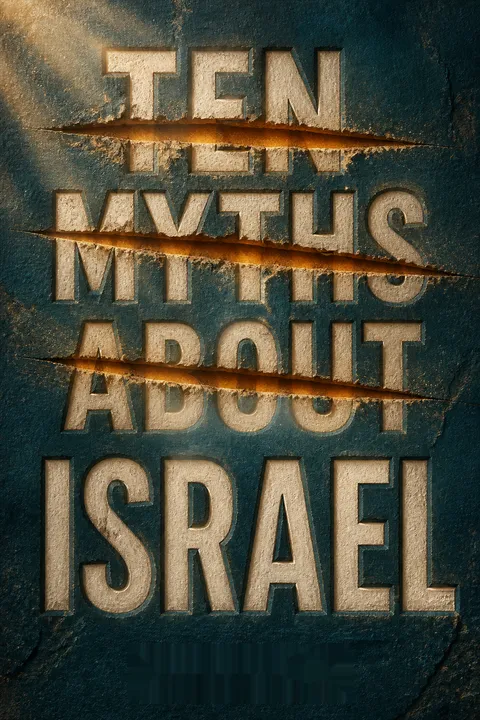
Ten Myths About Israel is a polemical history organized as a sequence of corrections. Its central move is to connect disputes about Palestine’s pre-Zionist society, Zionist ideology, 1948, 1967, occupation, Oslo, Gaza, and the two-state formula through one explanatory frame: settler colonialism. The result is a narrative about continuity. Events commonly presented as separate crises become stages in a longer struggle over land, population, and political membership.
The book’s value lies partly in its insistence that apparently technical questions carry moral and political consequences. Whether a society existed before settlement, whether refugees departed or were expelled, and whether an occupation is temporary all affect which claims readers consider legitimate. Pappé makes archival debates accessible and highlights the gap between diplomatic language and conditions on the ground. His openly declared commitment to Palestinians also makes the book’s purpose unusually clear.
That commitment is also a reason to read with distinctions in mind. The word myth can group together claims supported by different kinds of evidence, from demographic records to interpretations of war decisions and legal categories. Pappé’s account of 1967, his explanation of the intentions behind Israeli policy, and his use of genocide terminology are arguments, not conclusions made self-evident by the book’s structure. Some chapters move quickly from evidence about particular decisions to a general theory of political purpose. Readers should separate what the cited records establish, what the author infers, and what he judges morally.
The strongest way to engage the book is neither to accept its framework as a complete explanation nor to dismiss it as advocacy. Use it to ask focused questions about land, law, displacement, and power, then test the answers against competing interpretations and the experiences of all affected populations. Its most durable challenge is methodological: peace cannot be assessed only by official declarations. The rights and political possibilities created on the ground are part of the historical evidence.
Review Summary
Ten Myths About Israel by Ilan Pappé is widely praised for its concise yet comprehensive deconstruction of common narratives about Israel and Palestine. Readers appreciate Pappé's academic rigor, clear writing style, and use of historical evidence to challenge dominant perspectives. The book is seen as an essential read for understanding the Israeli-Palestinian conflict, particularly for those seeking to explore alternative viewpoints. While some critics find certain arguments lacking, most reviewers commend the book for its thought-provoking content and accessibility to both newcomers and those familiar with the subject.
People Also Read


Glossary
Settler colonialism
Settlers seek permanent land controlA form of colonization in which settlers seek to establish a lasting society on land already inhabited by another population. In Pappé’s account, the project differs from colonial rule focused mainly on extracting resources because settlers aim to make the territory a new homeland. The framework emphasizes land control and the removal or subordination of native populations.
logic of elimination
Removing native presenceA concept associated in the book with settler-colonial scholar Patrick Wolfe. It describes the recurring pressure within settler projects to remove Indigenous people from land desired by settlers. Removal can take different forms, including expulsion, legal exclusion, or coercive confinement. Pappé uses the concept to interpret policies that reduce Palestinian control of land and political life.
logic of dehumanization
Denying equal human statusPappé’s companion idea to the logic of elimination. It describes the portrayal of a native population as inferior, alien, or undeserving of the rights granted to settlers. In his account, such narratives can make dispossession and unequal treatment seem acceptable. It is an interpretive concept about how political justification accompanies coercive practices.
Nakbah
Palestinian catastrophe of 1948Arabic for “catastrophe,” the term refers to the mass displacement of Palestinians and the destruction or depopulation of communities during the 1948 war and the creation of Israel. Pappé centers the Nakbah in explaining the continuing refugee question. The term also names a collective Palestinian memory of lost homes, land, and political life.
Plan Dalet
Haganah military planAlso called Plan D, this was a plan prepared by the Haganah high command in March 1948, before the end of the British Mandate. Pappé interprets its instructions for capturing territory, destroying villages, and expelling populations as part of the organized removal of Palestinians. Historians debate its overall intent and implementation.
qawmiyya
Pan-Arab national belongingAn Arabic term used in the book for a broad Arab nationalist outlook that sought political unity across the Arab world. Pappé contrasts it with wataniyya, a more locally focused form of territorial nationalism. Palestinian political thought included both currents as people debated independence, Arab unity, and the future borders of Palestine.
wataniyya
Territorial national belongingAn Arabic term for a national identity centered on a particular territory or homeland. Pappé uses it to describe the growth of locally focused Palestinian nationalism as Ottoman and imperial administrative borders changed. It does not require that a sovereign state already exist; it refers to political belonging organized around a defined country.
ethnocracy
Ethnic preference in governanceA political system with democratic institutions or elections but a formal preference for one ethnic group over others. Pappé draws on the term to question whether Israel can be described simply as a democracy when Palestinians experience unequal citizenship, land access, or political rights. The term focuses on how state power distributes membership and resources.
de-development
Reversing social and economic developmentA term cited in the book to describe the erosion of a society’s productive capacity and infrastructure. Pappé applies it to Gaza, where blockade and repeated military destruction are said to prevent recovery and reduce economic well-being. The concept points to cumulative damage, not only the destruction caused by a single military operation.
incremental genocide
Pappé’s term for cumulative destructionPappé’s characterization of Israeli policies toward Gaza since 2006. He uses the phrase to describe the cumulative effects of blockade, repeated military assaults, civilian deaths, and destruction of infrastructure. It is a highly contested legal and political term; its appearance here identifies the author’s claim, not a conclusion that a court has established.
FAQ
What's "Ten Myths About Israel" about?
- Debunking Myths: The book by Ilan Pappé aims to debunk ten widely held myths about the history and politics of Israel and Palestine, challenging the narratives that have shaped public perception.
- Historical Analysis: It provides a historical analysis of the Israel-Palestine conflict, focusing on the manipulation and distortion of historical facts that have perpetuated the conflict.
- Zionist Narratives: Pappé critically examines the Zionist narratives that have been accepted by Western media and political elites, questioning their validity and impact on the conflict.
- Alternative Perspectives: The book offers alternative perspectives based on historical research, aiming to provide a more balanced understanding of the conflict's origins and current dynamics.
Why should I read "Ten Myths About Israel"?
- Critical Insight: It offers critical insights into the Israel-Palestine conflict, challenging mainstream narratives and encouraging readers to question accepted truths.
- Historical Context: The book provides a comprehensive historical context, helping readers understand the roots of the conflict and the role of historical disinformation.
- Educational Value: It serves as an educational tool for those interested in Middle Eastern politics, history, and the impact of colonialism.
- Engagement with Current Issues: By understanding the myths and realities, readers can engage more effectively with current debates and discussions about the conflict.
What are the key takeaways of "Ten Myths About Israel"?
- Myth-Busting: The book systematically debunks ten myths about Israel, providing evidence and arguments to counter these misconceptions.
- Historical Distortion: It highlights how historical distortion has been used to justify policies and actions in the Israel-Palestine conflict.
- Colonialism and Zionism: Pappé argues that Zionism is a form of settler colonialism, similar to other colonial projects around the world.
- Call for Reconciliation: The book advocates for setting the historical record straight as a step towards peace and reconciliation in the region.
What are the best quotes from "Ten Myths About Israel" and what do they mean?
- "History lies at the core of every conflict." This quote emphasizes the importance of understanding history accurately to resolve conflicts and achieve peace.
- "The Zionist historical account... is based on a cluster of myths." Pappé challenges the accepted Zionist narratives, suggesting they are myths that need to be critically examined.
- "Refuting mythologies that sustain injustice should be of benefit to everyone." This highlights the book's aim to promote justice and equality by debunking harmful myths.
- "Palestine was not an empty land." This counters the myth that Palestine was uninhabited before Zionist settlement, emphasizing the existence of a thriving society.
How does Ilan Pappé define Zionism in "Ten Myths About Israel"?
- Zionism as Colonialism: Pappé defines Zionism as a settler colonial project, similar to those in South Africa, the Americas, and Australia.
- National Liberation vs. Colonialism: He contrasts the Zionist claim of being a national liberation movement with its colonialist practices of land appropriation and displacement.
- Religious Manipulation: The book discusses how Zionism has manipulated Judaism for colonial and strategic purposes, equating anti-Zionism with anti-Semitism.
- Historical Context: Pappé provides a historical context for Zionism, tracing its roots and development as a response to European anti-Semitism and nationalism.
What myths does "Ten Myths About Israel" address?
- Empty Land Myth: The book refutes the myth that Palestine was an empty land before Zionist settlement.
- People Without a Land: It challenges the notion that Jews were a people without a land, questioning the genealogical connection to ancient Palestine.
- Zionism Equals Judaism: Pappé disputes the equation of Zionism with Judaism, arguing that many Jews historically opposed Zionism.
- Voluntary Palestinian Exodus: The book debunks the myth that Palestinians voluntarily left their homeland in 1948, presenting evidence of forced expulsions.
How does "Ten Myths About Israel" address the 1948 Palestinian exodus?
- Ethnic Cleansing: Pappé argues that the 1948 exodus was a result of a systematic ethnic cleansing campaign by Zionist forces.
- Transfer Plans: The book discusses the Zionist leadership's plans for the transfer of Palestinians, highlighting statements and documents supporting this claim.
- Myth of Voluntary Departure: It refutes the myth that Palestinians left voluntarily, presenting evidence of expulsions, fear, and intimidation.
- Historical Responsibility: Pappé holds Israel responsible for the creation of the Palestinian refugee problem, emphasizing the need for acknowledgment and restitution.
What is Ilan Pappé's perspective on the two-states solution in "Ten Myths About Israel"?
- Improbable Vision: Pappé argues that the two-states solution is an improbable vision due to ongoing Israeli colonization of the West Bank.
- Bantustan Reality: He suggests that the most likely outcome would be a Palestinian Bantustan, lacking true sovereignty and viability.
- Israeli Invention: The book describes the two-states solution as an Israeli invention to maintain control over the West Bank without incorporating its population.
- Call for Alternatives: Pappé advocates for rethinking solutions beyond the two-states framework, considering a single democratic state for all inhabitants.
How does "Ten Myths About Israel" view the Oslo Accord?
- Failed Peace Process: Pappé views the Oslo Accord as a failed peace process that did not address core issues like refugees and settlements.
- Partition Principle: The book criticizes the Accord's reliance on partition, which historically led to more conflict rather than peace.
- Arafat's Role: It challenges the myth that Yasser Arafat was responsible for the failure of the peace process, highlighting Israeli intransigence.
- Impact on Palestinians: Pappé argues that the Oslo process worsened conditions for Palestinians, leading to increased colonization and control.
What does "Ten Myths About Israel" say about Israel's democracy?
- Questionable Democracy: Pappé questions Israel's claim to being a democracy, citing its treatment of Palestinian citizens and occupied territories.
- Military Rule: The book highlights the military rule imposed on Palestinian citizens within Israel and the occupied territories, denying them basic rights.
- Discriminatory Laws: It discusses laws that prioritize Jewish citizens, such as the Law of Return, while denying Palestinian rights.
- Occupation's Impact: Pappé argues that the occupation and settlement policies undermine Israel's democratic claims, creating an apartheid-like system.
How does "Ten Myths About Israel" address the Gaza Strip situation?
- Incremental Genocide: Pappé describes Israel's actions in Gaza as an incremental genocide, challenging the narrative of self-defense.
- Hamas as Liberation Movement: The book argues that Hamas is a legitimate liberation movement, not merely a terrorist organization.
- Disengagement Strategy: It views Israel's 2005 disengagement from Gaza as a strategic move to strengthen control over the West Bank, not a peace gesture.
- Humanitarian Crisis: Pappé highlights the dire humanitarian situation in Gaza, exacerbated by Israeli blockades and military operations.
What historical context does "Ten Myths About Israel" provide for the Israel-Palestine conflict?
- Colonial Roots: The book traces the conflict's roots to Zionist settler colonialism, drawing parallels with other colonial projects.
- Manipulated Narratives: Pappé discusses how historical narratives have been manipulated to justify Israeli policies and actions.
- Palestinian Nationalism: It explores the development of Palestinian nationalism and resistance to Zionist colonization.
- Impact of Myths: The book emphasizes the role of myths in perpetuating the conflict and hindering peace efforts.
About the Author
Download PDF
Download EPUB
.epub digital book format is ideal for reading ebooks on phones, tablets, and e-readers.








