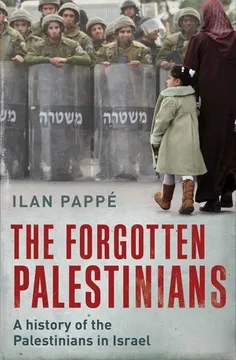


Key Takeaways
Treat Palestinians inside Israel as central to history, not a footnote.
A history begins before 1948. Pappé starts with a Palestine of villages, towns, schools, farms, and growing urban life. Haganah intelligence files mapped Palestinian villages in unusual detail, recording families, occupations, land, and buildings. He uses these records to challenge the idea that the land was empty or its people incidental. On the eve of the Nakbah, the 1948 catastrophe for Palestinians, about 1.3 million Palestinians lived in Palestine, alongside roughly 600,000 Jews.
A minority made by rupture. During the 1948 war, about 750,000 Palestinians were expelled or fled and could not return. Roughly 160,000 remained inside the new state of Israel. Their history, Pappé argues, is not a side story to the conflict: it is the story of a community formed by displacement, divided families, and life under a state that did not expect to contain it.
The opening move changes the unit of analysis. Instead of treating a minority as a demographic detail within a national story, it asks how state formation remade the lives of people already there. That shift resembles a basic insight in migration history: borders do not merely separate populations, they can create new categories of belonging. Pappé’s village files are especially effective because they make the lived landscape legible. Still, archives record what officials chose to observe; pairing them with testimony and local histories helps recover what administrative maps leave out.
Formal citizenship did not undo dispossession or guarantee equal membership.
Rights were unevenly assigned. Israel’s citizenship law made registration in a late 1948 census central to automatic citizenship. Pappé notes that about 100,000 of the 160,000 Palestinians who remained were not registered, often because their areas had not yet been occupied or because they were displaced from their homes. Jews immigrating to Israel received citizenship under a separate Law of Return, without the same census condition.
Property followed the same divide. The Absentees’ Property Law gave the state control over land and possessions belonging to Palestinians who had left, including internal refugees who remained in Israel but could not return to their homes. Pappé estimates that Palestinian-owned land within Israel fell from 4.6 million dunams before the war to 0.5 million by 1950. In his account, citizenship offered a foothold, not restoration or equal access to the country’s resources.
This is a sharp example of how legal categories can distribute security and vulnerability without openly abolishing citizenship. A right on paper may coexist with rules that determine who can exercise it, and whose loss becomes permanent. The comparison between census-based citizenship and automatic immigration-based citizenship makes that asymmetry concrete. Yet legal status is not the whole story: people also use courts, elections, and public institutions to press claims. The book’s strongest point is that these routes existed, but operated inside rules that sharply constrained what they could repair.
Military rule ended in 1966, but its controls outlived the regime.
Daily life required permission. From 1948 to 1966, military rule governed Palestinian areas through emergency regulations. Military authorities could restrict movement, impose curfews, arrest people without trial, close organizations, and limit work or political activity. A trip to a hospital, a job, or a relative could depend on a permit. Pappé emphasizes that such controls affected rural villages and, through similar civilian practices, Palestinian neighborhoods in cities.
Kafr Qassem became a turning point. On 29 October 1956, a curfew was imposed earlier than villagers had been told. Soldiers shot people returning from work; the book records 48 people killed. The massacre and subsequent public pressure helped weaken support for military rule, which formally ended in 1966. But Pappé argues that the end of the system did not erase the emergency laws, surveillance, or the assumption that Palestinian citizens posed a security problem.
Emergency powers are often defended as temporary, but their social effects can become durable: people adapt their routes, work, and public speech to avoid risk. This is a form of institutional memory, even after a policy formally ends. The Kafr Qassem account makes the human stakes unmistakable, while also showing why the massacre could shift public debate. A useful distinction is between ending a governing instrument and changing the assumptions that made it acceptable. The book suggests the first can happen without the second.
Treat political compromise as survival under unequal choices, not simple consent.
There was no safe political lane. Some Palestinians joined Zionist parties or state institutions to seek jobs, resources, and protection. Others organized through the Communist Party, which gave national aspirations a limited public channel. The government also used benefits, pressure, and surveillance to recruit local notables and divide political opposition. Pappé cautions against calling every person who worked within the system a collaborator: for many, participation was necessary for survival.
Opposition took different forms. The Communist Party, labor activism, local councils, and the more openly nationalist al-Ard movement offered distinct strategies. Al-Ard’s activists pushed claims such as refugee return and Palestinian national identity, but faced bans, arrests, or exile. The community was not politically passive; its choices were shaped by severe constraints, internal disagreements, and the risks of challenging the state directly.
This section resists a tidy moral division between resistance and collaboration. Under unequal power, the same action can provide a family with income, a town with services, and a government with leverage. Political sociology calls attention to this mix of coercion and incorporation, but the lived judgment belongs to the people navigating it. Pappé’s caution is valuable because it prevents hindsight from turning survival decisions into character tests. At the same time, close attention to who gained resources, and who bore the costs, keeps the analysis from treating all accommodation as equivalent.
When speech was policed, poetry carried the national memory.
Culture made room for what politics could not. Under military rule, public expression of Palestinian identity could bring censorship, arrest, or worse. Poetry became a way to connect ordinary life, family, love, and loss with land confiscation and political control. The authorities themselves struggled to decide whether poetry gatherings were cultural events or political threats. Writers also engaged with Hebrew culture without surrendering Palestinian identity: poet Rashed Husayn translated the work of Hebrew poet Haim Bialik into Arabic.
Identity remained contested. At a conference in Belgrade, Husayn felt rejected by both Israeli and Arab intellectual circles, each treating him as belonging elsewhere. His experience captures the double pressure on Palestinians in Israel: prove loyalty to the state, while remaining connected to a people beyond its borders. Pappé presents cultural work not as decoration around politics, but as a means of preserving a shared account of who the community was.
Art can function as a public record when official institutions narrow the terms of acceptable speech. Poetry’s compression is especially suited to carrying several registers at once: personal grief, local memory, and political claim. Husayn’s divided reception also complicates the idea that identity is simply a choice between national labels. Still, cultural expression does not automatically build political agreement; the same poem can sustain memory without resolving disputes over strategy, religion, or class. Its power here is more basic: it keeps experience available for later interpretation.
Defending land turned scattered grievances into a shared political identity.
Land was the pressure point. Pappé describes decades of expropriation, restricted village growth, and Jewish settlement projects as connected policies, not isolated local disputes. In 1976, the government announced a new plan to take 20,000 dunams in the Galilee, after earlier seizures in the region. Palestinian organizers called a general strike and protest for 30 March, linking the land issue to wider discrimination.
A local protest became a landmark. Demonstrations in Sakhnin, Arabeh, and other towns met police and army force. Six Palestinians were killed. The event became known as the Day of the Land, commemorated annually as a symbol of collective resistance. The strike’s near-universal participation showed that land loss could unite people across political factions and local divisions. It also made visible a central contradiction: citizens were protesting the seizure of land in the country where they lived.
Land is never only an asset in this history. It supports livelihood, anchors family memory, and determines whether a community can expand or remain connected to neighboring communities. That helps explain why a specific confiscation could become a shared political symbol. The Day of the Land also shows how collective action can emerge from networks that are not centrally commanded. A note of caution: commemoration can unify a community around a past event while leaving current disagreements unresolved. Its importance lies in establishing a common reference point, not eliminating internal difference.
Hold Palestinian belonging and Israeli citizenship together without pretending they fit neatly.
1967 brought reunion and friction. After Israel occupied the West Bank and Gaza, Palestinian citizens could reconnect with relatives and communities from which they had been separated. They found shared language and history, but also different circumstances and priorities. Palestinians under occupation focused on ending military rule; Palestinians inside Israel sought equal rights and land security as citizens, while expressing solidarity with the wider national struggle.
A third-space strategy. Pappé uses this term for the effort to avoid both full assimilation into the state and complete absorption into a single national movement. In practice, many supported the PLO’s two-state position, demanded equal rights in Israel, and used tactics available within Israeli law. This was not a settled identity or a perfect compromise. It was a way to navigate competing obligations while preserving room for local political life.
The idea of a third space is useful because it treats identity as something people manage in context, rather than a single allegiance that can be measured once and for all. Citizenship, language, kinship, and national solidarity can coexist, even when institutions demand that they conflict. This also clarifies why similar communities may choose different strategies under occupation and citizenship. The risk is that a flexible framework can sound more harmonious than the reality it describes. Pappé’s account is most persuasive when it keeps the pressures and trade-offs visible.
Do not mistake Oslo’s brief access for inclusion in the peace settlement.
Hope briefly entered official politics. In the mid-1990s, Palestinian members of the Knesset supported Yitzhak Rabin’s government without joining its formal coalition. Some gained parliamentary roles, and the government made limited moves on public employment, education, and social welfare. For a short time, this suggested that Palestinian citizens might be treated as legitimate political partners.
The negotiations left them out. The Oslo process addressed Israel and the PLO, but Palestinians inside Israel had no direct role in shaping it. Refugees and other Palestinians were also absent from key decisions. As the promised peace failed to materialize, local organizations took on work the state neglected. Groups such as Adalah pursued legal equality, while community organizations addressed health, education, and women’s needs. The book presents these institutions as a way to defend collective life, not evidence that exclusion had ended.
The distinction between access and influence matters in any negotiated settlement. Being invited into an institution, or benefiting briefly from a government’s policy, is not the same as having a role in defining the settlement’s terms. The NGO response is also significant: community organizations can create expertise and services where state provision is absent. But self-organization has a limit. It can mitigate neglect and preserve political capacity, while also allowing governments to shift responsibility for public needs onto communities with fewer resources.
October 2000 showed how fast protest could be reframed as a security threat.
A protest became a deadly confrontation. In October 2000, Palestinian citizens demonstrated in solidarity with Palestinians in the occupied territories and against the failure of the peace process. Police used live ammunition; 13 Palestinian citizens were killed, and hundreds were wounded. One Jewish citizen also died during the clashes. Pappé argues that forceful policing, rather than the protest itself, was central to the deadly outcome.
The aftermath deepened distrust. The official Orr Commission identified land policy and unmet needs as sources of Palestinian frustration, but its conclusions also criticized political leaders and police preparation. No police officers were ultimately prosecuted for the killings. For Pappé, the events exposed how quickly the state could treat its own Palestinian citizens through a security lens. They also widened the divide between people who had hoped that legal participation and peace negotiations might bring meaningful change.
The episode highlights a basic test of public order: whether authorities distinguish protest from threat, and whether force is accountable afterward. That distinction is crucial because a security response can create the very distrust it claims to contain. Pappé’s reading foregrounds state conduct, while the inquiry’s account also assigns responsibility to political leadership and policing failures. Both points matter, though they do not carry equal explanatory weight in his narrative. A careful reader should separate the documented sequence of events from competing interpretations of intent.
Test Israeli democracy where security agencies meet citizens, not only at ballot boxes.
Democratic procedures can coexist with unequal power. Pappé uses “ethnocracy” for a system in which formal political rights coexist with the dominance of one ethnic group over state institutions and resources. He then proposes “Mukhabarat state,” borrowing the Arabic word for intelligence service, to stress the security apparatus’s role in governing Palestinian citizens. In this account, security is not only an occasional response to crisis; it shapes ordinary policy and political limits.
The claim is about a relationship. Pappé does not use this framework to describe every aspect of Israeli society or the experience of every citizen. He applies it to the state’s treatment of its Palestinian minority, from military rule and land policy to surveillance and the response to protest. The test of democracy, then, is not just whether citizens can vote, but whether they can exercise rights without being treated as an internal enemy.
The framework directs attention to the institutions that make rights usable or merely formal. Elections matter, but so do policing, courts, land administration, and the ability to organize without coercive suspicion. This is a productive lens for examining how security language can become routine governance. Yet “Mukhabarat state” is an analogy, not proof that Israel and Arab authoritarian regimes are interchangeable. Pappé’s narrower claim is stronger: a state can maintain democratic forms for some while governing a minority through exceptional and coercive practices.
Analysis
The book’s central achievement is to make a community usually treated as a footnote into the main subject of a historical narrative. Its chronology connects the upheaval of 1948 to citizenship law, military rule, land policy, political organization, cultural production, Oslo, and the killings of October 2000. That sequence makes an important analytical point: formal citizenship did not dissolve the structures created by displacement and ethnic hierarchy. In Pappé’s account, land, legal status, security policy, and public memory reinforce one another.
The narrative also avoids portraying Palestinians inside Israel as politically uniform. Communist organizing, nationalist activism, religious movements, local leadership, cultural work, and civil-society organizations appear as different responses to constraint. The idea of a third-space strategy helps explain why attachment to Palestinian national life could coexist with demands made as citizens of Israel. This is more illuminating than forcing the community into a binary of assimilation or rejection.
Pappé is explicit about his political commitments, and the book’s voice is openly interpretive. That candor gives the account urgency, but it also means that readers should distinguish archival material and reported events from the author’s explanations of motive, continuity, and state strategy. His concepts of ethnocracy and the Mukhabarat state organize a vast history into a clear argument; they can also risk making variation across time and institutions look more uniform than it was. The book’s own scholarship appendix signals that these interpretations sit within active academic disputes.
The most enduring question is not whether the community belongs to one national story or another. It is what equal citizenship requires when a state defines its national identity around a majority group. By tracing daily constraints alongside collective action, Pappé shows why that question cannot be answered through constitutional language alone.
Review Summary
Reviews of The Forgotten Palestinians are largely positive, with an overall rating of 4.17/5. Readers praise Pappé's meticulous research and comprehensive chronological history of Palestinians living within Israel. Many highlight its academic depth as both a strength and weakness — thorough and well-footnoted, yet dense and challenging for general readers. Reviewers recommend it primarily to those already familiar with the conflict, suggesting other Pappé works as better entry points. Common criticisms include editorial issues, grammatical errors, and occasionally redundant information. Most agree it provides invaluable, often overlooked perspectives on Palestinian citizens of Israel.
Glossary
Nakbah
The 1948 Palestinian catastropheThe Arabic term for catastrophe, used for the mass displacement of Palestinians during the 1948 war and the destruction or depopulation of many Palestinian towns and villages. In Pappé’s account, the Nakbah is not a closed episode: it shaped the status of those who remained inside Israel, those displaced within it, and the refugees barred from return.
Military rule
Military administration over citizensThe system imposed on Palestinian citizens in Israel from 1948 to 1966, drawing on emergency regulations and military authorities. It restricted movement, political activity, work, and public expression, and gave officials broad powers to detain or expel people. Pappé argues that its formal end did not remove the security assumptions and administrative practices that had sustained it.
Day of the Land
Protest against land confiscationThe name given to the Palestinian general strike and demonstrations of 30 March 1976, called in response to land confiscation in the Galilee and wider discrimination. Police and army forces confronted demonstrators, and six Palestinians were killed. The date became an annual commemoration and a lasting symbol of collective resistance to dispossession.
third-space strategy
A way to navigate competing identitiesPappé’s term for a political and personal space between full assimilation into the Israeli state and total absorption into a unified Palestinian national movement. It describes how Palestinian citizens could assert national belonging, seek equal civic rights in Israel, and choose forms of action shaped by their specific circumstances.
ethnocracy
Ethnic dominance within state institutionsA political system in which formal democratic practices coexist with the dominance of one ethnic group over state power, land, and resources. Pappé uses the term to explain how Palestinian citizens may have voting rights and other individual freedoms while facing structural limits on collective equality and participation.
Mukhabarat state
Security services as governing powerPappé’s comparative term for a state in which intelligence and security agencies exert pervasive influence over the lives of a targeted population. He applies it specifically to Israel’s relationship with its Palestinian minority, arguing that security institutions help shape ordinary governance, not only responses to exceptional crises.
About the Author

Download PDF
Download EPUB
.epub digital book format is ideal for reading ebooks on phones, tablets, and e-readers.








