

Key Takeaways
Apply your principles to Palestinians, not only to politically convenient causes
The revealing contrast. In 2018, progressives condemned Donald Trump’s treatment of Central American migrants, yet largely overlooked his decision to end U.S. funding for UNRWA, the agency providing food, health care, and education to Palestinian refugees. The funding cut threatened basic services for millions, at a cost of about $200 million that year. The authors do not claim the two situations are identical. They ask why concern for vulnerable people so often stops at Palestine.
A political exception. Their central charge is that progressives apply values such as equality and human rights selectively when Israel and Palestine are involved. That silence, they argue, helps normalize policies they would challenge elsewhere, including occupation, displacement, and restrictions on Palestinian life.
What's striking is that the opening comparison tests not whether two crises match in every detail, but whether the same moral vocabulary can cross a political boundary. That is a useful audit for any movement: identify who is routinely left outside its circle of concern. The comparison also needs care. Different histories and security contexts matter, and moral consistency does not require treating every case as identical. It requires explaining why a difference justifies a different response, rather than treating Palestine as exempt from scrutiny.
Separate Jewish safety from demands that Palestinians validate their own dispossession
Two different questions. The authors distinguish Jewish and Israeli people’s right to live safely from the political demand that Palestinians recognize Israel specifically as a Jewish state. They argue that the phrase right to exist often blurs these questions, making criticism of state policy sound like a threat to Jewish lives. Israeli diplomat Abba Eban called the country’s existence self-evident in 1981, but the demand for Palestinian recognition later became a condition in diplomacy.
Recognition already given. The Palestine Liberation Organization recognized Israel in 1988 and again in the 1993 Oslo exchange. Yet demands continued, eventually including recognition of Israel as the homeland of the Jewish people. The authors point to Israel’s 2018 Nation-State Law, which reserves national self-determination in Israel for Jews, as a reason Palestinians might refuse to endorse that political arrangement.
This distinction helps disentangle a real security concern from a demand for political endorsement. In constitutional design, a state can protect a people’s collective identity while also guaranteeing equal standing to minorities, but those commitments can conflict in practice. The authors’ argument is strongest when it asks why Palestinians alone must affirm a state’s preferred self-description. A fuller debate also has to take seriously why many Jews view national self-determination as a safeguard against persecution. Acknowledging that history need not settle questions about unequal rights.
Defend the right to boycott, even when you reject the boycott itself
A civil society tactic. In 2005, more than 170 Palestinian organizations called for boycott, divestment, and sanctions, commonly shortened to BDS. The call sought three changes: an end to occupation and settlement activity, full equality for Palestinian citizens of Israel, and respect for Palestinian refugees’ claims to return. The authors describe BDS as a nonviolent form of political pressure, not as a requirement for every supporter of Palestinian rights.
Speech under pressure. By 2020, 28 U.S. states had laws or policies penalizing some forms of boycott activity. Federal courts in Kansas, Arizona, and Texas blocked challenged laws, finding that political boycotts receive First Amendment protection. A study cited by the authors estimated BDS-related economic damage at 0.004 percent of Israel’s economy from 2010 through 2017. They argue that the debate should be answered with argument, not government penalties.
The distinction between endorsing a tactic and defending its legal protection is crucial. A democracy is most tested when it protects expression that many citizens consider unfair or misguided. Boycotts also operate through economic pressure, so opponents can reasonably debate their targets, effectiveness, and consequences. The authors’ account makes room for that disagreement while resisting a shortcut: treating political expression as illegitimate because it is directed at Israel. Protecting the right to protest does not require agreeing with every slogan or proposed remedy.
Treat Trump's Israel policy as acceleration, not a bipartisan rupture
Long roots, sharper style. Trump recognized Israeli sovereignty over the Golan Heights, a break with earlier U.S. policy. But the authors argue that many other moves accelerated existing bipartisan positions. Congress passed the 1995 Jerusalem Embassy Act by 93 to 5 in the Senate and 374 to 37 in the House. Presidents delayed implementation through waivers until Trump moved the embassy in 2018. Obama, meanwhile, finalized $38 billion in military aid to Israel without tying it to concrete demands on Palestinian rights.
Continuity beneath spectacle. The authors also note that the United States had vetoed 44 Security Council resolutions critical of Israel since 1972. Trump’s approach was unusually blunt, but the underlying pattern of diplomatic protection and military support preceded him. Seeing him as a complete departure, they warn, lets earlier administrations and their supporters escape responsibility.
This is an argument about institutional path dependence: a dramatic president can make old commitments more visible without inventing them. The distinction matters because replacing one administration may change tone while leaving the machinery intact. At the same time, continuity should not erase meaningful differences in policy, legal posture, or consequences. The Golan decision illustrates that Trump could both extend a longstanding alignment and make a genuine break. A careful assessment separates the policies themselves from the style and speed with which they are enacted.
A negotiation cannot be fair when one side controls the terms and leverage
The table is not neutral. The Oslo Accords created an interim Palestinian self-governing authority and a process meant to produce a final agreement within five years. Instead, settlement growth continued, and Palestinians had little influence over assumptions that negotiators treated as inevitable, such as Israel retaining major settlements and most refugees receiving no return. The authors call these unstated expectations the everybody knows assumptions: ideas presented as practical necessities before Palestinians had accepted them.
The Iron Wall. Zionist thinker Ze’ev Jabotinsky argued that Palestinians would resist colonization and that force would first have to make Zionist presence permanent. He envisioned negotiation after that resistance was weakened. The authors argue that Israeli policy often retained the coercive first part without delivering a credible offer of equal rights. This history helps explain why demands for Palestinian recognition can sound less like confidence-building than a request to approve terms already set by the stronger party.
Negotiation theory distinguishes formal equality at the table from actual bargaining power. If one party controls movement, territory, and key resources, an agreement can be voluntary in procedure yet deeply constrained in substance. The authors make a persuasive case that inherited assumptions can quietly predetermine outcomes. Still, no account of power should erase the fears or political divisions on either side. Durable agreements need both credible guarantees and public legitimacy. A deal that Palestinian leaders cannot defend to their own constituents is not a stable bargain, however elegant its diplomatic language.
Read Gaza's crisis as engineered dependence, not a natural disaster
A system, not a storm. Scholar Sara Roy’s term de-development describes policies that weaken Gaza’s ability to sustain an independent economy. The process includes loss of land and water, dependence on Israel for labor and trade, and restrictions that undermine local institutions. Before Israel withdrew its settlements from Gaza, 21 Jewish-only settlements occupied about one-third of the Strip, while roughly 1.1 million Palestinians lived in the remaining area.
The cost of enclosure. The book’s account describes unemployment at about 44 percent in 2014 and reports that 95 percent of Gaza’s water was unfit to drink. Electricity, trade, and movement remained heavily restricted. The authors also discuss rocket attacks on Israeli civilians and the security arguments used to justify closures. Their point is not that those attacks are harmless, but that prolonged restrictions deepen civilian hardship without creating a political solution.
The concept of de-development shifts attention from a crisis’s visible symptoms to the rules that produce dependence. That perspective is valuable in political economy, where access to markets, infrastructure, and mobility can matter as much as aid. Emergency relief can keep people alive while leaving the underlying system untouched. The account also needs a two-level analysis: attacks on civilians are wrong, and restrictions that impoverish a whole population carry their own moral and strategic costs. Recognizing both does not create equivalence; it permits each policy to be judged on its effects.
Do not punish voters for choosing leaders outsiders dislike
An election with consequences. In 2006, Hamas won a majority in Palestinian legislative elections. The authors attribute the result in part to public anger at Fatah’s corruption, cronyism, and poor governance, not simply support for Hamas’s militancy. Israel and Western governments then restricted aid and dealings with the Palestinian Authority unless Hamas accepted specific conditions. The United States also supported efforts to strengthen Fatah, and fighting between the factions ended with Hamas in control of Gaza and the Palestinian leadership divided.
A revealing comparison. The authors contrast this response with U.S. treatment of Israeli governments whose leading party platforms rejected Palestinian statehood. Those governments were not subjected to the same demand that the governing party change its stated position before diplomacy could proceed. The comparison raises a question about whether democratic legitimacy is applied consistently when voters choose leaders whom powerful outsiders oppose.
Democratic elections do not make every elected party’s policies acceptable, especially when violence or exclusion is involved. But punishing a population for its vote can discredit electoral participation and strengthen the very actors sanctions are meant to weaken. The authors’ comparison exposes an asymmetry in how political platforms are treated. It also underscores a practical distinction: engagement with a government is not the same as approving its conduct. Diplomatic policy can set clear limits while still preserving channels through which elected authorities and their constituents can be heard.
Judge security claims by their effects on civilians and nonviolent protest
A protest at the barrier. The Great March of Return began in Gaza in 2018 as a grassroots campaign demanding an end to the siege and recognition of refugees’ claims to return. Families gathered near the fence; some protesters engaged in violence, while many others demonstrated peacefully. Israel described the protests as a security threat. The authors report that after a year, 266 Palestinians had been killed and more than 30,000 wounded, including medical workers and journalists.
Security has limits. The march touched a core dispute: Palestinian return could challenge Israel’s Jewish majority, while Palestinians regard return as a central national claim. The authors argue that the danger of some participants’ actions cannot justify treating every demonstrator as a combatant or ignoring the wider humanitarian conditions. They also note that Hamas came to play a role in the protests, complicating any simple picture of them as wholly independent or uniformly peaceful.
Security analysis is more credible when it distinguishes among people, actions, and levels of threat rather than treating a crowd as a single actor. That distinction is central to civilian protection in any conflict. The march’s demand also shows how a symbol can carry sharply different meanings: return represents justice to many Palestinians and demographic danger to many Israelis. A serious political response must account for both perceptions without letting fear settle the question of rights. The authors’ emphasis on force deserves attention, alongside careful scrutiny of particular violent acts.
Make equal rights the starting point, not a reward for strategic usefulness
A changing constituency. A 2018 University of Maryland poll found that 56 percent of Democrats favored sanctions or stronger action in response to new Israeli settlements. Pew polling that year also showed liberal Democrats’ sympathies shifting toward Palestinians, though elected officials remained more cautious. For the authors, these findings suggest that criticism of U.S. policy is not confined to a fringe, even if it remains contested within the party.
Principle before formula. The book does not insist on one final map, whether one state or two. It argues that any durable arrangement must protect equal individual and collective rights, safety, and self-determination for Palestinians and Israelis. The authors urge progressives to press for practical changes, including ending Gaza’s siege, halting settlement expansion, and allowing Palestinian communities greater freedom of movement and growth. Palestinian rights matter in their own right, not only when they benefit Israel.
Separating the moral objective from the institutional design is a productive move. Equal rights can serve as a test for competing proposals without pretending that constitutional arrangements, borders, and refugee claims are easy to resolve. The polling also signals a political opening, not a settled consensus. Public sympathy can change quickly, and support for sanctions may reflect different motives among respondents. Translating sentiment into durable policy requires clear goals, accountability, and attention to Israeli security as well as Palestinian freedom. The standard, however, should not depend on which group is more electorally useful.
Analysis
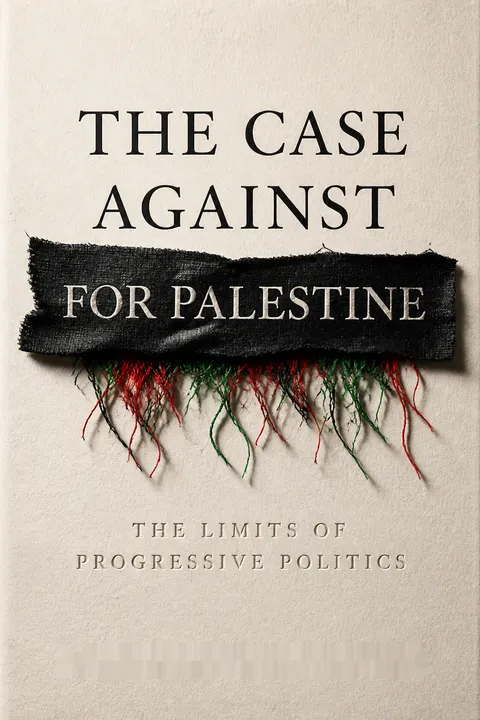
Except for Palestine is an argument about selective universalism, not a comprehensive account of every dimension of the Israeli-Palestinian conflict. Its narrative moves from a moral contrast, the difference between American responses to migrant refugees and Palestinian refugees, through debates over recognition, protest, U.S. policy, and Gaza. That structure makes the book’s recurring claim legible: Palestinian rights are often treated as negotiable in U.S. politics even by people who defend comparable rights elsewhere.
The book’s most useful analytical distinction is between a population’s safety and a state’s political character. That distinction helps prevent criticism of state policy from being collapsed into an alleged threat to Jewish life. Its account of bipartisan policy also challenges a familiar shortcut in American politics: attributing structural outcomes to one unusually visible president. The embassy move and the funding cuts become examples of how laws, aid commitments, and established assumptions can narrow diplomatic choices before any single administration acts.
The authors’ strongest contribution is to insist that power belongs inside any account of negotiation. A formally voluntary agreement can be constrained when one party controls territory, movement, and resources. Their discussion of Gaza extends that point from diplomacy to political economy, showing how restrictions can shape the very conditions then cited as reasons for further restrictions.
The approach is intentionally advocacy-driven. It foregrounds Palestinian dispossession and argues that some security rationales obscure their human costs. Readers should therefore distinguish the book’s well-supported critique of unequal treatment from its broader interpretations of contested events. Israeli security fears, Palestinian political divisions, Hamas’s conduct, and disagreement over refugee return all complicate proposed remedies. Recognizing those complications need not dissolve the book’s central test: policies should be judged by consistent standards of human dignity and political equality. The unresolved question is how to convert that standard into institutions that protect both peoples without making one people’s rights contingent on the other’s consent.
Review Summary
Except for Palestine receives mixed reviews, with praise for its concise and informative approach to US-Israel-Palestine relations. Readers appreciate the book's focus on progressive hypocrisy regarding Palestine and its clear explanations of complex issues. Some criticize its liberal perspective and lack of deeper analysis. The book is recommended for those seeking to understand US involvement in the conflict, though it assumes some prior knowledge. Critics note its potential bias and limited scope, while supporters value its contribution to the discourse on Palestinian rights.
People Also Read




Glossary
Palestine as an exception
Selective concern for PalestiniansThe book’s description of a political double standard in which people who defend human rights and equality in other contexts often remain silent about, or excuse, policies affecting Palestinians. The phrase directs attention to how Palestinian rights are treated as a special case rather than evaluated by the same principles applied elsewhere.
BDS
Boycott, divestment, and sanctionsA campaign of economic and political pressure initiated by a broad coalition of Palestinian civil society organizations in 2005. Its stated demands concern ending occupation and settlement activity, securing equal rights for Palestinian citizens of Israel, and respecting Palestinian refugees’ claims to return. The book distinguishes support for BDS from support for the right to engage in political boycotts.
de-development
Erosion of economic capacityScholar Sara Roy’s term for a process that reduces Gaza’s ability to develop an independent economy and society. The book describes three connected mechanisms: dispossession of land and resources, economic dependence shaped by external control, and the weakening or restriction of local institutions and organizations.
The Iron Wall
Force before negotiationZe’ev Jabotinsky’s strategy for Zionism, as discussed in the book. Jabotinsky argued that Palestinians would resist colonization and that a strong, immovable Jewish presence would first have to make that resistance futile. He envisioned negotiation after this stage, but the authors argue that political practice often emphasized coercive dominance without a comparable offer of equality.
Great March of Return
Gaza protest campaignA series of demonstrations that began near Gaza’s perimeter fence in 2018. Participants called for an end to the siege and for Palestinian refugees’ claims to return to be recognized. The demonstrations included many peaceful participants as well as some violent acts, and Israeli forces used lethal force against protesters, according to the book’s account.
Oslo Accords
Interim Israeli-Palestinian agreementsAgreements between Israel and the Palestine Liberation Organization beginning in 1993. They established mutual recognition, created the Palestinian Authority as an interim self-governing body, and set a process intended to resolve final-status issues within five years. The book emphasizes that the process did not produce a final settlement and that settlement growth and occupation continued.
UNRWA
UN agency serving Palestinian refugeesThe United Nations Relief and Works Agency for Palestine Refugees in the Near East was established in 1949 to provide services such as education, health care, food, and emergency assistance to Palestinian refugees. The book stresses that UNRWA delivers services and uses an operational registration definition; it does not determine the legal status or rights of refugees.
Download PDF
Download EPUB
.epub digital book format is ideal for reading ebooks on phones, tablets, and e-readers.








