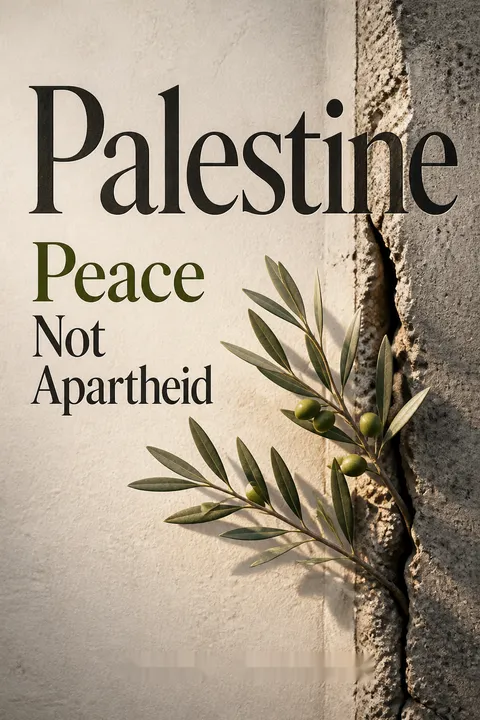


Key Takeaways
Peace requires Israeli security and Palestinian sovereignty, not permanent domination.
Two rights must coexist. Carter’s central claim is that peace depends on Israel’s right to live securely within recognized borders and Palestinians’ right to live with dignity and self-government. He argues that neither military strength nor the rejection of Israel can settle the conflict. U.N. Security Council Resolution 242, which Carter treats as a foundation for negotiations, pairs security for every state with withdrawal from territory occupied in war and a just response to the refugee issue.
A disputed comparison. Carter uses “apartheid” to warn that permanent separation and unequal rights could define life under occupation. He explicitly distinguishes this from South Africa’s system, arguing that the driving purpose in Palestine is land acquisition rather than racism. That distinction matters: the analogy is a warning about political structure, not a claim that the histories are identical.
What's striking is the insistence that security and self-determination are not competing moral currencies. In negotiation theory, durable agreements need both parties to believe their core interests survive the bargain. A security arrangement that denies political agency can create the insecurity it is meant to prevent. Carter’s analogy is most useful when it directs attention to institutions and unequal control; it becomes less precise if treated as a complete historical equivalence. His own distinction helps readers keep that boundary clear.
Treat official promises skeptically when settlements make temporary occupation permanent.
A first impression changed. Carter’s 1973 visit to Israel left him optimistic. Israeli leaders described the territories captured in 1967 as leverage to exchange for peace, and he assumed the occupation would end through negotiation. He saw few signs of the Palestinian experience beyond Israel’s borders and accepted assurances that rights would be protected. The visit later became a baseline against which he measured a marked change in policy.
The facts on the ground shifted. Settlements grew, and Carter came to see the occupation as more than a temporary security measure. His account shows how a visitor can mistake calm for consent when the people most affected have little voice in the conversation. The book’s personal narrative is also a record of his own assumptions being revised by later visits and direct contact with Palestinians.
The memoir’s strength is its admission that proximity does not guarantee understanding. Carter was welcomed by senior Israeli officials, yet his early view left Palestinian lives largely outside the frame. That is a useful lesson for political reporting and organizational leadership: access to decision-makers can illuminate policy while obscuring its costs. Firsthand observation still has limits, since any visitor sees a curated slice of reality. Carter’s account gains credibility by showing how his perspective changed, rather than presenting his later judgment as inevitable.
Camp David secured Egypt-Israel peace but left Palestinian self-rule promises exposed.
A breakthrough with boundaries. In 1978, Carter spent thirteen days mediating between Egyptian President Anwar Sadat and Israeli Prime Minister Menachem Begin at Camp David. The resulting Camp David Accords established a framework for Palestinian self-government and helped produce the durable Egypt-Israel peace treaty. Israel withdrew from the Sinai, and the two countries established normal diplomatic relations.
The unfinished part mattered. The accords also called for Palestinian participation in negotiations, withdrawal of Israeli military and civilian forces from the West Bank and Gaza, and a process to determine their future. Carter says those provisions were not meaningfully implemented. The two leaders also removed a paragraph on Jerusalem from the final text. The episode shows both the power and the limits of diplomacy: a major bilateral agreement can endure while leaving the conflict’s central political questions unresolved.
Camp David makes a strong case for patient mediation, precise language, and a clear payoff for compromise. It also illustrates a commitment problem: once Egypt had secured its national interests, pressure to fulfill the broader Palestinian provisions weakened. Agreements are not self-enforcing, especially when some parties gain immediate benefits while others wait for later stages. Carter’s account therefore points beyond the skill of the mediator to the need for monitoring, incentives, and consequences that protect the parts of a bargain most vulnerable to neglect.
Use the shared diplomatic blueprint, then negotiate the disputed details.
The proposals overlap. Carter traces recurring elements across Resolution 242, the Camp David Accords, the Oslo Agreement, the Quartet’s Roadmap for Peace, and the Arab Peace Proposal of 2002. These initiatives offer a recognizable basis for negotiations: Israel’s security, a Palestinian state, borders grounded in the pre-1967 lines, a negotiated solution for refugees, and arrangements for Jerusalem. The Arab proposal offered normal relations with Israel in return for withdrawal from occupied Arab territories and an agreed resolution of the Palestinian issue.
A more detailed model. The unofficial Geneva Initiative, developed by Israeli and Palestinian negotiators, proposed land swaps, shared arrangements for Jerusalem, and limited refugee return to Israel, with other refugees returning to Palestine or receiving compensation. Carter presents it as a practical starting point, not a final agreement. The recurring framework matters because negotiation can focus on trade-offs rather than pretending no common ground exists.
What's valuable here is the distinction between agreement on principles and agreement on implementation. Political disputes often persist not because every endpoint is unknown, but because the costs of specific concessions are uneven and domestically visible. A detailed draft can make abstract compromise testable, revealing which differences are negotiable and which are being used to delay. Still, repeating a blueprint cannot create political consent by itself. The proposal needs legitimate representatives, public explanation, and credible guarantees so that compromise is not portrayed as unilateral surrender.
A barrier becomes a land policy when its route fragments a future state.
The route carries consequences. Carter accepts that barriers can reduce attacks, but argues that the West Bank barrier was built largely inside Palestinian territory rather than along Israel’s recognized boundary. By his 2006 account, it was projected to be more than three times the boundary’s length and would place about 375,000 Palestinians on its Israeli-facing side. It divided villages, separated families from farmland, and restricted movement between Palestinian communities.
Security and sovereignty collide. The International Court of Justice had called construction in occupied territory illegal and urged that the barrier be removed there; Israel’s Supreme Court did not accept that ruling but recognized the West Bank as under belligerent occupation. Carter argues that the barrier’s route, settlements, roads, and controls could leave Palestinians without a contiguous, viable state. The book’s point is not that security is imaginary, but that its design can also shape borders.
Infrastructure is never merely technical when it determines who can move, farm, worship, or reach public services. In political geography, routes and chokepoints distribute power as surely as formal boundaries do. A barrier may reduce immediate risk while also making future political separation harder to negotiate. The key analytical question is therefore not simply whether it protects, but where it runs, who controls passage, and whether its effects are reversible. Carter emphasizes those costs, while readers should also keep the security threats that motivate barriers in view.
Washington cannot broker peace while treating one side’s demands as untouchable.
Influence requires trust. Carter argues that the United States must be a reliable partner to both Israelis and Palestinians, not a judge whose position is assumed in advance. He points to earlier moments when Washington used leverage: President Reagan publicly backed withdrawal from occupied territories as part of the land-for-peace principle, and President George H. W. Bush withheld a portion of aid and loan guarantees over settlement construction.
Inconsistency weakens leverage. Carter criticizes later U.S. policy for condemning violence while applying little pressure to halt settlements or advance negotiations. He also objects to repeated U.S. vetoes of U.N. resolutions critical of Israel. In his view, public support for a peace process means little if the most powerful outside actor will not press its allies to honor commitments. He proposes coordinated U.S. leadership with the United Nations, European Union, and Russia.
The argument connects credibility to leverage: a mediator can influence an ally only if its commitments are not automatic. This resembles a principal-agent problem, in which a sponsor wants an ally’s cooperation but has difficulty imposing costs when interests diverge. Evenhandedness need not mean moral equivalence or identical treatment; it means applying stated rules consistently and explaining exceptions. Carter’s prescription is persuasive on consistency, though the role of domestic politics in limiting U.S. freedom of action deserves equal attention.
Elections reveal political legitimacy that foreign governments cannot appoint away.
Ballots carried a message. Carter’s teams monitored Palestinian elections in 1996, 2005, and 2006. In 1996, about three-quarters of registered voters participated, despite movement restrictions and problems in East Jerusalem. A decade later, Hamas won a narrow plurality of popular votes but secured 74 of 132 legislative seats. Carter links the result to Fatah’s perceived corruption and poor administration, as well as Hamas’s local political strength.
A mandate is not an endorsement of everything. Hamas rejected recognition of Israel and had a record of violence, but Carter also reports its electoral victory, a period of ceasefire, and public statements suggesting openness to a long-term truce. He argues that isolating an elected government risks punishing ordinary Palestinians and erasing political realities. The result posed a difficult question: how can outside governments demand democratic legitimacy and then refuse to engage with the winners?
Elections produce authorization, not moral absolution. A winning party can be accountable for violence and still represent voters whose grievances cannot be ignored. Treating ballots as meaningful only when they deliver preferred leaders undermines democratic credibility and can strengthen claims that peaceful participation changes nothing. Conversely, electoral victory does not erase obligations to protect civilians or recognize political agreements. Carter’s account is strongest when it separates engagement from approval, a distinction that makes diplomacy possible without granting any faction a blank check.
Do not demand perfect partners before starting negotiations.
Conditions can become a veto. Carter describes repeated demands that Palestinian leaders first end all violence, reform institutions, or accept terms before substantive talks could begin. He argues that requiring total control over every armed act in an occupied and politically divided society makes negotiations depend on an outcome that talks themselves may help produce. He also criticizes Washington’s refusal to deal with leaders it considered unacceptable, including Yasir Arafat and, after the 2006 election, Hamas.
Dialogue is not endorsement. Carter’s case is that adversaries need channels to test intentions, clarify terms, and make reciprocal commitments. He does not excuse attacks on civilians or reject the need for security guarantees. Rather, he argues that demands should apply to both sides and that engagement should be tied to verifiable steps. A ceasefire, recognition, or institutional reform can be negotiated as part of a process, instead of being used to bar the process altogether.
This is a classic bargaining dilemma: each side wants proof of the other’s good faith before accepting risk, but the proof may only emerge through reciprocal action. Requiring complete compliance first can create a permanent stalemate, while unconditional engagement can reward spoilers. The practical middle ground is staged, observable commitments with defined responses to violations. Carter’s insistence on talking to adversaries is strongest when paired with accountability. Communication opens the door; it does not establish trust or guarantee that either party will walk through.
Condemn attacks on civilians, then examine how occupation makes violence recur.
The cycle has multiple authors. Carter condemns Palestinian attacks on Israeli civilians as morally wrong and politically damaging. He also describes Israeli military responses that killed civilians, destroyed homes and infrastructure, and tightened restrictions on Palestinian life. For September 2000 to March 2006, he reports 3,982 Palestinian deaths and 1,084 Israeli deaths in the second intifada, including children on both sides.
Triggers do not explain the whole pattern. The book argues that occupation, settlement expansion, attacks on civilians, retaliation, and imprisonment reinforce fear and anger. It does not treat these actions as equal in scale or power: Israel is a state with far greater military capacity, while Palestinian factions use attacks that Carter rejects. The practical lesson is to investigate both the immediate provocation and the political conditions that make each new round easier to launch and harder to stop.
A cycle of violence is not a natural force; it is a sequence of choices shaped by asymmetry, fear, and incentives. Naming the initiating act matters, but so does asking whether the response prevents future harm or recruits new support for armed groups. Carter’s emphasis on civilian suffering helps shift analysis from victory claims to consequences. The challenge is to avoid flattening distinct responsibilities into a generic both-sides formula: scale, authority, intent, and legal obligations all matter when judging particular acts.
Analysis
This is history, memoir, and argument in one book. Carter’s organizing claim is that the conflict is not an ancient trap beyond political control: repeated agreements establish a workable diplomatic basis, while settlement expansion, violence, and inconsistent outside pressure undermine it. His strongest evidence is often documentary. He places negotiated commitments beside later policy, making the distance between signed text and lived conditions visible. The Camp David story is central because it demonstrates both possibilities: sustained mediation produced a lasting Egypt-Israel treaty, yet provisions concerning Palestinian self-government were left unrealized.
The book’s personal arc strengthens its case. Carter describes an early visit in which Israeli assurances and limited contact with Palestinians shaped his confidence, then revises that view through later visits, election monitoring, and conversations with people under occupation. This is a useful account of how political knowledge changes when the observer’s access changes. It also remains a partial account. Carter writes as an advocate for a two-state settlement and interprets international resolutions in a way that supports that position. His narrative gives more space to Palestinian conditions and U.S. policy than to a full presentation of Israeli security doctrine or competing interpretations of legal texts.
The title’s apartheid comparison is best read as a warning about permanent separation and unequal political rights, not as a claim that the South African and Israeli-Palestinian histories are identical. Carter explicitly distinguishes their purposes. That qualification improves precision, though the analogy remains politically charged and can distract from the specific institutional questions he raises.
The book’s most durable insight is procedural as well as moral: peace needs reciprocal recognition, credible security, meaningful Palestinian sovereignty, and outside actors willing to enforce the same principles consistently. It treats dialogue as necessary without equating dialogue with endorsement. Its proposed path is not painless or guaranteed, but the alternatives Carter describes leave the underlying claims intact while multiplying the costs of unresolved conflict.
Review Summary
Palestine: Peace Not Apartheid received mixed reviews. Many praised Carter's diplomatic experience and even-handed approach, though some criticized his pro-Palestinian stance. Readers found the book informative and accessible, offering valuable historical context and insights into peace negotiations. Critics accused Carter of anti-Semitism and misrepresenting facts. Some felt the book lacked nuance in addressing complex issues. Overall, reviewers appreciated Carter's courage in tackling a controversial topic, even if they disagreed with his conclusions. The book was seen as a good introduction to the Israeli-Palestinian conflict for general readers.
People Also Read






Glossary
U.N. Security Council Resolution 242
A basis for land-for-peace talksA 1967 Security Council resolution that sets out principles for a just peace in the Middle East, including withdrawal of Israeli forces from territories occupied in the recent conflict, recognition of every state’s sovereignty and right to live within secure borders, freedom of navigation, and a just settlement of the refugee problem. Carter treats it as a core basis for negotiated borders and regional peace.
Camp David Accords
A 1978 peace frameworkThe agreements negotiated by Egyptian President Anwar Sadat, Israeli Prime Minister Menachem Begin, and U.S. President Jimmy Carter in 1978. They established a framework for peace between Egypt and Israel and proposed transitional self-government and later negotiations for Palestinians in the West Bank and Gaza. The resulting Egypt-Israel treaty endured, while Carter argues that key Palestinian provisions were not carried out.
Oslo Agreement
A phased Israel-PLO accordThe 1993 agreement in which Israel and the Palestine Liberation Organization recognized one another and set out a phased process. It established a Palestinian governing authority, provided for Israeli redeployment from parts of the West Bank and Gaza, and reserved difficult questions such as borders, Jerusalem, settlements, and refugees for later negotiations. Carter argues that the interim process left Palestinians with limited authority and did not ensure a final settlement.
Roadmap for Peace
A Quartet peace planA proposal issued in 2003 by the United States, Russia, the United Nations, and the European Union. It described a staged route toward an independent Palestinian state living beside Israel, drawing on earlier agreements, U.N. resolutions, and the principle of land for peace. Carter says the Palestinian leadership accepted it, while Israeli caveats and preconditions weakened or blocked its implementation.
Geneva Initiative
An unofficial final-status proposalA 2003 plan developed by Israeli and Palestinian political figures outside their governments. It offered a detailed model for a two-state agreement, including a border based on the 1967 lines with mutual land swaps, arrangements for Jerusalem’s holy sites, and a limited return of Palestinian refugees to Israel, with return to Palestine or compensation for others. Carter presents it as a practical basis for official negotiations, not a signed government agreement.
intifada
A Palestinian uprisingAn Arabic term used for Palestinian uprisings against Israeli rule. Carter describes the first intifada, beginning in 1987, as sustained Palestinian civil resistance met by harsh Israeli responses, and the second, beginning in 2000, as a more violent period involving attacks and reprisals. The term identifies an uprising, but does not by itself specify the tactics or conduct of participants.
hudna
A temporary ceasefireA term Hamas used for a ceasefire or truce. In Carter’s account of the 2006 Palestinian political situation, Hamas representatives said they were willing to maintain a long-term hudna if Israel reciprocated by refraining from attacks on Palestinians. Carter treats the proposal as a possible opening for negotiation, while noting that Hamas had not recognized Israel or renounced violence as a permanent policy.
Palestine Liberation Organization (PLO)
The recognized Palestinian representativeAn umbrella political organization established to represent Palestinian national claims and interests. It developed diplomatic missions, gained observer status at the United Nations, and was recognized by Arab governments and Israel as the representative of the Palestinian people in negotiations. In the 1993 Oslo process, the PLO recognized Israel and committed to a peaceful resolution, though Carter describes continuing divisions among Palestinian factions and leaders.
About the Author
Other books by Jimmy Carter

Download PDF
Download EPUB
.epub digital book format is ideal for reading ebooks on phones, tablets, and e-readers.








