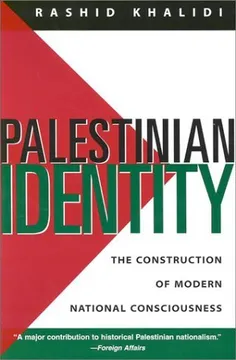


Key Takeaways
Treat national identity as a history people build, not an inheritance they uncover.
Constructed does not mean false. Khalidi argues that national identity is made from existing attachments, political pressures, shared stories, and institutions. It is neither timeless nor imaginary in the sense of being unreal. Benedict Anderson's term imagined community describes people who see themselves as belonging to one political community despite not knowing most of its members. The Palestinian case matters because this identity grew strong without a sovereign state to define borders, teach a national curriculum, or broadcast an official history.
Borders make identity tangible. The book opens with Palestinians facing checkpoints, airports, and travel documents that can mark them as stateless or leave nationality undefined. Those encounters turn an abstract question, who belongs, into a daily practical one. Disparate experiences of scrutiny and exclusion can reinforce a sense of shared fate.
What's striking is how identity appears here as both a story and an administrative fact. A passport, checkpoint, or border regime classifies people from above, while shared interpretation turns that classification into collective belonging. This connects to scholarship on bureaucracy, where official categories do not merely describe populations; they shape access, risk, and political life. Yet a shared experience of exclusion does not automatically produce a unified movement. The book's distinction between a durable identity and the harder task of achieving political agency helps prevent that leap.
Read Palestinian belonging as layered loyalty, not a sudden break from empire and Arabism.
Several loyalties coexisted. Before World War I, people could feel attached to Palestine, their town or family, Islam or Christianity, Arab culture, and the Ottoman state without treating these ties as mutually exclusive. Jerusalem notables Yusuf Diya al-Khalidi and his nephew Ruhi illustrate the overlap: both served Ottoman institutions and valued reform, while also expressing Arab cultural pride and concern for Palestine.
Political shocks changed the mix. The Ottoman Empire's collapse, European partition plans, and British rule altered which attachments could provide political direction. Arabism and Islam remained important, but increasingly specific Palestinian institutions and pressures gave local belonging sharper political meaning. The point is not that one identity replaced all others. It is that their relative force changed as the political landscape changed.
This layered account corrects a familiar mistake: treating national identity as a single label that must crowd out religion, locality, or broader cultural ties. Social identity research often finds that people activate different affiliations in different settings, rather than carrying one fixed hierarchy everywhere. The Khalidis make that flexibility concrete. At the same time, elite biographies cannot establish how every villager or worker understood these loyalties. The book recognizes that unevenness, and its evidence is strongest when it treats identity as a changing social process, not a uniform feeling.
Watch Jerusalem's names and ruins: cultural authority can make territorial claims feel ancient.
Naming is political work. Jerusalem has been known in Arabic as al-Quds and Bayt al-Maqdis, while Hebrew usage calls it Yerushalaim. The names themselves reflect distinct linguistic and religious histories. Khalidi argues that imposing one vocabulary in official documents, maps, or tourist guides can privilege one community's claim and make another seem secondary.
The landscape carries competing histories. The Haram al-Sharif, where the Dome of the Rock and al-Aqsa Mosque stand, is also called the Temple Mount. In Silwan, a Palestinian neighborhood, the name City of David has been promoted for a nearby archaeological area. Excavations and signage can elevate one historical layer over others. The same place may therefore hold overlapping memories, even as political control determines which account is presented as authoritative.
What's valuable is the link between symbolic representation and physical power. Maps, excavation choices, and place names can turn selective memory into common sense, especially for visitors who encounter a site through official guides rather than local lives. This resembles a broader process in heritage politics: preserving the past also means choosing what counts as heritage. The analysis is strongest when it shows that several histories can inhabit one place. Its challenge is to avoid implying that every naming choice is equally deliberate or politically consequential.
Land dispossession turned village resistance into a national issue before 1914.
Land sales changed daily life. Ottoman land registration and expanding commercial agriculture helped concentrate ownership in the hands of urban and absentee landlords. When land was sold to Zionist agencies, village cultivators could lose customary rights to work and live on it. In some cases, new settlers also replaced Arab laborers with Jewish workers, a policy associated with the second aliya, the wave of Jewish immigration from 1904 to 1914.
Local clashes reached the cities. At al-Fula in 1910 to 1911, peasants resisted eviction after the Sursuq family sold village land to the Jewish National Fund. Officials and newspapers made the dispute a public political issue. Khalidi's sample of documented prewar transfers attributes 58 percent to non-Palestinian absentee landlords, 36 percent to Palestinian absentee landlords, and 6 percent to local owners and cultivators. These figures describe a partial sample, not every sale.
This account shifts attention from declarations by political leaders to the material conditions that made nationalism urgent. Land is not simply a symbol here: it is livelihood, residence, inheritance, and local authority. The pattern resembles other settler-colonial conflicts in which legal title and customary use collide, with the state often enforcing the title recognized by formal law. The careful qualification of the land-sale figures matters. The records are incomplete, and aggregate numbers cannot capture every tenant's experience or settle every dispute about ownership.
Use the press to see how scattered grievances become a shared political world.
Newspapers connected distant readers. After the 1908 Ottoman constitutional revolution loosened press restrictions, papers in Jaffa, Haifa, Beirut, Damascus, and Cairo reported on Zionist settlement and debated its meaning. Khalidi examined more than 10,000 issues from ten major papers and found over 600 articles on Zionism. In 1911 alone, those papers published 286 such articles. The Arabic cultural revival called the nahda also expanded publishing and intellectual exchange across the region.
Circulation was social, not just individual. Literacy was limited, but papers could be shared, read aloud, and reprinted elsewhere. This resembles what Anderson calls print capitalism: the circulation of print helps people imagine that distant strangers share concerns and political interests. Palestinian papers linked village land loss to wider questions of Palestine's future, while regional papers made the issue a concern beyond Palestine.
The press functions here as infrastructure for political imagination, not simply as a mirror of opinion. Reprints and shared reading can create a common agenda even when readers never meet. This helps explain how local events became politically legible across a region. The method also has limits: surviving newspaper pages reveal what editors chose to publish, not exactly what every reader believed or did. Khalidi addresses that gap by noting oral circulation and village distribution, while leaving popular reception an important open question.
When empire collapsed, Palestinians shifted from Ottoman and Syrian horizons toward Palestine.
War scrambled political loyalties. Between 1917 and 1923, Ottoman rule ended, British forces occupied Palestine, and the Balfour Declaration and Sykes-Picot arrangement revealed competing plans for the region. Many Palestinian Arabists initially hoped to belong to a united Syria under Faisal. The French removal of Faisal's government in Damascus in 1920 weakened that possibility, while British support for Zionism made Palestine's particular circumstances impossible to ignore.
A new political focus emerged. The newspaper Suriyya al-Janubiyya promoted Arab and Syrian unity, yet its pages also increasingly named Palestine as a homeland with distinct claims. By 1921, Filastin described Syria as Palestine's sister country. A geography textbook published in 1923 treated Syria and Palestine as separate subjects. These shifts show a new Palestinian focus taking shape alongside, rather than instantly erasing, broader Arab attachment.
The rapid reorientation is a useful reminder that national consciousness does not always mature gradually. War, institutional collapse, and the failure of a hoped-for political arrangement can make an existing local attachment newly decisive. Comparative history offers many examples of crises accelerating political identification, but crisis alone does not dictate the outcome. In this case, preexisting religious, administrative, and local ties gave Palestinians a foundation on which to interpret events. The distinction between Arab solidarity and Palestinian political focus also resists an overly simple either-or account.
Build identity without a state, but recognize what statelessness prevents people from controlling.
States normally make nations visible. They can organize schools, official histories, museums, borders, and public media. Palestinians lacked sovereign control over these tools, while British Mandate authorities excluded them from senior positions and blocked representative government that could challenge the promised Jewish national home. Education expanded, but its systems remained divided and outside Palestinian control.
Identity still spread through other channels. Newspapers, schools, family networks, political associations, and common experiences helped carry Palestinian identification beyond a small urban elite. By 1947 to 1948, nearly 45 percent of Arab school-age children were enrolled in schools, according to the book's cited figures. Yet education alone could not replace sovereign institutions. Compared with neighboring Arab populations, Palestinians had fewer means to standardize or officially project a national narrative.
The book's central institutional insight is that national identity can survive without a nation-state, but the absence of a state changes how it develops. Networks, schools, and civic organizations can transmit belonging, though they lack the reach and authority of a national education system. This is a useful corrective to theories that make state formation the necessary starting point of nationhood. It also highlights a tension: state institutions can unify, but they can impose exclusions and official myths. Their absence is not a simple deficit, yet it sharply limits collective control.
Explain Palestinian defeats through both imperial power and internal fractures.
The losses were not caused by one factor. The 1936 to 1939 revolt began with broad popular participation, but British repression, weak national organization, and divisions among Palestinian leaders left the movement badly damaged. In 1947 to 1949, military defeat and mass displacement followed amid a sharp imbalance in organization, arms, and international support. About half of Palestine's 1.4 million Arab inhabitants were uprooted, and the traditional political leadership was scattered.
The catastrophe became shared memory. Palestinians call the 1948 disaster al-Nakba, meaning the catastrophe. Displacement and loss were experienced across class and regional divisions, helping deepen a common identity. Later nationalist accounts often presented defeats as heroic resistance against overwhelming odds. That framing could sustain solidarity, but it could also hide strategic errors and the costs of leadership failure.
The most persuasive reading holds structural constraint and political agency together. British imperial power and Zionist organization shaped an unequal contest, while Palestinian fragmentation affected the ability to respond. Neither explanation cancels the other. This balance matters because memory can become either a verdict of blame or a story that absolves every decision. Collective memory research suggests that shared trauma can strengthen group solidarity, but the same narrative may make self-criticism feel disloyal. Historical explanation is more useful when it preserves both grief and causal complexity.
Separate national recognition from sovereignty; one can advance while the other recedes.
Recognition is not self-rule. By the 1990s, Israel and the PLO had formally recognized one another, and the Palestinian Authority took shape in parts of the West Bank and Gaza. But the accords did not grant full independence or control over borders and territory. In the 2010 reissue's introduction, Khalidi argues that the Authority's state-like symbols risked disguising the limits of its actual power.
Identity outlasts political arrangements. The book's central historical finding is that Palestinian identity remained strong through displacement, exile, and the absence of a sovereign homeland. The 2010 introduction also warns that recognition and national consciousness do not guarantee a viable state. These claims refer to the author's assessment at that time, not a forecast that the political future was settled.
This distinction is valuable well beyond Palestine: symbolic recognition, administrative autonomy, and sovereignty are different political conditions. A flag or government office may establish visibility without transferring control over land, movement, or security. Political science often treats sovereignty as a bundle of capacities rather than a yes-or-no status, which clarifies why partial self-government can coexist with dependence. The section also guards against equating national identity with statehood. Its caution is that the material meaning of any arrangement must be assessed through lived authority, not labels alone.
Analysis
Khalidi's strongest move is to replace the argument over whether Palestinian identity is ancient or artificial with a more historically useful question: how did older loyalties become a modern national consciousness under unusual political pressure? His answer is cumulative. Religious attachment to Palestine, local and family ties, Ottoman administrative arrangements, expanding education, the Arabic press, land conflict, and the upheavals of war all contributed. The identity was constructed, but construction here means historical formation, not fraud.
The book's narrative is especially effective when it moves between scales. The career of two Jerusalem notables shows that Ottoman loyalty and Arab cultural identification could coexist. The al-Fula land dispute shows how a village conflict could become a public political controversy. The press then connected local grievances to a wider imagined community. The method also reveals why the absence of a Palestinian state mattered: no central authority could standardize schooling, official history, or political representation as neighboring states increasingly did.
The argument's main strength is its refusal to reduce Palestinian identity to a reaction to Zionism. Zionism is central, but it acts upon a society with existing attachments and changing institutions. The chapters on the prewar press and peasant resistance give this claim unusually concrete support. At the same time, evidence is uneven. Literate elites and newspapers are easier to recover than rural voices, so the book cannot fully show how all social groups interpreted emerging national language. Khalidi treats that limitation seriously rather than claiming a complete popular history.
The later account of defeat adds a productive tension. External power and internal division both shaped Palestinian political failure, while shared loss strengthened identity. Remembering defeat as resistance can sustain solidarity, yet it can also blur responsibility. The lasting insight is that national consciousness and national sovereignty are separate achievements. A people can become unmistakable to itself and to others without gaining the institutions or territory needed to govern its own future.
Review Summary
Reviews of Palestinian Identity are generally positive, averaging 4.03/5. Many praise Khalidi's rigorous scholarship and use of primary Arabic sources to trace the development of Palestinian national consciousness. Supporters appreciate his nuanced handling of complex identities and his challenge to narratives denying Palestinian legitimacy. Critics, however, argue his thesis is weakened by over-reliance on anti-Zionist sentiment as evidence of identity, structural repetitiveness, and occasional bias. Several readers note tension between his Benedict Anderson-influenced framework and his desire to prove Palestinian identity's independence from Zionism.
Glossary
Imagined community
Shared political belongingA political community whose members understand themselves as belonging together even though most will never meet. In Khalidi's account, the idea helps explain how newspapers, shared histories, and common political concerns could connect Palestinians across towns and social groups without a Palestinian state or unified national institutions.
Print capitalism
Circulation that builds publicsBenedict Anderson's term for the spread of printed material through a commercial publishing system. Newspapers and books allow readers to encounter similar language and political concerns at roughly the same time. Khalidi uses the concept to explain how Arabic-language journalism helped make Palestine and Zionist settlement matters of shared public concern.
second aliya
Jewish immigration, 1904 to 1914The wave of Jewish immigration to Palestine from 1904 to 1914, including many settlers with socialist and nationalist commitments. In Khalidi's account, some promoted exclusive Jewish labor and settlement, intensifying conflict with Arab cultivators and workers as new settlements displaced existing populations.
conquest of labor
Replacing Arab workersA Zionist principle associated with the second aliya that sought to employ Jewish rather than Arab workers in Jewish-owned settlements and farms. Khalidi presents it as a shift from land purchase alone toward constructing an economically separate Jewish community, with direct consequences for Palestinian laborers and cultivators.
al-Nakba
The 1948 catastropheThe Palestinian name for the mass displacement and political destruction that accompanied the 1947 to 1949 war. Roughly half of Palestine's Arab population was uprooted, and Palestinian society was fragmented among Israel, neighboring states, and refugee communities. The shared experience became a powerful foundation of collective memory and identity.
sumud
Steadfast enduranceA Palestinian concept commonly rendered as steadfastness, with meanings that include persistence and survival under severe pressure. Khalidi describes how it became central to accounts of Palestinian endurance through defeat, exile, and occupation. It can express resilience, though a narrative centered on endurance may also understate the need to examine political choices and strategy.
About the Author
Other books by Rashid Khalidi
Download PDF
Download EPUB
.epub digital book format is ideal for reading ebooks on phones, tablets, and e-readers.








