Key Takeaways
1. Traditions are often invented, not ancient.
‘Traditions’ which appear or claim to be old are often quite recent in origin and sometimes invented.
Modern origins. Many practices and symbols widely believed to be ancient, deeply rooted traditions are, in fact, modern constructs. These "invented traditions" are formally instituted or emerge rapidly within a brief, dateable period, establishing themselves with surprising speed. This contrasts sharply with genuine "custom," which evolves slowly and is flexible, adapting to changing life without necessarily implying fixed, formalized repetition.
Distinguishing from custom. Unlike custom, which functions as both a motor and flywheel in traditional societies, allowing for innovation while maintaining precedent, invented traditions prioritize invariance and continuity with a (often factitious) past. Custom is what judges do; tradition is the wig and robe. Routine, on the other hand, is purely technical and lacks the ritual or symbolic function of invented tradition, being readily modified for efficiency.
Examples abound. The pageantry surrounding the British monarchy, seemingly immemorial, is largely a product of the late nineteenth and twentieth centuries. Similarly, the Scottish kilt and clan tartans, often presented as ancient Highland dress, were invented by an English Quaker industrialist in the 18th century and later differentiated for royal pageantry, respectively. These examples highlight the deliberate construction of practices to establish continuity with a suitable historic past, even if that continuity is largely fabricated.
2. Rapid social transformation fuels the invention of tradition.
However, we should expect it to occur more frequently when a rapid transformation of society weakens or destroys the social patterns for which ‘old’ traditions had been designed, producing new ones to which they were not applicable, or when such old traditions and their institutional carriers and promulgators no longer prove sufficiently adaptable and flexible, or are otherwise eliminated: in short, when there are sufficiently large and rapid changes on the demand or the supply side.
Weakening old patterns. The invention of tradition is a response to novel situations, particularly when rapid societal change weakens or destroys existing social patterns and traditions. This creates a void that new, often formalized, practices are designed to fill, providing a sense of stability and continuity in a world of constant innovation. Such changes have been especially significant in the past two centuries, leading to a clustering of these "instant formalizations."
Inadaptability of old ways. Old traditions and their institutional carriers may no longer be adaptable or flexible enough for new conditions, or they may be deliberately discarded by innovators. For instance, 19th-century liberal ideology, with its focus on radical innovation and rejection of "irrationalism," often created social voids by failing to provide for the social and authority ties taken for granted in earlier societies. This necessitated the generation of new, invented practices.
Modern societies' need. Contrary to earlier assumptions that tradition was confined to "traditional" societies, modern societies also invent traditions. This is evident in the contrast between the constant change of the modern world and the attempt to structure parts of social life as unchanging. These formalizations are not merely confined to so-called 'traditional' societies, but also have their place, in one form or another, in 'modern' ones.
3. Invented traditions forge social cohesion, legitimacy, and socialization.
They seem to belong to three overlapping types: a) those establishing or symbolizing social cohesion or the membership of groups, real or artificial communities, b) those establishing or legitimizing institutions, status or relations of authority, and c) those whose main purpose was socialization, the inculcation of beliefs, value systems and conventions of behaviour.
Building community. Invented traditions primarily serve to establish or symbolize social cohesion, creating a sense of belonging within real or artificial communities. This is crucial in societies undergoing rapid change, where older forms of community might be eroding. Examples include national flags, anthems, and public ceremonies that foster a collective identity.
Legitimizing power. A second key function is to establish or legitimize institutions, status, or relations of authority. This can involve creating a sense of historical continuity for new power structures or reinforcing existing hierarchies. The deliberate choice of a Gothic style for the British Parliament's rebuilding, or the restyling of the British coronation ceremony, are examples of using invented tradition to sanction authority.
Inculcating values. Finally, many invented traditions aim at socialization, instilling specific beliefs, value systems, and norms of behavior through repetition. These practices, often ritualistic or symbolic, seek to shape individual and collective conduct. The flag ritual in American schools, for instance, serves to inculcate patriotism and loyalty, demonstrating how invented traditions are used to transmit core societal values.
4. Nationalism is a primary catalyst for inventing traditions.
And just because so much of what subjectively makes up the modern ‘nation’ consists of such constructs and is associated with appropriate and, in general, fairly recent symbols or suitably tailored discourse (such as ‘national history’), the national phenomenon cannot be adequately investigated without careful attention to the ‘invention of tradition’.
Constructing national identity. Modern nations, despite claiming ancient roots and natural existence, are largely constructed entities, and their formation heavily relies on invented traditions. These traditions provide the necessary symbols, histories, and narratives to forge a collective identity for diverse populations within a defined territory. The very concept of a "national history" is often a tailored discourse designed to serve present-day national purposes.
Welsh cultural revival. In Wales, the decay of traditional life in the 18th century spurred an unprecedented, often artificial, cultural revival. Scholars and patriots, lamenting the loss of a coherent past, actively created new traditions, such as the modern eisteddfod and neo-Druidism, to provide a grandiose history and unique cultural identity for a nation perceived as lacking status. This mythologizing, though often bogus, left a permanent mark on Welsh history.
Scottish Highland myth. Similarly, the distinct Highland tradition of Scotland, with its iconic kilt and clan tartans, was a retrospective invention. Before the 18th century, Highland culture was largely an overflow of Ireland, and its dress was seen as barbaric. The Macphersons forged an indigenous literature and history, while the kilt was invented by an English industrialist for practical purposes, later becoming a symbol of Scottish identity through romanticism and royal pageantry.
5. Colonial powers strategically invent traditions to legitimize rule.
Colonial rule is based on forms of knowledge as much as it is based on institutions of direct control.
Defining "colonial sociology." In Victorian India, the British invented a ritual idiom to legitimize their authority after the 1857 uprising. This involved codifying a "colonial sociology" that defined Indian society and its relationship to British rulers. They transformed Mughal court rituals like durbars, shifting their meaning from incorporation and mystical bonding to contractual subordination and a clear hierarchy under the British monarch.
Imperial Assemblage of 1877. The Imperial Assemblage in Delhi, proclaiming Queen Victoria Empress of India, was a grand spectacle designed to make manifest this new order. It aimed to conspicuously "place the Queen’s authority upon the ancient throne of the Moguls," using Delhi as a symbolic capital. The event showcased a reified vision of India's diversity, which, in the British view, necessitated imperial rule for unity and progress.
Inventing "African traditions." In colonial Africa, Europeans deployed invented traditions to define their roles as masters and to subordinate Africans. Administrators invented "customary law," "tribal" identities, and "traditional" political structures, often misinterpreting flexible pre-colonial customs as rigid prescriptions. This served to control populations, reinforce ethnic divisions, and justify European authority, even as it profoundly distorted African realities.
6. Royal and state rituals are deliberately transformed for political ends.
In England, unlike other countries, it was not so much the re-opening of the theatre of power as the première of the cavalcade of impotence.
From power to symbolism. The British monarchy's public image underwent a profound transformation from the 1820s to the 1970s. Initially, royal rituals were inept and unpopular, reflecting the monarch's significant political power and often negative public perception. As the monarchy's real political power waned, particularly from the late 19th century, its ceremonial role was deliberately enhanced to become splendid, public, and popular, serving as a unifying symbol of permanence and national community.
Theatrical grandeur. This shift was driven by factors like the rise of mass media, new transport technologies making royal carriages anachronistic and romantic, and international competition. Coronations and jubilees became meticulously planned spectacles, often featuring newly commissioned music and elaborate pageantry. This transformation allowed the monarchy to project an image of stability and continuity, even as Britain faced internal changes and external challenges.
International context. While other European monarchies (e.g., German, Austrian, Russian) used ceremonial to exalt real royal influence, the British monarchy's enhanced ritual was paradoxically enabled by its growing political weakness. After World War I, as many European monarchies fell, the British monarchy's survival made its rituals unique, embodying a long tradition in an age of unprecedented change, providing comfort and a sense of national greatness.
7. Mass movements and social classes actively invent their own traditions.
The major international ritual of such movements, May Day (1890), was spontaneously evolved within a surprisingly short period.
Workers' solidarity. Beyond state-sponsored traditions, organized mass movements and social classes also invented their own rituals and symbols. The socialist labor movements, for instance, spontaneously evolved May Day as a highly charged annual festival. Initially a pragmatic demand for an eight-hour day, it rapidly absorbed ritualistic elements like red flags, flowers, and quasi-religious celebrations, becoming a powerful assertion of working-class presence and solidarity.
Middle-class identity. The burgeoning middle classes, facing challenges in defining their status beyond birth or wealth, developed their own invented traditions. This included a passion for genealogy (e.g., Daughters of the American Revolution), the institutionalization of schooling (public schools, fraternities) to create exclusive networks, and the adoption of amateur sports. These served to establish social comparability, common values, and a sense of belonging among a diverse and expanding group.
Sport as a social marker. Sport, particularly football in Britain, rapidly became a mass proletarian cult from the 1870s, with its own rituals, professionalism, and local/national rivalries. Simultaneously, upper and middle-class sports like tennis and golf were institutionalized, often emphasizing amateurism to distinguish themselves from the working class. These sporting traditions provided both a public showcase and a mechanism for social stratification and group identification.
8. Historical reinterpretation and fabrication are central to tradition invention.
It is also clear that entirely new symbols and devices came into existence as part of national movements and states, such as the national anthem (of which the British in 1740 seems to be the earliest), the national flag (still largely a variation on the French revolutionary tricolour, evolved 1790–4), or the personification of ‘the nation’ in symbol or image, either official, as with Marianne and Germania, or unofficial, as in the cartoon stereotypes of John Bull, the lean Yankee Uncle Sam and the ‘German Michel’.
Creating a usable past. The invention of tradition often involves a deliberate reinterpretation or outright fabrication of history to serve contemporary needs. This is particularly evident in the creation of national narratives and symbols, where historical continuity is asserted even if largely factitious. New symbols like national anthems and flags are created, and figures are personified to embody national character or ideals.
Welsh myths and heroes. In Wales, the romantic period saw extensive mythologizing, turning obscure figures into national heroes and fabricating historical events.
- Owain Glyndŵr, once a "misguided rebel," was reinvented as a national hero and pioneer of Welsh nationalism.
- The legend of Madoc, a Welsh prince who supposedly discovered America in 1170, was revived to fuel emigration and dreams of a purer society.
- The story of Edward I slaughtering Welsh bards in 1282, popularized by Thomas Gray, became a powerful, albeit mythical, symbol of Welsh persecution.
- Iolo Morganwg famously forged documents and created neo-Druidism, complete with elaborate rituals and a fabricated ancient alphabet, to give Wales a culturally superior past.
Scottish fabrications. Hugh Trevor-Roper meticulously details how the "ancient" Highland tradition was largely invented. The poems of Ossian, presented by James Macpherson as ancient Gaelic epics, were bold forgeries that usurped Irish culture and created an indigenous literature for Celtic Scotland. The kilt, far from being ancient, was an 18th-century invention by an English Quaker, and differentiated clan tartans were a later commercial and ceremonial construct. These fabrications, though exposed, became deeply embedded in Scottish identity.
9. Invented traditions become powerful realities, shaping behavior and identity.
The invented traditions imported from Europe not only provided whites with models of command but also offered many Africans models of ‘modern’ behaviour.
Influence on colonial subjects. Even if artificial in origin, invented traditions profoundly influence how people perceive themselves and their society, becoming integral to social and political life. In colonial Africa, European invented traditions, such as military discipline, public school ethos, and bureaucratic procedures, offered Africans clear points of entry into the colonial world, albeit often in subordinate roles. These models shaped behavior, from the "spirit of the school" at King's College, Budo, to the "razor sharp starched creases" of African soldiers' uniforms.
African adaptation and resistance. Africans did not passively accept these imposed traditions; they actively adapted, manipulated, and sometimes subverted them.
- Dance associations in East Africa adopted European military drills or paraded as "peers of the house of lords" to express prestige or comment on colonial power.
- Mission-educated Africans created "Tumbuka paramountcies" with coronation rites modeled on British ones, seeking to redefine chiefly authority and introduce modernizing changes.
- Young men and women used witchcraft eradication movements or missionary organizations like the Mothers' Union to challenge the rigid, male-dominated "customs" enforced by elders under colonial rule.
Enduring legacies. These invented traditions, whether European or African responses, distorted the past but became realities through which much of the colonial encounter was expressed. They shaped the identities of new elites, influenced nationalist movements, and contributed to the formation of "tribal" identities. Even after independence, some of these traditions, like national anthems and flags, continue to function as symbols of new multi-ethnic states, demonstrating their lasting impact on collective identity and political culture.
10. The late 19th and early 20th centuries marked a peak in tradition invention.
Once we are aware how commonly traditions are invented, it can easily be discovered that one period which saw them spring up with particular assiduity was in the thirty or forty years before the first world war.
Confluence of factors. The period between 1870 and 1914 witnessed an extraordinary proliferation of invented traditions across Europe and its empires. This "mass-generation" was driven by a unique confluence of profound social transformations and political developments.
- Mass politics: The rise of mass electorates and political movements (socialism, nationalism) necessitated new ways for states to secure loyalty and for groups to assert identity.
- Industrialization and urbanization: Rapid economic and social changes eroded older, localized social bonds, creating a need for new forms of cohesion in increasingly anonymous mass societies.
- Decline of old institutions: Traditional sources of authority like church and monarchy faced challenges, prompting deliberate efforts to reinvent their legitimacy and public appeal.
Official and unofficial efforts. Both states and unofficial social groups enthusiastically engaged in this invention.
- Official: The French Third Republic invented Bastille Day and secular education; the German Empire constructed monumental statuary and military commemorations; the USA institutionalized flag worship and national holidays to assimilate immigrants.
- Unofficial: Socialist movements created May Day; middle classes developed genealogical societies, public school networks, and amateur sports; working classes adopted football culture and distinctive dress.
Symbolic discourse. This era saw a shift in symbolic discourse, with a mania for statuary and allegorically decorated public buildings, alongside the rise of theatrical public ceremonies and mass gatherings. While some symbolic languages (like elaborate allegory) would later decline, the emphasis on public ritualization, mass participation, and the creation of formal spaces for spectacle (like sports stadia) anticipated future developments in modern societies. This period fundamentally reshaped how societies understood and expressed their collective identities.
Last updated:
Review Summary
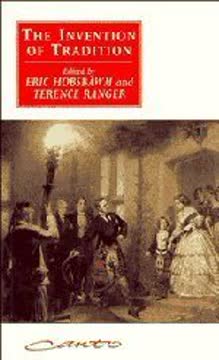
The Invention of Tradition, edited by Eric Hobsbawm and Terence Ranger, examines how many supposedly ancient traditions were actually invented relatively recently. The collection of essays explores British monarchy ceremonies, Scottish kilts and tartans, Welsh cultural symbols, and colonial traditions in India and Africa. Reviews praise Hobsbawm's accessible theoretical framework explaining how traditions emerge during rapid social change to create cohesion and legitimize authority. While some find certain chapters dry or overly specific to British history, most appreciate the book's eye-opening analysis of how societies construct their cultural identities and pasts.
Similar Books