

Key Takeaways
Stop treating the plough and state as humanity's inevitable upgrade
Progress was no straight road. The familiar story says farming made people healthier, more settled, and more civilized, with states arising naturally from villages. Scott’s archaeological account unsettles that sequence. People lived in settled communities before relying on domesticated crops, and crops were cultivated for millennia before states appeared. Hunting and gathering could offer varied diets, good health, and substantial leisure. Farming often demanded more labor and produced poorer health, especially in its early forms.
Choices stayed reversible. Communities shifted among foraging, herding, and cultivation as conditions changed. Some adopted crops gradually; others moved away from farming when it made sense. This history does not prove that mobile life was always preferable. It does show that sedentism, farming, and state rule were neither inevitable nor universally desired.
What's striking is how much the story changes when evidence of bodily health and daily labor is placed beside familiar markers of civilization, such as cities and writing. The comparison also cautions against measuring well-being by food output or population density alone. Modern societies often mistake administrative growth for human improvement in the same way. Still, archaeological remains cannot tell the whole story of satisfaction, security, or freedom, and conditions varied greatly across regions. The strongest conclusion is not that farming was a mistake, but that its costs deserve equal attention with its capacity to support larger populations.
Fire began remaking ecosystems long before fields or governments appeared
The first landscape tool. Hominids used fire hundreds of thousands of years before agriculture. Burning cleared old growth, encouraged useful plants, and drew grazing animals toward fresh vegetation. It could also help hunters drive prey into traps or off cliffs. Over generations, these practices changed the distribution of plants and animals, making food more predictable and often closer to camp.
Cooking changed the eater. Fire made many foods easier to digest, including hard seeds and fibrous plants. The book links cooking with human changes such as smaller teeth and guts, and the capacity to support a larger brain. Scott uses the term “niche construction” for organisms changing their environment in ways that shape the conditions of life. Farming, in this view, continued a long process of environmental management rather than beginning it.
This account expands environmental history beyond the dramatic technologies that leave obvious monuments. Repeated small interventions can reshape habitats just as surely as a dam or a bulldozer, only over a longer timescale. The idea also complicates the boundary between “natural” and “human-made” landscapes. Yet fire’s effects depended on local ecology, and not every burned landscape was deliberately engineered for human use. The careful point is that human influence predates agriculture, not that ancient people controlled ecosystems with modern precision.
Wetland abundance made early towns possible without making them states
Water brought people together. In southern Mesopotamia, rising sea levels created extensive wetlands around the Tigris and Euphrates delta. From settlements on slightly raised ground, people could draw on fish, birds, turtles, reeds, edible plants, and seasonal game. Some early towns grew to thousands of inhabitants without depending mainly on cultivated grain. Waterways also made travel and trade easier.
Abundance resisted control. A wetland offered many kinds of food, each with its own season and location. That diversity made communities resilient, but it also made their production difficult for a central authority to measure or seize. These settlements predated the first Mesopotamian states by millennia. Scott’s point is not that wetlands prevented political hierarchy everywhere, but that dense settlement alone did not automatically produce a state.
The wetland case is a useful corrective to theories that treat population concentration as a sufficient explanation for government. Ecological diversity can sustain large communities while making centralized accounting difficult. In that sense, resilience and governability may pull in opposite directions: a varied livelihood portfolio buffers shocks but frustrates simple systems of assessment. The reconstruction of ancient wetlands is necessarily indirect, however, drawing on landscape and archaeological evidence. It should be read as a compelling regional explanation, not a universal rule about how towns or states begin.
Farming domesticated people too, narrowing diets, routines, and daily attention
The household remade life. Scott calls the cluster of home, fields, stores, people, and animals the “domus.” Cultivated plants and penned livestock changed through human selection, but they also required humans to weed, guard, harvest, and feed them. A farmer’s year became organized around a few crops and their schedules. By contrast, foragers drew on many food sources and followed a wider range of seasonal rhythms.
Bodies record the work. Skeletal remains of early farmers show signs associated with repetitive labor and nutritional stress. Scott notes the characteristic strain on women’s knees and toes from long hours processing grain. He suggests that settled people may also have undergone forms of biological and behavioral adaptation, but marks this human “self-domestication” idea as speculative. The strongest evidence concerns changed work, diet, and bodily wear.
The concept of domestication becomes more revealing when it includes the routines that plants and animals impose on their caretakers. A crop can be an asset and a demanding schedule at once. This resembles a broader feature of technology: tools create new dependencies even as they solve old problems. The analogy between humans and domesticated animals is suggestive, but it must not flatten the differences between biological adaptation and social coercion. Scott’s evidence supports changes in labor and health more firmly than claims about altered human temperament.
Cereal grains gave rulers a harvest they could count, store, and seize
Some crops suit administration. Wheat, barley, rice, millet, and maize grow above ground and can ripen in a relatively concentrated period. Their small, divisible grains are easy to measure, store, transport, and distribute as rations. Those traits made them unusually convenient for taxation. Legumes often ripen over a longer period, while tubers can remain underground, making harvests harder to assess and appropriate.
Grain enabled a state, not certainty. A tax authority could estimate fields and yields, then collect a share of the harvest. Writing and record keeping helped officials track land, labor, and supplies. But grain and fertile soil did not automatically create a state. Scott treats them as conditions that made state formation possible, while emphasizing that early governments still had to assemble and hold a population able to produce the surplus.
This is a powerful example of how material properties shape political possibilities. A crop’s visibility, timing, and storability can matter as much to government as its nutritional value. The same principle applies whenever institutions favor what can be counted and standardized. But this argument does not mean that grains mechanically produce states. Geography, conflict, and political organization also matter, and rulers could tax people or trade goods by other means. Grain explains a recurring advantage of early agrarian states, not a universal law of political development.
Early states built populations through coercion, not just the promise of order
Manpower was state wealth. Early governments needed people to grow grain, build walls and canals, serve in armies, and work in workshops. They drew on forms of unfree labor including war captives, debt bondage, forced resettlement, and compulsory service. The state’s need to retain cultivators also helps explain legal efforts to punish runaways.
Captives filled strategic roles. In Uruk, textile workshops may have employed as many as nine thousand women, a striking share of the city’s estimated population. Captives and other dependent workers also performed dangerous or degrading tasks. The scale and legal status of these workers remain debated, and Mesopotamian labor systems did not simply duplicate the later slave societies of Greece or Rome. Scott’s central claim is that coercion was integral to early state building, not an incidental exception to it.
The emphasis on coercion corrects accounts that explain state formation mainly through protection or shared benefits. A government’s ability to mobilize labor reveals who gains from the surplus and who bears its costs. The comparison with domestication is provocative because both projects involve control over reproduction and work, though human bondage is not reducible to animal management. The evidence also varies by place and period. Estimates of labor forces and categories such as “slave” are uncertain, so the argument is strongest as a challenge to idealized narratives, not as a single template for every early state.
Crowding made grain settlements disease incubators, despite farmers’ fertility advantage
A new disease environment. Settled communities brought people, livestock, crops, waste, and parasites into close contact. This created opportunities for infections to spread and for animal diseases to cross into human populations. Larger towns and expanding trade connected previously separated pools of pathogens. Epidemics may help explain some sudden abandonments of early settlements, although evidence from periods before written records is difficult to establish.
More births offset more deaths. Early farmers often faced poorer health and high infant and maternal mortality than foragers. Yet sedentism and a grain-based diet could support more frequent childbearing and earlier weaning. The book contrasts a world population of roughly four million around 10,000 BCE with about five million around 5,000 BCE, followed by much faster growth. The demographic success of farming did not mean that individual farmers were healthier.
The key distinction is between population-level success and individual well-being. A system can expand because it produces enough surviving descendants, even while exposing people to chronic illness and high mortality. That distinction remains essential in public health, where averages can obscure who carries the burden. The historical disease argument is plausible but partly inferential: pathogens often leave no clear trace in bones, and sudden settlement abandonment has multiple possible causes. Scott’s restraint about the evidence matters as much as the epidemiological hypothesis itself.
Read collapse as possible escape and dispersal, not automatic civilizational ruin
The center is not the whole society. When a palace or city emptied, populations might scatter into villages or return to more mobile livelihoods. Monumental construction and written records could disappear without the people or their culture disappearing. What later historians call a “dark age” may describe the loss of a centralized court more than a collapse in everyday life.
States carried their own risks. Crop failure, disease, warfare, deforestation, silted waterways, and soil salinization could weaken a settlement or government. Taxes and forced labor could also push subjects to flee. Some collapses were catastrophic, and others may have improved life for people escaping an oppressive center. The word “collapse” should therefore prompt questions about what changed, who suffered, and who benefited.
This reframing separates the fate of governing institutions from the fate of the people they govern. It also challenges the habit of treating scale and centralization as synonyms for social progress. In systems thinking, decentralization can be a form of resilience when a central node fails, although it may also reduce coordination and access to shared resources. The book’s invitation to reconsider collapse is not a claim that every breakdown is liberating. The effects must be reconstructed from evidence about mortality, settlement, health, and daily life.
Nonstate peoples made states trading partners, prey, or places to flee
“Barbarian” was a political label. It described people outside a state’s administration, not a single culture or stage of human development. Foragers, herders, and other mobile communities traded with states, raided them, or avoided their taxes and conscription. Some people moved out of state territory to escape disease, labor demands, or political oppression.
The frontier was an economy. Settled states offered concentrated stores of grain, livestock, and goods. Mobile groups could raid these stores, demand payments for protection, or trade raw materials and services. As trade expanded, the surrounding regions became valuable markets rather than empty margins. Scott calls the long period before state control became widespread a “golden age” for nonstate peoples, while acknowledging that raiding, slavery, and mercenary service also harmed them.
The most useful shift here is from seeing frontiers as empty space to seeing them as active political and economic zones. States and mobile peoples shaped one another through commerce, conflict, and migration. That perspective also questions archives that preserve rulers’ anxieties more clearly than the choices of people beyond their reach. The phrase “golden age” remains deliberately provocative: life outside a state could offer mobility and autonomy, but also insecurity and exposure to predation. The contrast is not civilization versus chaos, but competing ways of organizing livelihood and power.
Analysis
Scott’s argument is strongest as a change of vantage point. Rather than beginning with the state’s monuments and records, he begins with the ecological conditions that made concentrated settlement possible, then asks what those conditions cost and whom they served. This method exposes a basic asymmetry in the historical record: states produce durable buildings, archives, and official accounts, while mobile people and decentralized communities leave fewer traces. The resulting visibility of states can be mistaken for their historical dominance.
The book’s most important distinctions are between settlement and agriculture, agriculture and state formation, and state collapse and social collapse. Each interrupts a convenient evolutionary sequence. Wetland communities show that sedentism could precede intensive grain farming. The long delay before the first Mesopotamian states shows that cultivation alone did not make state rule inevitable. The possibility that people dispersed after a state failed shows why political centralization cannot serve as a proxy for welfare.
The grain argument supplies a concrete mechanism connecting ecology to administration. Crops that are visible, harvestable at once, measurable, and storable are easier for rulers to tax. That is more illuminating than treating the state as an abstract invention, but it should be understood as an advantage rather than a universal cause. Geography, violence, labor systems, and contingency remain essential to explaining why particular states formed.
Scott is careful to distinguish evidence from conjecture, especially concerning prehistoric epidemics and human self-domestication. That caution is necessary: the absence of direct records makes some of the most consequential claims difficult to test. The broader lesson is methodological. Historical explanations should not simply reproduce the categories of the most powerful institutions in the archive. They should ask what those institutions made visible, what they obscured, and whether the people described as primitive or disorderly were making rational choices about the costs of rule.
Review Summary
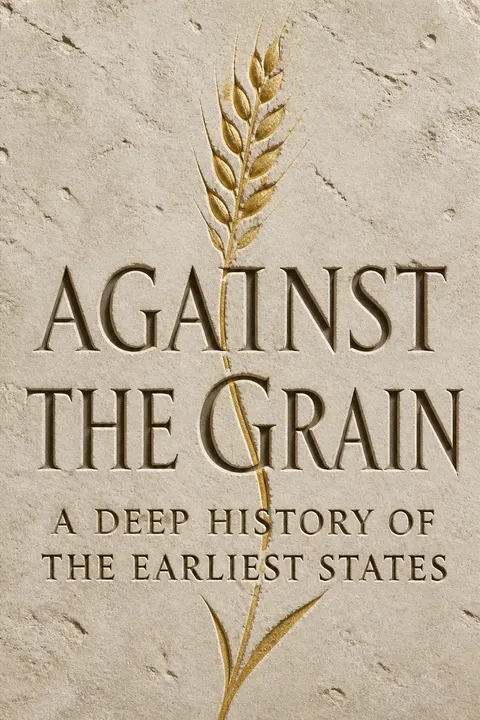
Against the Grain challenges conventional narratives about early state formation and civilization. Scott argues that sedentary communities and agriculture predated states by millennia, and that early states were fragile, reliant on grain cultivation and slave labor. He posits that non-state "barbarians" often led healthier lives than their state-dwelling counterparts. The book explores themes of domestication, taxation, and the relationship between states and surrounding populations. While some reviewers praise its insights, others criticize its repetitiveness and potential ideological bias.
People Also Read





Glossary
thin Anthropocene
Early human environmental influenceScott’s term for the long, early phase of human influence on the planet, beginning with the use of fire and continuing through land clearing, cultivation, and grazing. It contrasts with the more recent, intensified environmental impact associated with industrial society and fossil fuels.
niche construction
Organisms reshaping their habitatsA biological concept used in the book for organisms altering their surroundings in ways that affect the resources and conditions available to themselves and other species. Human examples include using fire to change vegetation and animal distributions, and modifying landscapes to support preferred foods.
domus
Household and its managed landscapeScott uses the Latin term for home to describe a wider ecological and social complex: houses, fields, stored food, people, livestock, and the organisms drawn to them. The domus became a concentrated environment where crops and animals were managed, and where new patterns of work, health, and dependency developed.
late-Neolithic multispecies resettlement camp
Crowded human and animal settlementScott’s description of early settled communities as unprecedented concentrations of people, domesticated animals, crops, and accompanying organisms. The phrase emphasizes that the Neolithic was not simply a human settlement change. It assembled multiple species in close contact, creating new ecological relationships and opportunities for disease transmission.
low-level food production
Limited use of domesticated foodsA term used by archaeologists for long periods when people cultivated plants or kept animals without making them the basis of a fully agricultural economy. Scott stresses that this pattern could be stable and deliberate: communities continued to combine domesticates with hunting, gathering, and other livelihoods rather than advancing automatically toward intensive farming.
secondary primitivism
Leaving state life for the peripheryThe process by which people who have lived under state rule move beyond its reach and adopt or return to mobile, less administratively visible ways of life. Scott uses the term to challenge the idea that all nonstate peoples were untouched holdovers from an earlier stage; some were refugees from state taxes, coercion, warfare, or disease.
FAQ
What is [Against the Grain: A Deep History of the Earliest States] by James C. Scott about?
- Deep history of early states: The book explores the origins, development, and fragility of the earliest agrarian states, focusing on how they formed around grain agriculture and population control.
- Challenges traditional narratives: Scott questions the idea that state formation was a natural or beneficial progression, highlighting the coercive and unstable nature of early states.
- Interdisciplinary synthesis: Drawing on archaeology, anthropology, history, and ecology, Scott connects diverse fields to provide a new perspective on state formation and its consequences.
Why should I read [Against the Grain] by James C. Scott?
- Revises common historical narratives: The book overturns the belief that agriculture and states naturally improved human well-being, showing that early states often exploited and harmed their populations.
- Insight into power and resistance: Scott offers a nuanced view of the relationship between states and nonstate peoples, revealing the complexities of freedom, coercion, and survival.
- Relevance to modern issues: By examining themes like coercion, environmental degradation, and social stratification, the book provides insights that resonate with contemporary political and social dynamics.
What are the key takeaways from [Against the Grain] by James C. Scott?
- Sedentism before domestication: Sedentary life and towns existed long before the domestication of plants and animals and the rise of states.
- States relied on coercion: Early states depended on forced labor, slavery, and tribute to produce surplus and maintain power.
- Fragility and collapse: Early states were vulnerable to ecological, epidemiological, and political pressures, often collapsing and fragmenting into smaller units.
- Life outside states: Nonstate peoples often enjoyed more freedom, better health, and diverse subsistence strategies compared to those within states.
What are the best quotes from [Against the Grain] by James C. Scott and what do they mean?
- "No slavery, no state": This quote underscores Scott's argument that early states fundamentally depended on various forms of bondage to function and survive.
- "Domestication as niche construction": Scott expands the concept of domestication to include humans shaping and being shaped by their environments, not just plants and animals.
- "Collapse as disassembly": He reframes state collapse as a process that often improved human welfare, rather than a tragic end, by dispersing populations and reducing coercion.
How does [Against the Grain] by James C. Scott challenge traditional views of state formation and agriculture?
- Sedentism predates agriculture: Scott shows that people lived in settled communities long before they domesticated plants and animals, challenging the idea that agriculture led directly to states.
- States as coercive, not progressive: He argues that early states were fragile, coercive, and often detrimental to the majority, rather than inevitable or beneficial.
- Dark ages reconsidered: The book suggests that periods of state collapse may have improved human welfare, contrary to the common view of "dark ages" as purely negative.
What is James C. Scott’s definition of domestication in [Against the Grain]?
- Broad concept of domestication: Scott defines domestication as an ongoing human effort to shape environments, including the use of fire, landscape modification, and the management of plants, animals, and even humans.
- Multispecies resettlement: Early villages were complex ecosystems involving humans, animals, plants, commensals, and parasites, all co-evolving.
- Humans as domesticated: He argues that humans themselves were domesticated by sedentism, crowding, and dietary changes, leading to physical and behavioral shifts.
What role did fire play in early human history according to [Against the Grain] by James C. Scott?
- Fire as a tool: Fire was humanity’s oldest and most powerful tool for reshaping landscapes, encouraging useful plants, and attracting prey.
- Enabled sedentism: The use of fire concentrated food resources, making it possible for humans to settle in previously inhospitable environments.
- Cooking and evolution: Cooking with fire made food more digestible and nutritious, contributing to human brain development and smaller digestive tracts.
Why did early states form only millennia after domestication and sedentism, according to [Against the Grain]?
- Long lag explained: Sedentism and domestication existed for thousands of years before states because people had diverse subsistence options and mobility, resisting full agricultural dependence.
- Ecological concentration required: States arose only where ecological conditions allowed dense, concentrated grain production and population.
- States needed taxable staples: Only cereal grains provided a measurable, storable, and divisible tax base suitable for state appropriation.
How did early states produce surplus and maintain power according to [Against the Grain] by James C. Scott?
- Surplus through coercion: Surplus production was not automatic; it required forced labor systems like slavery, debt bondage, and tribute to compel peasants to produce beyond subsistence.
- Control of the grain core: States held peasants in fertile core areas and prevented escape to maintain a steady labor supply.
- Replacement strategies: States waged wars, purchased slaves, and forcibly resettled communities to replenish their labor force.
What role did slavery and bondage play in early states as explained in [Against the Grain]?
- Central to state economies: Slavery and various forms of bondage were essential for producing surplus and maintaining state power.
- Labor for onerous tasks: Slaves and captives performed the most dangerous and degrading work, sparing free subjects and elites.
- War captives as resources: Captives were valued for their labor and reproductive potential, helping to sustain and grow the state's population.
Why were early states fragile and prone to collapse according to [Against the Grain] by James C. Scott?
- Ecological vulnerabilities: Dependence on a single annual cereal harvest made states susceptible to drought, flood, pests, and soil degradation.
- Epidemics and disease: High population density and close contact with animals facilitated the spread of infectious diseases, undermining state stability.
- Political and social pressures: Overexploitation of core populations risked provoking flight, rebellion, or depopulation, leading to cycles of collapse and decentralization.
How does [Against the Grain] by James C. Scott describe the relationship between early states and "barbarians"?
- Barbarians as nonstate peoples: These groups lived outside state control, practicing hunting, foraging, pastoralism, and shifting cultivation.
- Mutual dependence and conflict: States relied on barbarians for trade and raw materials, while barbarians raided states for plunder and slaves.
- Barbarians limited state growth: Their mobility and military pressure constrained state expansion and contributed to cycles of state collapse and decentralization.
- Golden age of barbarians: There was a long period when barbarians thrived by exploiting state wealth through raiding, trade, and protection rackets, often enjoying greater freedom and well-being.
About the Author


Download PDF
Download EPUB
.epub digital book format is ideal for reading ebooks on phones, tablets, and e-readers.








