

Key Takeaways
Treat 1177 BC as a warning marker, not civilization’s exact expiration date
A dramatic benchmark. In 1177 BC, during the eighth year of Pharaoh Ramses III, Egyptian forces defeated an attack by several groups later called the Sea Peoples. The battle gives the book its title and a vivid focal point, but it was not the single instant when the Bronze Age ended. Many cities had already been damaged or destroyed, and some places fell decades afterward, around 1130 BC.
A rolling breakdown. The decisive transition unfolded across years and regions. By using 1177 as a reference point, Cline turns a sprawling process into a story readers can follow, while stressing that the date is shorthand rather than a precise timestamp for the end of an entire world.
A memorable date can make a complicated historical process legible, much as a financial crisis is often attached to one recognizable day. The danger is that a vivid marker can become a false cause: readers may mistake the Egyptian battle for the event that toppled every neighboring kingdom. Cline’s distinction between a benchmark and a boundary is therefore essential. Historical timelines are useful maps, but maps simplify uneven terrain. The dates of collapse varied by site, and the evidence does not support one synchronized ending.
Interdependence made Bronze Age prosperity powerful, then made failure contagious
A connected world. For centuries, Egyptian, Hittite, Mycenaean, Minoan, Cypriot, Babylonian, Assyrian, and Canaanite rulers traded, negotiated, exchanged gifts, and married across borders. The Uluburun shipwreck, carrying goods from at least seven regions, makes those connections tangible. Tin, copper, timber, glass, food, and luxury goods moved through networks spanning great distances.
Shared exposure. These contacts brought wealth and access to scarce resources, but also tied local fortunes to distant events. A disruption in shipping, political relations, or access to materials could affect production and power far from its source. Cline argues that the same connections that enabled a flourishing international system also gave crises ways to spread through it.
The central paradox is not that connection is inherently dangerous, but that efficiency can hide dependence. A palace system able to obtain scarce metals from far away may flourish while routes remain open, yet have few substitutes when they fail. This is a useful distinction between connectivity and resilience: a network can be highly connected but poorly equipped to absorb shocks. The book’s analogy to modern globalization is suggestive, not exact. Bronze Age rulers lacked today’s institutions and technologies, so the comparison illuminates structure, not equivalence.
Stop blaming the Sea Peoples for every burned city
A convenient culprit. Egyptian records describe several foreign groups attacking in 1207 and again in 1177 BC. The groups had different names, clothing, and possible origins, and their motives remain uncertain. Some may have sought plunder; others may have been displaced people looking for new homes. Ramses III’s inscriptions celebrate Egyptian victory, but they are the claims of a victorious ruler, not a neutral account of every regional disaster.
Victims as well as attackers. Cline argues that the Sea Peoples may have been pushed from their own homes by upheaval and then encountered kingdoms already weakened by other pressures. They likely caused some destruction, but the evidence does not make them the sole cause of the collapse or even identify them as the destroyers at every site.
The label “Sea Peoples” compresses multiple groups into one dramatic character, which makes a complicated history easier to tell and easier to misread. Treating them as a single invading force risks reproducing the perspective of the Egyptian state that recorded its battles with them. The more careful interpretation allows for overlapping roles: migrants, raiders, settlers, or opportunists, depending on the group and place. That flexibility is not a claim that they were harmless. It is a reminder that the same population can be fleeing danger in one context and creating it in another.
Read destruction layers as evidence of damage, not proof of a culprit
What ruins establish. Excavation can reveal that a building burned, a city was abandoned, or bodies were trapped beneath collapsed walls. It does not automatically identify who caused the destruction. At Troy, for example, evidence supports destruction by fire and fighting in the later settlement, but the identity of the attackers remains uncertain. At Hattusa, the Hittite capital far inland, public buildings burned, yet the city’s longtime enemies, the Kashka, may be more plausible attackers than seaborne raiders.
Clues need context. Archaeologists compare weapons, damage patterns, written records, and the dates of objects found in secure layers. Even then, competing explanations can remain. Earlier scholarship often assigned destruction to the Sea Peoples before sites had been excavated, showing how an attractive theory can outrun its evidence.
This is a lesson in causal inference as much as archaeology. A burned building is an observation; “an invading people burned it” is an explanation. Moving from the first to the second requires evidence that excludes alternatives such as earthquake, internal conflict, or abandonment followed by later damage. Archaeology often faces equifinality, where different causes produce similar traces. The book’s restraint is valuable because it preserves uncertainty without pretending that all explanations are equally likely. Strong historical reasoning ranks possibilities while keeping the gap between evidence and conclusion visible.
Follow the cargo: one ship reveals a connected Bronze Age world
A floating archive. Around 1300 BC, the Uluburun ship sank off the coast of Turkey. Its cargo included more than 350 copper ingots, nearly a ton of tin, glass, resin, storage jars, ivory, and objects from at least seven regions. The tin may have traveled from Afghanistan; the copper came from Cyprus. The mixture suggests a vessel carrying valuable materials westward toward the Aegean, though its owner and destination are unknown.
Trade beyond the palace. The ship could have been a merchant’s venture, a royal delivery, or a purchasing expedition. Its cargo cannot settle that question, but it proves that people and goods crossed political boundaries on a substantial scale. Even the fragment of a writing tablet aboard hints at records that might once have revealed the ship’s route, but its writing surface did not survive.
Shipwrecks preserve an unusually vivid cross-section of exchange because a single accident freezes goods from different places together. That makes the Uluburun wreck a powerful corrective to histories built only from royal inscriptions, which tend to foreground rulers and military claims. Its cargo points toward the people who moved materials, not just the elites who received them. Yet one wreck is still a snapshot, not a complete trade map. Its exceptional preservation can reveal what usually disappears, but it cannot tell exactly how common this particular voyage was.
See diplomacy as trade conducted through gifts, marriages, and status
Kinship as statecraft. In the Amarna Letters, rulers address one another as “brother,” “father,” or “son,” whether or not they were truly related. These terms helped establish rank and trust among kings. Gifts of gold, chariots, horses, jewelry, and other goods accompanied messages and royal marriages, which could cement political agreements. Amenhotep III married princesses from several neighboring kingdoms, strengthening ties through family connections.
Ceremony had an economic edge. The exchanges were not always smooth. Babylonian kings complained that Egyptian gold shipments contained far less real gold than promised, and royal messengers’ caravans could be robbed. Beneath formal greetings and grand gifts lay practical concerns about resources, delivery, and reliable partners. Diplomacy was both relationship-building and bargaining, with status shaping what could be asked and expected.
The letters reveal that political relationships are not merely decorative language placed around economic transactions. Kinship terms helped define obligations, while marriage and gifts created channels through which rulers could negotiate access and influence. This resembles a broader principle of institutional life: trust is often built through repeated, visible exchanges rather than abstract promises alone. But ceremony did not eliminate opportunism. Complaints about diluted gold and stolen goods show that even a royal relationship needed verification and enforcement. Symbolic closeness could support cooperation without guaranteeing it.
When shocks converge, a resilient network can become a brittle system
Several pressures at once. The evidence points to earthquakes, drought, famine, warfare, political unrest, and interrupted trade during the period of collapse. A series of earthquakes, sometimes called an earthquake storm, affected parts of the Aegean and Eastern Mediterranean from about 1225 to 1175 BC. Texts also describe urgent requests for grain, while scientific studies discussed in the book suggest prolonged dry conditions in coastal Syria and Cyprus.
A multiplier, not a single trigger. None of these pressures alone convincingly explains why so many kingdoms failed. Together, however, they could magnify one another. Drought could reduce harvests; famine could increase unrest; warfare could disrupt trade; and lost supplies could weaken the authorities expected to respond. Cline presents this interacting sequence as a possible systems collapse, while acknowledging that the precise causal links remain uncertain.
The strongest version of the argument is not that every factor affected every place equally, but that several stressors could interact with existing vulnerabilities. Systems thinking helps explain why a succession of manageable disturbances can become a crisis when institutions have little slack. It also discourages the tidy search for one villain or trigger. The caution is that interaction can become an all-purpose explanation if each uncertain factor is simply added to the list. The argument is most persuasive where independent evidence connects a stressor to a specific local consequence.
Track the slow aftermath, not just the dramatic collapse
A world dismantled. The fall of palaces meant more than damaged buildings. In parts of Greece, palace administrations and Linear B writing disappeared; in the Levant, cuneiform writing also ceased. Centralized economies and elite institutions gave way to smaller political communities. Some places recovered more quickly than others, while regions such as Pylos remained severely depopulated for generations.
Not simply a dark age. The label “Dark Age” can obscure what followed. The collapse opened space for new political arrangements and for peoples such as the Phoenicians, Philistines, and Israelites to shape the region. The transition was uneven, and it took centuries for some societies to rebuild. The new order did not restore the old system; it developed from its ruins and carried forward selected practices, materials, and ideas.
A collapse is not a single event with a single aftermath. Institutions, writing, population, and trade can disappear at different speeds, while local communities preserve knowledge or adapt it to new conditions. This distinction helps avoid two extremes: imagining total erasure, or assuming that continuity means nothing important changed. Calling the period dark mainly describes the limited surviving records and the loss of palace systems, not an absence of human innovation. Recovery should be measured by the institutions and lives people rebuilt, not by whether the old capitals returned.
Treat new cultural styles as evidence of contact, not automatic proof of conquest
Cultures mixed. After the upheavals, new pottery, architecture, and domestic practices appeared in places such as Cyprus and Canaan. These changes have sometimes been interpreted as proof that foreign invaders displaced local populations. Cline presents a more complicated possibility: migrants from the Aegean and elsewhere may have settled alongside local people, exchanging and adapting customs. At Ashkelon, for example, new cultural patterns appeared without clear evidence of a violent takeover.
Objects do not equal identities. Aegean-style pottery can show influence or contact, but it does not by itself establish where its makers were born or who ruled a settlement. Some new communities combined local and foreign practices. This makes the post-collapse landscape less like a map divided between invaders and victims, and more like a series of local encounters shaped by migration, trade, and changing political power.
Material culture is evidence of practice, not a passport. A vessel can be imported, copied locally, or made by a migrant working within a new community. Treating style as a direct marker of ethnicity can therefore turn cultural influence into a simplistic story of replacement. The book’s emphasis on hybrid communities offers a more realistic account of how migration often works: newcomers and established residents shape one another’s habits. Still, peaceful adaptation at one site cannot establish what happened everywhere. Local evidence needs local interpretation, especially when written accounts are sparse.
Analysis
Cline’s book works as both a historical narrative and an investigation into an unresolved cause. It begins with Ramses III’s confrontation with the Sea Peoples, then rewinds through the centuries that created the Late Bronze Age’s interdependent political and commercial world. That structure matters: the reader first encounters the apparent catastrophe, then discovers that the world under threat was already a dense network of rival powers, diplomatic ties, and material dependencies.
The book’s most durable contribution is its refusal to treat the Sea Peoples as a complete explanation. Egyptian royal inscriptions provide vivid testimony to invasion and victory, but they are not neutral reports, and archaeological destruction cannot identify its perpetrator on its own. Cline repeatedly separates what is visible, such as burned buildings or abandoned cities, from what remains hypothetical, such as the identity and motives of attackers. This makes uncertainty part of the account rather than a defect to be hidden.
The proposed explanation is cumulative. Earthquakes, drought, famine, warfare, rebellion, and disrupted trade may have reinforced one another, weakening political systems already dependent on centralized institutions and long-distance exchange. The systems-collapse model captures that interaction, but it does not deliver a settled chain of causes. The evidence varies by region, chronology is contested, and some proposed links remain speculative. Its value is therefore explanatory rather than conclusive: it offers a way to understand how multiple pressures could exceed the capacity of connected societies to adapt.
The modern parallel is most useful at the level of structure. Global networks can spread prosperity and transmit shocks, but the Bronze Age was not simply an earlier version of today’s economy. Its technologies, institutions, and scale differed profoundly. The comparison should sharpen questions about dependence and resilience, not imply that history repeats mechanically. The aftermath also complicates the word collapse. Palace states and writing systems vanished in some regions, while new communities and cultural combinations emerged elsewhere. The old order ended, but human life did not stop; it reorganized unevenly around what remained.
Review Summary
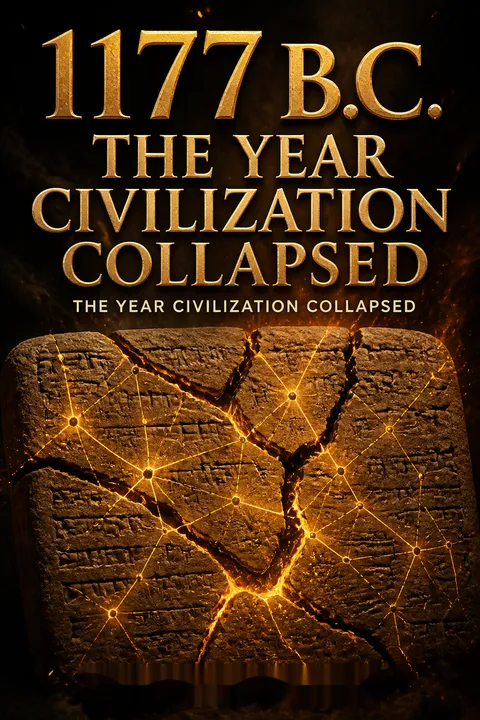
1177 B.C.: The Year Civilization Collapsed by Eric H. Cline examines the Late Bronze Age collapse around 1200 BCE in the Eastern Mediterranean. Reviews are mixed: many appreciate Cline's scholarly rigor and detailed synthesis of archaeological evidence, while others criticize the misleading title and packaging, noting the collapse took decades, not a single year. Readers praise the book's examination of interconnected Bronze Age civilizations and the "perfect storm" theory—combining drought, earthquakes, Sea Peoples invasions, and systems collapse—but some find it repetitive, overly detailed, or lacking narrative coherence for general audiences.
People Also Read


Glossary
Sea Peoples
Egyptian name for migrant groupsA modern collective label for several groups named in Egyptian records as attacking Egypt and other Eastern Mediterranean territories around 1207 and 1177 BC. The groups had different names, and their origins, motives, and relationships remain uncertain. They may have included raiders, migrants, refugees, or settlers, and should not be assumed to have caused every destruction attributed to them.
earthquake storm
A sequence of related earthquakesA prolonged sequence of earthquakes along a seismic fault, with pressure released through repeated events over years or decades. Cline discusses evidence for such a sequence affecting parts of the Aegean and Eastern Mediterranean between roughly 1225 and 1175 BC. The earthquakes damaged settlements, but the book argues that they alone cannot explain the broad regional collapse.
systems collapse
Breakdown of linked institutionsA process in which failures in central administration, elite authority, and a centralized economy combine with settlement shifts or population loss. In Cline’s account, it describes how connected Bronze Age societies may have been overwhelmed by interacting pressures rather than one decisive cause. The term frames a pattern of breakdown, not a proven, exact sequence of events.
complexity theory
Study of interacting systemsAn approach to understanding how many interacting parts can produce outcomes that are difficult to predict from any one part alone. Cline applies it cautiously to Late Bronze Age kingdoms and trade networks, which could be affected by distant events and internal changes. The framework helps describe nonlinear, interacting pressures, but the available evidence cannot establish every link in the system.
Amarna Letters
Royal diplomatic correspondenceA collection of nearly four hundred clay tablets found at the Egyptian site of Amarna, the capital built by Akhenaten. Written largely in Akkadian, the diplomatic language of the period, they record exchanges between Egyptian pharaohs and rulers or governors across the Near East. Their contents reveal alliances, requests, royal gifts, marriages, disputes, and the language of status between rulers.
Linear B
Early written form of GreekA script used by the Mycenaeans to record palace administration. Its clay tablets document aspects of palace economies and organization, but the surviving records are usually only those accidentally preserved when fires baked the tablets. Following the decline of the Mycenaean palaces, the use of Linear B and the administrative system it served disappeared in Greece.
hyper-coherence
Excessive system interdependenceA condition in which parts of a system become so dependent on one another that change in one part can destabilize the whole. Cline uses the concept to frame the danger in highly interconnected Late Bronze Age trade and political networks. It suggests that connections can transmit disruption as well as goods, although the degree of dependence varied among kingdoms.
About the Author
Other books by Eric H. Cline
Download PDF
Download EPUB
.epub digital book format is ideal for reading ebooks on phones, tablets, and e-readers.








