

Key Takeaways
Treat salt, fat, acid, and heat as your kitchen compass
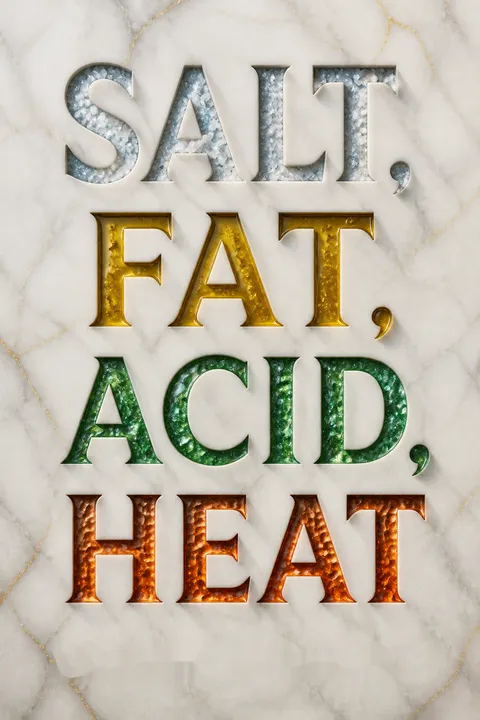
Four forces shape flavor. Salt strengthens and clarifies flavor. Fat carries aroma and creates richness. Acid offsets heaviness and sweetness. Heat changes texture and builds browned flavors. Nosrat arrived at this map while cooking at Chez Panisse, where menus changed daily and cooks often worked without recipes. As a novice, she wondered how they knew what to do. Then a pot of polenta transformed when her mentor added far more salt than she expected. The corn tasted sweeter, the butter richer, and the puzzle of good cooking began to seem less mysterious.
A guide, not a formula. The four elements offer questions to ask of any dish: Does it need more seasoning, richness, brightness, or a different cooking method? They apply across cuisines, but traditions and ingredients determine the answers. A Persian stew and a Tuscan pasta may use different ingredients, yet both depend on the same underlying decisions.
What's useful about the compass is that it turns a vague judgment, such as a dish tasting flat, into a set of concrete possibilities. It also keeps technique connected to eating: a method matters because of the flavor or texture it creates. The framework is most persuasive as a diagnostic tool, not a complete theory of cuisine. Ingredient quality, tradition, and personal preference still shape what counts as balance. Nosrat's own story makes the point: the principles helped her navigate unfamiliar kitchens, but apprenticeship and repeated tasting gave those principles practical meaning.
Salt early enough to season meat from the inside
Time does the traveling. Salt draws water to a food's surface, then gradually moves inward through diffusion, the spread of a substance from a more concentrated area to a less concentrated one. On meat, this means a modest amount applied hours ahead can season more evenly than a larger amount sprinkled on at the end. Nosrat recommends salting large cuts the day before when possible. A chicken can be salted overnight; a large turkey may need two or three days. Fish is different: its delicate texture can suffer from early salting, so most seafood should be seasoned close to cooking.
Taste at every stage. Salt also changes texture, and its effects depend on the ingredient. It helps beans soften, while salt in boiling water seasons vegetables as they cook. The author's starting points are about 1 percent salt by weight for meat, vegetables, and grains, and 2 percent salinity for blanching water. Salt density varies, so tasting remains essential.
The important shift is from measuring salt as a final topping to treating it as an ingredient that needs time to work. That makes planning part of seasoning: salting when groceries arrive can improve dinner without adding effort at the last minute. The distinctions among meat, seafood, vegetables, and beans also discourage one-size-fits-all rules. Ratios can help cooks orient themselves, but salt brands and ingredient sizes vary. The strongest feedback is still the palate, used repeatedly rather than only at the table.
Choose fat for both flavor and the texture you want
Fat has three jobs. It can be a main ingredient, a medium for cooking, or a finishing seasoning. Olive oil in pesto contributes flavor and body; oil in a frying pan transfers intense heat; a final spoonful of butter can enrich a sauce. The fat itself matters: Nosrat recalls a tomato-sauce contest at Chez Panisse where rancid olive oil spoiled otherwise promising entries. Her travels in Italy also showed how local fats shape regional cooking. Northern dishes often lean on butter and dairy, while olive oil anchors many southern and coastal foods.
Match fat to the dish. Choose a neutral oil when fat should not dominate, and a flavorful oil when it should. Butter adds dairy flavor but its milk solids burn at lower heat than many refined oils. Olive oils vary in taste and freshness, so taste before buying and use delicate finishing oils where their character can be noticed.
Fat is often treated as an invisible utility, but this account shows it functioning more like an ingredient with a point of view. It carries aromas, affects mouthfeel, and can steer a dish toward a particular culinary tradition. Thinking about its role first also prevents a common mismatch, such as using a strongly flavored oil where a clean taste is wanted. The cultural map is a useful starting place, not a rigid border. Cooks can learn a cuisine's conventions and still make deliberate substitutions.
Use acid to make rich or sweet food feel alive
Sour is not the whole story. Acid's most useful role is often contrast, not an obvious puckering taste. A drop of vinegar in a carrot soup surprised Nosrat by making the carrots, onions, and butter taste more distinct. Acid can balance sweetness, fat, salt, and starch, and its effect depends on what it meets. A sweet lemonade can remain acidic while tasting balanced because sugar offsets the sourness.
Choose when to add it. Wine or tomatoes added early to a braise are cooking acids: they mellow and shape the dish over time. Lemon juice or vinegar added just before serving are garnishing acids, useful for a final lift. Acid also affects texture. It can keep beans and vegetables firm, so cook them tender before adding acidic ingredients. It dulls green vegetables, making late additions best when vivid color matters.
Acid is especially valuable because it can correct the feeling of a dish without requiring a major change to its ingredients. A rich meal may need a sharper salad or sauce, not less richness in every component. The distinction between early and late additions clarifies why the same ingredient can taste different depending on when it enters the pot. Acid is not a universal fix, however. Its effects on color, texture, and flavor require attention, and a balanced dish need not announce its sourness.
Match heat to the food's tenderness and desired finish
Work backward from the result. Heat is the force that turns raw food into something tender, crisp, or browned. First decide what the finished food should be, then choose a method. Gentle heat suits delicate foods and transforms tough cuts over time. Intense heat creates browning and crisp surfaces. Tough meat often needs both: brown it for flavor, then cook it slowly until its connective tissue softens.
Watch the food, not the dial. Water and steam hold food near the boiling point, delaying browning; overcrowded vegetables trap steam and can turn soggy instead of golden. Nosrat urges cooks to use sensory cues: a steady sizzle suggests a hot pan, while a change in smell can signal browning or burning. A simmer should barely bubble. The target is a cooked interior and an exterior with the texture and color the cook intended.
This approach treats cooking as active observation rather than obedience to a timer. It is particularly helpful because domestic ovens and burners do not behave identically, so visual, aromatic, and tactile evidence can matter more than a prescribed minute count. Working backward from the desired result also makes recipes easier to understand: a step becomes a means to an end, not a ritual. Sensory judgment takes practice, and it does not replace food-safety care or a thermometer when precision is important.
Use fat and temperature to build the texture you want
Texture follows the method. Fat can help create crisp, creamy, flaky, tender, or light foods. Hot fat transfers enough heat to evaporate surface water and brown food. Cold pieces of butter in pastry release steam in the oven, separating layers into flakes. Oil coats flour and limits gluten development, which helps explain why oil cakes tend to be moist and tender.
Keep delicate mixtures together. An emulsion is a mixture in which tiny droplets of one liquid are dispersed through another, as in mayonnaise or vinaigrette. It may separate if ingredients are combined too quickly or handled at the wrong temperature. A broken mayonnaise can often be repaired by whisking it gradually into a fresh base. These examples make texture less mysterious: the cook can choose fat, temperature, and mixing to encourage a result rather than relying on luck.
Texture is not a decorative extra. It changes how a dish is experienced, and often explains why two preparations of the same ingredient feel entirely different. The useful insight is that seemingly fussy details, such as keeping pastry butter cold or adding oil slowly to mayonnaise, protect specific structures. This also helps cooks troubleshoot: a dense cake may reflect poor aeration, while a greasy fried crust may signal inadequate heat. Scientific explanations simplify complex processes, so cooks should use them as practical models rather than expect every kitchen result to follow a perfectly tidy rule.
Taste the dish, not just the recipe
Cooking needs feedback. Nosrat's most repeated instruction is to taste as food changes, then adjust. A recipe cannot know the exact salt, ripeness, pan, or cooking speed in another kitchen. In one kitchen lesson, she made corn custards by carefully following the steps but never tasted the mixture. Her mentor praised the texture and pointed out that the seasoning was weak. The failure taught her that accurate execution cannot replace judgment.
Use recipes as guides. Savory dishes often tolerate substitutions and adjustments; baking is less forgiving because proportions and temperatures drive structure. When learning a dish, compare several recipes to see what is essential and what varies. Then taste components separately and together. A Caesar dressing, for example, balances salty cheese and anchovies with vinegar and lemon. The right seasoning emerges through tasting the whole combination, not by blindly adding a listed amount.
The recipe becomes more useful when treated as an initial hypothesis about how a dish should work. Tasting supplies evidence from the actual ingredients, while adjustment turns that evidence into action. This is a powerful learning loop because it links cause and effect: adding salt, acid, or heat produces a noticeable change. The caution is that not every judgment is immediately reliable. A developing palate needs repeated comparisons and occasional guidance. Following a recipe closely can be a sensible first lesson, especially when technique or food safety is unfamiliar.
Build each meal around an anchor, then balance its contrasts
Start with one decision. Nosrat calls the organizing choice for a meal an anchor. It might be an ingredient already in the refrigerator, a cooking method, a cuisine, a time limit, or a special dish. At Chez Panisse, cooks took stock of the day's ingredients before planning the menu. Home cooks can do the same by shopping for what looks fresh, then deciding how to use it.
Balance the whole plate. A meal needs contrast as well as individually well-seasoned dishes. Pair rich braised meat with a bright slaw, or a creamy main course with a crisp salad. Avoid repeating heaviness, texture, or flavor without a reason. Seasonal ingredients often work naturally together, but restraint still matters: adding every appealing item to one dish can blur its character. A clear anchor gives the meal direction; contrast keeps it lively.
Anchoring makes menu planning manageable because it reduces an open-ended problem to a sequence of choices. It also turns constraints, such as limited oven space or a busy evening, into useful design information. The meal-level perspective is important: a dish can taste balanced alone yet feel exhausting beside several other rich courses. This is a reminder that flavor is relational, shaped by what came before and what appears alongside it. Seasonal pairing can guide choices, but it should support taste rather than become a rule that overrides it.
Master a few cooking patterns, then adapt them to what is fresh
Build a working repertoire. Nosrat organizes recipes around reusable patterns rather than treating every dish as a separate mystery. She groups pasta sauces into five families: cheese, tomato, vegetables, meat, and seafood. Vegetables can be blanched, sautéed, steamy-sautéed, roasted, long-cooked, or grilled. Once a cook understands a method, changing the produce or flavor direction becomes easier.
Change one variable at a time. Make a reliable version of a dish repeatedly, then experiment with a different fat, acid, herb, or cooking method. A cabbage slaw can move toward Mexican, Southern, or Asian flavors through changes to its dressing and additions. The goal is not random substitution. Each ingredient should have a job, and a small repertoire gives cooks enough familiarity to recognize when a change improves the dish.
The book's recipe collection works like a practice curriculum: a few dependable preparations teach patterns that can travel beyond the page. This is more empowering than collecting impressive dishes without understanding their structure. Changing one element at a time also makes experimentation legible, since the cook can notice what caused a change in flavor or texture. The method does not make every cuisine interchangeable. Familiar patterns provide a starting point, while cultural knowledge and respect help prevent a borrowed flavor from becoming a superficial costume.
Analysis
Salt, Fat, Acid, Heat is a cookbook built around a teaching claim: people become capable cooks when they understand why techniques work, not only what steps to follow. Its narrative follows Nosrat from a Persian-American childhood shaped by food, through the disorientation of her first professional kitchen, to the discovery of a compact way to reason across dishes and cuisines. The polenta episode gives that thesis a memorable origin. A startlingly generous addition of salt does not merely make food saltier; it reveals sweetness, richness, and aroma she had not been able to perceive.
The book's greatest strength is its conversion of sensory impressions into decisions. A flat soup suggests testing salt and acid. A wet pan signals trapped steam and poor browning. A tough cut suggests time, moisture, and gentler heat. This is a practical feedback system: observe, adjust, taste, and revise. Recipes then become records of workable approaches rather than commands. The extensive recipe section matters because it lets readers test the principles in actual cooking, from dressing a salad to building a braise.
The four elements are not a literal inventory of everything that makes food good. Ingredient quality, cultural tradition, memory, and technique cannot be reduced to four categories. Nosrat acknowledges this by treating geography and custom as guides to choosing fats, acids, and seasonings. The framework works best as a portable first map, not as a replacement for culinary history or individual taste. Some scientific explanations are intentionally simplified for practical use, and the reader should understand them as models rather than exhaustive accounts. The book's deeper lesson is not that cooking has four magic ingredients. It is that cooks can learn to notice what food needs, understand the likely consequences of a choice, and correct course before serving. That is the route from following directions to developing judgment.
Review Summary
Salt, Fat, Acid, Heat receives mixed reviews, with many praising its innovative approach to cooking fundamentals and engaging writing style. Readers appreciate the focus on understanding core elements rather than just following recipes. Some find it eye-opening and transformative for their cooking, while others feel it's oversimplified or geared towards beginners. The book's illustrations and Nosrat's enthusiasm are widely praised. Critics note repetitive anecdotes and occasional disconnection from everyday home cooking. Overall, it's seen as a valuable resource for developing cooking intuition, particularly for less experienced cooks.
People Also Read


Glossary
Salt, Fat, Acid, and Heat
Four cooking principlesNosrat's organizing framework for making food taste good. Salt amplifies flavor, fat carries flavor and shapes texture, acid balances other tastes, and heat transforms ingredients. The elements are a practical set of questions for choosing ingredients and methods, not a fixed recipe or a claim that every cuisine uses identical proportions.
Seasoning from within
Flavoring food throughoutThe practice of giving salt time and the right conditions to move beyond a food's surface. Salting meat in advance, or cooking vegetables in well-seasoned water, allows salt to distribute through the ingredient. This creates more even flavor than relying only on salt sprinkled on the finished dish.
Diffusion calculus
Planning salt penetrationNosrat's name for considering time, temperature, and water when deciding how salt will move through food. Salt travels more quickly at warmer temperatures and in the presence of water. Dense or large ingredients generally need more time, while watery cooking methods can help salt reach their centers.
Layering salt
Building seasoning from sourcesCombining different salt-bearing ingredients in one dish, such as anchovies, cheese, capers, or miso alongside added salt. Each source contributes its own flavor as well as salinity. The cook should account for all of them, taste the completed combination, and add salt crystals only as needed.
Cooking acids
Acids added earlyAcidic ingredients incorporated while a dish cooks, including wine in a braise or tomatoes in a sauce. Their flavor softens and integrates over time, while their acidity can affect texture and balance. They differ from finishing acids, which are added near serving to provide a fresh, distinct lift.
Garnishing acids
Acids added at finishingFresh acids used near the end of cooking or at the table, such as lemon juice, vinegar, or an acidic condiment. Their aromas and brightness are most noticeable when they have not been dulled by prolonged heat. They can refresh rich dishes and fine-tune the balance of a finished plate.
Anchoring
Choosing a meal's starting pointNosrat's method for planning a menu by first choosing one organizing element. The anchor may be an ingredient, a cooking method, a cuisine, a recipe, or a practical constraint such as time or oven space. Other dishes are selected to complement that starting point and balance the overall meal.
Macerate
Soften ingredients in acidTo let an ingredient, commonly sliced shallot or onion, sit in vinegar or citrus juice. The acid softens its sharp bite and takes on some of its flavor. The resulting liquid can season a dressing, while the softened ingredient adds tang and texture to salads or sauces.
Emulsion
Dispersed droplets of liquidsA mixture in which tiny droplets of one liquid remain dispersed through another liquid that would normally separate from it. Mayonnaise is an oil-in-water emulsion; vinaigrette is another, often less stable, example. Whisking breaks liquids into droplets, while emulsifiers such as egg yolk or mustard help the mixture hold together.
Steamy sauté
Steam vegetables, then brownA method for cooking dense vegetables through before browning them. The cook starts with a small amount of water, fat, and a covered pan, allowing steam to soften the vegetables. After the water is removed or evaporates, the pan is uncovered and the heat is raised to encourage browning.
FAQ
What is Salt, Fat, Acid, Heat by Samin Nosrat about?
- Core philosophy: The book distills cooking into four essential elements—salt, fat, acid, and heat—that govern flavor and technique in every cuisine.
- Teaching approach: Samin Nosrat explains the science and art behind these elements, empowering readers to cook intuitively rather than just follow recipes.
- Comprehensive guide: It combines storytelling, clear scientific explanations, and whimsical illustrations to make cooking accessible and joyful for all skill levels.
- Practical and philosophical: The book is both a cookbook and a guide to understanding how to balance and layer flavors for delicious results.
Why should I read Salt, Fat, Acid, Heat by Samin Nosrat?
- Transform your cooking: The book teaches you to taste, season, and balance dishes, helping you cook confidently and creatively.
- Foundational skills: By focusing on the four elements, you gain lasting skills that demystify cooking and make it easier to troubleshoot and improve any dish.
- Empowering and accessible: Nosrat’s warm, clear writing and Wendy MacNaughton’s illustrations make complex concepts approachable for home cooks and professionals alike.
- Highly praised: Esteemed chefs and authors endorse the book for its clarity, depth, and ability to change how people think about cooking.
What are the four elements of good cooking in Salt, Fat, Acid, Heat by Samin Nosrat?
- Salt: Enhances and balances flavor, seasons food from within, and affects texture through diffusion and osmosis.
- Fat: Carries and prolongs flavor, creates appealing textures (crispness, creaminess, flakiness), and is essential for many cooking techniques.
- Acid: Brightens and balances dishes, provides contrast, and adds complexity through ingredients like vinegar, citrus, and fermented foods.
- Heat: Transforms food’s texture and flavor via chemical reactions, and mastering its application is key to successful cooking.
How does Samin Nosrat explain the role of salt in cooking in Salt, Fat, Acid, Heat?
- Flavor enhancer: Salt is described as the most important seasoning, making food taste more vibrant and balanced.
- Science of salting: Salt works through diffusion and osmosis, seasoning food from within and affecting texture, especially in meats and vegetables.
- Timing and technique: Proper salting—such as seasoning meat in advance or salting cooking water—maximizes flavor and juiciness.
- Types of salt: The book discusses different salts (kosher, sea, table) and recommends kosher salt for its ease of use and control.
What is the function of fat in cooking according to Salt, Fat, Acid, Heat by Samin Nosrat?
- Flavor carrier: Fat coats the tongue, prolonging and intensifying flavor perception and carrying aromatic compounds.
- Texture creator: It enables textures like crispness, creaminess, flakiness, and tenderness in a wide range of dishes.
- Versatility: Fat can be a main ingredient, cooking medium, or seasoning, and choosing the right fat enhances authenticity and flavor harmony.
- Cooking techniques: Understanding different fats and their smoke points is crucial for safe and delicious cooking.
How does acid affect food in Salt, Fat, Acid, Heat by Samin Nosrat?
- Balance and brightness: Acid provides contrast to salt, fat, and sweetness, making food more appealing and mouthwatering.
- Flavor complexity: Different acids (vinegars, citrus, fermented foods) influence the direction and character of dishes.
- Chemical effects: Acid affects color, texture, and is essential in processes like fermentation, curdling dairy, and leavening baked goods.
- Layering acid: Thoughtful layering of acid can transform a dish from flat to vibrant.
What is the importance of heat in cooking according to Salt, Fat, Acid, Heat by Samin Nosrat?
- Element of transformation: Heat changes food from raw to cooked, altering texture and flavor through chemical reactions like browning.
- Sensory cues: Successful cooking relies on observing visual, auditory, tactile, and aromatic signals rather than just following timers or temperatures.
- Cooking methods: The book covers gentle (simmering, braising) and intense (searing, frying) heat applications for different textures and results.
- Measuring doneness: Nosrat teaches how to judge doneness by sight, touch, and timing, including the concept of carryover cooking.
How does Salt, Fat, Acid, Heat by Samin Nosrat teach improvisation and intuitive cooking?
- Layering elements: The book emphasizes seasoning and adjusting salt, fat, acid, and heat at multiple stages to build complex, balanced flavors.
- Taste and adjust: Nosrat encourages constant tasting and adjusting, adopting the mantra "Stir, taste, adjust" to develop a refined palate.
- Recipes as guides: Recipes are starting points; readers are urged to rely on their senses and knowledge to adapt and improvise.
- Practical examples: Charts, variations, and pairing suggestions help readers confidently adapt recipes and ingredients.
What cooking methods and techniques are covered in Salt, Fat, Acid, Heat by Samin Nosrat?
- Vegetable techniques: The book details six fundamental methods—blanching, sautéing, steamy sauté, roasting, long-cooking, and grilling.
- Proteins: It covers spatchcocking, confit, marinating, slow-roasting, and braising for chicken, fish, and meat, with guidance on cuts and doneness.
- Baking and sweets: Techniques for butter-and-flour doughs, cakes, puddings, and meringues are explained, focusing on balancing the four elements.
- Practical tips: Advice on pan selection, oil use, temperature control, and avoiding common pitfalls is included throughout.
How does Salt, Fat, Acid, Heat by Samin Nosrat approach planning balanced meals and menus?
- Anchoring: Start with one element—an ingredient, cooking method, or flavor profile—as the foundation of your meal.
- Balance and contrast: Combine rich, long-cooked dishes with light, fresh ones, and vary textures and flavors for a harmonious menu.
- Layering flavors: Use multiple forms of salt, fat, acid, and umami-rich ingredients to create depth and harmony across dishes.
- Meal as a whole: Consider how each dish complements the others to avoid repetition and ensure a satisfying meal.
What are some standout recipes and recipe concepts in Salt, Fat, Acid, Heat by Samin Nosrat?
- Salads and dressings: Recipes like Bright Cabbage Slaw and Three Classic Shaved Salads showcase balance and acidity, with variations for different cuisines.
- Proteins: Techniques for Crispiest Spatchcocked Chicken, Chicken Confit, slow-roasted salmon, and braised meats highlight the four elements in action.
- Baking and sweets: All-Butter Pie Dough, Classic Apple Pie, Lori’s Chocolate Midnight Cake, and Salted Caramel Sauce demonstrate balancing salt, fat, acid, and heat in desserts.
- Improvisation: The book provides charts and variations to inspire creativity and adaptation in the kitchen.
What are the best quotes from Salt, Fat, Acid, Heat by Samin Nosrat and what do they mean?
- On soup: “Beethoven once said, ‘Only the pure in heart can make a good soup.’ Oh, that guy—what a romantic! But clearly, not much of a cook.” This playfully suggests that good cooking is about skill and intention, not just sentiment.
- On salt: “Salt is the most important seasoning.” This underscores salt’s fundamental role in enhancing and balancing flavors.
- On eggs: “Armed with an egg and some courage, you can perform any one of a hundred kitchen miracles.” This celebrates the versatility and transformative power of eggs.
- On pesto: “In Italian, the word pesto just means ‘pounded.’” This highlights the importance of simple techniques and culinary heritage.
- On stock: “With stock on hand, dinner is always within reach.” This emphasizes the value of foundational preparations in making cooking easier and more flavorful.
Download PDF
Download EPUB
.epub digital book format is ideal for reading ebooks on phones, tablets, and e-readers.








