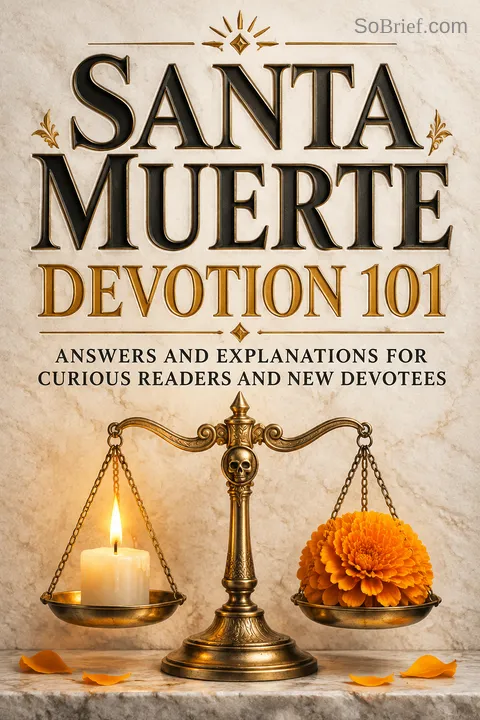


Key Takeaways
Treat Santa Muerte as death itself, not merely a deity of death.
Death made personal. Bustillo describes Santa Muerte as death personified, a force that exists whether anyone believes in her or not. In his account, her feminine form makes death approachable, while the word “Santa” can suggest holiness and a good death, understood as the kind of ending each person hopes for. He presents death not as a force that rules over mortality, but as mortality itself.
A discovery in Tijuana. Bustillo recounts arriving in Tijuana, mistaking local images of a cloaked skeleton for the Grim Reaper, then learning they depicted Santa Muerte. He studied her practices, visited public altars, and began making offerings. His account frames the book as a practical introduction shaped by that personal encounter.
What's distinctive is the shift from asking a supernatural figure to manage death to relating to death as a constant fact of existence. Personification can make an abstraction emotionally addressable, much as people use symbols to approach grief or uncertainty. Yet the claim that death itself hears petitions is a spiritual interpretation, not a verifiable consequence of death's biological reality. Keeping those registers distinct helps readers understand both the appeal of the devotion and the kind of belief it asks them to consider.
Let death's certainty sharpen how fully you inhabit the life you have.
Mortality as attention. Bustillo argues that devotion is as much about living as dying. Remembering that life ends can make ordinary pleasures, such as a meal, a sunny day, or time with loved ones, feel less routine. It can also make suffering seem less permanent. The point is not to obsess over death, but to stop treating time as unlimited.
A personal definition. The book does not prescribe one ideal ending. A good death might mean a quick, relatively painless end for one person, or familiar surroundings and loved ones nearby for another. Devotion, in this view, means contemplating what a good death would mean personally, then letting that awareness influence how the remaining life is spent.
This is a useful reversal: mortality becomes a prompt for choosing, not merely a subject for fear. The idea is strongest when it leads to concrete priorities, such as making time for relationships or revising what counts as a worthwhile day. But awareness of death does not reliably produce calm or gratitude for everyone. For some, it can intensify anxiety. The practical test is whether reflection helps someone engage more fully with life, rather than making mortality the center of every decision.
No lineage, religion, or reputation bars anyone from Santa Muerte's attention.
An open invitation. Bustillo portrays Santa Muerte as accepting devotees regardless of nationality, race, religion, or lack of religion. Because everyone is mortal, everyone shares a connection to death. He also says atheists can approach her without accepting a god: in his framing, death is an observable certainty even when gods remain matters of belief.
Acceptance is not approval. The book also addresses the association between Santa Muerte and criminal activity. Bustillo argues that criminals may pray to her because they expect no judgment, but their choices remain their own, and human societies can still enforce laws. A petition may be heard, he says, without a promise of protection or success. His own story includes combat service in Baghdad, an atheist outlook, and a later turn toward devotion in Tijuana.
The distinction between welcome and endorsement matters. A spiritual practice can include people society marginalizes without declaring every action ethically harmless. That broad welcome may also explain why Bustillo emphasizes freedom from shame and rigid entry requirements. At the same time, describing a Mexican folk saint as universally available can make cultural context seem optional. Readers can hold both points together: the book presents an inclusive personal path, while its own story locates that path in Mexican settings and practices.
Build devotion through sincere attention, not expensive objects or perfect ritual.
Start with acknowledgment. Bustillo treats prayer, offerings, and altars as ways to build a relationship, not as mandatory initiation steps. Prayer can be formal or conversational, spoken aloud or silently, and offered as a request, thanks, or simple greeting. A physical altar can be modest or temporary. His first was built around a one-inch medallion placed on a dresser.
Practice can travel. An astral altar is Bustillo's term for an altar imagined in the mind's eye, useful when a physical shrine is impractical. The Santa Muerte Rosary is a sequence of prayers that can be recited with beads to keep one's place; the book describes a 59-bead version. Both examples make room for devotion within different living situations and levels of privacy.
The book's flexibility makes its practice accessible without making it entirely casual. A small object or imagined shrine can serve as a stable focus, while repeated prayer turns attention into a routine. In that sense, ritual can be understood as a way of organizing intention and marking what matters. The author also places weight on effort and sincerity, which are subjective standards. That can motivate care, but it should not make people with limited money, privacy, or time feel spiritually inadequate.
Make petitions specific, then let ritual objects focus your intention.
Clarify the request. A petition is a request for help. Bustillo recommends being precise about the desired outcome before choosing prayers or ritual materials. His example process may include a clear statement of intent, a prayer, a candle, herbs, and a target link, meaning an item or identifying information that connects the ritual to a person or place. A photograph or written address could serve as a link.
Objects support focus. Candle colors and herbs are selected to match the aim, while grinding and arranging materials gives the petitioner time to concentrate. The book also says elaborate tools are not essential: a simple prayer can express a request. For Bustillo, the ritual's work is partly the attention and effort invested, rather than a particular object or set of words guaranteeing an outcome.
Specificity is valuable even outside a spiritual framework. A request that names a desired outcome is easier to reflect on, communicate, and compare with what actually happens. Ritual can also create a deliberate pause before action. The caution is that concentration and elaborate preparation do not establish that a petition will be granted. Requests involving health, legal trouble, or another person's choices still call for practical judgment and respect for other people's agency.
Treat contracts as bounded bargains, and promise only what you can deliver.
A conditional commitment. In Bustillo's use, a contract is an agreement to offer a specific deed in return for one specific miracle. Unlike a petition, where an offering accompanies the request, the promised deed is due only if the request is fulfilled. The agreement can be written down with the request, the promised action, the petitioner's name, and the date.
Keep the promise realistic. The book suggests that the scale of the deed should feel proportionate to the request and to the person's circumstances. It gives examples such as donating money, volunteering, or committing to prayer. Bustillo advises allowing three months for an answer. If the request is not fulfilled, the contract can be treated as declined; if it is fulfilled, the promised deed should be completed within a reasonable time.
This structure resembles a contingent commitment: responsibility begins only when a stated condition is met. That can make a promise clearer and less vulnerable to vague, enduring guilt. It also highlights the importance of defining success in advance. A person may otherwise reinterpret ambiguous events as fulfillment and feel bound by an obligation they did not clearly understand. The book's advice to promise only what is feasible is especially sound, since an impossible vow can turn devotion into avoidable distress.
Read unanswered petitions as uncertain, not as proof of punishment or failure.
No guaranteed results. Bustillo says Santa Muerte cannot be commanded and that even committed devotees receive no answers to some petitions. He suggests waiting about three months, reviewing how the request was made, and possibly trying again with more effort or a different offering. If a second attempt fails, he recommends reconsidering the request itself. After a third unsuccessful attempt, he advises letting the matter rest for a while.
An unexpected turn. Bustillo tells how he asked for more freelance writing clients but instead attracted readers to his Santa Muerte website and began writing for devotees. He came to see that unexpected path as a blessing he had not known to request. The story offers a way to reinterpret disappointment, while the book also leaves open the possibility that some requests simply remain unanswered.
The story makes room for outcomes that do not match the original plan, a useful counterweight to rigid goal pursuit. A rejected path can prompt reconsideration, and a changed request may better fit the situation. Still, an unanswered petition does not prove that a hidden blessing is underway. Treating every setback as secretly beneficial can discourage practical learning. The more balanced reading is to allow spiritual reflection while also asking what observable information the outcome provides.
Use color and herbs as attention-guides, not as separate powers.
One figure, varied aspects. Bustillo explains that differently colored cloaks represent different aspects of the same Santa Muerte, rather than separate beings. In his system, white is associated with peace and protection, red with love and passion, gold with work and material success, green with legal matters, and purple with intuition. These correspondences help a petitioner focus on a particular aim.
Herbs add another layer. The book pairs herbs with intended effects: basil appears in protection and prosperity work, rose in love petitions, and lavender in matters of lust or emotional healing. These are presented as magical correspondences, not as a requirement for devotion. Bustillo includes a long list, and warns that some plants, including mandrake, tansy, and wormwood, can be poisonous and require caution.
A symbolic system can make a broad wish more concrete: choosing a color or plant asks the petitioner to name what kind of help is being sought. The book is clear that colors describe aspects of one figure, which avoids turning each color into an entirely different power. The crucial boundary is between symbolic correspondence and empirical effect. In particular, herbal associations should not be confused with medical evidence or treated as instructions to ingest or handle hazardous plants.
Handle offerings respectfully without turning devotion into waste or fire risk.
Care includes cleanup. Bustillo calls leftovers from magical work magick trash. His practical advice is to sort them as ordinary waste, recycling, or compost when appropriate, rather than assuming they must be burned or buried. Offerings left outdoors should be chosen so they will not become litter or harm the surroundings. A usable offering should not be kept by the person who gave it, though it may be given away.
Keep the altar safe. Organic offerings, such as fruit or flowers, should be removed when they begin to spoil. Other items can be rotated when they have become stale to the devotee. If using a real candle, the book advises never leaving it unattended or burning it while asleep. The author presents practical care as compatible with respectful practice, not as a lesser form of devotion.
This is a modest but valuable feature of the book: ritual has material consequences, so disposal and fire safety belong in a spiritual manual. The guidance resists a false choice between treating an offering as sacred and handling it responsibly. It also makes room for urban life, where burial or outdoor burning may be impractical. A further principle follows naturally: care for the altar should not create avoidable danger or environmental harm.
Admit the afterlife is unknown, and focus devotion on conduct among the living.
Uncertainty without a story. Bustillo offers no settled map of what happens after death. He argues that people should be honest about what they cannot know rather than treating a comforting account as established fact. In his view, the unknown is not a reason to abandon spiritual practice; it is a reason to bring attention back to what can be experienced now.
A present-day ethic. The book encourages readers to consider how they wish to live, how they treat others, and what they would count as a good death. It also connects devotion with supporting other people, rather than keeping blessings solely for oneself. The promised afterlife is not the centerpiece. The emphasis is on mortality, relationships, and the choices available during life.
This restraint distinguishes the book from traditions that make detailed claims about life after death. It can be intellectually honest to mark the boundary between hope and knowledge, while still finding meaning in ritual and community. The ethical pivot toward present conduct is also practical: the living can respond to obligations and repair relationships. One tension remains. Santa Muerte is described both as unknowable death and as a presence who may grant favors. The book holds those views together through personal devotion rather than resolving them as a formal theology.
Analysis
Santa Muerte Devotion 101 is best understood as a practice guide shaped by one devotee's experience, rather than a comprehensive history or a formal theology. Its structure follows the questions a newcomer might ask: who Santa Muerte is, who may approach her, how to establish a relationship, how to make requests, and how to manage the practical details of ritual. The central premise is strikingly direct: death is universal, so access to its personification is universal too.
The book's practical strength is its low threshold for participation. A prayer can be improvised, an altar can be temporary or imagined, and offerings need not be expensive. At the same time, the author insists that attention, reciprocity, and effort matter. This creates a productive tension. Ritual tools are described as optional aids to focus, yet the author also associates increased effort with better chances of a favorable response. The book does not provide evidence that effort reliably changes supernatural outcomes, and it acknowledges that petitions may fail. Readers can therefore take the procedures as devotional commitments without mistaking them for guaranteed techniques.
Its most useful ethical distinction is that acceptance does not erase human responsibility. Santa Muerte may hear requests from criminals, but the author does not treat that as a defense of crime. Likewise, he does not promise that spiritual petitions override practical consequences. The emphasis on uncertainty about the afterlife also prevents the guide from depending on detailed claims about what cannot be known.
The account is candidly personal, including the author's transition from atheism to devotion and his encounter with Santa Muerte in Tijuana. That gives the guide narrative force, but also sets its limits. It reflects Bustillo's interpretation and ritual preferences, not every devotee's understanding or the full range of Mexican religious and cultural contexts. Read with that distinction in mind, the book offers a clear entry point: approach death without shame, make devotion meaningful through attention, and remain honest about what belief cannot guarantee.
Glossary
astral altar
Imagined devotional altarA Santa Muerte altar visualized in the mind rather than assembled from physical objects. Bustillo presents it as an option for people who cannot keep a visible shrine, or who want a devotional focus they can imagine wherever they are. It may use a mental image of Santa Muerte or another symbol of death.
target link
Ritual connection to a targetAn item or piece of information used in a petition ritual to focus the request on a particular person or place. The book gives examples such as a photograph, a person's identifying information, a business card, or an address. Bustillo treats the link as a way to direct intention, not as a guarantee of a result.
Santa Muerte Rosary
Bead-guided prayer sequenceA collection of prayers recited as an act of devotion or meditation. Bustillo describes a version using 59 beads, a Santa Muerte medallion, and a connector, with different prayers assigned to points in the sequence. Beads help a person keep track, but the book says the prayers can also be recited without a physical rosary.
contract
Conditional spiritual bargainAn agreement in which a devotee promises a specific deed in exchange for a specific requested miracle. In Bustillo's account, the promised deed is due only if the request is fulfilled. A contract can be documented in writing, and the book recommends making promises proportionate to the request and realistic for the person making them.
magick trash
Leftovers from ritual workBustillo's term for items left after a petition or offering that will not be kept as charms or reused. He recommends practical disposal through appropriate garbage, recycling, or compost, rather than assuming items must be burned or buried. Outdoor offerings should be selected and placed so they do not become litter or damage the environment.
Download PDF
Download EPUB
.epub digital book format is ideal for reading ebooks on phones, tablets, and e-readers.








