Key Takeaways
1. ADHD is a Real, Lifelong Neurological Disorder, Not a Moral Failing
The darkness of the world of the moral diagnosis can and now ought to give way to the light of the medical diagnosis.
Beyond judgment. For decades, adults struggling with ADHD symptoms were often labeled "bad," "lazy," or "incompetent," leading to deep feelings of despair and underachievement. This "moral diagnosis" failed to recognize the underlying medical reality. ADHD is a verifiable neuropsychiatric disorder, not a character flaw or a choice, and understanding this is the first step toward healing.
Persistent struggle. Many adults with undiagnosed ADHD face ongoing frustration, lost jobs, fractured relationships, and low self-regard. Some even resort to dangerous behaviors or substance abuse. The condition's roots are in childhood, with two out of three children with ADHD continuing to experience symptoms into adulthood, making it a lifelong challenge that demands proper medical attention.
Hope through knowledge. Recognizing ADHD as a medical condition, rather than a personal failing, opens the door to effective treatment and a dramatically improved quality of life. This shift from judgment to scientific understanding is gradually dissipating the stigma and fear surrounding mental and physical differences, offering millions of adults the realistic hope for improvement.
2. Adult ADHD Manifests Subtly, Often as Internal Restlessness and Inattention
Often, the frank hyperactivity of childhood is now felt as a sense of internal restlessness and discomfort.
Evolving symptoms. While childhood ADHD is often characterized by overt hyperactivity and impulsivity, these symptoms tend to lessen in visibility during adulthood. The "itchy bottom" syndrome of a child transforms into a pervasive sense of internal restlessness, making it harder for others to recognize the disorder. Inattentive symptoms, such as difficulty focusing, disorganization, and forgetfulness, become more prominent and troublesome.
Hidden struggles. Adults with ADHD often develop elaborate coping mechanisms to mask their difficulties, making their condition less obvious to peers and employers. They might appear "scatterbrained" or "lazy," but internally, they are expending immense effort just to manage daily tasks. This constant struggle, coupled with underperformance, can lead to significant stress and feelings of inadequacy.
Daily challenges. The demands of adult life—managing work, family, and social interactions—exacerbate ADHD symptoms. Tasks requiring vigilance, organization, planning, and complex problem-solving become exceptionally difficult. This can manifest as:
- Chronic procrastination and missed deadlines
- Difficulty remembering conversations or reading material
- Frequent misplacement of items
- Challenges in maintaining relationships and employment
3. Accurate Diagnosis Requires a Comprehensive, Lifelong History and Professional Evaluation
The only way to get a diagnosis is to sit down with your physician and talk about your life story—your symptoms and how they have affected your life.
Beyond self-diagnosis. While many adults suspect they have ADHD after recognizing symptoms in themselves or their children, self-diagnosis is often inaccurate. The symptoms are subtle, context-dependent, and can mimic other conditions. A professional diagnosis is crucial to differentiate ADHD from normal life stressors or other medical issues.
Multistep process. A definitive diagnosis involves a thorough evaluation by a qualified professional, typically a psychiatrist or psychologist. Key components include:
- Clinical interviews: Detailed discussions about current and past symptoms, their severity, frequency, and impact on life.
- Childhood onset verification: Establishing that symptoms have been present since early childhood, often requiring input from family members.
- Rating scales: Standardized tools like the Adult ADHD Self-Report Scale (ASRS v1.1) to quantify symptoms and their impact.
- Objective evidence: Corroborating information from family, friends, or past records.
Coping mechanisms and comorbidities. Clinicians must be adept at identifying coping strategies that mask symptoms and distinguishing ADHD from co-occurring conditions. For instance, a patient might deny organizational problems but rely heavily on a spouse or assistant, revealing underlying impairment. Neuropsychological testing can also be used in complex cases to assess cognitive abilities and rule out learning disabilities.
4. ADHD Has a Strong Biological Basis Rooted in Brain Chemistry and Structure
Abnormally low levels of dopamine and norepinephrine, two important neurotransmitters that affect areas of the brain that enable a person to pay attention to and maintain interest in an ongoing activity, seem to be involved in both the cause and the perpetuation of ADHD.
Genetic blueprint. ADHD is largely hereditary, with an astonishing 80% heritability rate. This means specific gene combinations passed down through generations heavily influence the brain's development and function. While no single gene is predominant, several have been implicated, contributing to the condition's complex genetic landscape.
Brain differences. Scientific studies using advanced imaging techniques like fMRI and PET scans reveal distinct structural and functional differences in the brains of individuals with ADHD:
- Reduced volume: Frontal cortices, cerebellums, and subcortical areas often have less volume.
- Neurotransmitter imbalance: Lower levels of dopamine and norepinephrine, crucial for attention, impulse control, and executive functions.
- Inefficient pathways: Brain circuits involved in motor control, executive functions, and behavior inhibition do not perform optimally.
Underactivity, not overactivity. Counterintuitively, the hyperactivity seen in ADHD is often a compensatory mechanism for an underactive brain. When certain cortical areas are sluggish, the body may activate itself to reach a functional threshold. Stimulant medications work by making dopamine more accessible, allowing these underactive brain regions to function more normally and reducing outward overactivity.
5. Co-occurring Conditions (Comorbidities) Are Common and Complicate Treatment
It is estimated that 50 to 70 percent of adults with ADHD have another mental health disorder.
The rule, not the exception. Coexisting conditions are highly prevalent in adults with ADHD, making diagnosis and treatment more complex. These comorbidities can mask ADHD symptoms or be misdiagnosed as the primary issue, leading to ineffective treatment if ADHD is overlooked.
Common co-conditions:
- Depressive disorders: Major depression, chronic depression (dysthymia) affect about 35% of adults with ADHD.
- Anxiety disorders: Generalized anxiety, panic disorder, social phobias, OCD, and PTSD affect 25-40%.
- Substance use disorders: Over 50% of untreated ADHD adults develop issues with alcohol, marijuana, cocaine, or heavy smoking/caffeine use, often as self-medication.
- Bipolar disorder: Affects up to 20% of individuals with ADHD.
- Oppositional/Conduct disorders: Prevalent in childhood, can lead to antisocial personality disorder in adulthood.
Prioritizing treatment. When multiple conditions are present, the most pressing or life-threatening disorder should be addressed first. For example, severe depression or active substance abuse must be stabilized before effectively treating ADHD. A skilled physician will determine the appropriate treatment hierarchy, as some ADHD symptoms may even improve once a comorbid condition is managed.
6. Medication is the Primary and Most Effective Treatment for ADHD Symptoms
Happily, physicians have found that the effects of medication on ADHD are pronounced. In fact, patients generally have a 70 percent chance of getting better from the first medication they take.
Proven efficacy. Medication is a cornerstone of ADHD treatment, with decades of research supporting its effectiveness in mitigating symptoms. Both stimulant and non-stimulant options are available, offering significant relief for most adults. The goal is to achieve symptom control throughout the day, which often requires long-acting formulations.
Stimulant medications. These drugs, including methylphenidates (e.g., Ritalin, Concerta, Focalin XR) and amphetamines (e.g., Adderall, Adderall XR), regulate the release and reuptake of norepinephrine and dopamine in the brain.
- Mechanism: Stimulate the central nervous system, improving attention, impulse control, and self-regulating behavior.
- Onset: Effects can be seen within the first day, maximizing over weeks of dose adjustment.
- Side effects: Common side effects include insomnia, decreased appetite, headaches, and edginess. Cardiovascular monitoring is essential.
Non-stimulant options. Atomoxetine (Strattera) is the first FDA-approved non-stimulant, inhibiting norepinephrine uptake.
- Advantages: Lower risk of abuse, longer duration of action, lower risk of rebound effects or tics.
- Onset: Takes several weeks to observe maximal effects.
- Considerations: Preferred for patients with active substance abuse or tic disorders.
7. Treatment Involves a Physician Partnership to Optimize Medication and Dosage
The most important factor for success is to find a doctor who can establish the diagnosis; then the patient must partner with that doctor to establish the optimal treatment paradigm, including type of medication, dosage, and follow-up plan.
Tailored approach. There is no one-size-fits-all treatment for adult ADHD. The choice of medication (stimulant vs. non-stimulant), specific drug, and dosage is a collaborative decision between the patient and physician, considering:
- ADHD subtype: Inattentive, hyperactive/impulsive, or combined.
- Symptom priorities: Which symptoms the patient most wants to mitigate.
- Coexisting conditions: Impact of depression, anxiety, substance abuse, etc.
- Lifestyle factors: Occupation, daily schedule, and personal preferences.
Long-term commitment. While medication can yield rapid improvements, treatment is often a long-term process. Dosage adjustments are common as patients experience side effects or as their needs evolve. Patients should maintain realistic expectations and commit to consistent medication use, even when feeling better, as symptoms often return upon discontinuation.
Monitoring and adjustment. Regular follow-up with the physician is crucial to monitor treatment response, manage side effects, and track symptom changes using assessment scales. This ongoing dialogue ensures the treatment plan remains optimized for the patient's evolving needs, aiming for at least a 30% reduction in overall symptoms and significant improvements in daily functioning.
8. Complementary Psychosocial Therapies Enhance Coping Skills and Life Management
Once the symptoms are managed, some individuals need additional help to make real life changes.
Beyond medication. While medication effectively addresses core ADHD symptoms, it doesn't automatically teach organizational skills or repair damaged relationships. Psychosocial treatments serve as vital complements, helping adults translate symptom improvements into tangible life changes and develop sustainable coping strategies.
Key psychosocial therapies:
- Individual Supportive Psychotherapy: Helps patients understand how ADHD impacts their lives, build self-esteem, and process painful emotions, offering a safe space for discussion and problem-solving.
- Cognitive Behavioral Therapy (CBT): Focuses on identifying and changing negative thought patterns and destructive behaviors. It provides practical strategies for organization, planning, and emotional regulation, helping patients react rationally to challenges.
- Coaching: A goal-driven, action-oriented approach where coaches work with clients to set and achieve practical goals in areas like planning, organization, and time management. Coaches provide reminders, motivation, and accountability.
Relationship and group support. ADHD often strains personal relationships and can lead to feelings of isolation.
- Marriage and Family Therapy: Helps spouses and family members understand ADHD, alleviate blame, and improve communication, fostering collective healing.
- Group Therapy: Provides a supportive environment where individuals with ADHD can share experiences, reduce feelings of alienation, and collectively develop coping strategies, realizing they are not alone.
9. Alternative and Mind/Body Treatments Should Complement, Not Replace, Medical Care
My general take on alternative therapies falls under the “Do no harm” dictum. Consider trying them if they “do no harm” and only in conjunction with your doctor’s advice and counsel.
Unproven efficacy. Alternative treatments, while popular, generally lack robust scientific evidence to support their effectiveness as standalone treatments for ADHD. They are best considered as complements to, rather than replacements for, physician-prescribed medication and established psychosocial therapies.
Common alternative approaches:
- Diet and Nutritional Adjustments: Some advocate eliminating additives or sugars, or supplementing with essential fatty acids (omega-3s, omega-6s), vitamins (RDA-based multivitamins), or minerals (iron, zinc, magnesium, calcium). While a healthy diet is universally beneficial, specific dietary changes for ADHD lack strong scientific backing.
- Herbal Remedies: Ginkgo biloba, hawthorn, gotu kola, and rosemary are sometimes suggested for cognitive benefits, but their primary effects on ADHD and interactions with medications are largely unknown.
- Traditional Chinese Medicine (TCM) & Acupuncture: Ancient practices used for anxiety, depression, and stress. While acupuncture's efficacy for some ailments is recognized, its long-term effectiveness for adult ADHD symptoms is not systematically studied.
Mind/body treatments. These holistic approaches aim to strengthen the mind-body connection, promoting relaxation and concentration.
- Exercise: Reduces hyperactivity, aggression, and stress, and releases endorphins, which can alleviate depression.
- Massage: Deep-pressure stimulation can have calming effects, reducing anxiety and improving mood.
- Meditation: Trains the mind to maintain concentration and achieve deep calm, counteracting inattentiveness.
- Movement Therapies (Yoga, Tai Chi): Improve emotional states, reduce anxiety, anger, tension, and hyperactivity through controlled movements and breathing.
10. A Better, More Fulfilling Life is Attainable Through Diagnosis and Consistent Treatment
Treatment is available, and it is a powerful tool that can help you move forward in your life with greater success, a sense of well-being, and happiness.
Empowerment through understanding. Recognizing that ADHD is a treatable condition, not a personal failing, is profoundly empowering. It frees individuals from years of self-blame and opens the door to a life of greater control and fulfillment. The journey begins with an accurate diagnosis, which provides the framework for effective intervention.
The path to well-being. Successful management of ADHD involves a multi-faceted approach:
- Medication: Provides the foundational stability by mitigating core symptoms.
- Psychosocial therapies: Equip individuals with essential coping skills, organizational strategies, and emotional resilience.
- Patience and persistence: Progress may be gradual, requiring consistent effort and open communication with healthcare providers.
Reclaiming your life. With proper care, individuals can experience dramatic improvements in all areas of their lives. They can reconnect with family and friends, achieve professional success, and cultivate a profound sense of well-being and happiness that may have previously eluded them. The goal is not just symptom reduction, but a complete transformation that allows one to pursue life's rewards more fully.
Last updated:
Review Summary
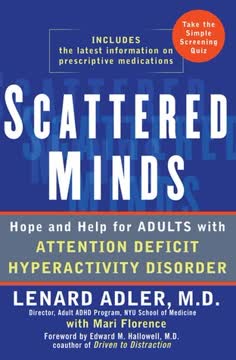
Scattered Minds receives generally positive reviews as an accessible introductory resource for adult ADHD, rated 3.71 out of 5. Readers appreciate its clear explanations of ADHD neuroscience, organized presentation, and helpful case studies. Many recommend it as a solid starting point for those newly diagnosed or researching the condition. Common criticisms include lack of depth for experienced readers, repetitive content, and outdated medical information from its 2001 publication. Several reviewers note it effectively explains treatment options, particularly medication, though some wanted more emphasis on coping strategies and potential side effects.
Similar Books