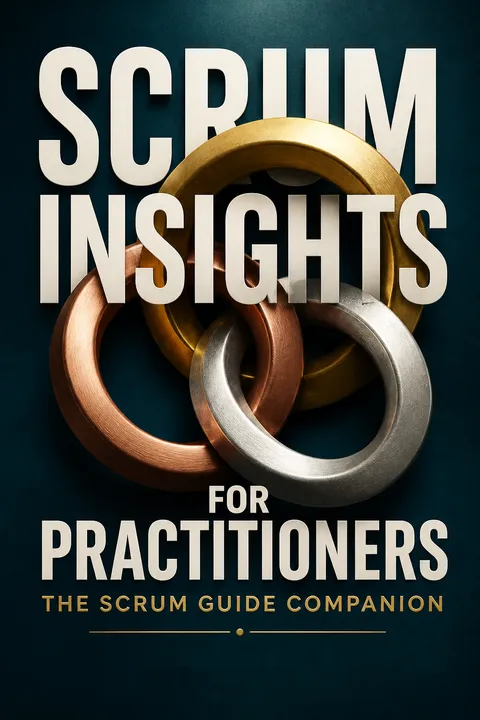


Key Takeaways
Use Scrum for uncertain products, not projects whose outcomes are already predictable.
Match the process to uncertainty. Scrum is a lightweight framework for developing products when important facts are not known in advance. Requirements shift, technology changes, and teams discover what customers need by showing them working software. The book uses the Cynefin framework to distinguish this complex territory from obvious or complicated work, where established knowledge can support a detailed plan. Rebuilding a familiar payroll system or constructing a conventional bridge may be more predictable than creating a new digital product.
Learn before committing too far. Scrum is not presented as the right tool for every project. Its purpose is to make progress when long-range predictions are unreliable, using short cycles to reveal what is working and what needs to change.
What's useful here is the distinction between uncertainty and mere difficulty. A technically demanding project can still be predictable if its requirements and methods are well understood. Conversely, a modest product feature can be complex if users' responses are unknown. This resembles adaptive management in ecology, where decisions are treated as tests and revised as evidence arrives. The caveat is that teams can label any troubled project complex and use that label to excuse weak planning. The better question is whether meaningful uncertainty can be reduced through short, observable experiments.
Plan with evidence from finished work, not optimistic estimates alone.
Empiricism means learning from reality. In Scrum, empirical process control uses observation and experience to guide decisions instead of treating a forecast as fact. The book illustrates this with a team expecting five similarly sized features in a Sprint. If it completes seven, it can use that evidence to revise its next forecast upward. If it completes only two, it should plan less, investigate the mismatch, or change how the work is divided.
A short cycle limits surprise. Each Sprint aims to produce a usable, potentially releasable increment that can be examined. Even a Sprint that produces no completed feature offers evidence: the team may have misunderstood the work or chosen slices that were too large.
This is a practical form of feedback control: compare the intended result with the observed result, then adjust the next action. The key benefit is not that every forecast becomes accurate, but that error becomes visible soon enough to matter. There is also a measurement trap. A single Sprint can be distorted by absences, dependencies, or unusually difficult work, so one result should not become a verdict on a team's ability. Evidence is most useful as a prompt for inquiry, not as a weapon for ranking people.
Make transparency, inspection, and adaptation a loop people can trust.
Three pillars support learning. Scrum's pillars of empiricism are transparency, inspection, and adaptation. Transparency makes the state of the work visible, including risks and unfinished items. Inspection gives the team and stakeholders regular chances to examine the product and the way it is being built. Adaptation means changing course when inspection shows a gap between the current approach and the desired result.
Values make visibility safer. The book connects these pillars to five Scrum values: courage, focus, commitment, respect, and openness. For example, a team needs courage to reveal that a feature is behind schedule, and openness to hear customer feedback without treating it as an attack. When these behaviors are absent, formal reviews can become demonstrations staged to hide problems rather than opportunities to learn.
Visibility alone does not create trust. In organizational psychology, people disclose problems more readily when they expect a fair response rather than blame. That makes the values operational, not decorative: they shape whether the information needed for adaptation can surface at all. The same principle applies to product demonstrations. A team should not be punished for discovering that a hypothesis was wrong. At the same time, openness does not mean every decision needs consensus. Scrum still assigns clear accountabilities so that candid information can lead to action.
Keep product value, team delivery, and process coaching separately accountable.
Three roles balance different responsibilities. The Product Owner orders work to maximize product value and represents the product's business direction. The Development Team decides how much work it can forecast and how to turn that work into a completed increment. The Scrum Master teaches and coaches Scrum, helps the team improve, and works to remove obstacles. One product has one Product Backlog and one Product Owner, rather than a committee issuing competing priorities.
Authority should match the work. The team doing the development estimates and organizes its work; the Product Owner decides the order of the backlog. The Scrum Master should help the team solve its own problems instead of becoming its permanent fixer. The book also recommends separating the Product Owner and Scrum Master roles to avoid conflicts between pressing for value and protecting a sustainable pace.
This division helps prevent a familiar principal-agent problem: people accountable for outcomes need enough authority to shape the work, while those closest to the implementation need discretion over how to do it. The roles are useful precisely because they are not interchangeable job titles. Yet separation on paper is insufficient if executives or stakeholders routinely bypass the Product Owner and redirect developers. Managers still matter in this model, especially when they can remove organizational barriers, mentor teams, and support the framework without assigning daily tasks.
Use each Scrum event to make a decision, not perform ceremony.
Events create inspection points. A Sprint lasts one month or less and contains four formal events: Sprint Planning, the Daily Scrum, the Sprint Review, and the Sprint Retrospective. Planning establishes a Sprint Goal and a forecast of work. The Daily Scrum helps developers coordinate toward that goal. The Review examines the increment with stakeholders and informs future priorities. The Retrospective examines how the team works and selects improvements. Product Backlog refinement supports planning, but is not a formal Scrum event.
Keep the cadence honest. The Sprint is not extended simply because work remains. The book warns against labels such as Sprint 0, hardening Sprint, or testing Sprint when they defer the expectation of completed value. If a Review has no increment to show, it still matters: the team and stakeholders need to inspect what happened and adapt.
The events are best understood as a recurring decision architecture, not a calendar full of meetings. Each meeting has a different object of attention: scope, coordination, product evidence, or team process. This separation can reduce the tendency to mix status reporting with problem-solving. Still, a meeting's name cannot guarantee its function. A Daily Scrum that becomes a manager's interrogation undermines team ownership, while a Review without genuine stakeholder feedback offers little inspection. The test is whether the event changes shared understanding or enables a concrete decision.
Order small backlog bets so customer feedback can change the destination.
Treat the backlog as changeable. The Product Backlog is the ordered list of work that may be needed for a product. It is a single source of requirements, but not a fixed contract: new evidence can change what matters. Items near the top need enough detail to be understood and small enough to complete within a Sprint. Refinement helps the Product Owner and Development Team clarify likely near-term work, including acceptance criteria and dependencies.
The email example shows the payoff. A customer requested several ways to filter email. The team ordered options by value, built date filtering first, and then added keyword filtering. After seeing those increments, the customer decided the available filters were enough and stopped the remaining work. The team delivered useful functionality without building every requested variation.
This is a concrete example of option value: small deliveries preserve the ability to redirect effort as new information arrives. The customer is not merely approving a finished specification; the customer is learning from an actual product. The distinction matters because requests often express a proposed solution, not the underlying need. A backlog can still become a disguised long-range contract if every item is treated as a promise. Its value lies in making priorities discussable and revisable, not in accumulating an impressive queue.
Define Done as a release-quality promise, not a progress label.
Shared quality prevents false completion. The Definition of Done is the team's shared description of the quality and work required before an item counts as complete. The book's illustrative criteria include passing acceptance tests, a minimum level of automated testing, and no high-severity defects. These are examples, not universal Scrum requirements. A clear definition helps the team forecast capacity because each selected item includes the work needed to meet the agreed standard.
Quality belongs to the whole increment. If teams call work done before integration, testing, or other necessary work is complete, hidden tasks accumulate as technical debt and release stabilization takes longer. Teams working on one product need a common minimum definition of Done for their integrated increment. A more mature team can exceed that shared baseline while preserving compatibility.
A rigorous completion rule improves the quality of information available to decision-makers. Without it, a chart may show progress while the product remains unshippable, much like financial accounts that omit liabilities. The definition also makes trade-offs visible: stricter testing may reduce the number of items completed today while lowering the cost and risk of maintaining them. The standard should fit the product's real quality needs, though. A metric such as test coverage can be useful, but coverage alone does not prove that tests detect the failures users care about.
Give teams bounded authority instead of asking them to self-organize by slogan.
Self-organization needs structure. In Scrum, self-organization means that developers decide how to perform and coordinate their work within clear boundaries. It does not mean that everyone can ignore the Sprint Goal, quality agreements, or product priorities. Trust, a defined Sprint length, an agreed Definition of Done, and the Scrum values give the team room to act without turning autonomy into aimlessness.
Decision rights must be real. The Development Team selects work from the ordered backlog, creates its Sprint Backlog, and can replan as it learns. A Scrum Master supports this by coaching rather than assigning tasks. The book describes a group of 100 developers organizing themselves into teams, using shared discussion of skills, product needs, and dependencies, then adjusting their arrangement as they learned.
The idea fits research on autonomy at work: discretion tends to support ownership when people also understand goals and have the capability to act. Scrum's boundaries provide that context, while the team's responsibility for its own plan supplies meaningful choice. The 100-person example is an aspiration, not proof that every group will self-organize effectively on its first attempt. Teams may need facilitation, skill development, and organizational support. Autonomy without access to information or authority over relevant decisions is only a more flattering name for abandonment.
Let architecture emerge from validated needs without postponing all customer value.
Build architecture in response to evidence. Emergent architecture means that design develops as the team learns which product capabilities and technical qualities matter. The book's example begins with a basic deployment structure and a small amount of user-facing functionality. As users ask for more data and the team learns about its needs, the team changes its data-access approach. A third-party component is also evaluated and integrated, with a small feature used to test whether it works as intended.
Keep technical learning connected to product learning. Architecture can take substantial effort in a Sprint, especially early in a product, but the book argues for delivering at least a small piece of business-facing functionality as well. When additional Scrum Teams join, dependencies and integration work can reduce the original team's capacity, so teams need to coordinate around one integrated increment.
This is a middle path between speculative upfront design and careless improvisation. Early technical decisions are treated as hypotheses that need validation, while guiding principles and automated tests help changes remain manageable. The approach is especially compelling when requirements are uncertain, but it does not imply that every architectural choice can be safely postponed. Security, compliance, scalability, and integration constraints may need early attention because they shape what can be built at all. The practical challenge is to distinguish enabling architecture from elaborate infrastructure that has not yet earned its cost.
Treat velocity as a planning clue, never as a productivity score.
Metrics describe, they do not explain. The book describes velocity as a planning aid for estimating how much work a team might take on, not as a measure of productivity or success. Scrum does not require burn-down charts, burn-up charts, or cumulative-flow diagrams; teams should use measures only when they help them make decisions. Splitting people across projects creates context switching, while adding a second team can bring dependencies and integration costs that reduce the first team's output.
Look for value, not activity. The Product Owner may consider measures such as feature usage, customer satisfaction, time to market, or the cost of maintaining the product. These can help assess outcomes, but none is a complete measure by itself. A rising velocity can reflect changed estimation or easier work rather than more value delivered.
This caution anticipates Goodhart's law: when a measure becomes a target, people can optimize the number while weakening the outcome it was meant to represent. Velocity is particularly vulnerable because it is team-specific and depends on local estimation conventions. Combining delivery data with product outcomes and qualitative customer evidence gives a richer picture, although it also requires judgment. The book's emphasis on avoiding multitasking is similarly practical: utilization can look efficient while work waits in queues. Faster completion of valuable, integrated functionality matters more than keeping every specialist busy.
Analysis
The book's central contribution is not a novel Scrum mechanism, but a practitioner's interpretation of what the framework is for: making work visible, testing assumptions with working increments, and changing direction before large commitments become sunk costs. Its strongest thread is the repeated return to evidence. A forecast is provisional, a backlog is revisable, and an architectural decision should respond to actual product needs. Together, these ideas turn Scrum from a schedule-management ritual into a way to learn under uncertainty.
That learning depends on organizational conditions that a process diagram cannot supply. The Product Owner must be empowered to order work, developers must be allowed to determine implementation, and stakeholders must engage with increments rather than demand certainty from distant plans. The Scrum Master can coach and remove obstacles, but cannot manufacture trust or cross-functional capability by enforcing meetings. The book is strongest when it connects roles and artifacts to their purpose, and weaker where readers might mistake its practical suggestions, such as a recommended team size or particular acceptance criteria, for universal rules.
Its examples reveal a useful economic logic. Small increments limit the cost of being wrong and preserve the option to stop work when customers have enough. The email-filtering case makes this especially clear: a complete list of requested features would have consumed more effort than the observed need justified. Yet iteration is not automatically efficient. Integration, weak quality practices, external dependencies, and fragmented staffing can make short cycles performative. Frequent feedback helps only when the product is genuinely inspectable and the organization can respond.
The most important reading discipline is therefore to separate Scrum's essential accountabilities and feedback cadence from optional techniques. Charts, estimation styles, and meeting formats should serve the work, not define success. The framework offers a compact structure for adaptive development; expertise lies in using that structure to expose reality without turning it into bureaucracy.
Review Summary
Scrum Insights for Practitioners receives mostly positive reviews, with readers praising its clarity, practical approach, and value for both beginners and experienced practitioners. Many find it helpful for Scrum certification exam preparation. The book is commended for its simplicity, real-world examples, and complementary nature to the Scrum Guide. Some criticisms include its basis on an older Scrum Guide version and lack of visual elements. Overall, reviewers appreciate the book's insights and recommend it for those seeking to understand Scrum implementation in practice.
People Also Read








Glossary
Cynefin Framework
Classifies problem contextsA framework used in the book to distinguish problem contexts by how much is known and whether reliable practices exist. It describes obvious, complicated, complex, and chaotic domains. Predictive plans may suit more knowable work, while complex product development calls for experimentation and repeated learning.
Empirical process control
Decisions based on evidenceAn approach to controlling work through observation, experience, and evidence rather than relying on a plan as if it were certain. In Scrum, teams inspect actual product progress and use what they learn to adjust future work, forecasts, and priorities.
Three Pillars of Empiricism (Scrum)
Transparency, inspection, adaptationThe three principles that support empirical work in Scrum. Transparency makes the state of work understandable, inspection examines the product and process, and adaptation changes the approach in response to what inspection reveals. The book connects these pillars to the Scrum values, which help teams practice them honestly.
Product Backlog
Ordered product workThe evolving, ordered list of work that may be needed in a product. It is the single source of requirements for Scrum Teams working on that product. The Product Owner is accountable for its ordering, while details and priorities can change as the product, customer needs, and available evidence change.
Sprint Goal
Purpose for a SprintA shared objective that gives a Sprint direction. The Scrum Team shapes it during Sprint Planning, and the Development Team uses it to guide the work in its Sprint Backlog. During the Sprint, changes should not undermine the goal, though the team can adapt its plan and discuss scope with the Product Owner.
Definition of Done
Shared completion standardThe Scrum Team's shared description of the quality and work required for an increment or backlog item to count as complete. It makes completion more transparent and helps teams forecast how much work they can take on. For multiple teams on one product, a common minimum standard supports integration into one usable increment.
Self-organization
Team-directed workThe ability of a Development Team to organize and manage how it performs its work, rather than receiving daily task assignments from a manager. In Scrum, this autonomy operates within boundaries such as the Sprint Goal, the ordered Product Backlog, and the Definition of Done. It requires trust, collaboration, and authority to make relevant decisions.
Five Whys
Root-cause questioningA technique used in a Sprint Retrospective to explore why a problem occurred by asking why repeatedly. The book's example traces poor Sprint Planning through unprepared backlog items and missed refinement meetings to the absence of an owner for the meeting. The goal is to identify a cause that can be addressed, rather than stopping at a visible symptom.
Minimum viable feature (MVF)
Smallest useful featureThe smallest piece of functionality that provides enough value to test or satisfy a customer need. In the book's email-filtering example, date and keyword filters proved sufficient for the customer, who then stopped the remaining filter work. The concept illustrates how incremental delivery can reveal that more requested functionality is unnecessary.
Download PDF
Download EPUB
.epub digital book format is ideal for reading ebooks on phones, tablets, and e-readers.








