Key Takeaways
1. Feeling is the Lost Mode of Prayer
“Feeling is the prayer!”
Beyond words. The true "lost mode of prayer" is not found in spoken words, rituals, or outward expressions, but in the silent language of human emotion. Ancient traditions, like those of Tibetan monks, emphasize that external practices are merely tools to cultivate a specific inner feeling. This feeling, rather than a request, is the actual prayer.
Embody the answer. This mode of prayer invites us to feel gratitude and appreciation as if our prayers have already been answered. Instead of asking for something we lack, we embody the desired outcome. For example, to pray for rain, one feels the sensation of rain, smells the wet earth, and experiences the abundance it brings, rather than asking for it.
Direct access. By cultivating this quality of feeling, ancient wisdom suggests we gain direct access to the power of creation, often referred to as the "Spirit of God." This approach transcends the helplessness of asking and empowers us to participate actively in shaping our reality through our emotional state.
2. The Universe Mirrors Our Inner State
The Field simply mirrors the quality of our feelings as the experiences of our lives.
Quantum connection. Modern science, through concepts like the Quantum Hologram or the "Mind of God," has rediscovered a universal energy field that connects all things. This field is not empty space but a living canvas that responds to human emotion, acting as a feedback mechanism for our inner experiences.
Reflecting beliefs. This field serves as a mirror, reflecting our innermost feelings, thoughts, and beliefs back to us in the form of our relationships, careers, and health. What we perceive as chaos or peace in the world is often a direct reflection of the collective and individual emotional states we project into this field.
Conscious influence. Understanding this mirror means that if we view the world through lenses of anger or hurt, these qualities are reflected back. Conversely, if we cultivate feelings of unity, appreciation, and love, these become the mirrored experiences. This principle empowers us to change our outer world by first changing our inner state.
3. Hurt is a Catalyst for Wisdom
Blessed is the man who has suffered and found life.
Doorway to healing. The experience of hurt, whether personal or global, is a universal human experience that serves as a profound teacher. Ancient texts, like the Gospel of Thomas, suggest that our vulnerability to suffering is not a weakness but a doorway to deeper healing and life.
Inner strength revealed. Life's greatest challenges and pains appear only when we possess all the necessary inner tools and strength to survive and heal from them. This perspective, often echoed in phrases like "God never gives us more than we can bear," implies that every crisis is an opportunity to demonstrate our mastery and discover our inherent capacity to love.
Transforming pain. Rather than allowing unresolved pain to linger and destroy, finding wisdom in our hurt gives new meaning to painful experiences. This transformation allows us to become better individuals, fostering personal growth and contributing to a better world by healing patterns of suffering.
4. Blessing Releases Emotional Pain
Out beyond ideas of wrongdoing and rightdoing, there is a field. I will meet you there.
Emotional lubricant. Blessing is an ancient secret that releases us from life's hurts by temporarily suspending the cycle of pain. It's a quality of thought and feeling that allows us to redefine our emotions about past or present suffering, acting as a "lubricant" to free stuck emotions.
Acknowledgment without judgment. This form of blessing does not condone or excuse hurtful actions; it simply acknowledges that they have occurred. This act of acknowledgment, free from judgment, creates an opening for healing to begin, allowing emotions to move through the body rather than being buried.
Accessing neutrality. By blessing those who suffer, the cause of the suffering, and ourselves as witnesses, we transcend the polarities of right and wrong. This practice allows us to enter a neutral state, Rumi's "field beyond wrongdoing and rightdoing," from which our prayers can be offered with strength and clarity, rather than from a place of rage or hurt.
5. Beauty Transforms Perception
Beauty is eternity gazing at itself in a mirror. But you are eternity and you are the mirror.
Beyond the visible. Beauty is more than what is pleasing to our eyes; it is a profound experience of heart, mind, and soul. It is an ever-present force, dormant until awakened by our conscious acknowledgment. Humans are unique in their capacity to perceive beauty, making our choice to see it a powerful act.
Perfection in imperfection. Finding beauty involves recognizing perfection even in life's perceived "imperfections" or challenging moments. It's about shifting our perspective and choosing to see the inherent balance and symmetry in all experiences, rather than comparing them to an idealized standard.
Catalyst for change. Our experience of beauty directly influences our feelings, which in turn impact the physical world. By choosing to see beauty, even in tragedy or suffering, we transform our inner state. This transformation becomes a blueprint for positive change, unleashing the potential of prayer and shaping our reality.
6. Consciousness Actively Shapes Reality
We are part of a universe that is a work in progress. We are tiny patches of the universe looking at itself, and building itself.
Participatory universe. Pioneering physicists like John Wheeler suggest we live in a "participatory" universe, where consciousness is not merely a byproduct but an active force in creation. The very act of our observation, coupled with our beliefs, influences what manifests in the quantum world and, by extension, our lives.
Blueprints of belief. Our thoughts, feelings, emotions, and beliefs create "disturbances" in the universal field, forming the blueprints for our experiences. If we hold beliefs of separateness, anger, or hate, the quantum mirror reflects these back as conflict and illness.
Empowering perspective. This principle means that our inner world directly dictates our outer reality. By cultivating life-affirming emotions like gratitude, compassion, and love, we trigger positive conditions in our bodies and world. This understanding shifts responsibility from "chance" to our conscious choices, empowering us to create desired outcomes.
7. Unresolved Emotions Impact Health
Perhaps when people talk about dying of a broken heart, they are really saying that intense emotional reactions to loss and disappointment can cause a fatal heart attack.
Mind-body connection. A growing body of research indicates that unresolved negative emotions, or "hurts," have the power to create physical conditions like cardiovascular disease, high blood pressure, and impaired immune responses. Our emotional state directly influences our body's chemistry, releasing either life-affirming or life-denying hormones.
Beyond physical factors. While diet, toxins, and stress are recognized contributors to illness, ancient traditions and modern studies suggest that the underlying "why" often lies in unhealed emotional trauma. The body remembers what the mind tries to forget, storing these emotions in cells and organs, potentially leading to long-term health issues.
Longevity's secret. The miraculous self-healing capacity of our bodies, particularly the heart, suggests a potential for much longer, healthier lives than currently experienced. The book posits that the traditional human lifespan limit of around 100 years might be the maximum duration the body can endure unresolved emotional hurt before it leads to catastrophic organ failure.
8. Prayer is a Continuous State of Being
Life is a prayer!
Constant communication. Unlike the common perception of prayer as an occasional act, ancient wisdom reveals that prayer is a continuous state of being. Since we are always feeling, and feeling is the prayer, every moment of our lives is a prayer, constantly sending messages to the mirror of creation.
Beyond the sanctuary. When we confine prayer to specific times or places, its effects are temporary. Studies show that when people stop their meditations or prayers, the positive effects on their environment diminish. This highlights that sustained positive feeling is crucial for lasting change.
Embodying the message. To truly harness the power of prayer, we must become the qualities we wish to experience. If we desire peace, we must embody peace. If we seek healing, we must feel healed. This continuous state of feeling, rather than intermittent asking, is the language the universe recognizes and responds to.
9. Personalize Prayers for Potent Connection
Create your own! Find the special words that are meaningful to you, and you alone, to serve you as a sacred and secret prayer that’s between you and God.
Catalysts for feeling. The words of traditional prayers, like the Lord's Prayer or the 23rd Psalm, are not the prayers themselves but powerful codes designed to elicit specific feelings within us. They are catalysts that trigger gratitude, comfort, or a sense of being cared for, which then become the true prayer.
Crafting your code. To make prayer deeply personal and effective, we are invited to create our own prayers. These can be simple statements, rhymes, or affirmations that resonate uniquely with us, designed to evoke the feeling of our desires already being fulfilled.
Anchoring intention. By personalizing prayers and anchoring them with specific feelings and sensory details (e.g., seeing groceries put away after a safe journey), we set powerful intentions. This inner technology, often seen in childhood rhymes or ancient benedictions, accesses the universe's most powerful force by aligning our feelings with our desired reality.
Last updated:
Review Summary
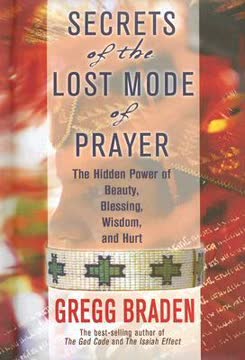
Secrets of the Lost Mode of Prayer by Gregg Braden explores ancient prayer techniques based on feeling rather than words. Reviewers appreciate Braden's accessible writing and integration of science and spirituality, though some criticize lack of specific scientific citations. The core message emphasizes praying with gratitude as if requests are already answered, using emotion and all senses. Many found the concept transformative, drawing on Braden's research in Tibetan monasteries and Native American traditions. Critics note the content could be condensed, finding it repetitive. Overall, readers value the book's simple yet profound reimagining of prayer as embodied feeling rather than verbal supplication.
Similar Books