


Key Takeaways
Treat self-control as the price of freedom, not its opposite
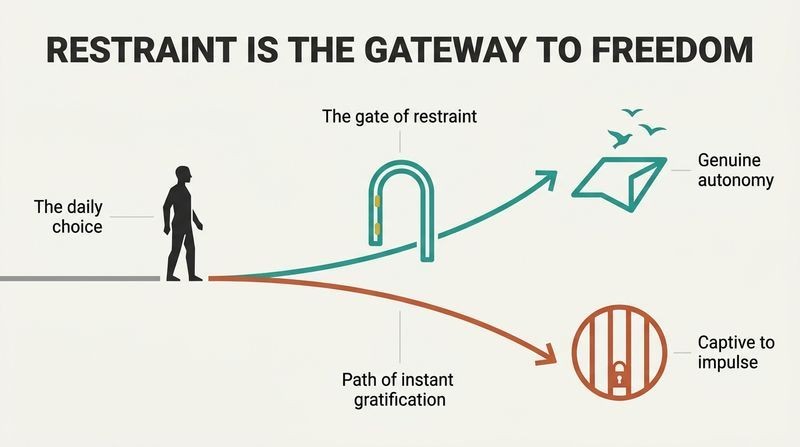
The daily crossroads. The book opens with Hercules choosing between an easy life of indulgence and a harder path of excellence. The story is a metaphor: each day brings choices between immediate desire and the person one wants to become. Holiday calls this virtue temperance, meaning self-command and moderation, not joyless denial. It makes freedom usable by helping a person choose what matters instead of being ruled by cravings, fear, or distraction.
Power requires restraint. Dwight Eisenhower spent decades in unglamorous military posts before becoming a wartime commander and president. His authority did not excuse him from restraint; it demanded more of it. He led through patience, example, and control of his temper, and avoided turning power into personal indulgence. The book’s central claim is that discipline shapes both what a person can accomplish and who they become.
The strongest version of this argument is not that everyone controls every outcome, but that self-command creates room to respond within real constraints. That distinction matters: the book recognizes that poverty and unequal opportunity make discipline harder, even as it remains valuable to everyone. Temperance is therefore best understood as agency, not a moral scorecard. Its measure is not how little pleasure someone permits themselves, but whether their choices serve their considered priorities rather than an impulse that takes over.
Train your body so fatigue does not make your decisions for you
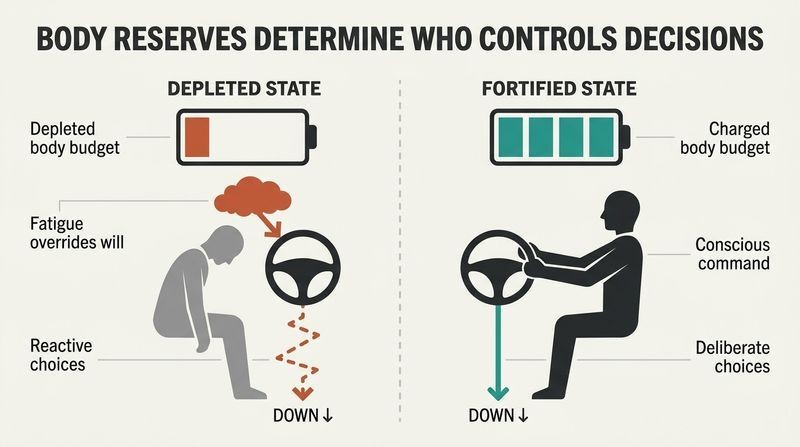
The body is the instrument. Lou Gehrig played 2,130 consecutive baseball games despite illnesses, injuries, and numerous healed fractures. He treated fitness and preparation as part of his profession, not as optional extras. His example shows how bodily habits can support sustained effort, but it also contains an important limit: when ALS made him unable to help his team, he removed himself from the lineup. Discipline meant knowing when persistence had stopped serving the work.
Care enables command. The book treats exercise, food, and sleep as foundations for clearer thought and steadier behavior. It cites the idea of a “body budget”: the brain’s ability to regulate emotions and make decisions depends partly on the body’s physical resources. A useful warning from addiction work is HALT, which prompts people to notice hunger, anger, loneliness, and tiredness before these states steer their choices.
Gehrig’s story is compelling partly because it refuses to make self-control purely mental. A person’s capacity to focus or stay calm is affected by whether they are depleted. That is a practical corrective to advice that treats every lapse as weak character. Yet the story also risks making pain tolerance look like a universal ideal. Gehrig’s own decision to stop is as instructive as his streak: listening to physical limits can be an expression of discipline, not its failure.
Make consistency and deliberate practice your answer to uneven talent
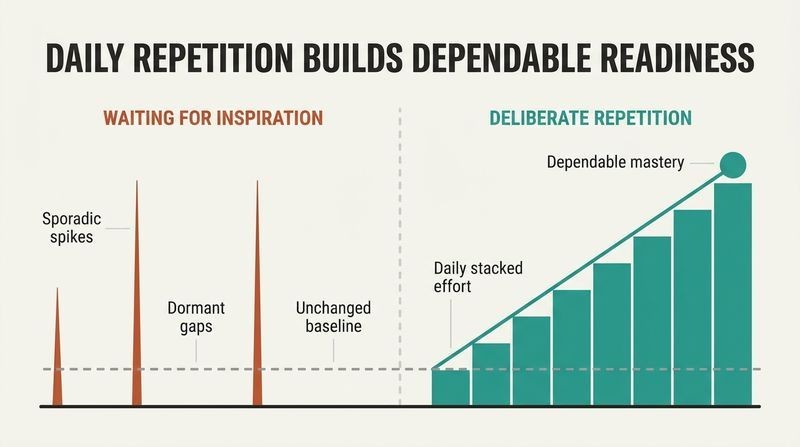
Show up before inspiration. Thomas Edison credited his presence in the laboratory as much as his ideas: discoveries could only benefit him if he was there to notice and develop them. Joyce Carol Oates likewise built an enormous body of work through years of regular writing, rather than waiting for ideal conditions. The point is not that every session produces something remarkable. A baseball scout once explained to Lou Gehrig that even excellent hitters miss often. The next attempt still matters.
Repetition becomes readiness. The swordsman Nakayama Hakudo reportedly practiced drawing his sword thousands of times. Repetition helped turn a learned movement into a dependable response under pressure. The book’s standard is not activity for its own sake, but persistent work that improves a craft. Choose a useful skill, return to it regularly, and learn from the results.
Consistency is powerful because it increases the number of opportunities for learning, discovery, and useful luck. It also changes how people interpret a bad session: a single poor result does not have to become a verdict on their ability. Still, time spent is not automatically practice. Repetition is most valuable when it includes attention, correction, and a clear idea of what is being improved. The book’s examples are strongest when persistence is paired with feedback, rather than treated as a substitute for it.
Pace effort, rest, and discomfort to stay useful for the long haul
Restraint includes recovery. In 2012, San Antonio Spurs coach Gregg Popovich rested several star players during a demanding stretch of the season. The choice drew criticism and a league fine, but it reflected a longer view: protecting players’ health could improve their chances of performing later. Sleep is part of that same discipline. Boxer Floyd Patterson rested extensively before a title fight, treating recovery as preparation rather than laziness.
Practice being uncomfortable. Seneca, a wealthy Roman, periodically chose sparse food, rough clothing, and hard sleeping conditions so that he could learn what he was capable of enduring. That is different from exhausting oneself without purpose. The book contrasts useful, chosen difficulty with James Forrestal’s destructive overwork, which eroded his health and judgment. Sustainable discipline means knowing when to push, when to rest, and what discomfort is worth accepting.
This section improves the familiar celebration of grit by making restraint part of the training plan. In physical training, craft, and leadership, the aim is not maximum effort at every moment; it is reliable capacity over time. Voluntary discomfort can also reduce fear of losing comfort, but it has limits. Practicing a hard thing is not proof that every hardship is beneficial, and rest should not need to be earned through suffering. The useful question is whether a demand builds capacity or merely consumes it.
Guard your main work by controlling attention, time, and commitments
Choose before the day chooses. Booker T. Washington ran an institute, traveled, spoke, and wrote, yet protected his central purpose by declining requests that would consume his time. His example leads to a basic test: without a clear priority, it is impossible to know which invitations deserve a yes. Toni Morrison found quiet morning hours for writing while balancing work and parenting. The point is not that everyone must wake early, but that important work needs protected time.
Make focus easier to keep. Beethoven could become absorbed in musical ideas; Robert Moses processed incoming papers instead of letting them pile up. A clean workspace, a routine, and fewer interruptions reduce the effort spent switching tasks. Time is finite, so each commitment displaces another. Saying no to a secondary demand can be a concrete way of saying yes to the work, relationships, or responsibilities that matter most.
The useful connection here is between attention and architecture. A priority becomes real when the calendar, workspace, and rules for interruptions support it. This is more durable than relying on motivation each morning. The limitation is that people do not all control their schedules equally; caregiving, unstable work, and financial pressure can make uninterrupted time scarce. In those cases, the principle still applies, but its expression may be a protected half-hour or a negotiated boundary rather than an idealized block of quiet.
Pause before pleasure, pain, anger, or provocation takes the reins
Insert a moment of judgment. George Washington faced battlefield setbacks, criticism, and conflict among his officers. Rather than treating his first reaction as a command, he tried to examine events before responding. That pause matters because emotion can narrow attention and make an immediate response feel unavoidable. In another example, businessman William Thalhimer endured insults during a land negotiation because retaliating would have jeopardized the purchase he came to make.
Distinguish relief from repair. President John F. Kennedy lived with serious pain, but relied on a dangerous mix of drugs in pursuit of relief. The book does not argue against appropriate treatment. It warns against shortcuts that mask a problem while impairing judgment. Epicurus offers a related test for pleasure: consider not only the immediate enjoyment, but also the discomfort or regret that may follow. Self-command is the ability to feel an urge without automatically obeying it.
A pause is a small intervention with large consequences: it can keep an insult from dictating a negotiation or an impulse from becoming a habit. The section also usefully distinguishes managing pain from pretending it does not exist. That distinction is essential, since restraint should not be confused with refusing medical or psychological help. The practical challenge is identifying the moment early enough. A response plan, such as stepping away before sending an angry message, can make the pause easier to access under pressure.
Set limits on ambition, money, and comfort before success sets them
More can become a master. Napoleon once wrote against ambition without limits, then dismissed the warning when it was presented to him after he had gained power. Alexander the Great provides another caution: his expanding conquests did not satisfy him, and his empire did not endure him. The point is not to abandon goals. It is to ask whether achievement serves a cause or feeds a need that can never be filled.
Buy independence, not dependence. Cato the Elder avoided costly luxuries because he believed unnecessary possessions could make a person vulnerable to pressure. Babe Ruth, by contrast, earned enormous sums yet spent so freely that he often needed to borrow. Money can provide options, but it can also create new obligations and anxieties. A useful test is whether a purchase or pursuit supports freedom and values, or mainly serves comparison, appetite, or status.
The section challenges a common assumption that achievement naturally produces contentment. Ambition can provide direction, but without a stopping rule it tends to redefine success as the next acquisition. Likewise, financial restraint is valuable when it protects choices, not when saving becomes a new compulsion. The book’s examples suggest a helpful distinction: resources are tools, while identity built around constant accumulation is a trap. The hard question is not simply how much is enough, but what the person hopes the next gain will finally make them feel.
Finish imperfect work, learn from losses, and return to the arena
Do not let standards become an alibi. Choreographer Martha Graham became so dissatisfied with a dance she had created that she feared the entire project was worthless. A trusted collaborator pushed her to complete it. Her story shows how high standards can turn against their purpose when they prevent a work from reaching an audience. Joyce Carol Oates used a different form of patience: she let manuscripts rest before revising them, giving herself distance without abandoning the task.
A loss need not become an identity. Boxer Floyd Patterson lost his heavyweight title after being knocked down repeatedly. Advice from former champion Archie Moore helped him study the defeat and prepare for a rematch, which he won about a year later. Setbacks are inevitable; the next decision is not. Review what happened, make a correction, and resume the work instead of treating one failure as a permanent definition.
The distinction between revision and avoidance is central. Delay can improve a piece when it creates perspective, as it did for Oates, but it can also protect a creator from the risk of judgment. A deadline or trusted collaborator can turn a vague desire for perfection into a finished attempt. Patterson’s comeback adds a related lesson: recovery is not denial of failure, but a willingness to examine it without surrendering one’s future to it.
Lead by carrying burdens and giving away power
Authority is a responsibility. On Christmas Day, Marine officer Jim Mattis took a guard shift so an enlisted man could be home with his family. The gesture matched a principle in the book’s leadership examples: rank should not exempt someone from the burdens others carry. Harry Belafonte paid for household help for Martin Luther King Jr. and Coretta Scott King, protecting time for their central work and family life. Supporting others can be a practical form of service, not merely a display of generosity.
Power can be shared. After the American Revolution, George Washington resigned his military command instead of turning victory into personal rule. Marcus Aurelius made his stepbrother a co-emperor rather than eliminating him as a rival. Their choices show self-command in public life: the powerful person need not monopolize credit, control, or opportunity. Delegation and succession can strengthen a cause beyond one person’s reach.
These examples make restraint observable. A leader’s values become credible when they accept inconvenience, share authority, and create room for others to contribute. Delegation also protects the mission from becoming dependent on one person’s energy or judgment. The principle has an important boundary: sacrifice should not become a performance that demands everyone else imitate it. Effective leadership is not simply taking on more, but deciding which burdens to carry personally and which to distribute fairly.
Make discipline a model for others, not a weapon against them
Keep standards aimed inward. Cato the Younger held himself to severe standards but continued to love his more indulgent brother. The contrast matters: being disciplined does not give someone authority over other people’s choices. Basketball star Kobe Bryant’s intensity helped make him exceptional, but the book notes that expecting teammates to match his standards could alienate them. A strong example can inspire; relentless comparison can drive people away.
Stay humane and adaptable. The philosopher Cleanthes once stopped a stranger who was scolding himself after a mistake, reminding him to treat himself as a person capable of error. The book also warns that methods can become rigid: the swordsman Musashi kept learning new approaches rather than relying on one favored technique. Self-command is not self-punishment or stubbornness. It includes self-kindness, respect for others’ limits, and the willingness to adjust methods while preserving principles.
Discipline becomes socially valuable when it produces steadiness, generosity, and reliability rather than superiority. This is a useful check on the temptation to turn personal standards into a universal measure of worth. The Kobe example shows how excellence in an individual can coexist with poor fit as a team standard. Flexibility is equally important: a routine should serve a purpose, not become an identity that cannot be questioned. The best discipline can explain why it exists and recognize when its form needs to change.
Analysis
Discipline Is Destiny is a story-driven argument for temperance, organized as a progression from the body, to the temperament, to public life. Its central idea is that self-control is not a narrow productivity trick or a campaign against pleasure. It is the capacity to choose, persist, and restrain oneself in service of a considered purpose. The historical portraits make this claim concrete: Lou Gehrig’s preparation, Queen Elizabeth’s reserve, Washington’s measured judgment, and Marcus Aurelius’s restraint under pressure each show a different application of the same virtue.
The book’s most valuable tension is between effort and restraint. Readers are urged to work, practice, endure discomfort, and show up consistently, but also to sleep, recover, delegate, wait, and leave when persistence becomes harmful. That balance prevents discipline from collapsing into mere overwork. It also clarifies why the stories of Gehrig and Forrestal matter: endurance is not automatically wisdom, and a streak is not worth preserving at any cost. The method has limits. Biographies often spotlight exceptional figures whose lives are unusually visible, and such examples can make demanding standards seem more universally achievable than they are. The author acknowledges unequal circumstances, but the emphasis remains on personal command. A fuller application must distinguish controllable choices from conditions shaped by illness, poverty, caregiving, or institutional power. Otherwise, a language of virtue can accidentally turn hardship into a test of character.
The book is most persuasive when discipline is treated as a practiced capacity, not a fixed personality trait. Routines, boundaries, preparation, and supportive collaborators help make good choices more available. Equally, mistakes do not erase that capacity; recovery is part of it. The practical question running through the book is therefore not whether someone can control everything, but whether they can respond deliberately, protect what matters, and remain humane while doing so. Its title is best read as a claim about formation: repeated choices shape character, and character influences what becomes possible.
Review Summary
Discipline is Destiny received mixed reviews. Many praised its inspirational content and accessible approach to Stoic philosophy, highlighting Holiday's engaging writing style and use of historical examples. Some found it repetitive or shallow in philosophical depth. Positive reviewers appreciated the practical advice on self-discipline and temperance. Critics felt the book lacked originality or relied too heavily on oversimplified interpretations of historical figures. Several readers noted similarities to Holiday's previous works, while others found it his best yet. Overall, opinions varied widely on the book's value and impact.
People Also Read










Glossary
Temperance
self-command through moderationThe cardinal virtue at the center of the book. Temperance means governing appetites, emotions, effort, and power rather than being governed by them. It is not the rejection of pleasure or ambition, but the ability to pursue or refuse them in proportion to a considered purpose.
akrasia
acting against better judgmentAn ancient Greek term for the inner conflict between what a person knows they should do and what they are tempted to do instead. The book uses it to describe the recurring choice between a considered, higher aim and an immediate impulse.
festina lente
make haste slowlyA Latin maxim associated in the book with Augustus Caesar. It describes acting with urgency while avoiding rashness: prepare carefully, move deliberately, and do not confuse speed with effectiveness. The phrase captures the balance between energetic effort and controlled pacing.
load management
planned effort and recoveryA sports practice of managing an athlete’s workload, including planned rest, to reduce injury risk and preserve performance over time. The book uses Gregg Popovich’s decision to rest key San Antonio Spurs players as an example of choosing sustainable performance over immediate approval.
kaizen
continuous incremental improvementA Japanese term for ongoing improvement through small, repeated changes. In the book, it describes the disciplined habit of identifying what can be improved each day rather than expecting a dramatic transformation. The practice applies to skills, work, and personal conduct.
Ekāgratā
single-pointed attentionA term from yogic tradition for intense focus on one point or task. The book connects it to sustained concentration: putting the mind fully on the work at hand and setting aside competing distractions. It presents focus as a capacity to cultivate, not merely a feeling that arrives.
philoponia
love of hard workAn ancient Greek term the book uses for a committed affection for toil and effort. It describes a person who values the work itself, not only recognition or results. Joyce Carol Oates’s sustained writing practice and Lou Gehrig’s dedication to baseball illustrate this orientation.
sitzfleisch
staying with a taskA German term for the capacity to remain seated and persist with difficult work instead of leaving when discomfort or boredom sets in. The book uses it to name a form of endurance required for sustained writing, leadership, and problem-solving.
emmenetea
what must be enduredA Stoic term used in the book for conditions or pain that must be tolerated. It frames endurance as part of life’s demands, while the book also distinguishes tolerating necessary difficulty from ignoring warning signs or refusing appropriate help.
HALT
a relapse warning checklistAn acronym used in addiction settings to flag states that can make relapse more likely: hungry, angry, lonely, and tired. The book presents it as a practical cue to check bodily and emotional conditions before they undermine judgment or self-control.
FAQ
What's Discipline Is Destiny: The Power of Self-Control about?
- Focus on Self-Control: The book by Ryan Holiday emphasizes the importance of self-discipline as a foundational virtue for achieving personal and professional success.
- Three Domains of Discipline: It is structured around three main parts: the exterior (the body), the inner domain (the temperament), and the magisterial (the soul).
- Historical Examples: Holiday uses historical figures like Marcus Aurelius, Queen Elizabeth II, and Lou Gehrig to illustrate the principles of self-discipline.
- Cardinal Virtues: The book connects discipline to the four cardinal virtues: courage, temperance, justice, and wisdom.
Why should I read Discipline Is Destiny?
- Practical Guidance: The book offers practical advice and strategies for cultivating self-discipline in various aspects of life.
- Inspiration from Historical Figures: It draws on examples from historical figures to illustrate the power of discipline, serving as motivation for readers.
- Timeless Wisdom: The principles are rooted in ancient philosophy and modern psychology, making them relevant across different contexts and eras.
- Guidance for Modern Life: It helps readers navigate the complexities of modern life with clarity and intention.
What are the key takeaways of Discipline Is Destiny?
- Discipline Equals Freedom: True freedom comes from self-discipline, allowing individuals to achieve their goals and live authentically.
- Endurance and Resilience: The book emphasizes the importance of endurance and resilience in the face of challenges.
- Balance and Moderation: Holiday advocates for moderation rather than excess, arguing that true pleasure comes from self-control.
- Focus on the Main Thing: Identifying and prioritizing primary goals helps eliminate distractions and fosters a more productive life.
What are the best quotes from Discipline Is Destiny and what do they mean?
- “Self-discipline is giving everything you have … and knowing what to hold back.”: Highlights the balance required in self-discipline, suggesting mastery involves knowing when to push forward and when to exercise restraint.
- “Freedom requires discipline. Discipline gives us freedom.”: Encapsulates the book's core philosophy, asserting that self-discipline is essential for achieving personal freedom.
- “Discipline is not a punishment, it’s a way to avoid punishment.”: Suggests that by exercising self-control, individuals can prevent negative consequences in their lives.
- “Seek yourself, not distraction.”: Encourages readers to focus on their true selves and aspirations rather than getting lost in distractions.
How does Ryan Holiday define self-discipline in Discipline Is Destiny?
- Control Over Impulses: Self-discipline is the ability to control one's impulses and desires, making conscious choices that align with long-term goals.
- Commitment to Growth: It requires ongoing effort and reflection to cultivate habits that support one's aspirations.
- Foundation for Other Virtues: Holiday argues that self-discipline is the bedrock upon which other virtues like courage, justice, and wisdom are built.
What specific methods does Ryan Holiday suggest for developing self-discipline?
- Ruling Over the Body: Emphasizes physical discipline through regular exercise, proper nutrition, and adequate sleep.
- Practicing Patience: Advocates for the discipline of patience, encouraging readers to wait for the right moment before acting.
- Embracing Discomfort: Suggests seeking out discomfort as a way to build resilience and strengthen character.
How does Discipline Is Destiny relate to the concept of the four cardinal virtues?
- Interconnected Virtues: The four cardinal virtues—courage, temperance, justice, and wisdom—are interrelated and essential for a disciplined life.
- Courage in Discipline: Courage is necessary to practice self-discipline, especially when facing fears or challenges.
- Temperance as Self-Control: Defined as the ability to exercise self-control and moderation, crucial for maintaining balance in life.
What role does mental resilience play in Discipline Is Destiny?
- Mental Toughness: Mental resilience is a key component of self-discipline, essential for achieving long-term goals.
- Focus and Clarity: Allows individuals to maintain focus on their objectives, even in the face of distractions or difficulties.
- Emotional Regulation: Highlights the importance of managing emotions as part of mental resilience, enabling effective responses to situations.
How does Discipline Is Destiny address the balance between work and rest?
- Importance of Rest: Emphasizes that self-discipline includes knowing when to rest and recover to maintain long-term productivity.
- Load Management: Discusses balancing effort with recovery to sustain performance over time.
- Mindful Breaks: Encourages taking mindful breaks to recharge mentally and physically, enhancing focus and creativity.
How does Discipline Is Destiny suggest handling failure?
- Embrace Mistakes: Encourages readers to embrace mistakes as opportunities for growth and learning.
- Practice Self-Compassion: Emphasizes being kind to oneself in the face of failure, fostering resilience and determination.
- Focus on Progress: Advocates for focusing on progress rather than perfection, recognizing incremental improvements.
What is the relationship between self-discipline and success in Discipline Is Destiny?
- Self-Discipline as a Catalyst: Posits that self-discipline is a catalyst for success, enabling focus and overcoming obstacles.
- Long-Term Perspective: Success is about sustained effort over time, with self-discipline maintaining commitment to long-term goals.
- Character Development: Cultivating discipline not only achieves goals but also develops better versions of oneself.
How can I apply the lessons from Discipline Is Destiny in my daily life?
- Set Clear Goals: Identify main objectives and prioritize them for focused efforts and better decision-making.
- Establish Routines: Create daily routines incorporating physical, mental, and emotional discipline to build self-discipline over time.
- Reflect and Adjust: Regularly assess progress and adjust strategies to stay aligned with goals and reinforce commitment to self-discipline.
About the Author
Other books by Ryan Holiday








Download PDF
Download EPUB
.epub digital book format is ideal for reading ebooks on phones, tablets, and e-readers.








