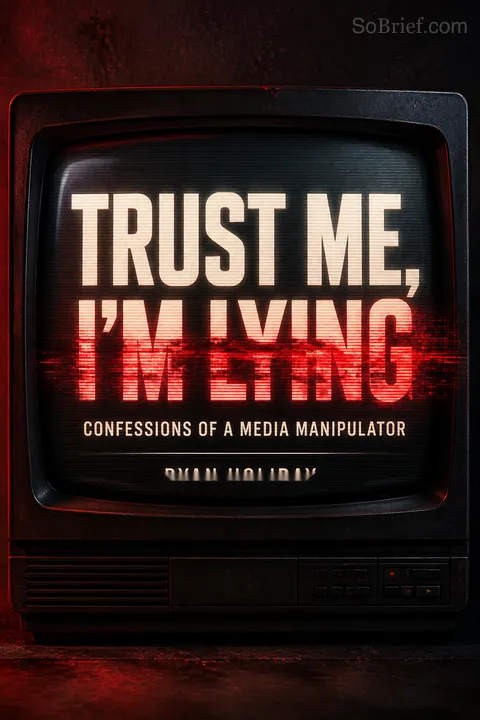


Key Takeaways
Assume viral coverage can turn a fabricated event into real consequences.
A hoax gathered momentum. Holiday opens with a campaign for a film based on Tucker Max’s book. He secretly altered the film’s billboards, sent photos to blogs under a fake name, and encouraged protests against the movie. News outlets covered the outrage, although much of it had been manufactured by the film’s own publicist. The attention helped sell the book and make Max more famous. But some people who encountered the story were genuine protesters, not actors in Holiday’s scheme.
The reaction became real. This is the book’s central warning: a false report can prompt real beliefs, decisions, and behavior. Coverage does not simply describe an event. It can create the conditions that make the event consequential. Holiday admits that he helped build this system before understanding its wider costs.
The campaign illustrates a feedback loop, not merely a lie that fooled a few readers. Once a claim enters public circulation, people respond to one another’s reactions as well as to the original claim. The resulting outrage can be sincere even when its starting point was staged. That distinction matters: checking whether an initial event was real is not enough if the coverage itself has already changed what people do. The example is also a useful test of claims that publicity is harmless because audiences can simply ignore it.
Follow the paycheck: pageview pay rewards speed, outrage, and volume.
Attention pays the bills. Most blogs in Holiday’s account earn money by selling ads against traffic. More pageviews mean more ad impressions, so a story that attracts clicks can be financially valuable even if it is inaccurate, trivial, or quickly forgotten. The writer’s incentives often mirror the publisher’s: some sites paid by the post or rewarded writers for traffic. Holiday cites early blogging rates as low as four dollars per post, and describes pageview targets that could determine bonuses or continued employment.
Influence need not be bought outright. Free products, trips, access, and promising tips can help sources win coverage because they serve a writer’s needs. Holiday argues that the strongest pressure is built into the job itself: write quickly, publish often, and attract attention. This explains the system’s vulnerability, though it does not excuse an individual writer’s choices.
The important distinction is between bribery and incentive design. A writer need not accept cash from a source to face a conflict of interest; compensation tied to clicks can reward sensational framing regardless of who supplies the story. This is a measurement problem: what can be counted easily starts to stand in for what matters. Pageviews reveal that someone looked, not whether the work informed them. The account is most persuasive as a diagnosis of pressure, not as proof that every traffic-funded outlet or journalist behaves alike.
Trace a story to its first source before trusting the reach it has gained.
Stories can climb by repetition. Holiday calls the method “trading up the chain”: seed a claim with a small blog, let larger outlets cite that coverage, then use the apparent buzz to attract national media. Each new publication can make the claim seem more credible, even when nobody has verified it independently. A Brooklyn charity used this route to raise nearly $10,000: a local blog covered its video, the Huffington Post picked it up, and the coverage helped it reach television and Reddit.
The same path can harm. Holiday describes a Florida pastor’s planned Quran burning gaining attention through blogs and news outlets. When the pastor went ahead, riots in Afghanistan killed 27 people, including seven UN workers. The point is not that every small story grows dangerously, but that a chain of repetition can turn a marginal stunt into an event with serious consequences.
The chain makes provenance more important than popularity. Five articles may look like five confirmations while actually tracing back to one unverified tip. This resembles a common weakness in evidence networks: repeated circulation is mistaken for independent corroboration. Readers can interrupt that illusion by asking who first made the claim and whether later reports gathered new evidence. The charity example also shows that a tactic’s mechanics do not determine its moral value. The same amplification process can help a cause or magnify a reckless provocation.
Shareability favors high-arousal anger, not the human detail that explains a crisis.
Emotion selects the picture. Holiday cites a study of 7,000 New York Times articles that made the paper’s Most E-mailed list. Anger was the strongest predictor of sharing; sadness was less likely to prompt it. He contrasts widely circulated photographs of Detroit’s empty, ruined buildings with less-shared images that included residents and other signs of hardship. The abandoned architecture made a striking, simple image. The people living amid the damage made the story harder to consume and pass along.
What spreads can mislead by omission. The most popular version of Detroit offered a compelling visual story while leaving out details that might invite empathy or a more complicated account. Holiday’s argument is not that every viral item is false, but that the pressure to provoke can systematically favor simplified, emotionally charged versions of events.
This is a subtle form of distortion: no image needs to be fabricated if the selection of images creates a misleading impression. Attention rewards what can be felt and forwarded quickly, while structural explanations and human context take longer to absorb. The distinction between anger and sadness is useful because emotion affects not only what people remember, but what they choose to circulate. Still, strong emotion can sometimes focus attention on neglected harm. The key question is whether the feeling opens inquiry or substitutes for it.
When every article must sell alone, journalism starts acting like tabloid street sales.
Distribution shapes the news. Holiday compares online publishing with the nineteenth-century Yellow Press, which sold individual papers on the street. Each issue had to win a buyer’s attention, encouraging dramatic headlines and sensational stories. Later, publishers such as New York Times owner Adolph Ochs built a subscription model in which readers bought the publication as a whole. That gave reputation and consistent value a larger role. Online articles, Holiday argues, again compete one by one for attention from search, social feeds, and aggregators. He calls this pressure the “One-Off Problem.”
Format adds pressure. Blogs stack new material at the top and push older posts down, encouraging constant updates and short articles. A headline must attract a reader before the article can explain itself. The result is a medium that often favors immediacy and provocative packaging over patient context.
The historical comparison helps explain why the same sensational habits can return under new technology. The platform changes, but the commercial problem remains: publishers must repeatedly persuade people to stop and pay attention. Subscription can soften that pressure by making trust valuable across many stories, although it cannot guarantee accuracy or independence. The broader lesson is that media ethics cannot rely only on individual restraint. The way work is distributed and funded helps determine which editorial virtues are rewarded.
Treat hyperlinks as leads to inspect, not proof that anyone checked.
A link can launder a claim. The “link economy” is the practice of sites linking to and building on one another’s reporting. In principle, it lets publishers share information. Holiday argues that it can also create an illusion of verification: a blog cites another blog, which cites a source that nobody checked. A fabricated quotation attributed to composer Maurice Jarre appeared on Wikipedia after his death, then spread through obituaries, including coverage in The Guardian. Repetition made the invented line seem authentic.
Sources can have agendas. Holiday also describes marketers supplying press releases, anonymous tips, Wikipedia edits, or supposedly expert commentary through HARO, a service matching reporters with sources. These materials can be useful starting points, but they are not neutral evidence. A link shows where a writer points the reader; it does not establish that the source is reliable or that the claim is supported.
The link’s visual authority is easy to confuse with evidential authority. A citation only helps when the underlying source is relevant, trustworthy, and accurately represented. Readers can test a claim by opening the link and checking whether it supports the sentence attached to it, then following the trail toward primary evidence. The book’s examples also expose a limitation in distributed reporting: many participants do not automatically create independent verification. Collaboration improves accuracy only when someone is responsible for checking the shared foundation.
A correction cannot reliably erase the first, loud version of a claim.
The first impression travels farther. Holiday criticizes “iterative journalism,” the practice of publishing an unverified report and adding information as it develops. He argues that updates often arrive after the initial story has already spread, sometimes buried at the bottom of the post. In one example, a Jezebel article accusing The Daily Show of sexism received about 333,000 views; a later post reporting the show’s women’s response received about 10,000. The rebuttal existed, but far fewer readers encountered it.
An update may not repair the story. Holiday describes corrections that leave the original headline and framing intact, or add a denial without reconsidering the claim built on it. The book also discusses research on the “backfire effect,” in which corrections can sometimes reinforce a disputed belief. The practical lesson is to treat an initial allegation as provisional, not as a fact that a later note will neatly undo.
A correction is not a rewind button. Readers encounter reports at different times, through different links, and often see only a headline or excerpt. That makes prominence and placement part of accuracy, not cosmetic choices. The comparison of audience sizes is especially revealing: a correction can be technically available while functionally invisible. The book’s stronger claim that corrections may backfire deserves careful handling, since responses can vary. Even so, the basic asymmetry remains: accusations are often easier to circulate than careful revisions.
Treat online pile-ons as punishment rituals, not dependable investigations.
A target becomes a caricature. Holiday uses the term “degradation ceremonies” for public rituals that strip someone of status and belonging. In online coverage, speculation, snark, and repeated accusations can turn a person into a fixed villain before the evidence is settled. He describes Shirley Sherrod, a government official forced to resign after a selectively edited video made her speech appear racist. The full context showed that she was describing how she had overcome racial prejudice, and the government later apologized for its rush to judgment.
Humor can intensify the damage. Snark often gives a publisher a quick way to mock a target without carefully defending the claim. Once jokes and labels spread, a serious response can be recast as proof of guilt or a lack of humor. The person’s reputation can suffer even after the story is challenged.
Public criticism can expose genuine misconduct, so the answer is not to shield powerful people from scrutiny. The distinction is between investigation, which tests evidence, and ritualized condemnation, which uses attention to enforce a social verdict. Selective editing and mockery are especially dangerous because they make a complex dispute feel settled and entertaining. A useful standard is proportionality: the certainty and severity of coverage should match the quality of the evidence, while the subject retains a meaningful opportunity to respond.
Reward useful reporting with attention, money, and demands for visible accountability.
Readers help set the market. Holiday’s conclusion is that publishers respond to what audiences click, share, and pay for. He urges readers to ask what they can actually do with a piece of information, rather than treating constant updates as knowledge. He also points to subscription models as a way to make sustained trust more valuable than a single viral hit. For publishers, he argues for prominent corrections and responsibility for the harms caused by reckless reporting.
The operator is part of the problem. Holiday does not present himself as an innocent critic. He admits to staging controversies, planting material, and profiting from the system he condemns. His final message is that opting out matters: marketers can refuse deceptive tactics, readers can stop rewarding empty outrage, and publishers can choose accuracy even when it is slower or less immediately profitable.
The proposed response is deliberately broader than a checklist because the problem is collective: sources, publishers, advertisers, and audiences all shape the attention market. Individual skepticism helps, but it cannot replace newsroom standards or business models that reward reliability. The most useful question is not simply whether a story is interesting, but what evidence supports it and what purpose its circulation serves. Holiday’s confession adds force to the argument while also reminding readers that exposing a tactic does not, by itself, dismantle the incentives behind it.
Analysis
The book works as both an insider confession and an account of how commercial incentives shape public knowledge. Its most distinctive move is to connect small editorial choices, such as a headline or an anonymous tip, to large consequences. A claim can travel from a local blog through national outlets, gather apparent credibility at each step, and provoke behavior that makes the original fiction consequential. The opening publicity campaign gives this argument a human narrator who is not merely diagnosing manipulation but admitting to practicing it.
That perspective is a strength and a limitation. Holiday’s access gives the account concrete detail about pitches, traffic goals, and publisher relationships. Yet his claims about online media sometimes generalize from the outlets and campaigns he knew best. Traffic incentives create risks, but they do not make every ad-supported journalist dishonest, nor do subscriptions guarantee sound reporting. Editorial checks, source transparency, corrections, and ownership structures also matter. The book is strongest when it describes incentive patterns and weakest when it treats a diverse media system as though it had one motive.
Its enduring contribution is to make credibility a question of process, not presentation. A familiar logo, a link, an exclusive label, or repeated coverage can look like verification without being verification. Readers need to trace claims to their origins, distinguish independent confirmation from repetition, and notice when emotion is doing the work of evidence. Publishers, meanwhile, cannot outsource accountability to audiences or rely on buried updates to repair preventable harm. The central challenge is institutional: whether media organizations will make trust economically valuable, even when doing so means publishing less quickly and less often.
Review Summary
Trust Me, I'm Lying exposes the manipulative tactics used in online media and blogging. Holiday reveals how easily news can be fabricated and spread, driven by profit motives and page views. The book is divided into two parts: the first explaining media manipulation techniques, and the second exploring their societal impact. Readers found the content eye-opening and disturbing, praising Holiday's insights into the flaws of modern journalism. However, some criticized the repetitive nature of certain sections and questioned the author's motives for exposing these practices.
People Also Read








Glossary
Trading up the chain
Escalating a planted storyA media manipulation technique that starts a claim with a small or local outlet, then uses its coverage to attract larger publishers and eventually national attention. Each outlet may treat earlier coverage as evidence of public interest or credibility, even when the original claim has not been independently verified.
One-Off Problem
Every story must win attentionHoliday’s term for the pressure created when a publication must sell each article separately rather than relying on readers to buy or subscribe to the publication as a whole. Online stories compete individually for clicks, encouraging dramatic headlines and emotionally charged subjects that can attract immediate attention.
Link economy
Traffic exchanged through linksA network in which websites link to one another’s reporting and use earlier coverage as material for new posts. Links can help readers follow a story, but Holiday warns that repeated citation may create the appearance of independent confirmation even when later publishers have not checked the original evidence.
Iterative journalism
Publish first, update afterwardA publishing approach that releases developing or uncertain claims quickly and revises the story as more information becomes available. Its advocates see speed and updates as a way to improve coverage over time. Holiday argues that readers often encounter only the first version, while corrections may be less visible and unable to undo its effects.
Degradation ceremonies
Public rituals of disgraceA sociological term used for collective acts that lower a person’s status or cast them out of a group. Holiday applies it to online pile-ons in which allegations, jokes, and repeated coverage turn a target into a public caricature. The ritual can produce social punishment before facts are fully established.
Pseudo-events
Events staged for coverageEvents planned primarily to attract media attention, rather than to accomplish their apparent purpose on their own. Product launches, press conferences, and staged controversies can all function this way. Holiday argues that online outlets often welcome such events because they provide ready-made material for stories and traffic.
Backfire effect
Correction strengthens a beliefA concept discussed in the book through research on political misperceptions. It describes cases in which a correction does not reduce belief in a false claim and may instead reinforce it. Holiday uses the concept to challenge the assumption that an online correction can reliably repair the influence of an earlier accusation.
FAQ
What's Trust Me, I'm Lying about?
- Media Manipulation Exposed: The book reveals how modern media, especially blogs, can be manipulated for profit and influence. Ryan Holiday shares his experiences as a media manipulator, detailing the tactics he used to create news stories.
- Cultural Critique: It critiques the current state of journalism, emphasizing how sensationalism and the pursuit of clicks have degraded the quality of news.
- Personal Confession: Holiday provides a candid account of his role in shaping narratives and manipulating public perception, ultimately expressing regret for his actions and their consequences.
Why should I read Trust Me, I'm Lying?
- Insight into Media Dynamics: The book offers a behind-the-scenes look at how media operates today, making it essential for anyone interested in understanding modern journalism.
- Understanding Manipulation: Readers will learn about the tactics used by marketers and media manipulators, which can help them recognize and resist manipulation in their own media consumption.
- Cautionary Tale: Holiday's experiences serve as a warning about the dangers of misinformation and the ethical implications of media manipulation.
What are the key takeaways of Trust Me, I'm Lying?
- Media is Manipulable: The book emphasizes that the current media landscape is highly susceptible to manipulation, particularly by those who understand its mechanics.
- The Link Economy: Holiday introduces the concept where the value of a story is determined by its ability to generate clicks and links rather than its truthfulness.
- Consequences of Misinformation: The book discusses the real-world consequences of media manipulation, including public outrage and the potential for harm to individuals and organizations.
What are the best quotes from Trust Me, I'm Lying and what do they mean?
- “I am, to put it bluntly, a media manipulator—I’m paid to deceive.”: This quote encapsulates Holiday's role in the media landscape, highlighting the ethical dilemmas faced by those in public relations.
- “The economics of the Internet created a twisted set of incentives that make traffic more important—and more profitable—than the truth.”: This statement critiques the prioritization of clicks over journalistic integrity.
- “The manipulators are indistinguishable from the publishers and bloggers.”: This highlights the blurred lines between content creators and those who are supposed to report the news.
What are the nine tactics outlined in Trust Me, I’m Lying?
- Bloggers are Poor: This tactic involves providing incentives to bloggers, such as free products or payments, to ensure coverage of a story.
- Tell Them What They Want: Manipulators craft narratives that align with bloggers' biases or interests, making it easier for them to publish sensational stories.
- Just Make Stuff Up: Acknowledging that many bloggers do not verify their sources, manipulators can create false narratives that are easily accepted.
How does Ryan Holiday define a media manipulator in Trust Me, I’m Lying?
- Deceptive Practices: Holiday describes a media manipulator as someone who uses deception and manipulation to influence public perception and media narratives.
- Strategic Influence: The role involves understanding the vulnerabilities of the media system and exploiting them for personal or client gain.
- Ethical Dilemmas: The book raises questions about the morality of such practices, as they can lead to significant consequences for individuals and society.
What is the One-Off Problem mentioned in Trust Me, I’m Lying?
- Definition: This concept refers to the tendency of blogs to chase sensational stories that generate immediate traffic without considering the long-term implications.
- Impact on Content Quality: It encourages bloggers to prioritize short-term gains over the integrity of their reporting.
- Cycle of Misinformation: This problem perpetuates a cycle where misinformation spreads rapidly, as blogs compete for attention.
How does Trust Me, I’m Lying define iterative journalism?
- Definition: Holiday describes iterative journalism as a practice where stories are published quickly, often before they are verified.
- Consequences: This approach prioritizes speed over accuracy, leading to a proliferation of rumors and speculation.
- Critique: Holiday critiques this model for its lack of accountability and the way it undermines the public's trust in the media.
What role does snark play in the media according to Trust Me, I’m Lying?
- Definition: Holiday defines snark as a form of humor that often involves mocking or deriding individuals or situations.
- Impact on Public Figures: Snark can destroy reputations and reduce complex individuals to caricatures.
- Cultural Reflection: It reflects a broader cultural trend of cynicism and detachment.
How does Trust Me, I’m Lying illustrate the concept of unreality?
- Definition: Holiday describes unreality as a state where the lines between truth and fiction are blurred due to the manipulative practices of media.
- Examples: The book provides examples of how sensationalized stories can lead to real-world consequences, such as public outrage or political fallout.
- Cultural Implications: Living in a state of unreality can have detrimental effects on society, as it undermines informed decision-making and critical thinking.
What are the ethical implications discussed in Trust Me, I’m Lying?
- Ethics of Manipulation: Holiday reflects on his own role in manipulating media narratives and the ethical dilemmas that arise from such actions.
- Responsibility of Media: The book emphasizes the responsibility of media outlets to provide accurate and truthful information.
- Call for Change: Holiday advocates for a reevaluation of media practices and a return to journalistic integrity.
How does Trust Me, I’m Lying suggest readers approach media consumption?
- Critical Thinking: Holiday encourages readers to approach media with skepticism and to question the sources of information.
- Awareness of Manipulation: The book advises readers to be aware of the tactics used by media to manipulate narratives and generate clicks.
- Demanding Accountability: Holiday calls on readers to hold media outlets accountable for their reporting.
About the Author
Other books by Ryan Holiday





Download PDF
Download EPUB
.epub digital book format is ideal for reading ebooks on phones, tablets, and e-readers.








