

Key Takeaways
Security isn't who you are; it's a state you paddle back toward
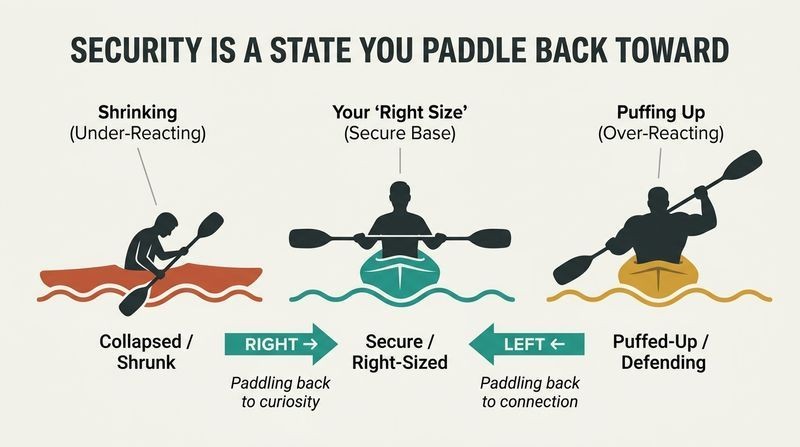
Secure relating is a verb, not a trait. The book's central reframe is that security is a state of mind you enter and leave dozens of times a day, not a fixed personality type or a diagnosis you either have or lack. When you are in a secure state, you can hold your own feelings and stay curious about someone else's at the same time, set boundaries without collapsing, and take in care without deflecting it.
You don't have to feel calm to be secure. You can be angry, hurt, or lonely and still keep your thinking online and your compassion intact. Marriott and Kelley call this being "your right size": neither shrinking to protect someone's ego nor puffing up to seem bigger than you feel. It is a destination you aim for, not a place you move into permanently.
What's striking is how this reframing dissolves the fatalism baked into pop-psychology attachment quizzes. If security is a state rather than a label, then a rough childhood is not a life sentence. This aligns with research on "earned security," pioneered by Mary Main, showing that adults who make coherent sense of painful pasts can raise secure children. The move also echoes acceptance-based therapies: the goal is not to eliminate difficult emotion but to stay functional inside it. One caution: calling security a "choice" risks implying people in chronic danger simply need better attitudes, a tension the authors themselves flag when discussing marginalized communities.
You didn't squash the bug; your protection circuit hijacked your curiosity

Two circuits run your relationships. The connection circuit pulls you toward exploration, bonding, and belonging. The protection circuit scans for danger and armors you up. The authors open with a parable: you admire a strange, beautiful insect on your wall, lean in fascinated, until it twitches and locks eyes with you. Within seconds curiosity flips to threat, and you crush it under your shoe. The bug did nothing; your perception changed once alarm bells rang.
The problem is invisibility. When the protection circuit fires, you feel certain the danger is "out there" (the bug, your partner, your teenager) rather than inside your own interpretation. Scary background music starts playing, you squint suspiciously, and you swear you are being perfectly rational. Recognizing that the action is happening inside you is the first move of secure relating.
The bug story is a small masterpiece of misdirection because it makes threat-reactivity impossible to deny in oneself. It maps neatly onto Daniel Kahneman's fast System 1 versus slow System 2, but the authors add a relational twist: the fast system doesn't just err, it rewrites the emotional meaning of another being in real time. Neuroscientist Lisa Feldman Barrett's work on constructed emotion reinforces the point that perception is prediction, not passive recording. The practical payoff is diagnostic humility: when someone suddenly seems like an enemy, the more useful question is not "what did they do" but "what just changed in me."
Blame the amygdala, not the person: felt safety is the only off-switch

Your alarm system has no volume knob. The amygdala, the brain's threat detector, is online at full charge from birth and fires before conscious thought. The authors' podcast catchphrase, "It's not me, it's my amygdala," de-shames reactive behavior: you aren't choosing to be needy or cold, your brain is doing its ancient job. Crucially, the amygdala cannot calm itself; as infants we borrow a caregiver's mature nervous system to learn that distress can be soothed.
The solution is always the same: increase felt safety. Chronic stress shrinks the hippocampus (memory, context) and weakens the prefrontal cortex (the wise elder that checks impulses). Under enough threat, cortisol triggers an "amygdala hijack" and both go offline, so it feels like whatever you feel is all there is and ever will be.
The reframe is compassionate and clinically grounded, but worth stress-testing. "It's not me, it's my amygdala" can slide into abdication if it becomes a standing excuse for cruelty. The authors clearly intend the opposite: understanding the mechanism to reclaim agency, not to dodge it. The neuroscience is a useful simplification, since threat processing actually involves the broader HPA axis and networks LeDoux calls "survival circuits." A cross-disciplinary echo: Stephen Porges's polyvagal framing and trauma-informed policing reforms both hinge on the same insight, that you cannot reason someone out of a state their body reads as dangerous. Safety precedes cognition.
Track whether you run hot or cold when threatened, then steer green
The MARS spectrum gives you a live dashboard. The Modern Attachment-Regulation Spectrum plots your in-the-moment state on a color band. Green in the middle is the secure sweet spot. Slide right into reds (amber, crimson, scarlet) and you are up-regulating: louder, more urgent, chasing conflict, terrified of losing connection. Slide left into blues (aqua, indigo, navy) and you are down-regulating: cooler, withdrawing, intellectualizing, avoiding vulnerability.
Naming the color builds the green zone. You don't need to know why you are activated or decode your whole history. Simply noticing "I'm going pink right now" engages the prefrontal cortex and starts the return to regulation. Red leaners should slow down and question the urgency to act; blue leaners should go looking for their heart, because caring feelings are what warm them back toward green.
Turning arousal states into a color gradient is a clever piece of interface design; it externalizes an internal process the way a fuel gauge externalizes engine chemistry. It resembles the therapeutic "window of tolerance" (Siegel) but adds directionality, which is its real contribution: most models tell you that you are dysregulated, not which way you tend to bolt. The risk is reification, treating oneself as permanently "a red" or "a blue." The authors repeatedly warn against this. A useful extension: couples often polarize, one fleeing hot while the other freezes cold, each escalating the other, which the color map makes vivid at a glance.
Fights about the vacation are never really about the vacation
Surface content hides the real conflict. DJ and Mia's date night implodes over a beach trip he says they never agreed to book. But the argument isn't about logistics. Mia (red-leaning) reads his phone-scrolling distance as rejection and escalates; DJ (blue-leaning) feels her neediness as invasion, defends his innocence, and shuts down. Both are drowning in cortisol, co-dysregulating each other into the ceiling. No video replay of "who agreed to what" could resolve it, because the fight is about competing bids for emotional security.
Watch the shift from content to "always/never." When couples move from the immediate issue to "you always work" and "you never ask," they have left the specific and entered entrenched pattern territory. The repair is not winning the facts; it is de-escalating both nervous systems first, then sorting details.
This is Gottman's research dramatized: the content of a fight is usually a proxy for what he calls perpetual problems rooted in unmet needs. The authors' contribution is the physiological layer, showing how each partner's defensive move is precisely the trigger for the other's. It resembles the pursue-withdraw cycle in Sue Johnson's Emotionally Focused Therapy, where the anxious pursuer's protest intensifies the avoidant partner's retreat in a self-reinforcing loop. The clinical implication is counterintuitive for most couples: stop litigating accuracy. Being right is orthogonal to being close, and often the pursuit of the former actively sabotages the latter.
Your caregivers wired a map that still distorts what you see today
Attachment maps are tinted sunglasses. Built from early experience plus biology plus culture, your map is a mostly-unconscious template of what you expect from yourself and others. It literally distorts incoming information. Red-tinted lenses magnify relational signals and tilt them toward rejection (you obsess over an unread text). Blue-tinted lenses block emotional data (you shrug "no big deal" and forget it, leaving others feeling unseen).
Jacki's story shows the map in action. Abandoned by her mother, raised by an unpredictable grandmother, adult Jacki fires off a furious group text after a night out where she felt excluded. Her limbic system scans relentlessly for signs of being left out, then externalizes the pain as blame. Her friends were right there, no actual danger present, but her map ran the old script line by line.
The "sunglasses" metaphor operationalizes cognitive-bias research for the emotional domain: attention and memory are not neutral but organized by prior learning, echoing Patricia Crittenden's work on information-processing distortions in attachment. What elevates it is the bidirectional insight, that maps don't just misread the world, they provoke it. Jacki's vigilance manufactures the rejection she dreads, a textbook self-fulfilling prophecy of the kind Robert Merton described in sociology. One nuance the authors honor well: a distorted lens is not a false one. Jacki's friends genuinely excluded her. The map inflates the volume, it doesn't invent the signal.
Blue leaners: your fear of feelings is oversensitivity in disguise
Avoidance is not coolness, it's stress. People who lean blue automatically turn down or shut off emotion under social pressure. In the classic Strange Situation experiment, avoidant toddlers appeared unbothered when their mothers left, playing on calmly, but physiological measures (sweating, heart rate) revealed they were highly distressed. By twelve months they had already learned to bypass their own needs, because reaching out with tears had reliably pushed their caregivers away.
The reframe stings and liberates. Blue leaners think emotional expression is the problem and rational fixing is the answer. But shutting down is itself a threat response. The authors argue that fear of intimacy is a form of oversensitivity: your body panics at closeness and cuts off. Behind most emotional avoidance sits carefully hidden shame and an inflated sense of personal responsibility.
Calling avoidance a hypersensitivity, not a deficit of feeling, is a genuinely counterintuitive move that inverts the cultural stereotype of the stoic as unbothered. The Strange Situation heart-rate data is the strongest evidence: outward calm masking internal storm. Adult neuroimaging cited in the field shows dismissing individuals actively down-regulating amygdala response via prefrontal control, which is effortful, not absent. The steelman for blue strategies, which the authors fairly grant, is that emotional compartmentalization is genuinely adaptive for surgeons, pilots, and first responders. The pathology is not the skill but its indiscriminate application to intimate life, where the people who love you experience it as abandonment.
Red leaners: name yourself, slow the cascade, send sentences not essays
Urgency is neurochemistry, not truth. Red-leaning activation floods you with "Act! Move! Hurry!" You replay conversations, chase your partner out of the room, fire off the text you know you shouldn't. The authors offer concrete brakes:
1. Say your own name aloud to add reflective distance ("Ann, take a breath").
2. Time-shift: picture yourself and the other person calm a few hours later.
3. Take slow breaths to signal your sonar that there is enough oxygen, meaning safety.
Speak in bullet points, not paragraphs. When flooded, red leaners over-explain, drowning the listener and undermining their own message. The fix is to state the need plainly without justifying it: "Whether it feels too sensitive to you or not, it's important to me." You do not have to be right to have a feeling, and boundaries are clarity about what you need, not accusations about what others did wrong.
The advice is behavioral and testable, which is its strength. Saying your name recruits what researchers call "distanced self-talk," and Ethan Kross's work shows third-person self-reference measurably reduces emotional reactivity. Time-shifting exploits the hippocampus's role in mental time travel, which the amygdala hijack shuts down, so deliberately imagining the future literally re-engages higher brain regions. The "sentences not essays" prescription connects to attachment-interview findings that anxious narratives wander and lose the listener. One honest tension: telling someone in a genuine power imbalance to "just state your need calmly" can misfire if the other party weaponizes their composure. The authors rightly gate all of this behind "safe-enough" relationships.
Trauma isn't the event; it's the imprint that outweighed your resources
Picture a balance scale. When the shock of an experience outweighs your capacity to cope (age, resilience, a protective person stepping in), the anguish lodges in the body to be processed later. Two people can live the same event and only one is traumatized. Developmental trauma comes from many small injuries, often neglect, the absence of something you needed, which is hard for a child's mind to name.
Tie-dye is scrambled coping. When early life was so chaotic that no single strategy kept caregivers safely available, people develop disorganized patterns, a swirl the authors call the tie-dye puddle beneath the spectrum. Beth, a landscape designer with nightmares and a pill habit, self-sabotages and can't trust her loving partner. Her body holds unprocessed terror from an abusive stepfather. Healing came not from insight but from a safe reconnection with her old youth pastor and a trauma-informed therapist.
Defining trauma by subjective imprint rather than objective event, following van der Kolk and Levine, is now clinical consensus and rightly decouples suffering from an event-severity ranking. The neglect emphasis matters: attachment research consistently finds that emotional absence can be more disorganizing than active abuse, because there is no coherent narrative to grasp. The "concussion" analogy, that one trauma sensitizes the system to the next, aligns with kindling models in neuroscience. Beth's arc makes a subtle argument worth underlining: cognitive insight is necessary but not sufficient. What rewires the limbic system is repeated felt safety with a trusted other, which is why relationship, not explanation, does the healing.
Insecurity isn't always personal; rigged systems keep nervous systems on alert
Context is not a footnote to attachment. The authors insist a "context umbrella" (race, class, gender, immigration status, disability) shapes the nervous system as powerfully as early caregiving. Black children carry higher baseline cortisol than white peers regardless of a warm home, reflecting generational and ongoing racial stress. For a Black man, vigilance toward authority is not preoccupied attachment; it is accurate threat-reading encoded by reality.
Vigilance can be adaptive, not disordered. What looks like insecurity in marginalized kids is often smart self-protection. Dismissing (blue) attachment predicts depression in white teens but has a weaker negative effect for Black teens, where emotional control is protective. The lesson: sometimes security must come from the outside in. Briana, a Black grad student, only discovered her constant "disconnection" was racial microaggression, not personal inadequacy, inside a therapy group of women of color.
This chapter is the book's most important corrective to attachment theory's WEIRD (Western, educated, industrialized, rich, democratic) origins, a sample representing roughly 5% of humanity yet treated as the norm. Grounding it in cortisol data and the misuse of attachment concepts in custody cases gives it teeth beyond gesture. The move parallels critiques in public health that individualize structural harm, blaming patients for outcomes produced by housing, policing, and income. The alloparenting point is especially sharp: cooperative child-rearing is the human default, not the exception, yet Western developmental science long pathologized it. The challenge left open is integration, how to hold both a real amygdala and a rigged system without collapsing one into the other.
Loneliness rivals smoking; connection beats blood-pressure meds for survival
Isolation is a measurable health hazard. A 2023 US Surgeon General report found weak social ties raise heart-disease risk by 29%, stroke risk by 32%, and dementia risk in older adults by roughly 50%, with mortality effects comparable to smoking. The remedy runs the other way: strong social connection increased the odds of still being alive at seven-year follow-up by 50% across 148 studies, and outperforms blood-pressure medication.
Reach out before you feel like it. Loneliness tricks you into blaming yourself and doubling down on the very avoidance that keeps you stuck. The authors urge action ahead of desire: join a kickball league, a study group, a knitting circle, even a silent weekly yoga class. You need no best friend to start. Everyone else in the room likely feels as awkward as you do.
The epidemiological case for connection has become one of the most robust findings in behavioral medicine, and framing loneliness as a physiological stressor reframes socializing from luxury to prescription. Julianne Holt-Lunstad's meta-analyses, which underpin the Surgeon General's figures, put social isolation's mortality risk on par with obesity and smoking. The mechanism ties back to the book's spine: co-regulation buffers the stress response, so relationships are not merely pleasant but literally anti-inflammatory. The practical wisdom, act before motivation arrives, inverts the intuitive order and matches behavioral-activation protocols for depression. The one gap is quality versus quantity; hostile or contemptuous relationships can raise cortisol more than solitude.
Power quietly damages the brain's capacity for empathy
Authority can produce "acquired sociopathy." Psychologist Dacher Keltner's two decades of research found that holding power changes brain function, producing behavior resembling traumatic brain injury: more impulsivity, less risk-awareness, and impaired mirror-neuron activity, the very circuitry that lets us feel others' states. The powerful literally stop mirroring the people around them, going relationally blind to their own impact.
This scales from bedrooms to nations. The same dynamic plays out in a spouse who treats a partner as a subordinate and in authoritarian leaders who stoke fear, blame an "other," and offer simple answers to complex problems to keep a scared populace loyal. Groupthink dumbs groups down by punishing dissent; collective intelligence, where diverse views are genuinely welcomed, makes them smarter. Secure relating means accepting influence and offering it, sharing power rather than hoarding it.
Keltner's "power paradox," that the empathy which earns influence erodes once influence is gained, is one of social psychology's more unsettling findings, and extending it to intimate relationships is a genuinely original synthesis. It dovetails with Philip Zimbardo and Stanley Milgram's demonstrations that situational power reshapes ordinary behavior. The antidote the authors propose, real-time honest feedback, matches organizational research showing that leaders insulated from candor make worse decisions. The political application risks partisanship, but the underlying mechanism is nonpartisan: in-group bias and threat-driven simplification are human universals, replicable even when groups are assigned by coin toss. The humbling takeaway is that no one is immune, including the well-intentioned.
Analysis
Secure Relating repackages a half-century of attachment science into a state-based, non-diagnostic model built for daily use. Its central and genuinely useful pivot is treating security as a fluctuating state of mind (a verb) rather than a fixed category (a noun). This dissolves the fatalism of viral attachment-style quizzes and reframes healing as an ongoing practice of noticing activation and steering back toward regulation. The MARS color spectrum is the book's most portable innovation: by adding directionality (do you run hot-red or cold-blue under threat) it improves on Siegel's window of tolerance, which tells you that you are dysregulated but not which way you flee.
The book's intellectual spine is solid and current. It correctly distinguishes three research lineages usually conflated in popular discourse: developmental attachment (Bowlby, Ainsworth, the Strange Situation), the interviews and internal working models of the second generation, and the self-report adult attachment styles of social psychology. It rightly stresses these are only moderately correlated, puncturing the common assumption that an online quiz reveals one's infant history. The integration of Porges, Schore, Siegel, and LeDoux is competent, if necessarily simplified.
Two things distinguish it from the crowded attachment shelf. First, the context umbrella: insisting that race, class, and gender shape the nervous system as forcefully as parenting, and that vigilance in marginalized bodies is adaptation, not disorder. Second, the scaling argument, that individual regulation is a civic act resisting political polarization and toxic invulnerability.
The weaknesses are the genre's usual ones. The character vignettes, while effective teaching devices, are idealized composites where insight arrives on cue. The prescriptive advice presumes "safe-enough" relationships and can strain when applied to genuine power imbalances, a limit the authors flag but cannot fully resolve. The therapeutic-modality survey reads as a catalog. Still, the core practice, notice your color, name it, paddle toward green, is memorable, evidence-informed, and immediately actionable.
Review Summary
Secure Relating receives high praise from readers for its accessible approach to attachment theory and neuroscience. Reviewers appreciate the practical advice for improving relationships and understanding oneself. The book's use of color-coding to explain attachment styles is highlighted as effective. Many readers find it transformative for personal growth and relationship dynamics. Some note its relevance to social issues and inclusivity. While a few readers found certain sections less engaging, the overall response is overwhelmingly positive, with readers describing it as insightful, compassionate, and applicable to various relationships.
Glossary
Secure Relating
Security as a practiced stateA healthy, grounded way of connecting to yourself and others, treated as a state of mind rather than a personality trait or diagnosis. In it you can hold your own feelings while staying aware of another's, set boundaries, and accept care. You aim for it and paddle back when you drift, rather than living there permanently.
MARS (Modern Attachment-Regulation Spectrum)
Color-coded map of activationA visual framework plotting your moment-to-moment nervous-system state on a color band. Green in the middle is the secure connection zone. Sliding right toward reds means up-regulating (louder, urgent, chasing connection); sliding left toward blues means down-regulating (cooler, withdrawing, intellectualizing). It tracks states, not fixed types.
Connection and Protection Circuits
Two competing nervous-system modesTwo core circuits governing relating. The connection circuit draws you toward exploration, bonding, and belonging. The protection circuit scans for danger and defensively armors you. Illustrated by the parable of admiring, then crushing, an insect once it seemed threatening: perceived threat instantly flips connection into self-protection.
Attachment Map
Embodied template for relationshipsA mostly-unconscious internal template, formed from biology, early relational experience, and cultural context, that guides what you expect from yourself and others. More stable than momentary states, it sets a trajectory but can shift toward security with new safe experiences. It also distorts perception like tinted sunglasses.
Tie-Dye Puddle
Disorganized trauma dysregulationThe authors' term for disorganized or unresolved attachment states, drawn as a multicolored puddle beneath the MARS spectrum. Not an organized coping strategy but a scrambled collapse of strategies, marked by flooding, disorientation, or dissociation, that people drop into when trauma is triggered. The goal is climbing back onto the predictable spectrum.
Context Umbrella
Systemic forces shaping developmentThe set of sociopolitical factors (race, class, culture, gender, immigration status, disability, systemic discrimination) that shape the nervous system and sense of self as powerfully as early attachment. It reframes vigilance in marginalized people as adaptive rather than pathological.
Toxic Invulnerability
Harmful refusal to be affectedThe authors' reframing of "toxic masculinity" to apply across genders: the culturally reinforced belief that needing others is weakness and that one should idealize independence, deny mistakes, and suppress emotion. It keeps the body locked in defensive armor and damages relationships and health.
3-R Healing Spiral
Recognize, reflect, rewireThe book's model of how change happens, in three non-linear phases: Recognizing your patterns and activation, Reflecting on your triggers and stories with curiosity, and Rewiring through new embodied experiences of safety. It is a spiral because you revisit the same sticking points from progressively more secure vantage points.
Right-to-Right Relating
Nonverbal attuned emotional connectionDrawn from Allan Schore's work, the implicit right-brain-to-right-brain communication (tone, eye contact, facial expression, pacing) through which people feel genuinely understood. A partner reciting your words correctly (left-brain literal) misses it; "feeling felt" comes from this deeper attunement that cannot be faked.
FAQ
What's Secure Relating: Holding Your Own in an Insecure World about?
- Transformative Journey: The book invites readers to deepen security within themselves and their relationships, emphasizing connection and belonging as fundamental human needs.
- Biological Basis: It explores how our neural wiring drives us to seek love and belonging, enhancing our ability to connect compassionately with others.
- Collective Action: The book suggests that personal growth can contribute to broader societal change, highlighting the need for collective action to build secure relationships.
Why should I read Secure Relating by Sue Marriott?
- Practical Strategies: Offers strategies for improving emotional regulation, communication, and conflict resolution, beneficial for personal growth and interpersonal connections.
- Understanding Attachment: Provides insights into attachment theory and relational neuroscience, helping readers understand their own and others' relational patterns.
- Healing and Growth: Explores the concept of "earning security," teaching readers how to heal from past traumas and develop healthier relational dynamics.
What are the key takeaways of Secure Relating?
- Secure Relating Defined: Described as a state of mind with emotional regulation, empathy, effective communication, and healthy boundaries, not a fixed trait but a dynamic interaction style.
- Three-Part Framework: The book uses a framework of Recognition, Reflection, and Rewiring to guide readers in developing secure relationships.
- Impact of Context: Emphasizes understanding cultural and systemic factors influencing attachment and relational dynamics, advocating for a broader perspective on security.
How does attachment theory relate to adult relationships in Secure Relating?
- Influence of Early Experiences: Early attachment experiences shape adult relational patterns, affecting how individuals connect with others.
- Internal Working Models: Introduces internal working models, mental representations from early experiences that guide relationship expectations, which can be updated through new experiences.
- Adult Attachment Styles: Discusses secure, anxious, and avoidant attachment styles, emphasizing understanding these styles to improve relational dynamics.
What is the Modern Attachment–Regulation Spectrum (MARS) in Secure Relating?
- Visual Framework: MARS illustrates the interplay between attachment styles and emotional regulation, helping readers identify their current state of mind.
- Color-Coded States: Includes green (secure), red (activated), and blue (deactivated) states, representing different emotional responses and activation levels.
- Dynamic Interaction: Emphasizes that attachment maps are not static and can shift based on experiences and relationships, allowing for growth and change.
What are the characteristics of secure relating according to Secure Relating?
- Emotional Regulation: Securely relating individuals manage emotions effectively, expressing feelings and needs without being overwhelmed.
- Empathy and Compassion: They have access to empathy, balancing their own needs with those of others, and expressing care.
- Effective Communication: Communicate transparently and constructively, fostering trust and reliability, and addressing conflicts with care.
What is the significance of the "earning security" concept in Secure Relating?
- Ongoing Process: Earning security is an ongoing process of developing a secure state of mind, involving self-awareness and personal growth.
- Healing from Trauma: Emphasizes that individuals can heal from past traumas and develop secure relationships, offering hope for those with insecure backgrounds.
- Collective Responsibility: It's a collective responsibility to foster secure environments for others, leading to broader societal change.
How can I apply the concepts from Secure Relating to my life?
- Self-Reflection: Engage in self-reflection to identify attachment patterns and emotional responses, the first step toward change.
- Practice Vulnerability: Practice vulnerability in relationships for deeper connections and emotional intimacy, essential for growth.
- Seek Support: Seek support from trusted individuals or professionals to navigate relationship complexities and build a secure support network.
What are some common defensive patterns discussed in Secure Relating?
- Avoidance of Vulnerability: Individuals may avoid emotional intimacy, manifesting as dismissiveness or emotional detachment.
- Over-Rationalization: Relying on rational thinking to avoid emotions, leading to a lack of connection with oneself and others.
- Emotional Shutdown: In high-stress situations, individuals may shut down emotionally, hindering effective communication and connection.
What role does relational neuroscience play in Secure Relating?
- Understanding the Brain: Explores how relational neuroscience informs attachment and emotional regulation, highlighting the brain's role in shaping relational experiences.
- Neuroplasticity: Discusses neuroplasticity, emphasizing that brains can change and adapt based on new experiences, offering hope for improving relational patterns.
- Biological Responses: Explains how biological responses to stress and connection impact the ability to relate securely, aiding in managing emotions effectively.
How can I identify my attachment style according to Secure Relating?
- Self-Reflection: Encourages examining childhood experiences and current relational patterns to identify attachment style.
- Experiences in Close Relationships (ECR): A self-report tool mentioned in the book to assess attachment style, measuring thoughts and feelings about relationships.
- Seek Feedback: Engaging with trusted friends or family for additional perspectives on relational behaviors, gaining clarity on attachment style.
What is the Ideal Parent Figure Protocol in Secure Relating?
- Therapeutic Technique: Helps individuals access their inner child and create an imagined ideal parent figure for nurturing and support.
- Memory Reconsolidation: Leverages memory reconsolidation to update and alter traumatic memories, reshaping emotional responses.
- Building Secure Relationships: Aims to foster safety and security, internalizing positive relational experiences for improved emotional regulation and healthier relationships.
Download PDF
Download EPUB
.epub digital book format is ideal for reading ebooks on phones, tablets, and e-readers.








