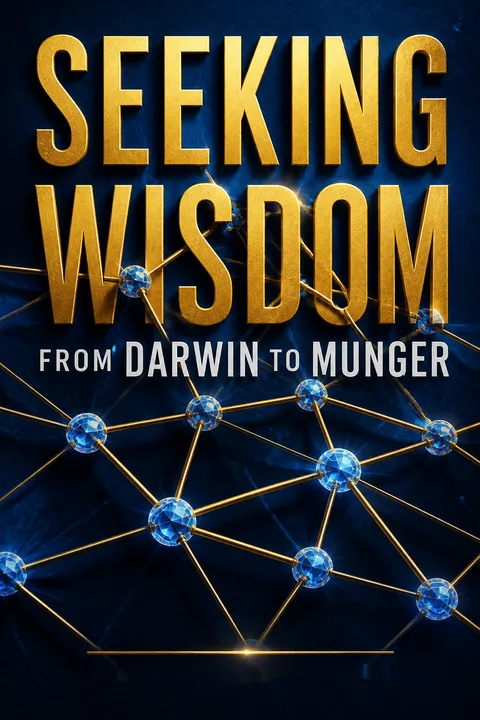


Key Takeaways
Build a toolkit of ideas to make fewer costly mistakes
Wisdom is assembled. Peter Bevelin’s central aim is practical: understand why people misjudge, then reduce the errors that do the most harm. His source material ranges from Darwin and Feynman to psychology, biology, mathematics, and the investing practice of Warren Buffett and Charlie Munger. The point is not to become expert in every field. It is to learn a set of reliable ideas that can help explain different problems.
Borrow before guessing. Darwin’s habit of recording facts that challenged his theories exemplifies intellectual discipline. Munger’s approach likewise favors learning what others have already figured out over relying on unaided intuition. Bevelin organizes these lessons around influences on thought, psychological traps, physical and mathematical reasoning, and practical tools for better decisions.
The book’s distinctive strength is its insistence that judgment improves through combination, not through one master theory. A psychological explanation may identify a bias, while mathematics tests whether the conclusion follows and systems thinking reveals what the decision changes. This resembles the logic of interdisciplinary science, where different methods constrain one another. The ambition has a cost: a compact collection can make ideas appear equally settled when their evidence varies. Readers benefit most by treating each model as a tool to test, not a universal law.
Treat intuition as survival gear, not a reliable truth detector
Judgment has roots. The book argues that behavior reflects biology, experience, the immediate situation, and chance. Evolution favored quick responses to danger, reward, and social cues, but those responses can misfire in a modern setting. Fear may protect someone from a real threat, yet also exaggerate a rare risk. A familiar face can feel trustworthy without being so.
Context changes behavior. The book describes Phineas Gage, whose personality reportedly changed after damage to the frontal region of his brain. It also stresses that life experience shapes neural connections, while a person’s current mood and circumstances influence judgment. Evolutionary explanations can illuminate tendencies, but the author warns that accounts of ancestral behavior are difficult to test and should not be stretched to explain every action.
This account avoids a simple battle between reason and emotion: emotions can supply useful signals, but their usefulness depends on context. That distinction is important because suppressing emotion is not the same as improving judgment. A better question is whether the feeling tracks relevant evidence or merely resembles a past threat. The book’s evolutionary lens is most persuasive when it suggests plausible pressures, and less secure when it assigns a single ancestral purpose to complex behavior. Its own caution about limited evidence deserves equal weight with its vivid examples.
Change the incentives before blaming the people
Rewards shape conduct. People tend to repeat actions that bring benefits and avoid those that bring costs. Rewards can be money, status, approval, or simply relief from an unpleasant task. In a Federal Express example, managers struggled to get overnight sorting completed on time until workers were paid for finishing a shift rather than for each hour worked. The revised incentive matched the desired result.
Metrics invite gaming. A New Orleans police program tied rewards to improved crime figures; one district responded by reclassifying serious offenses. The lesson is not that every worker is dishonest. It is that a system can make the wrong behavior personally advantageous. Before judging conduct, ask what is measured, who benefits, and what the reward actually encourages.
Incentives are a bridge between individual psychology and organizational design. A metric does not merely record performance; once attached to pay or promotion, it can reshape the behavior being measured. This is why a system should track outcomes that matter while checking for displacement, concealment, and unintended shortcuts. Incentives cannot explain everything, however. Professional identity, fairness, and intrinsic motivation also affect conduct. The strongest design combines clear rewards with accountability and a culture where reporting bad news is safer than hiding it.
Assume several biases are steering the same decision
Errors travel in groups. Bevelin catalogs 28 psychological tendencies, including overconfidence, denial, anchoring, social imitation, obedience to authority, and the urge to stay consistent with past choices. These influences often overlap. The book calls a powerful convergence of tendencies a lollapalooza effect: several forces push in the same direction, producing a result stronger than any one force alone.
A deal can gather momentum. In the book’s fictional example, a manager pursues an acquisition because he wants a promotion, trusts the seller, hears admired peers support it, and searches for confirming evidence. He has also made public commitments and received advice from people paid to complete the transaction. No single influence explains the outcome. Together, they make reconsideration feel increasingly difficult.
The combined-bias perspective improves on the idea that a decision can be diagnosed by naming one cognitive error. In real organizations, authority, incentives, group loyalty, and selective evidence can reinforce one another. A checklist helps because it interrupts the momentum of a persuasive story and prompts a separate look at motives, evidence, alternatives, and consequences. But checklists are not magic: a team can complete every box while sharing the same assumptions. Independent reviewers and genuine permission to disagree make the exercise more useful.
Let new evidence outrank the money and pride already spent
Past costs are gone. A sunk cost is money, time, or effort already spent and impossible to recover. It should not determine whether to spend more. Bevelin illustrates this with a nonrefundable conference fee: if attending no longer makes sense, the fee does not improve the experience by being remembered. The relevant comparison is between future options, not between the present and an unrecoverable past.
Commitment distorts evidence. People often defend prior choices to protect their self-image or reputation. They may look for facts that support a failing investment and ignore facts against it. Darwin’s practice of recording evidence that challenged his favored explanations offers a countermeasure. Ask what would change the conclusion, and evaluate the decision as if it were being made for the first time today.
This principle separates decision quality from outcome and identity. A person can make a reasonable choice with the information available, then revise it when conditions change. That is not inconsistency; it is updating. The hard part is social: public commitments make revision feel like an admission of incompetence. Organizations can reduce that pressure by recording assumptions in advance and reviewing forecasts against results without turning every miss into a personal indictment. A decision can still merit continuation after prior investment, but only when future benefits justify future costs.
Trace consequences through the whole system, including reactions
Actions ripple outward. Systems thinking means examining how connected parts interact, rather than improving one visible measure in isolation. A widow in Aesop’s fable gives her hen extra grain, hoping for two eggs a day; the hen grows fat and stops laying. A modern example in the book describes students paid for each dead campus mouse. The mice disappear, until students begin breeding them for the reward.
Ask what follows. A price cut may prompt competitors to cut prices too, so higher sales do not guarantee higher profits. A cost reduction can damage delivery, reputation, and customer retention. Before acting, identify the goal, the system’s important parts, other people’s likely responses, and the next effects of the first effects. The net result matters more than the immediate improvement.
This way of thinking is especially valuable when feedback loops are strong. A policy changes incentives, incentives change behavior, and changed behavior can alter the conditions the policy was meant to address. The mouse example makes that loop memorable because the unintended response is easy to see. Complex systems still resist complete prediction, so analysis should not promise certainty. It should expose plausible pathways, identify early warning signs, and favor interventions whose failure can be contained or reversed.
Use base rates and downside severity before trusting a vivid case
Start with comparable cases. A base rate is the frequency of an outcome in a relevant comparison group before adding evidence about one specific case. In a medical example, a disease affects 0.1% of a population. A test with 97% sensitivity and 95% specificity can still produce mostly false positives: among 100,000 people, the book estimates that only about 1.9% of positive results indicate the disease. The test result must be interpreted alongside how common the disease is.
Count the paths to failure. If six independent steps each have an 80% chance of success, the chance that all six succeed is about 26%. Also weigh the cost of being wrong, not only the likelihood. A low-probability catastrophe may deserve stronger precautions than a frequent, minor setback.
Base rates counter the mind’s tendency to let a striking anecdote dominate more representative evidence. The medical example also shows why conditional questions matter: the chance of a positive result when disease is present is not the same as the chance of disease given a positive result. This reasoning can improve medical, legal, and business judgments. Estimates remain only as sound as their comparison groups and assumptions. When conditions change, historical frequencies may no longer be reliable, and the uncertainty itself should influence the decision.
Value assets by future cash, capital needs, and alternatives
Price is not value. For an investment, ask how much cash it can produce, when that cash arrives, and how much must be reinvested to keep the business working. Reported earnings can mislead if they ignore equipment and other capital needs. A company that earns more may still create less value if it requires much more capital to do so.
Compare the next-best choice. Opportunity cost is the value forgone by using money, time, or effort in one way instead of its best available alternative. Bevelin’s investing discussion favors businesses whose economics are understandable, whose advantages can endure, whose managers are capable and honest, and whose purchase price leaves room for error. A margin of safety is that gap between estimated value and price, intended to protect against imperfect estimates.
The cash-flow focus gives valuation a concrete anchor and discourages fascination with labels, fashionable industries, or precise-looking forecasts. It also makes capital allocation comparative: an investment is not attractive merely because it may succeed, but because it is better than available alternatives after risk and effort are considered. The approach has limits. Long-term cash flows are uncertain, and an apparently durable advantage can erode. The margin of safety is therefore not a formula that removes uncertainty; it is a discipline for admitting that estimates may be wrong.
Invert the goal, then build safeguards and learn from failure
Find the failure path. Inversion means approaching a goal by asking what would reliably produce its opposite. To protect a business, list the actions that would destroy it, then avoid or guard against them. To improve a decision, ask what could make the prediction fail, what evidence would disprove it, and what the consequences would be. Bevelin links this habit to practical protections such as simple rules, checklists, and a margin of safety.
Review the record. A post mortem compares what decision-makers expected with what actually happened, then examines why. The book cites Johnson & Johnson’s practice of revisiting major acquisitions and comparing original projections with results. Such reviews can reveal repeated errors, but only if bad outcomes are not hidden or explained away. The aim is not to eliminate mistakes. It is to recognize and correct them sooner.
Inversion is powerful because people naturally build arguments for the outcome they already want. Imagining failure changes the search task: instead of polishing a preferred plan, decision-makers look for vulnerabilities and preventive measures. Post mortems extend that discipline across time by turning experience into usable feedback. Their quality depends on psychological safety and accurate records. If a review is designed to assign blame, people will protect themselves; if it avoids responsibility altogether, the same failures may recur. Learning requires both candor and a path to correction.
Analysis
Seeking Wisdom is less a single theory than a carefully organized toolkit. It begins with the biological and social roots of behavior, moves through psychological misjudgments, adds tools from physics and mathematics, then turns those tools into questions, rules, and checklists. The structure mirrors its central argument: better judgment comes from combining perspectives, not from trusting intelligence or intuition alone.
Its most useful contribution is the connection between errors that are often studied separately. A manager’s bad acquisition can involve incentives, overconfidence, social proof, commitment, and unreliable forecasts at once. Likewise, a reasonable intervention can fail because it changes the surrounding system. By pairing these psychological insights with probability, causation, scale, and opportunity cost, the book gives readers ways to inspect both their own reasoning and the conditions shaping other people’s behavior.
The book’s breadth is also its main vulnerability. It gathers research, historical anecdotes, investing principles, and evolutionary explanations under one roof, but these forms of evidence do not carry identical weight. Some behavioral tendencies are supported by experiments; some claims about ancestral adaptation are plausible interpretations rather than directly testable accounts. Readers should also remember that examples drawn from business and investing do not automatically transfer to medicine, public policy, or intimate relationships without adjustment for context.
The strongest way to use the book is not as a catalog of biases to diagnose everyone else. It is as a repeated decision practice: clarify the goal, examine incentives, seek comparison cases, trace consequences, test assumptions, consider the downside, and specify what evidence would change the conclusion. Its measure of wisdom is not perfect prediction. It is reduced avoidable error, faster correction, and a life less governed by comforting stories.
Review Summary
Seeking Wisdom receives mostly positive reviews, praised for its dense collection of insights from various fields like psychology, biology, and investing. Readers appreciate its practical wisdom and quotes from influential thinkers. However, some criticize its information-dump style and lack of cohesive narrative. Many consider it a valuable reference book for mental models and decision-making, though challenging to read straight through. Some note editing issues and high price as drawbacks. Overall, it's highly recommended for those interested in improving their thinking and decision-making processes.
People Also Read








Glossary
lollapalooza effect
biases combining into a powerful outcomeA lollapalooza effect occurs when several psychological tendencies, incentives, or other forces operate together in the same direction. Their combined influence can produce behavior much stronger than any one force would produce alone. The idea encourages analysis of interacting causes rather than explaining a complex outcome with a single bias.
Deprival Syndrome
intense reaction to threatened lossDeprival Syndrome describes the heightened desire, distress, or resistance that can arise when something valued is removed, restricted, or made less available. People may value possessions more because they own them, cling to losing investments, or pursue scarce and forbidden things. The reaction can distort judgment and intensify conflict.
Winner's Curse
winning by overestimating valueThe Winner's Curse is the risk that the successful bidder in an uncertain auction has offered more than the item is worth. When estimates vary, the highest bid is more likely to come from the most optimistic estimate. Winning is therefore evidence that the bidder may have overestimated value, especially when other bidders had similar information.
base rate
prior frequency in a comparison groupA base rate is the observed or estimated frequency of an event or characteristic in a relevant population before evidence about a particular case is considered. It helps place individual evidence in context. A vivid case or a positive test result can be misleading if the underlying event is rare or the comparison group is poorly chosen.
margin of safety
buffer against estimation errorA margin of safety is a protective gap between an estimated value and the price paid, or between a system’s expected capacity and the load it must handle. The buffer accounts for uncertainty, imperfect forecasts, and unexpected events. Greater uncertainty or more severe consequences of failure call for a larger margin.
circle of competence
the boundary of reliable understandingA circle of competence is the area in which a person can understand the important features of a decision well enough to make a grounded judgment. Its size matters less than knowing its boundaries. The concept advises people to avoid decisions they cannot evaluate, even when an opportunity looks attractive or experts appear confident.
post mortem
review comparing forecasts with outcomesA post mortem is a retrospective review of an important decision or project. It compares the original assumptions, projections, and reasons for acting with the actual results, then investigates what worked, what failed, and what was missed. Its purpose is to improve future judgment, not merely to defend the original decision or assign blame.
FAQ
What's Seeking Wisdom: From Darwin to Munger about?
- Exploration of Human Behavior: The book examines why humans behave as they do, focusing on psychological influences that lead to errors in thinking.
- Influence of Great Thinkers: It draws on insights from figures like Charles Darwin and Charles Munger, highlighting the importance of learning from others' experiences.
- Framework for Better Thinking: Peter Bevelin provides tools to improve decision-making and reasoning, helping readers avoid cognitive traps.
Why should I read Seeking Wisdom: From Darwin to Munger?
- Practical Insights: Offers advice on improving judgment and decision-making applicable to business and personal life.
- Learning from Mistakes: Emphasizes the value of learning from both personal and others' mistakes for better outcomes.
- Timeless Wisdom: Discusses concepts that are relevant across time, appealing to those interested in psychology, investing, or self-improvement.
What are the key takeaways of Seeking Wisdom: From Darwin to Munger?
- Understanding Misjudgments: Outlines 28 psychological reasons for misjudgments, such as self-serving bias and consistency bias.
- Systems Thinking: Stresses the importance of considering the whole system and interconnectedness when making decisions.
- Value of Experience: Highlights learning from both successes and failures and adapting thinking based on new information.
What are the best quotes from Seeking Wisdom: From Darwin to Munger and what do they mean?
- Confucius on Mistakes: "A man who has committed a mistake and doesn't correct it, is committing another mistake." Emphasizes learning from errors.
- Munger on Wisdom: "I think it’s a huge mistake not to absorb elementary worldly wisdom if you’re capable of doing it." Stresses acquiring practical knowledge.
- Intentions vs. Outcomes: "The road to hell is paved with good intentions." Reminds that good intentions need to be matched with positive outcomes.
How does Seeking Wisdom: From Darwin to Munger suggest improving decision-making?
- Awareness of Biases: Encourages awareness of cognitive biases that can lead to poor decisions.
- Use of Checklists: Advocates for checklists to ensure important factors are considered and biases minimized.
- Learning from Others: Emphasizes studying others' experiences and mistakes to inform better choices.
What is the significance of systems thinking in Seeking Wisdom: From Darwin to Munger?
- Holistic Perspective: Encourages looking at the entire system rather than isolated parts for better understanding.
- Anticipating Consequences: Helps anticipate both intended and unintended consequences of actions.
- Feedback Loops: Discusses how systems adjust based on feedback, refining strategies for improved results.
How does Seeking Wisdom: From Darwin to Munger relate to Darwin's ideas?
- Learning from Nature: Draws parallels between human behavior and Darwin's observations, suggesting evolutionary principles can inform decision-making.
- Adaptation and Survival: Highlights the need to adapt thinking and behaviors to navigate complex environments.
- Importance of Observation: Mirrors Darwin's emphasis on careful observation and data collection in understanding behavior.
What role does authority play in decision-making according to Seeking Wisdom: From Darwin to Munger?
- Influence of Authority: Discusses how deference to authority can lead to blind obedience and poor decisions.
- Critical Evaluation: Encourages critical evaluation of authority figures' advice rather than accepting it at face value.
- Awareness of Bias: Recognizing potential biases of authority figures aids in making informed decisions.
How does Seeking Wisdom: From Darwin to Munger address the concept of cognitive biases?
- Identification of Biases: Outlines common cognitive biases like confirmation bias and overconfidence.
- Strategies to Mitigate Biases: Provides strategies for recognizing and countering biases in decision-making.
- Real-Life Examples: Uses scenarios to demonstrate how biases lead to poor decisions, reinforcing the need for awareness.
What is the "margin of safety" concept in Seeking Wisdom: From Darwin to Munger?
- Risk Management Principle: Suggests investing with a buffer to protect against unforeseen risks.
- Application in Investing: Crucial in investment decisions to avoid overpaying based on optimistic projections.
- Long-Term Perspective: Emphasizes maintaining a long-term view for sustainable and profitable outcomes.
What is the significance of probability in Seeking Wisdom: From Darwin to Munger?
- Understanding Uncertainty: Discusses how probability aids in assessing risks and making informed decisions.
- Bayes’ Theorem: Introduces Bayes’ Theorem for updating beliefs based on new evidence.
- Real-World Applications: Illustrates probability's application in contexts like finance and medicine to improve outcomes.
What practical advice does Seeking Wisdom: From Darwin to Munger offer for everyday life?
- Continuous Learning: Encourages a mindset of lifelong learning to enhance understanding and decision-making.
- Embrace Uncertainty: Advises using probabilistic thinking to navigate complex situations.
- Cultivate Patience: Stresses the importance of patience in decision-making, advocating for thoughtful consideration.
About the Author


Download PDF
Download EPUB
.epub digital book format is ideal for reading ebooks on phones, tablets, and e-readers.








