

Plot Summary
Seven Moon Fragments
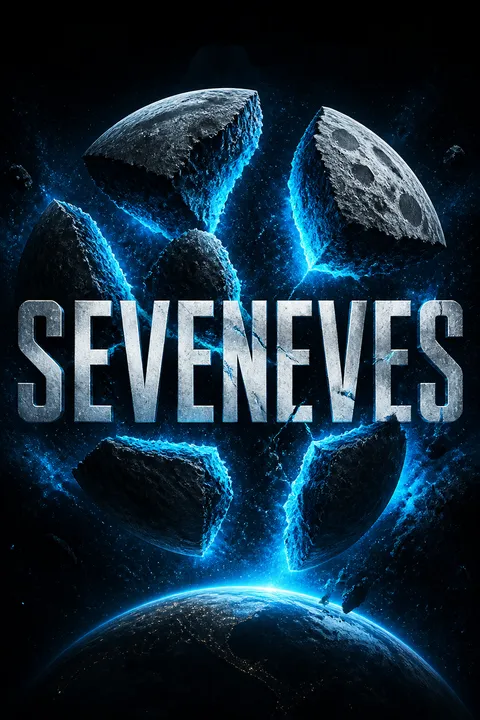
At 05:03 UTC, the Moon breaks into seven massive pieces and countless smaller fragments. The cause, soon called the Agent, remains unknown; the fragments stay bound by gravity and continue circling Earth.
On the International Space Station, mining engineer Dinah MacQuarie sees the change after her father, Rufus, interrupts her work with a Morse-code warning. Astronomer Dubois Harris, known to the public as Doc Dubois, first treats the event as a spectacular scientific puzzle.
Then he watches a collision split one of the seven fragments, raising the number of large pieces. The same collisions produce more debris and make further breakups more likely. The Moon’s destruction is not a single disaster, he realizes, but the beginning of an accelerating chain reaction.
The opening turns scientific curiosity into a moral hazard. Doob’s first instinct is to observe, name, and explain, habits that ordinarily make him valuable. But the collision that creates an eighth fragment reveals that observation is not neutral when the phenomenon being studied is also advancing toward catastrophe. Dinah’s father reaches her through an old technology, while the Moon’s fragments announce a future no human system can yet control. The contrast is precise: intimate communication survives for a moment, while the familiar celestial order does not. Stephenson makes the inciting event frightening not because its cause is known, but because its consequences can be calculated before anyone can stop them.
The Cloud Ark Is Born
After observing further collisions, Doob presents his calculations to President Julia Bliss Flaherty. The debris will eventually become a White Sky, followed by a Hard Rain of billions of fragments that will sterilize Earth for thousands of years. Spaceflight is suspended, leaving the crew of Izzy unable to return home.
The president asks them to turn the station into the nucleus of the Cloud Ark, a dispersed fleet meant to preserve human life and Earth’s genetic inheritance. Ivy Xiao remains in command.
Dinah is assigned to support other teams, so she insists that asteroid mining must continue: without materials from space, the Ark cannot build a lasting home. NASA chief Scott Spalding agrees to protect her work. The crew begins preparing modules, communications systems, and life support for a population far larger than Izzy was built to hold.
The Cloud Ark answers an impossible problem with an institutional contradiction: it promises to save humanity while admitting that only a tiny fraction can be saved. Its distributed design is both a practical defense against impacts and a political promise that survival will not depend on one single vessel. Dinah’s insistence on mining points beyond the immediate emergency. She understands that an ark capable only of carrying people is not a civilization. Ivy, meanwhile, must convert command into care while facing a future in which every decision sorts human beings into those launched and those left behind. The project begins as both rescue plan and public story, and those purposes will not always align.
A Scout in the Luk
The Cloud Ark’s urgent construction sends Russian Scouts outside Izzy to assemble docking ports and support structures. Their makeshift Luk shelters, space suits, and life support systems fail repeatedly; several Scouts die before reaching safety.
Dinah notices that test pilot Tekla Ilyushina cannot close the door of her suit and is trapped in her plastic shelter without reliable supplies. With Ivy, physiologist Margie Coghlan, and Mongolian cosmonaut Bo, Dinah uses robots to pull the shelter against her small airlock.
Tekla cuts through its layers and is forced into the lock, suffering severe facial and arm injuries. Dinah and Margie treat her while alarms sound over lost air. Tekla survives, and the rescue changes how the crew sees Dinah: her improvised engineering has saved a life where procedure offered none.
The rescue exposes the price hidden inside the word pioneer. The Scouts are not simply brave workers; they are people sent into conditions whose designers have not yet solved the basic problem of bringing them home safely. Dinah refuses to accept that the system’s failures make Tekla expendable. Her solution is technically inventive but ethically grounded in a decision to treat a worker as a person rather than as a replaceable component. The rescue also begins Dinah’s movement from solitary engineer toward someone others trust under pressure. That trust is earned through action, not rank, and becomes a form of authority that formal leadership will later struggle to recognize.
Lots, Love, and Launchpads
At Crater Lake, the world’s leaders announce that the Hard Rain is coming and ask communities to choose young people for the Cloud Ark. The plan offers hope, but far more candidates will be selected than can ever reach orbit.
Doob, who has fallen in love with elementary schoolteacher Amelia Hinojosa, is tasked with collecting candidates and explaining the mission to the public. In Bhutan, he watches families say goodbye to Dorji and Jigme, selected to represent their country, and understands the human cost behind the hopeful ceremony.
He later visits his son Henry at a makeshift rocket port in Moses Lake, where students and workers are building launch vehicles. When the president asks Doob to go to space, he accepts, arranging for his and Amelia’s embryo to travel with him.
The Casting of Lots turns an abstract rescue plan into a sequence of intimate separations. Public language promises representation and possibility, while the actual arithmetic guarantees that most chosen candidates will be rejected and most families will die. Doob’s work forces him to witness what his calculations can make him avoid: a king escorting two young people away from their parents, students building rockets in a collapsing economy, his own children approaching an end he will not share. His choice to go up is not simple faith in the Ark. It is a commitment to remain useful, even while knowing that usefulness will separate him from Amelia and his children.
Sean Bets on Ice
As launches multiply, the Cloud Ark’s leaders debate how to keep thousands of small vessels from running out of propellant. Billionaire Sean Probst arrives at Izzy in a one-person space capsule and challenges the official plan: without more water, the Ark cannot maneuver, make fuel, or survive long term.
He has secretly assembled Ymir, an expedition bound for Comet Grigg-Skjellerup, and asks Dinah for her robots. Dinah learns that Ymir will use a nuclear reactor to heat ice and propel a comet fragment back toward Earth.
Sean and robotics engineer Larz Hoedemaeker depart on the dangerous voyage. Meanwhile, Doob sees Peach Pit, the Moon’s iron core, as a nearer source of metal and begins considering how it might support a future home. The Ark now has two risky bets on space resources.
Sean’s intervention gives the Cloud Ark a material future, but it also exposes the gap between public reassurance and engineering reality. Water is not merely a survival resource; it is a reserve of mobility, cooling, shielding, and fuel. Sean acts where a government process hesitates, yet his secrecy and unilateral authority make him a source of political friction. Dinah recognizes both the value of his mission and the danger of surrendering her robots to a plan she cannot fully monitor. Doob’s interest in Peach Pit begins a parallel line of thought: the Moon’s destruction has scattered the raw materials that might eventually make survival more than an extended emergency.
A Bolo Finds Gravity
The Arkitects expand Izzy with hamster tubes, docking ports, inflatable habitats, and eventually a second torus. A first wave of Arkies arrives, among them robotics researcher Larz, who helps Dinah armor her robots with plates cut from Amalthea.
The first successful Bolo Coupling Operation joins two arklets with a cable; as they separate and spin, Ivy and Dinah experience Earth-normal gravity for the first time in orbit. Doob has already agreed to go up, and uses his remaining months on Earth to visit his children and collect candidates.
President Flaherty’s administration chooses Swiss pilot Markus Leuker to replace Ivy as commander of the growing Cloud Ark, partly to avoid handing the role to a major power. Ivy stays in the command structure, but her authority is increasingly questioned.
The first bolo converts orbital mechanics into something bodily: gravity returns, and the future becomes briefly imaginable as a place where people might live rather than merely endure. Yet the same period makes the Ark’s hierarchy more visible. Ivy has kept Izzy functioning, but the expansion demands a different image of leadership, and Markus’s selection reflects political optics as much as competence. The organization is building community while sorting people into ranks, shifts, and scarce living spaces. Doob’s journey toward orbit parallels this transition. He moves from speaking to the doomed world as a public figure toward becoming one more worker inside the system he has helped sell.
The Sky Turns White
As the lunar fragments multiply, Doob refines his predictions and tracks the approaching White Sky. Sean, still silent aboard Ymir, has found a dark asteroid in Arjuna Expeditions’ secret database.
Through Morse code and a one-time pad hidden in an employee manual, he warns Dinah that the asteroid will pass through the debris cloud. The impact triggers the predicted cascade: collisions spread through the fragments until the Moon’s remains become a widening white cloud. Soon afterward, bolides strike Earth in increasing numbers.
Doob’s warnings have proved accurate, but he cannot tell his family how it looks from orbit. The Cloud Ark prepares for the Hard Rain, while Dinah and Ivy monitor the swarm and the people below begin facing the last days of their world.
The Eight Ball is the novel’s most exacting reversal of scientific prediction. Doob can describe the broad catastrophe, yet Sean identifies a specific unseen object that may determine its timing. Knowledge is useful, but never complete; the future turns on an asteroid no one can see until it is nearly upon them. The encrypted messages also return the story to its earliest means of connection: Morse code, a technology built for clarity across distance. Here it carries both warning and uncertainty. The White Sky is visually beautiful, but its beauty is not consoling. It is the visible expansion of a process that has become too large for ordinary human perception.
Fire Over Kourou
The Hard Rain begins with a vast bolide that destroys cities and ignites the surface. At Kourou, Venezuelan protesters block launches, demanding representation for candidates excluded from the Ark. President Flaherty responds with a nuclear strike offshore and fuel-air weapons against the blockade, reopening the spaceport at terrible cost.
Julia later escapes Earth in an X-37 carrying a capsule, accompanied by science adviser Pete Starling. Dinah and Ivy intercept them in a Flivver. A smaller bolide punches through the capsule, killing Starling and forcing Dinah to plug the holes with his body and improvised materials.
Julia joins the Arkies, while the impact damages Izzy’s Human Genetic Archive. Only a small fraction of the stored reproductive samples survive, and the Cloud Ark’s political and biological promises begin failing together.
The transition from prediction to catastrophe does not produce a clean moral order. Julia uses immense violence to preserve the launch system, then arrives among the people whose survival depends on it. Her actions cannot be reduced to either necessary leadership or simple brutality. The capsule rescue makes that ambiguity physical: Dinah saves Julia while Starling’s body becomes part of an improvised seal. Meanwhile, the loss of most genetic samples reveals that preservation plans are vulnerable to the same material world they are meant to outlast. A political gesture, a rescue, and a scientific archive are all exposed to chance, force, and irreversible consequence.
A Dead Crew’s Message
Ymir returns from its long comet mission carrying a massive shard of ice, but its radio has been silent for years. Sean’s final encrypted message confirms that only two crew members are alive and the ship is still thrusting.
Markus assembles New Caird, a modular rescue craft, and leads Dinah, nuclear engineer Jiro Suzuki, and cosmonaut Vyacheslav to intercept it. They find Ymir’s command module buried inside the ice and discover that Sean died from internal bleeding after swallowing a radioactive fuel particle.
Larz and another crew member are also dead. Jiro traces the contamination to a ruptured reactor rod, but confirms that the engine still works. The survivors must decide whether to risk bringing the contaminated ship and its precious water back to the Cloud Ark.
The message from Ymir transforms a celebrated mission into a rescue of the dead and the machinery they left behind. The crew’s silence had allowed hope to persist without evidence, and the survivors now inherit both the expedition’s achievement and its hidden cost. Jiro’s forensic work makes the catastrophe legible: contamination moved through tools, robots, and human bodies, not through a single dramatic explosion. That slow, mundane pathway is more frightening than a spectacular failure because it reveals how many ordinary systems can carry danger. Still, Ymir’s functioning reactor offers the resource the Ark needs, so retreat is not a simple act of prudence.
The Ice Ship Turns
Ymir’s first attempt to brake near Earth pushes it through the expanded atmosphere and leaves it tumbling. Markus and Vyacheslav use New Caird’s engine to force the ice shard into a new orientation, but the craft buckles and its hot thruster begins melting through the hull.
Markus dies before the next burn. Dinah and Jiro continue without him, using robots to sculpt an asymmetrical nozzle whose off-axis thrust can slow the rotation. They complete several careful burns, then bring Ymir into a viable orbit.
As a nuclear storm approaches, a revolt led by Julia and Aïda’s faction tries to seize Endurance’s systems. Dinah’s robots eject Ymir’s contaminated reactor, while the breakaway group departs with many arklets. A bolide strike leaves Endurance badly damaged and hundreds dead.
The mission’s turning point is not a triumphant return but the loss of the commander who chose to lead it. Markus’s death leaves Dinah and Jiro with a task he had framed as his own responsibility, and they complete it through a combination of careful engineering and improvisation. At the same time, the Cloud Ark’s internal political conflict becomes physical. The Break is both an attempt to escape and a violent failure of shared governance, with the incoming radiation storm and bolide impacts magnifying the damage. Dinah’s act of ejecting the reactor saves the survivors from carrying its contamination forward, but it also severs the ship from the machinery that brought it home.
The Break Splits Endurance
Endurance is rebuilt from the surviving Izzy, Ymir’s ice, and eighty-one arklet engines. The crew seals the remaining genetic equipment inside Amalthea and begins the Big Ride toward Cleft, the iron-rich remnant of the Moon.
Over three years, equipment failures, hunger, radiation, cancer, bolide strikes, and suicide shrink the population. Rhys dies by suicide, and many others volunteer for dangerous work rather than consume scarce supplies.
The Swarm fares worse: agricultural systems fail, water dwindles, and a political split between Julia’s followers and Aïda’s rebels ends in cannibalism and collapse. When eleven survivors ask to rejoin Endurance, Ivy accepts them despite distrust. The reunion is exploited as cover for an armed seizure during a coronal mass ejection.
The Break leaves the survivors with two different meanings of freedom. Julia’s faction chooses separation from a leadership it distrusts; Endurance chooses the heavy, slow protection of Amalthea. Neither option is safe, but only one preserves enough infrastructure to keep working. The three-year climb tests not merely engineering but the social capacity to ration food, share danger, and endure grief without turning every shortage into a purge. The Swarm’s collapse is not caused by one villain or one bad design. Its food systems fail, its population divides, and its politics cannot repair the material crisis. The attempted reunion shows how desperate need can reopen solidarity and exploitation at once.
The Last Ride to Cleft
As Endurance nears Cleft, the crew prepares to abandon Amalthea and spend its remaining propellant in a final dash through the debris field. A coronal mass ejection gives the eleven Swarm survivors a reason to dock, but the arrival becomes a trap: Aïda’s group attacks, kills Steve Lake, and tries to seize the ship’s network.
Julia is restrained after the uprising, while Tekla and Zeke fight the attackers. With Amalthea detached and engines burning, Ivy pilots Endurance through the cloud of lunar fragments.
Bolides destroy modules and kill more people, but the ship reaches Cleft’s enormous cleft and settles inside it. Only eight women remain alive and healthy. The survivors restore essential systems, and Doob dies after one final walk on the asteroid’s surface.
The final approach forces the survivors to spend the protection they have spent years building. Removing Amalthea makes the ship nimble enough for the crossing but leaves it exposed to the debris field. At the same moment, the Swarm’s survivors arrive with both legitimate desperation and an organized plan to take control. The battle makes the old political division impossible to dismiss as mere disagreement, yet the need for shelter is greater than the need for revenge. The landing at Cleft is not a return to Earth but the establishment of a foothold elsewhere. Doob’s final walk brings the scientist who first calculated extinction to the refuge his calculations helped make possible.
Seven Eves Choose
After the last wounded survivors die, eight women remain: Dinah, Ivy, Moira, Tekla, Julia, Aïda, Camila, and Luisa, who has passed menopause. Moira explains that she can create embryos through a form of parthenogenesis and repair known genetic disorders, but the choices about inherited traits belong to each mother.
The women debate whether aggression, discipline, intelligence, depression, or other qualities should be altered. Aïda warns that their children will form distinct races and that her descendants will be treated as the offspring of a hated cannibal.
Dinah, furious at the suggestion that aggression should be bred away, plants a demolition charge beside the meeting room and gives the group ten minutes to decide. They agree that each fertile woman may choose one additional genetic alteration after disease correction. Dinah chooses to create children like Markus, whom she remembers as a flawed but principled hero.
The Council turns survival into a question of authorship. The women can no longer preserve humanity by reproducing the world they lost; they must choose which parts of it to carry forward and which to alter. Their debate is not a tidy contest between science and ethics. Each proposed trait has a double edge: aggression can protect or destroy, foresight can guide or torment, and intelligence cannot guarantee wisdom. Aïda’s warning about inherited stigma is especially sharp because the decision to create differentiated races will shape social life long after the original women are gone. Dinah’s explosive ultimatum is an extreme way to restore agency to a conversation that risks becoming abstract and coercive.
A Glider Over New Earth
Five thousand years later, Kath Two, a Moiran Surveyor, spends two weeks studying a newly seeded ecosystem on New Earth. She flies an unpowered glider, harvesting water from a lake and using thermals to climb toward the habitat ring.
On the surface she glimpses a camouflaged person watching her, far from any registered Indigen zone. The sight unsettles her, and her sleep and attention begin to shift in ways Moirans associate with an epigenetic change. After she returns to the ring, Quarantine detains her for questioning.
Julian investigator Ariane Casablancova learns that Kath Two has spoken to a Teklan surveyor, Beled Tomov, and that her report leaves a deliberate loose end. Rather than dismiss the sighting, Doc Hu Noah brings Kath Two into a Seven he is assembling for a mission.
Kath Two’s flight is both a scientific survey and a bodily experiment. She is not simply collecting observations; the landscape begins to alter the person doing the observing. Her encounter with the hidden human matters because it falls outside the official map of the surface, but her uncertainty about it is also central. Survey depends on judgment as much as instruments, and the Quarantine interview shows how quickly an unverified perception can become political evidence. The old catastrophe survives in institutions, racial histories, and orbital infrastructure, yet the surface is becoming a place that can surprise its descendants. The future’s first mystery is not extraterrestrial. It is human.
The Truck Beneath Beringia
Doc gathers a Seven consisting of Tyuratam Lake, a Dinan bartender from Cradle; Beled Tomov, a Teklan soldier; Langobard, a Neoander; Kath Two; Julian intelligence officer Ariane; and Einstein, an Ivyn guide from a nearby Indigen zone.
In Beringia they find that someone has excavated an ancient truck and buried its driver with a steering-wheel marker. The diggers have taken the engine for its iron. Soon a force of underground descendants confronts the group, led by an old man who claims Earth for his people.
Ariane reveals her allegiance by calling down a Red Thor, killing Doc and his Camite aide, Remembrance, and abducting a Digger woman named Marge. The Seven is broken, but Ty and the others escape with their lives and evidence of a hidden civilization.
The truck is valuable in two incompatible ways: to the Spacers it is a witness to the old world, while to the Diggers its engine is useful metal. The mismatch reveals how thoroughly scarcity has shaped each culture’s sense of value. The Diggers’ burial of the driver complicates any easy judgment of them as mere scavengers, while their claim to Earth challenges the Spacers’ assumption that a world rebuilt from orbit belongs naturally to them. Ariane’s betrayal escalates a tense encounter into a strategic rupture. Her Thor is not only a weapon; it is proof that Red’s reach extends far beyond the habitat ring.
The Gnomon and the Pingers
After Doc’s death, Ty leads the remaining group toward the coast, where Sonar Taxlaw helps him contact the Pingers, humans adapted to live beneath the sea. He learns that the Diggers have traded with them for generations and that their metal scarcity explains the excavated truck.
Meanwhile, Red unveils the Gnomon, a vast structure rising from the sea near the equator, built to rival Cradle and extend Red’s reach onto Earth. Blue answers by bringing the Pingers into negotiations, while Ty’s group tries to prevent both governments from turning first contact into another proxy war.
Kathree, no longer the hesitant observer she was as Kath Two, acts decisively in the skirmishes. The original Seven has become a larger, uneasy alliance, with humans from the ring, the surface, and the sea forced to confront a future none can control alone.
The final conflict expands the meaning of home. The Diggers have survived underground, the Pingers beneath the sea, and the Spacers in orbit; each community has a plausible claim shaped by the dangers it endured. Red’s Gnomon makes that disagreement architectural, turning political ambition into a machine that could alter access to the planet. Ty’s value lies less in formal authority than in his ability to read people and improvise trust across boundaries. Kathree’s changed state also matters: the Moiran capacity to shift is not merely an inward condition but a way to meet a changing world. The novel closes on negotiation, not settlement. Earth is habitable again, but belonging remains contested.
Epilogue
The Seven never reaches a final answer about the Purpose that some of its members believe has guided them. Ty returns to the Crow’s Nest with new companions and an uneasy understanding that the old struggle between Red and Blue is no longer the only story in play.
The Pingers, the Diggers, and the people of the ring must decide whether they can share a planet they have all survived in different ways. Ty offers the newcomers a place at his bar, not as a treaty or a victory, but as a beginning.
The ending refuses the comfort of a finished reconciliation. Earth’s recovery has produced neither a single human culture nor a clean return to the past. Instead, the novel leaves its characters with new neighbors, old grievances, and a practical invitation to meet. Ty’s bar, a modest institution built around listening and exchange, stands opposite the Gnomon’s monumental claim to power. That contrast does not settle the political future, but it identifies a possible first act: make room for people whose histories challenge the story one already believes.
Analysis
Seveneves treats catastrophe as a problem of time, scale, and incomplete knowledge. The Moon’s destruction is never explained, but its consequences can be modeled; even so, prediction cannot eliminate uncertainty. Characters repeatedly confront the difference between knowing the general risk and controlling the particular event. The White Sky arrives through a chain reaction, Ymir’s reactor fails through mundane contamination, and a supposedly safe spacecraft is destroyed by one small bolide. Survival depends on technical competence, but competence is always local and provisional.
The novel also refuses to separate engineering from politics. The Cloud Ark’s distribution of vessels is meant to protect against physical failure, yet it creates new inequalities between Arkies and the General Population, between leaders and passengers, and between people who can move and those who cannot. Julia’s public performances, Markus’s command decisions, and Aïda’s political organizing all show that a survival system must persuade people as well as keep them alive. Neither democratic procedure nor emergency authority proves sufficient by itself.
The long leap to the habitat ring makes the cost of survival visible in culture and biology. The Seven Eves do not merely preserve humanity; they make consequential choices about what humanity will become. Their descendants inherit genetic traits, social divisions, historical myths, and competing claims to Earth. The appearance of the Diggers and Pingers then undermines the Spacers’ assumption that rebuilding a world gives them exclusive ownership of it. Earth has not been waiting empty for its rightful heirs. It has become a shared political problem among populations with radically different histories.
The novel’s deepest tension is between endurance and transformation. Technology keeps people alive, but no machine can decide what kind of society deserves to survive. The answer must be made through concrete choices: whom to rescue, which risks to accept, what to change in a child, and whether to treat an unfamiliar community as a threat or a neighbor. The final gesture is not a solved future but an invitation to continue negotiating one.
Review Summary
Seveneves by Neal Stephenson receives polarized reviews centered on its extensive technical detail. Fans praise the hard science fiction approach, ambitious scope, and fascinating premise: the moon explodes, humanity has two years to prepare for extinction. Many appreciate Stephenson's meticulous research into orbital mechanics, engineering, and genetics. Critics find the info-dumps tedious and character development lacking. The narrative structure divides readers—two-thirds covers Earth's final years and space survival, while the final third jumps 5,000 years forward. Reviewers consistently note the book feels like two separate novels, with mixed reactions to pacing and the abrupt ending.
People Also Read



Characters
Dinah MacQuarie
Robot miner and rescuerDinah is an engineer raised among remote mines by her practical father, Rufus. Her expertise is hands-on: she programs robots, understands rock, and would rather test a machine than present it in a meeting. She begins as a fiercely independent specialist whose work is easy for administrators to sideline. Yet her willingness to improvise under pressure makes other people depend on her. Dinah’s relationship with Ivy is intimate and teasing, while her romances arise in a world where long-term plans have been stripped away. Her deepest drive is to build something that can last, a conviction that turns asteroid mining from a career into a responsibility.
Dubois Jerome Xavier Harris
Astronomer and public witnessKnown publicly as Doc Dubois, Doob is an astronomer whose warmth and bluntness make him a trusted explainer of science. His gift is translation: he can turn orbital mechanics into a story ordinary people can grasp. That same gift brings him into conflict with his private skepticism, especially when the Cloud Ark needs reassurance as much as analysis. A divorced father, he is drawn to Amelia and remains deeply attached to his children, even as his work separates him from them. Doob wants the truth to be useful, but the crisis forces him to ask whether honest speech can also be a form of care.
Ivy Xiao
Pilot and station commanderIvy is a navy pilot and applied physicist whose preparation makes her a natural commander of Izzy. She is precise, disciplined, and more emotionally private than her friendship with Dinah might suggest. Her instinct is to solve problems through expertise and procedure, but the Cloud Ark makes clear that authority also depends on trust and political legitimacy. Ivy has a dry humor and a strong sense of responsibility toward the crew, even when she doubts her own standing. Her friendship with Dinah gives her a place to be candid, while her leadership forces her to manage people who expect certainty from someone facing the same unknowns they do.
Markus Leuker
Pilot turned wartime leaderMarkus is a Swiss pilot, climber, and astronaut whose competence is matched by a direct, sometimes abrasive manner. He is comfortable making decisions when others are still debating, and he treats leadership as a practical duty rather than a prize. His strength is operational clarity: he keeps attention on the next task when fear threatens to overwhelm the crew. That decisiveness can make him seem blunt or authoritarian, especially as the Cloud Ark acquires more people and political factions. His personal relationship with Dinah gives him a private life inside an organization that increasingly treats every person as a resource.
Sean Probst
Asteroid-mining founderSean is a wealthy space entrepreneur who knows orbital mechanics, technology, and the practical limits of grand plans. He is impatient with ceremony and blunt about flaws others would rather leave unexamined. His private company gives him freedom to act, but his secrecy and forceful personality make cooperation difficult. Sean sees water as the missing resource that will determine whether the Cloud Ark can move and endure. He is driven by the conviction that engineering problems do not become less real because governments would prefer not to discuss them.
Julia Bliss Flaherty
President of a dying EarthJulia is a political leader accustomed to reading rooms, managing public perception, and building coalitions across ideological lines. She is bright, ambitious, and capable of genuine concern, but her need for influence can blur the line between serving others and directing them. She has a daughter with Down syndrome and a husband who is deeply involved in political life. Julia’s experience makes her unusually adept at turning symbols into instruments of policy. In a crisis where old governments are losing their authority, she must decide what leadership means when people cannot safely return to the lives she once governed.
Tekla Ilyushina
Cosmonaut and combat athleteTekla is a Russian test pilot, heptathlete, and experienced cosmonaut. Her physical strength and training make her suited to dangerous work, while her reserve and preference for order can make her difficult to read. She values discipline, competence, and direct action, and has little patience for people who use words to avoid decisions. Tekla’s relationships are shaped by loyalty more than display; she can be tender with people she trusts while remaining formidable to everyone else. Her place among the Scouts shows the costs of a system that relies on people willing to accept risk without guarantees.
Amelia Hinojosa
Teacher and Doob’s loveAmelia is an elementary schoolteacher whose practical optimism helps children face an impossible future. She becomes close to Doob at the moment his calculations convince him that Earth is doomed. Her warmth does not depend on pretending the facts are better than they are. Amelia understands that people need a reason to keep learning and caring even when the future has narrowed. She gives Doob a personal attachment beyond his work and helps him understand that hope is not the same thing as certainty.
Rufus MacQuarie
Dinah’s mining fatherRufus is a hard-rock miner, ham-radio enthusiast, and practical father who taught Dinah mathematics, explosives, and Morse code. His humor is dry and persistent, especially when fear threatens to make everything solemn. He lives far from the institutions making decisions about the Cloud Ark, but his radio connection keeps him present in Dinah’s life. Rufus’s affection is expressed through useful information, teasing, and a belief that his daughter should get back to work.
Rhys Aitken
Inventor of orbital structuresRhys is a British engineer and biomimetic designer who builds systems by borrowing from nature and old mechanical principles. He is thoughtful, playful, and good at seeing solutions in things other people dismiss as distractions, such as a moving chain. His attraction to Dinah grows amid the loosened rules and compressed time of the Ark. Rhys’s inventive imagination makes him valuable to the project, though he can lose momentum once a major design challenge is complete.
Moira Crewe
Geneticist of the ArkMoira is a British geneticist trained in de-extinction and the restoration of endangered populations. She thinks in terms of genetic diversity, practical laboratory work, and the slow conditions required for a stable ecosystem. Her wit and self-awareness help her live among people who often treat her science as a distant promise. Moira’s intellectual caution is balanced by a deep commitment to the future her work might enable. She is also attentive to the human realities around her, from social isolation to the question of how anyone might responsibly create a new generation.
Aïda Ferrari
Strategist of the SwarmAïda is an Italian Arkie with a sharp mind for rhetoric and a powerful sense of being excluded. She can read an audience and turn discontent into a shared political identity. Her interests extend from genetics and history to the ways people use stories to make unbearable conditions feel meaningful. Aïda’s intensity can be charismatic, but it also makes her suspicious of institutions and quick to see weakness as deliberate neglect. She challenges the assumption that survival plans are politically neutral, asking who gets to define the future and whose losses are hidden inside its calculations.
Camila
Refugee and education advocateCamila is an Afghan refugee who survived an assassination attempt and became an advocate for girls’ education. Her scars and face veil mark both a history of violence and the choices she makes about how much of herself to show. She is thoughtful, reserved, and wary of power that claims to speak on her behalf. Camila’s time with Julia gives her access to political life, but she retains an independent moral judgment. She asks uncomfortable questions about what traits a future society should value and who has the right to decide.
Luisa Soter
Social worker among the ArkiesLuisa is a psychologist and social worker who has worked with refugees and migrants. She understands how frightened people form communities under pressure, and she is willing to name the human needs that engineers and administrators may overlook. Her questions often bring hidden political consequences into view. Luisa is warm without being sentimental and uses humor to defuse tension, but she does not mistake emotional comfort for a solution. Her perspective helps the Cloud Ark recognize that social cohesion is as necessary to survival as oxygen and food.
Vyacheslav Panteleimon
Veteran Russian spacewalkerVyacheslav is a veteran cosmonaut and one of the most experienced spacewalkers aboard Izzy. He is taciturn, capable, and accustomed to doing difficult work without ceremony. His expertise becomes essential as the Cloud Ark expands its trusswork and later attempts to control Ymir. Vyacheslav embodies an older professional culture that values reliability over display. He follows orders, but his judgment is not passive; he knows how to improvise when equipment and plans fail.
Bolor-Erdene, Bo
Mongolian cosmonautBolor-Erdene, who asks to be called Bo, was once rejected from the cosmonaut program because she was too small for standard suits. She reaches Izzy through a jury-rigged seat and quickly learns to operate Dinah’s robots. Bo is observant, practical, and willing to help without waiting for an official assignment. Her adaptability makes her a valuable collaborator in a place where the rules and equipment are changing faster than anyone can master them.
Larz Hoedemaeker
Robotics engineer on YmirLarz is a Dutch robotics researcher recruited by Arjuna Expeditions. He is cheerful, technically gifted, and generous with code and ideas. His work on small robots helps turn Dinah’s machines into tools for handling ice and sustaining Ymir’s propulsion system. Larz is also a companion who brings warmth and humor into a workplace increasingly dominated by danger. His relationship with Dinah is shaped by shared engineering interests and the unusual freedom of life in orbit.
Jiro Suzuki
Nuclear engineer on YmirJiro is a nuclear engineer who understands the reactor at the heart of Ymir’s unusual propulsion system. He is methodical, quiet, and careful about explaining danger without exaggerating it. His work requires him to read radiation levels, diagnose equipment failures, and make decisions with incomplete information. Jiro’s calm manner provides a counterweight to the more improvisational energy of Dinah and Markus, especially when the mission’s safety depends on a precise sequence of mechanical actions.
Zeke Petersen
Pilot and security officerZeke is an Air Force pilot and experienced astronaut with an open, cooperative manner. He tends to trust that systems and people above him have considered the problems he has noticed. The emergency forces him to think more independently about loyalty and authority. Zeke is trained for practical work, not political maneuvering, but his steadiness makes him useful when the Cloud Ark’s chain of command becomes uncertain.
Tavistock Prowse
Journalist and public criticTav is a technology journalist and public commentator who believes that ideas and media can shape the society emerging in space. He is persistent, self-promoting, and drawn to large claims about humanity’s future. His debates with Doob show a genuine difference in how they understand adaptation: Tav trusts that people can reinvent themselves quickly, while Doob worries about material limits. Tav’s influence comes less from formal authority than from his ability to make an argument travel.
Remembrance, Memmie
Doc’s trusted aideRemembrance, called Memmie, is a Camite aide who manages Doc’s practical needs and helps him move through a world built for younger bodies. She is observant, discreet, and comfortable doing work that others may not notice. Her role is not simply medical care; she protects Doc’s time and helps him navigate the social demands surrounding his reputation. Memmie’s calm presence gives the group a model of service that is neither submissive nor showy.
Einstein
Ivyn guide from BeringiaEinstein is a young Ivyn from an Indigen zone who knows the terrain of Beringia and is curious about the world beyond it. His name reflects the Diggers’ practice of using names found in the surviving reference books. He asks direct questions and learns quickly, though his romantic interest in Sonar can distract him from immediate danger. Einstein is the group’s bridge between the ring’s technical civilization and the hidden communities that have grown on Earth.
Tyuratam Lake
Dinan bartender and negotiatorTy is a Dinan bartender from Cradle with experience in military life and a talent for reading social situations. He is not the most technically trained member of the Seven, but he understands people, institutions, and the importance of how events are presented. His manner can be blunt and irreverent, especially when he sees someone hiding behind status or ideology. Ty’s work in a bar has made him an observer of human behavior, and he carries that skill into negotiations where trust is uncertain and each side has reasons to fear the other.
Ariane Casablancova
Julian intelligence officerAriane is a Julian whose large eyes and reserved manner fit a culture often associated with foresight and secrecy. She is observant, strategic, and skilled at gathering information without drawing attention to herself. Her involvement in the Seven brings intelligence work into a mission that might otherwise appear purely exploratory. Ariane’s presence reminds the group that even a seemingly ceremonial expedition can have political stakes, and that the person asking the questions may have an agenda of her own.
Sonar Taxlaw
Cyc and Pinger contactSonar is a Digger girl trained as one of the Cycs, who memorize and preserve knowledge from the inherited encyclopedia. Her curiosity is disciplined by an education built around reference, classification, and recall. She knows about the Pingers through the Diggers’ long history of coastal exploration and helps the Seven make contact with them. Sonar is direct, quick to learn, and more socially perceptive than her narrow upbringing might suggest. Her connection with Einstein offers a small, personal opening between communities that have lived apart for generations.
Plot Devices
The Agent and lunar debris
Turns observation into catastropheThe mysterious Agent shatters the Moon into seven large fragments and countless smaller ones. Their collisions create more debris, and the process accelerates until the fragments form the White Sky and rain down on Earth. This device links the novel’s opening mystery to its long-term survival problem: no one discovers why the Moon broke, but astronomers can calculate what the fragments will do. The debris is both a physical threat and a persistent source of uncertainty, forcing the characters to make decisions from incomplete observations. Its continuing presence connects the first generation of survivors to the ring civilization thousands of years later.
The Cloud Ark
Scatters survival across vesselsThe Cloud Ark is a fleet of small, semi-independent arklets built around the existing station Izzy. Its distributed design reduces the risk that one impact will destroy everyone, while bolos provide artificial gravity and Parambulator helps vessels avoid collisions. The architecture is a technical solution with political consequences: people must be selected, assigned, and coordinated, while the Ark’s leaders debate central control versus autonomy. It also exposes a practical limit of decentralization. Small vessels can survive only if they share supplies, information, and maintenance. The Ark’s design therefore makes cooperation necessary without guaranteeing that people will cooperate.
Nats, robots, and pykrete
Make improvised engineering possibleDinah’s small robots, including Grabbs, Siwis, Buckies, and Nats, let the crew cut, move, inspect, and reshape material outside a spacecraft. Later, fiber-reinforced ice known as pykrete gives the survivors a way to turn Ymir’s water into both structure and shielding. The robots solve problems too varied and dangerous for human labor, but they are not magic: they fail, need power, and depend on programs written by people. Their swarm behavior reflects the book’s larger interest in intelligence distributed across many simple agents. A single robot is limited; a coordinated group can perform work no one machine could manage.
Ymir and its nuclear engine
Brings propellant from a cometSean Probst’s expedition turns a fragment of Comet Grigg-Skjellerup into a ship. A nuclear reactor heats ice, producing steam for propulsion, while robots mine and feed the ice into the engine. The design is an answer to the Cloud Ark’s shortage of water, but its improvised systems make it dangerous. A ruptured fuel rod contaminates the ship and kills members of the expedition. Even after the survivors retrieve Ymir, they must control its rotation and survive an atmospheric pass before its water can power the Big Ride. The device embodies the novel’s recurring bargain: greater capability arrives attached to new, sometimes fatal risks.
Parthenogenesis and the seven strains
Rebuilds humanity through choiceAfter the journey to Cleft leaves eight women alive, Moira proposes creating embryos through parthenogenesis and using genetic tools to correct known diseases. Each fertile woman may choose one additional alteration for her child. The procedure makes a new population possible, but it also turns private values into biological inheritance. The choices help create the seven human races that dominate the world five thousand years later. The device is not a simple triumph of technology: its promise of survival carries the risk of new divisions, inherited reputations, and later arguments over which traits ought to be changed. It links the novel’s immediate catastrophe to its distant social landscape.
About the Author
Other books by Neal Stephenson

Download PDF
Download EPUB
.epub digital book format is ideal for reading ebooks on phones, tablets, and e-readers.








