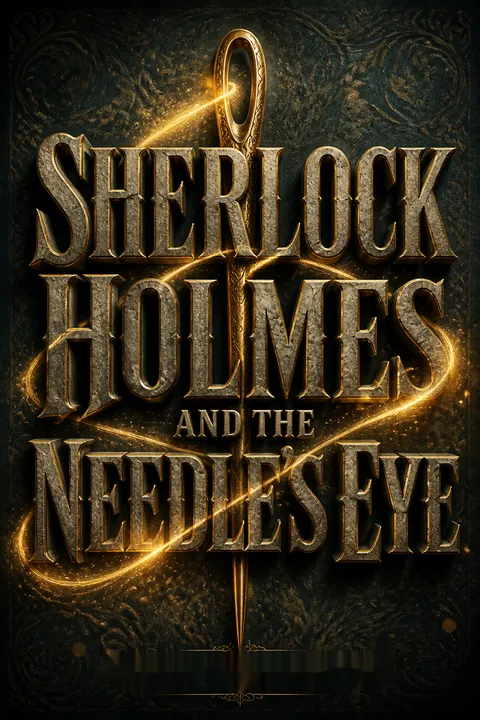


Plot Summary
Prologue
After three weeks away in Scotland, Dr. Watson returns to Baker Street and finds Sherlock Holmes missing, their rooms scorched by a hole blasted through the wall. A stranger leads Watson through the fog to the paddle steamer Viceroy of India, where he finds Holmes gaunt, feverish, and exhilarated beside an immense machine.
Holmes explains that he built the Needle’s Eye from stolen equations by Professor Moriarty, adapting its light-speed mechanism to carry people backward through time. An anonymous patron has offered a fortune for ten biblical mysteries, each identified by a mysterious card. Holmes has already glimpsed a hanging man in the past. With Watson beside him, he activates the machine and begins the first investigation.
The opening makes Holmes’s brilliance look perilously close to self-destruction: he has secluded himself with a dangerous invention, neglected food, and nearly burned down his home. Watson’s return restores the human bond that Holmes’s abstractions cannot replace. The machine then gives the detective’s usual method a radical new object. Instead of reconstructing events from traces, he can enter history itself, yet the unexplained cards and the machine’s strange rules ensure that observation will not equal mastery. The prologue establishes the book’s central tension: Holmes trusts evidence, but the evidence will repeatedly demand that he revise what he believes counts as knowable.
Ahithophel's Last Counsel
In the Judean hills, Holmes and Watson first inspect Ahithophel’s hanging body, then travel back to observe the counselor’s life. Ahithophel appears loyal to King David until a night meeting with Prince Absalom reveals that he has joined the rebellion. Holmes discovers the injury behind that change: Bathsheba, Ahithophel’s granddaughter, was the woman David took while her husband, Uriah, was away at war.
David then arranged Uriah’s death and failed to punish his own son Amnon for raping Bathsheba’s sister Tamar. Ahithophel helps Absalom seize Jerusalem, but the prince rejects his decisive plan to kill David. Knowing revenge has failed and defeat is near, Ahithophel returns home, orders his household, and hangs himself.
Holmes turns a brief biblical notice into a study of injury preserved as political judgment. Ahithophel’s revolt is not presented as simple ambition: the king’s private abuse of power has entered the counselor’s family and made loyalty morally unbearable. Yet Ahithophel’s response reproduces the violence he opposes. He uses his strategic gifts to destroy David, then cannot imagine a future once that plan collapses. The case also forces Holmes to treat family love as evidence rather than sentiment. Watson’s compassion helps him see what the clues alone cannot: a household can become the hidden center of a kingdom’s political crisis.
The Missing Adulterer
In Jerusalem, Holmes and Watson interrupt a mob dragging a wounded woman toward Jesus, but she slips away before they can learn why she was targeted. They later find her surrounded by religious authorities who want Jesus to endorse her execution.
Holmes notices that the leaders claim she was caught in the act, although the law requires the man involved to face judgment too. He reasons that Jesus wrote this missing fact in the dust: where is the man?
The accusers leave, oldest first, exposed as men who have manipulated the law to trap Jesus while sparing the woman’s partner. Jesus releases the woman and urges her to change her life. Watson and Holmes conclude that her accusers have committed a deeper betrayal by putting legal prestige above justice.
The mystery turns on an absence, not a hidden object: the missing man reveals that the authorities have curated the evidence. Holmes’s solution makes their procedural failure a moral act. They do not merely overlook the law; they exploit it selectively, using a woman’s vulnerability to stage a test for Jesus. The distinction matters because their public righteousness depends on making power appear impersonal. Jesus disrupts that performance by returning responsibility to the accusers themselves. The woman’s release is not a declaration that nothing happened, but a refusal to let punishment become a tool of political theater.
Two Zechariahs, One Charge
Holmes and Watson witness the priest Zechariah son of Jehoiada condemn King Joash’s turn to idolatry, then try to carry him away before soldiers can seize him. The queen helps the time travelers escape, but Zechariah remains to confront the crowd and is murdered.
Back in London, Watson fears that Jesus later confused this victim with Zechariah son of Berechiah. Professor Norberton offers possibilities, but none satisfies him. Holmes instead traces a repeated demand that Israel return to God through Jeremiah, Joel, and Zechariah’s own writings.
Their passages connect prophetic warnings, the temple courtyard, and innocent blood. Holmes argues that Jesus’ reference fits the later Zechariah, while Watson regains confidence that the apparent contradiction has a contextual explanation.
This case makes interpretation itself the action. Watson’s crisis begins when a textual discrepancy threatens the authority he has trusted; Holmes initially treats the issue as a puzzle, but his investigation becomes an exercise in reading across historical and prophetic contexts. Norberton’s expertise proves insufficient because facts detached from a governing pattern cannot settle the question. The repeated call to return supplies that pattern, linking two separated periods through the rejection of prophetic warning. The resolution does not erase uncertainty from textual transmission. Instead, it shows how careful comparison can replace a premature verdict with a more coherent account.
The Cross Becomes the Trial
Holmes and Watson watch Satan test Jesus in the wilderness with hunger, political dominion, and the demand that God prove his protection. Afterward, Holmes travels alone to Gethsemane and returns shaken by what he saw, carrying the question of when the devil next found an opportune moment.
Holmes links the answer to the crucifixion: three separate groups challenge Jesus to save himself, echoing the wilderness tests of identity and power. Above the cross, a public inscription identifies Jesus as king in three languages, answering the challenges without his abandoning his purpose.
Watson reads the scene as more than a clever parallel. The suffering and the condemned man who seeks mercy unsettle Holmes, whose old claim that faith is empty begins to lose its force.
The chapter reframes temptation as something more severe than appetite or spectacle. In the wilderness, Jesus refuses to use power for self-preservation; at the cross, the same demand returns under conditions of pain, humiliation, and apparent defeat. The multilingual inscription makes identity public while offering no immediate rescue, so the conflict cannot be resolved by a display of force. Watson’s response emphasizes not only Jesus’ endurance but the emotional cost borne by the Father. Holmes cannot reduce this to a closed case: his attention shifts from pattern recognition toward the question of whether detached observation can explain suffering.
Philippi's Dangerous Opening
In Philippi, the time travelers are mistaken for Paul and Silas. Watson receives a blow from the magistrates’ whip before the real prisoners arrive, and Holmes later helps him recover enough to enter the jail. They find Paul and Silas singing in stocks; an earthquake breaks the cells open, and the pair escape by cart before Roman soldiers can catch them.
Back in London, Holmes asks why Paul began his Macedonian mission in so hostile a city. He traces the route backward from Corinth and realizes that Philippi’s Roman-colony status made it the region’s policing center. Paul’s public mistreatment and vindication made its magistrates wary of further interference, weakening the authorities’ ability to stop his work in Thessalonica and beyond.
The episode makes geography consequential. Philippi is not merely the first stop in a missionary itinerary; its Roman status gives one city unusual power over movement and public order. By enduring punishment there, Paul’s mission changes the incentives of the officials who might otherwise have pursued him elsewhere. Holmes reaches the answer through reverse reasoning, a method that mirrors the machine’s backward travel. The connection suggests that historical meaning often becomes visible only when consequences are traced toward their causes. Watson’s own brief punishment gives this abstract political logic a bodily cost.
Four Stones Beyond Goliath
Holmes and Watson watch the young David face Goliath in the Valley of Elah. David chooses five stones, defeats the giant with one, and then takes Goliath’s sword to finish the fight. Later, the travelers witness Benaiah kill a lion in a pit, but Holmes cannot see why that scene belongs to the puzzle.
His breakthrough comes back in London, when Mrs. Hudson’s casual talk of four turns in a card game prompts him to revisit the biblical record. It names four other giant descendants who later fell to David’s warriors.
Holmes concludes that David took four spare stones because he expected a fight against Goliath and his four kin, not because he doubted his aim. The finding deepens Watson’s respect for David’s faith and sharpens Holmes’s discomfort with his own skepticism.
The solution depends on correcting the question. Holmes has been asking why David needed five stones, as if the number confessed uncertainty; Mrs. Hudson’s clue makes him ask why he would need the extra four. That shift changes the stones from insurance against failure into preparation for an entire threat. The case therefore distinguishes confidence from recklessness: David’s certainty is grounded in practiced skill and trust in God, not in the weapon’s power. Holmes recognizes the pattern but remains troubled by the possibility that his method can explain belief without sharing it.
Lazarus as Rehearsal
In Bethany, Holmes and Watson enter Lazarus’s sealed tomb and watch Jesus call the dead man back to life. Holmes searches for more than the familiar miracle, then connects the account to Jesus’ earlier insistence that he acts as the Father acts. A remark from mourners about Jesus healing the blind man leads Holmes to read the raising of Lazarus as a rehearsal: soon, the Father will allow his beloved Son to die and will raise him from the tomb.
The delayed arrival in Bethany thus foreshadows the delay before Jesus’ own resurrection. Watson, who had secretly resented Jesus for letting Lazarus suffer, recognizes a further cost: the story imagines the Father sharing the grief of a parent who watches a son die.
Holmes’s reading hinges on dramatic structure. Lazarus’s death and restoration do not merely display miraculous power; they provide a prior scene through which the later death of Jesus can be understood. The analogy makes divine grief part of the theological picture rather than an emotion assigned only to human mourners. Watson’s anger is equally important: his faith had faltered because he judged delay from the sufferer’s side alone. The case does not make that pain disappear, but it gives it a frame in which delay is neither indifference nor proof of abandonment.
Mary, Jezebel, and the Lineage
The Needle’s Eye first carries Holmes and Watson to Mary’s encounter with the angel who announces the child she will bear. Their next journey places them in Queen Jezebel’s chamber as Jehu’s forces close in, and the travelers return to London badly shaken by the encounter with overwhelming holiness and political evil.
Recovering at Baker Street, they take up a new puzzle: why Matthew includes King Jehoiachin despite Jeremiah’s curse against his descendants ruling Judah. Holmes explains that Matthew traces Joseph’s legal royal line, while Luke records Jesus’ maternal ancestry through David’s son Nathan, bypassing Solomon and Jehoiachin.
Mrs. Hudson’s remarks about family lines help Holmes locate the missing distinction. The solution restores Watson’s trust in the genealogy without requiring the two records to serve the same purpose.
This chapter places two kinds of inheritance beside each other: Mary’s acceptance of a future she did not choose and Jezebel’s use of royal power to preserve her own control. Their juxtaposition makes motherhood more than a biological category; it can signify receptivity, influence, or political domination. The genealogy puzzle then turns lineage into a question of legal and biological relation. Holmes resolves the apparent conflict by distinguishing what Matthew establishes from what Luke records. As in the Zechariah case, the text becomes intelligible through attention to purpose and context rather than by flattening separate accounts into one.
The Roads Out of Judea
Holmes and Watson witness Mary, Joseph, and the infant Jesus flee Bethlehem just before Herod’s soldiers kill children left behind. Later, they encounter Paul under Roman escort on the road to Caesarea, then narrowly evade the pursuing cavalry.
Holmes initially sees the birth’s political and religious setting as evidence that Jesus came at the worst possible time. Watson insists that the spread of Christianity matters too. Studying the journeys in Acts, Holmes recognizes the shared clue: Roman roads allowed frightened believers to leave Jerusalem quickly and carry the gospel across the empire.
The roads also help the family escape Herod’s reach. Holmes concludes that the period’s imperial infrastructure made the message’s survival and spread possible, even amid persecution, and the pair flee pursuing London police after their investigation.
The answer depends on scale. Holmes first judges the timing from the immediate suffering of Judea, especially the massacre of Bethlehem’s children. Watson presses him to include what happened after the violence. Roman roads become an ambivalent instrument: built to govern and move imperial power, they also enable refugees, missionaries, and new communities to travel. The solution does not neutralize the massacre or turn suffering into a simple benefit. Instead, it shows how an oppressive structure can create routes its rulers cannot fully control. Holmes’s method succeeds when he moves from local chronology to the larger system.
Jericho's Seventh Circuit
While Watson is ill, Mrs. Hudson joins Holmes on the final day of Israel’s march around Jericho. Her modern clothes, mixing bowl helmet, and Western adventure book leave Holmes struggling to manage both his landlady and the investigation.
As the Israelites circle the city for the seventh time, she rushes toward the advancing army. Holmes misses much of the action, but later notices the clue in her description of Jericho bristling. He realizes that repeated marches had made the defenders complacent, while the longer final circuit drew soldiers onto the walls and toward the gates.
When the trumpets sound and the city falls, many defenders are exposed to the collapsing stone. Mrs. Hudson’s attention earns her an honorary Scotland Yard badge, and Holmes must admit that his sharpest cases can require help from unlikely minds.
The final case makes the detective’s dependence on others impossible to disguise. Holmes’s fixation on Mrs. Hudson’s improvised outfit distracts him from the event he came to study, while her offhand observation supplies the key he missed. The march’s repeated pattern becomes a tactical instrument: routine lowers vigilance, then the changed final circuit forces defenders into vulnerable positions. The outcome is both a military explanation and a comic reversal, since the supposedly untrained landlady proves more observant than the celebrated detective. Her badge gives public form to a change Holmes has resisted acknowledging: intelligence is not confined to his own methods or status.
Epilogue
After ten journeys, Holmes and Watson share breakfast aboard the Viceroy of India as a mysterious vision passes over the Thames and the police arrive to dismantle the Needle’s Eye. Holmes protects Mrs. Hudson and young Billy Button while the vessel unexpectedly gets underway, carrying the group out of the officers’ reach.
He admits that the Bible has become the one book that seems to examine him as he reads it, though he still resists easy claims of faith. When Mrs. Hudson asks what mystery mattered most, Holmes chooses a story they never investigated: the feeding of the five thousand, because it depended on a small boy’s contribution. The boy at the table is Billy, who joins them for tea as their strange partnership continues.
The ending refuses a clean conversion scene. Holmes acknowledges that the Bible has reached beyond his professional habits, but he does not abandon his commitment to reason or claim certainty about the mysterious patron. Instead, the closing choice honors a small act of participation: Holmes values a miracle that required a child to offer what he had. Billy’s place at the table echoes the book’s repeated correction of status, since insight and courage have come from Watson, Mrs. Hudson, and people Holmes might otherwise overlook. The ship’s escape preserves the adventure while leaving its metaphysical explanation open.
Analysis
The book uses the machinery of detective fiction to dramatize interpretation. Holmes receives a question, gathers clues, and proposes a solution, but the biblical past repeatedly frustrates the fantasy that seeing an event means possessing its meaning. He and Watson can observe history directly and still miss the decisive detail. The missing man in the adultery case, the second Zechariah, the four additional giants, and Rome’s roads all require attention to context beyond the most obvious scene. Mrs. Hudson’s contributions make the same point socially: insight is distributed, and Holmes’s authority does not guarantee that he sees first. The episodes also connect private motives to public consequences. David’s misconduct enters Ahithophel’s household and then destabilizes a kingdom. In Philippi, an empire’s civic structure shapes the route of a missionary movement. Roman roads, built to serve imperial power, become channels through which a new faith can travel. Such reversals complicate a simple opposition between good intentions and evil systems; history’s structures can be used in ways their makers did not intend.
The emotional center is Holmes’s resistance to conclusions that exceed proof. His skepticism begins as professional discipline, but it can harden into a defense against suffering. Watson’s faith is not presented as effortless certainty either: textual difficulty, violence, and divine delay unsettle him. Their friendship gives the argument a human form. Holmes tests Watson’s assumptions; Watson insists that compassion and spiritual meaning are evidence of a different kind, not substitutes for observation. By the final chapters, Holmes has not become a conventional believer, but his earlier confidence in purely rational explanation has been disturbed. The book leaves him with a Bible that seems to read him in return, suggesting that investigation can change the investigator even when it cannot close every case.
Review Summary
Sherlock Holmes and the Needle's Eye receives mixed reviews. Many readers appreciate the creative blend of Holmes and biblical mysteries, finding it both entertaining and educational. Some praise Bailey's ability to capture Holmes' character and voice. However, others criticize the book for being too theological or deviating from canonical Holmes. Several reviewers note it works better as a Bible study tool than a novel. The time travel premise and Holmes' approach to biblical questions intrigue some readers while frustrating others. Overall, the book seems to appeal most to those interested in both Sherlock Holmes and biblical analysis.
People Also Read


Characters
Sherlock Holmes
The evidence-first detectiveHolmes is a brilliant consulting detective whose appetite for difficult problems often outruns his concern for his own health. He builds the Needle’s Eye from Professor Moriarty’s equations, then uses it to investigate biblical puzzles as if history were another crime scene. His first instinct is to separate fact from belief, and he frequently underestimates the emotional or spiritual weight of what he observes. Watson’s questions and Mrs. Hudson’s unexpected insights repeatedly force him to revise his conclusions. Holmes is not simply converted by spectacle; he is challenged to consider whether evidence can expose the limits of his own certainty.
Dr. John Watson
The faithful field chroniclerWatson is Holmes’s closest friend, a physician, former army surgeon, and narrator of their investigations. His medical training makes him attentive to bodies and suffering, while his Christian faith gives him a stake in the biblical questions Holmes treats as intellectual puzzles. He can be earnest, defensive, and occasionally too quick to settle for a familiar explanation. Yet he also challenges Holmes when detachment becomes a form of evasion. Watson’s emotional responses are not a weakness to be corrected; they often reveal what a purely technical reading leaves out.
Mrs. Hudson
The overlooked household strategistThe landlady of 221B Baker Street manages Holmes and Watson’s domestic life with patience, wit, and a firm sense of her own dignity. Holmes often treats her as a practical background presence, especially when absorbed in a case. Her observations, memory, and knack for numbers prove more valuable than he expects. Beneath her domestic competence is a lively appetite for experience and recognition. She is neither a mere comic foil nor a substitute for Watson; her independent judgment changes how Holmes understands who is capable of solving a mystery.
Jesus
The center of the mysteriesJesus appears in several investigations as teacher, healer, and the subject of contested interpretations. He refuses the religious leaders’ attempt to use a vulnerable woman against him, answers temptation without turning power toward self-preservation, and acts with deliberate purpose around Lazarus. The book presents him through what he does and the words others study, rather than through a conventional character arc. His presence unsettles Holmes because it resists reduction to either miracle or argument. For Watson, Jesus is the ground of faith and the figure whose suffering gives the investigations their deepest emotional stakes.
David
The flawed Israelite kingDavid appears at two stages of life: as the young shepherd confronting Goliath and as the king whose private choices damage his household and kingdom. He is courageous and capable of trust, but also a ruler whose authority can become dangerous when desire goes unchecked. The juxtaposition prevents his famous victory from turning him into a flawless hero. His story links personal conduct to political consequence, showing how a king’s failures reverberate through children, allies, and the nation he governs.
The Mysterious Client
The unseen case-giverAn anonymous patron recruits Holmes to investigate ten biblical mysteries, pays generously, and supplies questions on distinctive cards that appear at crucial moments. The client never joins the investigations in person, so Holmes and Watson must infer purpose from the assignments themselves. The initials on the cards invite speculation but do not settle the sender’s identity. This unseen presence gives the episodes a shared frame and keeps the detectives aware that their journeys may be intended for more than their own curiosity.
Ahithophel
The royal counselorAhithophel is an exceptionally respected adviser to King David, skilled in political counsel and military strategy. His position brings him close to royal power, but his deepest loyalties are bound to his family. Holmes studies the contrast between Ahithophel’s public authority and private vulnerability, treating the details of his household as essential evidence. He embodies the danger of allowing a real injury to dictate every future choice.
Bathsheba
The royal household's daughterBathsheba is the daughter of Eliam, a member of David’s circle of warriors, and granddaughter of Ahithophel. Her beauty draws the king’s attention, but the story’s investigation refuses to make her merely an object in the men’s political calculations. Her family connections expose how royal misconduct reaches into the lives of those with less power. Holmes must identify her through clues observed before he understands her place in the wider case.
Absalom
The ambitious royal sonAbsalom is David’s charismatic son, shaped by family grievance and a talent for winning public affection. He cultivates support among people seeking judgment and attention, turning personal conflict into a political challenge. His appeal rests partly on his ability to make others feel seen, while his ambition makes reconciliation difficult. He is a reminder that rebellion can grow from genuine injuries and still become a destructive bid for power.
Uriah
The principled soldierUriah is a Hittite soldier serving among David’s elite warriors and Bathsheba’s husband. His loyalty to comrades in the field contrasts with the king’s willingness to use him as a tool in a private deception. Holmes values Uriah’s conduct as an important clue to the emotional and ethical damage within David’s court. He represents a form of honor that does not depend on royal status.
The Pharisees
The law's self-appointed guardiansThe Pharisees and teachers of the law are religious authorities who defend their interpretations of scripture and tradition. In the temple episode, they treat a woman’s case as an opportunity to challenge Jesus rather than as a demand for impartial justice. Their confidence in their own righteousness makes it difficult for them to recognize how selectively they apply the law. The group functions as a collective antagonist whose authority depends on public standing and control of interpretation.
Zechariah son of Jehoiada
The temple's warning voiceZechariah is a priest who calls King Joash and the people back from idolatry. His authority comes from his religious office and from the history he shares with the royal household. He speaks despite the danger created by confronting both king and crowd. Holmes and Watson encounter him while trying to understand the later reference to another prophet with the same name.
Professor Cyril Norberton
The retired Bible scholarNorberton is a retired Cambridge professor of Old Testament studies whom Holmes consults when Watson questions a Gospel reference to Zechariah. He brings knowledge of manuscripts, history, and ancient customs, but his confident explanations do not always answer the detectives’ central question. His role distinguishes accumulated expertise from a complete argument: information matters, but it must be tested against the larger textual pattern.
Paul
The traveling apostlePaul is the missionary whose journeys through Macedonia and the Roman world give Holmes several historical puzzles to investigate. He persists despite arrest, public punishment, and opposition, while his letters and travels reveal a leader responsible for new communities and fellow workers. Watson admires his resilience and protective care for his companions. Paul’s movements also let Holmes examine how political systems and roads shape the spread of ideas.
Mary, mother of Jesus
The willing young motherMary is a young woman whose encounter with a heavenly messenger places her at the threshold of an extraordinary future. The scene emphasizes her fear, attention, and willingness to accept a responsibility she could not have planned for herself. Her place in the later genealogy investigation also makes maternal ancestry relevant to the question of Jesus’ royal descent. She is portrayed as a person making a consequential choice, not simply as a symbol.
Jezebel
The formidable queen motherJezebel is a politically forceful queen mother whose attachment to royal status and foreign religious traditions shapes the court around her. The narrative presents her as sharply self-conscious, skilled at ceremony, and unwilling to surrender control. Her scene stands against Mary’s earlier encounter, offering a very different image of maternal influence and power. She is an antagonist whose confidence makes her dangerous to anyone who threatens her authority.
Lazarus
The beloved Bethany brotherLazarus is the brother of Mary and Martha and a close friend of Jesus. His illness and the reactions of those around him make him central to a puzzle about delay, grief, and belief. Though he says little in the investigation, his relationship with Jesus gives the episode its emotional force. Holmes and Watson must consider not only what happens to Lazarus but what his family experiences while waiting.
Joshua
Israel's new commanderJoshua leads Israel after Moses and faces Jericho with a plan that makes little conventional military sense. The account emphasizes his obedience and steadiness under pressure. Holmes’s investigation examines the sequence of the marches rather than Joshua’s motives, but Joshua’s willingness to carry out an unusual strategy gives the puzzle its structure.
Rahab
Jericho's resourceful residentRahab is a resident of Jericho associated with the city wall and the arrival of Israelite spies. Holmes considers what her occupation and standing might have meant in the ancient city, rather than accepting a modern assumption without examination. Her story complicates the division between an enemy city and the people within it. Resourcefulness and quick judgment define her presence in the biblical material.
Benaiah
David's formidable warriorBenaiah is one of David’s mighty men, remembered for feats that place him against unusually dangerous opponents. Holmes and Watson witness his encounter with a lion in a pit, an episode that initially seems disconnected from their question about David. His courage supplies a clue that pushes Holmes deeper into the biblical record.
Goliath
The Philistine championGoliath is a heavily armed warrior from Gath who represents the Philistine challenge to Israel. His great size and military confidence contrast sharply with the young shepherd who approaches him. The story uses that imbalance to focus attention on David’s preparation, conviction, and choice of weapon.
Billy Button
The resourceful street boyBilly Button is a scruffy London street boy who moves easily through places that would be closed to the more respectable adults around him. His familiarity with Holmes’s circle and his boldness make him a lively presence aboard the Viceroy of India. Holmes’s affection for him reveals a softer regard for people whom polite society dismisses.
Mr. and Mrs. Ferguson
The ship's practical keepersThe Fergusons help maintain the Viceroy of India and provide the practical support that keeps Holmes’s hidden base functioning. Mrs. Ferguson handles the ship’s household tasks, while her husband contributes mechanical skill. They are not investigators, but their work gives Holmes and Watson a place to recover between journeys and keeps the machine’s secret life possible.
Plot Devices
The Needle's Eye
A passage through timeHolmes constructs the machine from equations stolen from Professor Moriarty, adapting its dynamo to reduce matter and send a person backward through time. It stands hidden aboard the Viceroy of India because its size and danger make Baker Street unsuitable. The machine also imposes rules the detectives cannot fully explain: their clothing changes in some journeys, and their visibility depends on what they wear. Each trip supplies firsthand observation, but not automatic understanding. Holmes and Watson still have to interpret what they see, and the machine’s unexplained operation leaves room for uncertainty about who or what is directing their investigations.
The Cream Calling Cards
A question for every journeyThe anonymous patron’s cards provide the investigative question for each biblical episode. They appear in unlikely locations, from a tree hollow to a Bible or a theater seat, and keep the series of adventures tied to a single commission. The cards do not supply answers, so Holmes and Watson must gather evidence and test interpretations for themselves. Their signature, K2L2, invites the detectives to consider the patron’s identity, but Holmes does not claim certainty. The cards make the cases feel commissioned and purposeful while preserving a final uncertainty beyond Holmes’s powers of deduction.
Changing Visibility
Clothing sets their presenceThe Needle’s Eye sometimes leaves Holmes and Watson in their Victorian clothes, making them nearly invisible and unable to affect the people they observe. In other journeys it supplies biblical garments, allowing ancient people to see and touch them. That difference creates practical danger, as when the pair are mistaken for men who can be punished, and it explains why their attempts to intervene do not always change recorded events. The rule is never fully mechanical or predictable, which keeps time travel from becoming a simple power fantasy and forces the travelers to judge when action is possible.
The Scriptural Case File
Clues across biblical passagesEach mystery begins with a difficult detail in a biblical narrative, then widens through cross-references, historical context, language, genealogy, or political geography. Holmes’s detective habits supply a method, but Watson’s faith and memory often expose the relevant human stakes. Minor details become evidence: an absent accused man, a repeated temple location, a number in a battle story, or a travel route. This structure turns familiar episodes into linked investigations without making every solution a simple hidden fact. The approach itself becomes part of the plot, since the detectives repeatedly discover that their first question has been framed too narrowly.
The Viceroy of India
A hidden Victorian headquartersThe aging paddle steamer gives Holmes a secluded workshop for the Needle’s Eye and a refuge between investigations. Its concealed rooms, hired protectors, and awkward provisions make it both a laboratory and a home, while Watson’s arrival turns it into the base for their shared adventures. The ship also carries the frame story: the police eventually discover the secret and move to dismantle the machine. Its battered engine and river setting connect Holmes’s grand experiment to the ordinary labor of the people who keep the vessel afloat.
FAQ
What's Sherlock Holmes and the Needle’s Eye about?
- Unique Concept: The book combines Sherlock Holmes' detective skills with biblical mysteries, presenting each Bible story as a case for Holmes and Watson to solve.
- Ten Mysteries: It features ten specific Bible stories, each framed as a mystery, offering fresh insights into these ancient texts.
- Engaging Format: Readers are encouraged to engage with biblical passages through investigative questions at the end of each chapter.
Why should I read Sherlock Holmes and the Needle’s Eye?
- Educational and Entertaining: The book is both informative and fun, appealing to fans of literature and biblical studies.
- Fresh Perspective: It offers a unique view of Bible stories, encouraging readers to explore them through mystery and investigation.
- Rich Historical Detail: Len Bailey incorporates historical context, enhancing the reading experience with vivid backdrops for the mysteries.
What are the key takeaways of Sherlock Holmes and the Needle’s Eye?
- Interconnection of Stories: The book shows how biblical narratives are interconnected and resonate with themes of mystery.
- Holmes’ Methodology: Readers learn about Holmes’ deductive reasoning and its application to biblical texts, emphasizing evidence and inquiry.
- Faith and Doubt: It explores themes of faith and doubt through the characters’ experiences and the biblical stories they investigate.
What are the best quotes from Sherlock Holmes and the Needle’s Eye and what do they mean?
- “The Needle’s Eye is the product of pure genius.”: Highlights the innovative concept of merging detective fiction with biblical exploration.
- “It is a capital mistake to theorize before you have all the evidence.”: Stresses the importance of gathering all relevant information before drawing conclusions.
- “Return to Me, and I will return to you.”: Encapsulates the theme of repentance and the relationship between God and humanity.
How does Len Bailey incorporate Sherlock Holmes into biblical stories?
- Character Integration: Holmes and Watson are seamlessly integrated into biblical narratives, interacting with historical figures and events.
- Mystery Format: Each biblical story is framed as a mystery for Holmes to solve, uncovering deeper meanings within the texts.
- Dialogue and Interaction: Their dialogue reflects their investigative process, encouraging readers to think critically about the stories.
How does Sherlock Holmes and the Needle’s Eye explore the character of David?
- David's Confidence: Portrays David as a figure of immense faith and courage, unafraid to confront giants.
- Five Stones Symbolism: Holmes questions David's choice of five stones, suggesting it reflects deliberate preparation and confidence in God's support.
- Contrast with Saul: Highlights the theme of faith versus doubt in leadership by contrasting David's boldness with Saul's fear.
What role does faith play in Sherlock Holmes and the Needle’s Eye?
- Holmes' Skepticism: Holmes often questions the existence of God and the validity of biblical miracles, reflecting a struggle with faith.
- Watson's Belief: Watson embodies faith and hope, reminding Holmes of the importance of belief in understanding life's mysteries.
- Exploration of Biblical Events: Uses biblical events to illustrate how faith shapes understanding and influences actions.
How does the book address the theme of timing?
- God's Perfect Timing: Discusses how Christ's birth and death occurred at the right time, emphasizing divine orchestration.
- Human Perception of Time: Holmes grapples with the idea that human understanding of timing often conflicts with God's timing.
- Lessons from Jericho: The Israelites' obedience to God's timing led to miraculous outcomes, illustrating the significance of divine timing.
What insights does Sherlock Holmes and the Needle’s Eye provide about the nature of evil?
- Evil in Leadership: Examines how leaders like Herod used power for evil, leading to suffering and injustice.
- Personal Responsibility: Suggests individuals must confront their own capacity for evil and the consequences of their actions.
- Redemption and Hope: Despite evil, the narrative points to the possibility of redemption and the transformative power of faith.
How does the book depict the relationship between Holmes and Watson?
- Complementary Characters: Holmes' skepticism contrasts with Watson's faith, creating a dynamic partnership.
- Mutual Respect: Despite differences, there is deep respect and affection between them as they explore moral and philosophical questions.
- Growth Through Challenges: Their experiences lead to personal growth, particularly for Holmes, as he grapples with faith.
What is the significance of the character of Rahab in Sherlock Holmes and the Needle’s Eye?
- Symbol of Faith: Rahab's actions demonstrate faith in God’s plan, serving as a model for belief and courage.
- Inclusion in Christ's Lineage: Her inclusion in Christ's genealogy highlights redemption, showing the role of those with troubled pasts in God's story.
- Contrast with Jericho's Fate: Rahab's survival amidst Jericho's destruction serves as a reminder of God's mercy and the importance of faith.
How does Sherlock Holmes and the Needle’s Eye compare to traditional Bible studies?
- Narrative Approach: Uses a story-driven exploration of biblical themes, unlike traditional text analysis.
- Mystery Element: Adds intrigue and excitement, making biblical stories more engaging and accessible.
- Interactive Learning: Includes investigative questions that encourage active participation and reflection, fostering dynamic learning.
Download PDF
Download EPUB
.epub digital book format is ideal for reading ebooks on phones, tablets, and e-readers.








