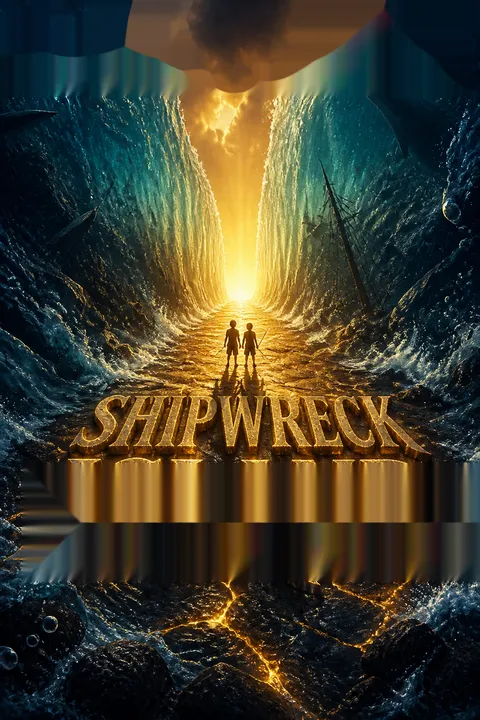


Plot Summary
A Whale Beneath the Raft
After three months at sea, Ellie and Seth drift toward the island marked on an Inquisitorial map. A killer whale overturns their raft, and Ellie glimpses a motionless human shape beneath the water before Seth pulls her to safety. The island rises around a gigantic Ark, with colorful houses on stilts and villagers praising a Queen they treat as divine.
Fish swarm behind the raft, following Seth’s strange pull on the sea, but the islanders also speak of failing harvests and empty waters. Ellie hopes to find people who will welcome her inventions; Seth expects danger and distrusts the island’s cheerful rituals. Their arrival offers shelter, but the mysterious shadow and Seth’s involuntary visions suggest the past has followed them.
The island’s bright welcome is immediately qualified by scarcity: fish appear in abundance, yet residents describe worsening harvests. This mismatch makes belief part of the island’s survival system, not merely its decoration. Ellie interprets the Queen as a possible answer to her own need for belonging, while Seth reads power as a warning because his past has taught him what authorities can do. The underwater figure unsettles their refuge before either child understands the threat. The opening therefore binds hope to uncertainty: a new home may offer community, but it may also demand faith in forces neither child can safely trust.
A Place for Seth
At the docks, Seth convinces Viola, a young fisher, to take him out on her boat. He returns with a miraculous catch, then collapses from the effort of using the sea’s power. Her father Janssen rewards him with work, and the sailors quickly welcome him. Ellie stays behind, gives Seth her mother’s patched coat to hide the blue markings on his arms, and feels the loss as soon as he leaves.
Unable to find work suited to her inventions, she wanders toward the palace and meets Kate, a handmaiden spying on a family. When the family’s father catches them, Ellie uses a smoke bomb to help Kate escape. Kate returns the favor by rescuing Ellie, then warns her that the Queen cannot be trusted.
Seth’s easy welcome and Ellie’s repeated rejection establish the book’s emotional fault line before either child names it. His usefulness is visible and immediate: he brings fish to a hungry crew. Ellie’s gifts are harder for strangers to recognize, and her coat, both a link to her mother and a shield from exposure, becomes an intimate sacrifice. Kate’s rescue complicates Ellie’s longing for a benevolent ruler. The person closest to the palace distrusts its center. Ellie’s desire to be useful is genuine, but it is also a defense against feeling unnecessary, a vulnerability that both friendship and manipulation can reach.
Gunpowder Wins an Audience
As Ellie struggles to find a job, an argument with Seth leaves her alone with her fear that the Enemy is returning. When a miner becomes trapped behind a boulder during a fire, Ellie uses homemade gunpowder to break through and save him. The blast also drops a stalactite onto her arm.
Loren Alexander, a celebrated courtier, treats her as a hero and carries her toward the palace, while the hostile Inquisitor Hargrath tries to seize her. In the Queen’s court, Ellie offers to help with the failing harvest. The Queen instead imprisons her, ordering her to produce an impressive invention or face execution. Ellie’s rescue has earned her attention, but the palace converts that attention into a test she may not survive.
Ellie’s decision to use gunpowder joins ingenuity to moral risk: she acts because a person is trapped, not because the invention is approved or safe. Loren recognizes both her usefulness and the public value of appearing to reward a hero. The court, by contrast, makes survival conditional on performance. Ellie has spent much of her life proving that she deserves to occupy space; a royal sentence turns that pressure into law. Hargrath’s pursuit also makes her earlier fear concrete. The section’s tension comes from conflicting interpretations of the same act: rescue, blasphemy, spectacle, and evidence of a dangerous girl.
The Queen in Disguise
In the palace workshop, Ellie and Kate make a mechanical hand for Ellie’s injured arm, but the Queen dismisses it as useless. Ellie then proposes a flying device, and she and Kate begin cutting palace dresses into wings. Their work gives the girls a rare ease with each other, though Kate remains guarded about her powers and status.
When Ellie notices Kate’s height, features, and access to the Queen’s clothing, the truth emerges: Kate is the Queen herself. Kate admits she used the threat of execution to keep Ellie working, not to kill her. She also admits that she can use her powers, though a later attempt to make a seed grow overwhelms her. Ellie sees that the ruler she hoped would save her is frightened of failing her people.
The reveal changes the meaning of the workshop without making the earlier intimacy false. Kate has used authority to conceal vulnerability, while Ellie has mistaken access to power for freedom from fear. Their collaboration is most honest when they are making something together, yet even that shared work carries unequal stakes: one girl risks her life, the other risks the image on which her rule rests. Kate’s failure with the seed makes divine ability feel less like a gift than an obligation she cannot fulfill on command. Ellie’s impulse to repair this problem is compassionate, but it also renews her belief that usefulness can secure love.
Leila’s Sea-Born Memories
Seth’s visions carry him into the life of Leila, a whale rider aboard the Ark centuries earlier. After her whale dies, the Crone reveals that the boy she is tending is a god of the sea, called Varu, and that he can draw fish and control the water. The Crone is herself a Vessel, carrying the God of Life, whose power makes plants grow but consumes part of her.
Seth resists remembering, while Ellie persuades him to ask the Crone how Vessels use their gifts. The answer is that they must temporarily surrender their sense of self, and that the God of Life may be able to destroy the Enemy. Ellie sees a possible way to help Kate, though Seth wants no role in divine history.
The diary strand turns Seth’s dreams into a second, parallel story about care under catastrophic conditions. Leila begins as a bereaved hunter who believes she has lost the only bond that gave her a place on the Ark; tending Varu gradually offers another. The Crone’s botanical power is not free, and her explanation gives the children a rule with an emotional price: to wield divine force, a Vessel must risk losing the self that makes the force humane. Ellie hears a possible solution for Kate. Seth hears an unwanted demand to become someone he has spent the novel trying not to be.
Harvest Under False Hope
Ellie’s soil-tillers and guano sprayers begin improving the fields, and Kate recruits blacksmiths to build more. Loren counters by poisoning the crops and destroying the hidden grain stores, then blames Ellie in front of the starving islanders. Kate gets Ellie away before the crowd recognizes her, but the Queen’s authority collapses as Loren promises to feed everyone and presents himself as the island’s real protector.
In private, Kate explains that her mother was the true Vessel. Kate’s father, inventor Altimus Ashenholme, took her mother to an underwater site and returned without her divine power; the harvests declined after her mother died. The Enemy visits Ellie and tempts her to use a wish, but she refuses.
The sabotage transforms a technical setback into a political crisis. Ellie’s machines have begun to work, but the public cannot distinguish their slow, visible gains from Loren’s sudden, persuasive story of betrayal. Kate’s history deepens that crisis: her apparent failure is not simply personal inadequacy but the aftermath of a theft she has hidden since childhood. Altimus’s invention is therefore linked to both scientific ambition and intimate exploitation. The Enemy’s offer arrives when Ellie is most desperate to protect Kate, making the temptation psychologically precise. Her refusal shows growth, but not immunity: she still believes she alone must find a repair for every wound.
Loren’s Book of Secrets
Ellie, Kate, Seth, and Viola break into Loren’s mansion while Janssen’s sailors distract the guards. In the house, they find Loren’s ledger of private scandals, with marks identifying people he has blackmailed into serving him. They copy the names rather than steal the book, but Loren’s informants discover the intruders.
As the group escapes to the beach, Seth uses his sea power to summon killer whales and sweep the pursuers away. The effort leaves him cold and unconscious. Viola realizes that Seth commands the water, but Ellie asks her to keep his identity secret. The ledger gives the friends a way to trace Loren’s operation, while Seth’s rescue turns a private suspicion into a danger others can see.
Loren’s ledger is a model of power built through asymmetrical knowledge. He does not need to persuade every islander; he needs only to know what each person fears losing. The friends’ choice to copy the informants’ names rather than take the book reflects their different instincts: Ellie plans, Kate strategizes, and Viola knows how the island’s networks work. Seth’s rescue makes the cost of secrecy sharper. His power saves the group, yet concealing it from Viola protects him only briefly and leaves her to interpret the event alone. Trust here is not a simple disclosure problem. It is the question of who is safe enough to know what another person can do.
The Drowning in the Diary
Reading Leila’s diary, Ellie learns that Varu lost control during the ancient war and caused the Drowning, the catastrophe that submerged the world. Later entries describe him steering the Ark toward land, dying in the crash, and the God-Bird choosing Leila as its new Vessel. Ellie is shaken by the knowledge that Seth’s past self caused so much suffering, and she argues with him before leaving for the mines without him.
There, she and Kate find Hargrath imprisoned by Loren. Kate tells the Inquisitor that Ellie is dead, protecting her identity. The girls then reach Loren’s secret meeting inside the volcano, where he threatens to expose Kate’s lack of power and demands to be named her successor.
The diary’s revelation makes historical guilt intimate: Ellie is not evaluating a distant god but a friend who has only recently learned what he may have done. Her choice to go on without Seth is partly strategic and partly an act of emotional recoil. The book does not let knowledge function as a clean moral verdict; Varu’s guilt is entangled with manipulation, grief, and a broken mind. Kate’s lie to Hargrath shows a different response to danger: she protects Ellie by controlling the story others can tell about her. In the volcano, Loren uses that same narrative power as a weapon against Kate.
Seth Faces the Sea
When Loren’s followers chase Ellie and Kate from the volcano, Seth follows the sea to them and intervenes with a wall of water. His power grows beyond his control, and a towering presence in the waves claims that the sea and Seth are one. Ellie reaches him, tells him what Leila’s diary revealed, and insists that the Enemy tricked him into causing the Drowning.
The memory breaks the surge; Seth returns to himself and collapses in grief. Ellie stays beside him rather than treating his power as proof that he is dangerous. Later diary pages show Varu’s death after the Ark reaches land and the God-Bird selecting Leila, completing the history that Seth’s visions have been restoring in fragments.
Seth’s rescue is both a triumph and a crisis: he can command the sea, but the power threatens to erase the person who is trying to wield it. Ellie does not deny the harm in his past. She separates responsibility from intention, giving him a way to face the truth without being reduced to it. That distinction is central to his recovery. The historical account of Varu’s death and Leila’s succession also makes the present relationship more than a puzzle about reincarnation. The old story survives because one person stayed with another through grief, and the current children must decide whether they can do the same.
Loren Takes the Crowd
Loren’s poisoning ruins the fields, and he uses the crisis to promise food, announce himself as Kate’s successor, and accuse her of weakness. The islanders demand that Kate make the dead soil bloom in front of them. She cannot, and the crowd’s worship turns into disappointment. Ellie tries to support her, but Kate blames her for the disaster and says she can no longer trust her.
The rupture leaves Kate alone with the choice Loren has forced upon her: accept his succession or watch him reveal that she is not a Vessel. While preparations begin for the Festival of Life, Kate refuses Ellie’s plan to flee. She would rather remain on the island with her people than abandon them, even if staying means surrendering her rule.
Loren understands that public authority depends on repeated, visible performances. The crowd’s demand is not simply for a miracle; it is for proof that Kate can still protect them. Her failure makes the private truth of her powerlessness politically explosive. Ellie’s attempt to help cannot undo the public humiliation, and Kate redirects her fear toward the friend who witnessed it. Their conflict is painful because both are acting from care, but they define care differently: Ellie wants Kate to survive, while Kate feels obliged to remain responsible for everyone else. Loren exploits that difference until self-sacrifice begins to look like consent.
The Festival’s False Miracle
At the Festival banquet, Loren prepares to be named Kate’s successor. Kate interrupts the ceremony by bringing in Hargrath, whose testimony reveals that Loren imprisoned him to learn the Enemy’s identity and hoped to kill its Vessel.
Loren’s attempt to deny the story collapses when he admits the scheme before the court. Kate then claims the Enemy’s spirit is loose and stages signs that make Loren appear to be its new Vessel. The guests believe her, and the Sentinels take Loren away.
Kate postpones his succession and presents herself as the island’s protector, while Ellie realizes that the rats, worms, and apparent transformation were part of Kate’s deception. The immediate coup is stopped, but Kate has learned how readily fear can restore her authority.
Kate defeats Loren by taking possession of the story he had been writing about her. Hargrath’s testimony exposes the machinery behind Loren’s heroism, while the staged signs give the audience a vivid replacement explanation. The tactic works because it satisfies an existing need for certainty, not because it produces truth. Kate’s performance is brilliant, but its cost is visible to Ellie: the Queen has learned to govern through manufactured terror. The feast therefore resolves the immediate succession crisis while planting a more intimate danger. Kate has protected her position, yet the method she uses resembles the very control she once feared in Loren.
The Enemy Wears Seth
Kate secretly starts a rumor that Loren has escaped, hoping the island’s fear will make people depend on her. She tells Ellie that she knows Seth is a god and wants him brought to the palace so she can use his power. Ellie leaves, but the figure waiting for her in the street looks like Seth and urges her to return. A loose flap of its skin exposes the Enemy beneath the disguise.
Ellie recognizes that it had also manipulated earlier moments of loneliness and conflict, then drives it away by remembering her brother Finn. At the Vile Oak, she learns that the Seven Sentinels have taken the real Seth. Viola and Molworth agree to help her reach the palace, while Ellie goes ahead to confront Kate.
The Enemy’s disguise exploits Ellie’s most specific vulnerability: the fear that Seth has chosen other people over her. Its deception does not require a new power so much as a precise reading of old pain. Ellie’s recognition marks a real gain in self-knowledge; she can identify the difference between a feeling and the interpretation someone is trying to impose on it. Kate’s parallel misuse of fear is more troubling because it is deliberate policy rather than supernatural coercion. The two dangers are not equivalent, but both test Ellie’s belief that a good outcome excuses manipulation. She has to act before she knows whether friendship can survive the truth.
The Sea Opens in Two
Kate binds Seth and demands that he part the sea, hoping to reach the underwater place where her mother lost her divine power. She also intends to approach the Enemy’s City without its fleet able to defend it. As Seth’s control fails, the sea rises into a wall and his eyes turn dark blue.
Ellie reaches him and tells him the truth about the Drowning, reminding him that he once caused the catastrophe without intending to. Seth returns to himself, but the sea remains parted, exposing the ocean floor and opening a route north. At the same moment, Viola and the sailors launch their Revolution inside the palace. Kate orders the Sentinels to fight them, while Ellie escapes onto the Ark’s crumbling exterior.
Kate’s desperation turns Seth from a friend into an instrument, precisely the kind of reduction that Ellie has spent the novel resisting. Her stated goal is to reclaim what was stolen from her mother, but the method threatens both Seth and the city she means to protect. Ellie’s intervention succeeds not by overpowering the sea but by restoring Seth’s sense of a self beyond its accumulated suffering. The parted water remains as a material consequence, however, and the Revolution arrives before anyone can decide what the opening means. A private breach of trust has become a public rupture in the island’s geography and government.
Ellie Jumps Toward the North
On the Ark’s unstable hull, Ellie confronts Kate for using Seth and tries to flee. Kate follows with her sword, slips among the crumbling statues, and falls. Ellie cries out for Kate to be saved, unknowingly granting the Enemy a wish and renewing its strength. Kate survives, recognizes Ellie as the Enemy’s Vessel, and tries to take that power for herself, but cannot bring herself to kill Ellie.
Ellie launches herself from the Ark in a glider sewn into her coat, deploys a parachute, and lands on the newly exposed seabed. The Enemy appears in Ellie’s own form and tells her their suffering is her fault. Ellie rejects that claim and heads north toward the underwater site where Altimus Ashenholme took Kate’s mother’s power.
The rescue is emotionally sincere and strategically disastrous. Ellie saves Kate because she cannot accept the other girl’s death, but the act gives the Enemy precisely what it needs: a renewed claim on Ellie. This is not a simple punishment for compassion. It shows how the Enemy turns care into leverage, then tries to make the victim interpret that leverage as personal failure. Kate’s refusal to kill Ellie preserves a remnant of attachment, but their friendship cannot simply be restored. Ellie’s final choice is neither escape nor victory. She walks toward the place where divine power was stolen, carrying the burden of resisting both the Enemy’s blame and her own wish to repair everyone.
Analysis
Shipwreck Island is built around the difference between care and control. Ellie invents because she believes suffering can be reduced through work, yet her habit of making herself useful leaves her open to relationships that treat her as an instrument. Seth fears his power because it brings exhaustion and the voices of the drowned; Kate fears her lack of power because an entire island expects her to embody divine protection. Each child is pushed toward a role that crowds out the ordinary self they want to keep.
The novel’s political conflict sharpens this psychological one. Loren manipulates hunger, secrets, and public attention, while Kate answers his propaganda with a staged miracle of her own. The strategy defeats an immediate coup, but it also shows how readily fear can restore authority. The book does not equate the two rulers: Loren seeks power for himself, while Kate believes she is protecting her people. Still, good intentions do not prevent her from using others as tools, and Ellie’s friendship with her cannot make that harm disappear.
The diary of Leila and the visions of Seth make history an active burden rather than a closed record. Varu’s responsibility for the Drowning cannot be erased, but neither does the past make Seth identical to the disaster. Ellie helps him recover by recognizing his capacity to choose differently. The Enemy counters with a harsher interpretation: that pain proves someone deserves blame. Ellie’s final journey begins when she refuses that explanation, even after her wish has strengthened the force she opposes. The ending offers no easy restoration. It leaves Ellie walking toward the source of stolen power, determined to confront the god that has repeatedly turned love, guilt, and hope against her.
Characters
Ellie Stonewall
The relentless inventorEllie is a young inventor who approaches danger as a problem that can be taken apart, tested, and rebuilt. Her patched coat, stuffed with tools and experiments, connects her to her dead mother and gives her a sense of competence when she feels exposed. She wants to be useful, but often confuses usefulness with being worthy of friendship. That need drives her toward the Queen and later makes her vulnerable to anyone who can promise approval. Ellie is courageous without being fearless: she improvises under pressure, yet must learn that she cannot engineer every person’s safety or control every consequence.
Seth
The wary sea boySeth is Ellie’s closest companion, a tall, reserved boy with a deep connection to the sea and little desire to explain it. He distrusts people because his previous encounters with authority brought pain, and he prefers the ordinary work of fishing to questions about who he is. His quiet care for Ellie appears in practical gestures, including sharing food and watching over her. Seth’s reluctance to use his abilities is not simple cowardice; he fears the exhaustion and memories they bring. He longs to be treated as a boy rather than a force of nature, even as others increasingly depend on what he can do.
Kate
The guarded island rulerKate is a sharp, watchful girl whose royal duties demand a poise she does not always feel. In private, she enjoys spectacle, play, and the company of someone who can treat her as a person rather than a sacred symbol. She is devoted to her island and acutely sensitive to the possibility that its people will see her as weak. That fear makes her conceal uncertainty behind authority and can lead her to control those closest to her. Kate’s friendship with Ellie offers a rare space for honesty, but the demands of ruling continually press against the ordinary closeness she wants.
Loren Alexander
The adored courtierLoren is a wealthy courtier, celebrated rescuer, and master of public presentation. His charm makes even self-promotion seem generous, while his access to newspapers, influence, and private information lets him shape what the island believes. He understands that people under pressure want a confident explanation and a person who promises immediate relief. Beneath his polished manners is a ruthless appetite for authority. Loren’s threat comes less from open force than from his ability to make manipulation look like service and to turn other people’s secrets into instruments of control.
The Enemy
The wish-granting godThe Enemy is a destructive god bound to Ellie, appearing through a frail, bandaged child and exploiting her fear, loneliness, and guilt. It studies the relationships Ellie values, then uses their pressure points to tempt her into making wishes. Its power is limited when Ellie refuses that bargain, but it remains psychologically present, speaking in the language of her private doubts. The Enemy is frightening not only because it can harm her, but because it can make cruelty sound like the truth Ellie already suspects about herself.
Viola
The irreverent fisherViola is an independent fisher who distrusts the Queen’s authority and dreams of a revolution against it. Her confidence, physical skill, and sharp humor make her a lively presence among the sailors. She treats Seth as a companion before she understands the scale of his power, and her reaction tests whether their friendship can withstand fear and withheld truths. Viola’s care is practical: she acts when someone is in danger, even when she has reasons to question the cause.
Leila
The whale-riding diaristLeila is a determined young hunter aboard the Ark, bonded to a whale and fiercely protective of the small circle of people she loves. Her diary gives the present-day characters access to a history she lived through, including the arrival of Varu and the Ark’s search for land. She begins with grief and anger, but her records reveal a capacity for loyalty that grows beyond her lost bond with the whale. Her voice makes ancient catastrophe immediate and personal.
The Crone
The garden’s hidden healerThe Crone is an aged healer and keeper of a secret garden inside the Ark. She understands the costs of divine power and tends Varu even when he cannot remember himself. Her manner is blunt, sometimes exasperating, but her care is patient and deliberate. She knows more about the past than she tells Leila, weighing truth against the risk of damaging someone who is not ready to bear it.
Molworth
The young innkeeperMolworth is a twelve-year-old innkeeper with an adult’s solemn opinions and a deep devotion to the Queen. He watches the sailors and guests from behind the bar, offering advice on friendship while struggling to practice it himself. His attachment to royal ritual gives him comfort and identity, especially when the island grows unstable. Beneath his fussiness, he can be generous and unexpectedly brave.
Janssen
Viola’s weathered fatherJanssen is a scarred fishing captain and Viola’s father. He worries about the dwindling catch and leans on faith in the Queen to explain how the island will survive. His affection for his daughter is clear even when her politics frustrate him. He gives Seth a chance to work, helping the boy find a place among the fishing crews.
Killian Hargrath
The relentless InquisitorHargrath is a brutal Inquisitor who pursues Ellie from the City to Shipwreck Island. His damaged body and obsessive hunt make him frightening, but his certainty about his mission has become its own prison. He believes he is protecting the world from the Enemy, and he sees little distinction between justice and destruction when pursuing that goal.
Altimus Ashenholme
The brilliant inventorAltimus Ashenholme is an inventor from the Enemy’s City who once mentored Ellie’s mother. His work connects scientific ingenuity to the island’s royal history, and his experiments have consequences far beyond his workshop. He is remembered as clever and driven, but not as someone whose brilliance necessarily serves other people.
Anna
Ellie’s absent friendAnna is Ellie’s closest friend from the City, left behind when Ellie and Seth fled. Her memory offers Ellie a model of friendship that survives separation and fear. Ellie often imagines how Anna would have acted, especially when she needs courage or a practical ally.
Finn
Ellie’s beloved brotherFinn is Ellie’s brother, remembered through shared childhood moments and the love that shaped her understanding of family. Ellie draws on those memories when fear threatens to overwhelm her. His presence in her thoughts gives her a way to resist the Enemy’s attempts to define her.
Archibald
Viola’s kittenArchibald is Viola’s small gray kitten, often perched on her shoulder or seeking warmth from the people around him. His presence softens the sailors’ rough humor and gives Viola a tender responsibility amid political turmoil.
Plot Devices
Vessels and the Divine Cycle
Power with a human costGods inhabit human or animal Vessels and can eventually take physical form. A Vessel’s power is not free: using it consumes part of the person carrying it, and control requires a temporary surrender of self. The system governs Kate’s royal legitimacy, the Crone’s healing, Seth’s sea powers, and Ellie’s bond with the Enemy. It makes questions of authority bodily and intimate. In this story, the possibility that a ruler is or is not a Vessel shapes public belief as much as actual ability.
Leila’s Diary and Visions
The buried past returnsLeila’s diary records life aboard the Ark centuries before it struck Shipwreck Island. Seth’s visions let him encounter fragments of that history, and Ellie uses the diary to connect those fragments to the present. The device gradually reveals Varu’s relationship with Leila, the Crone’s knowledge, the Ark’s search for land, and the catastrophe known as the Drowning. It also gives the children practical information about how divine powers work, while forcing Seth to confront memories he would rather leave untouched.
Ellie’s Inventions
Ingenuity under pressureEllie’s inventions give her a means of acting when she has little money, status, or physical strength. Smoke bombs help her escape danger, gunpowder opens a passage through a collapsed mine, and agricultural machines offer a practical response to failing crops. Her later glider and parachute turn a desperate escape into a dangerous journey across the newly exposed sea floor. The inventions are never effortless solutions: they misfire, break, or create new risks. Their function is to show how Ellie’s imagination becomes most effective when she combines it with observation, collaboration, and a willingness to revise.
Loren’s Secret Ledger
Blackmail mapped in inkLoren’s ledger lists the private scandals of islanders and identifies people he has turned into informants. It gives Ellie, Kate, Seth, and Viola a concrete map of how Loren’s political influence operates. Rather than rely only on guards or public speeches, he uses people’s fear of exposure to make them carry out sabotage and theft. The ledger also drives the break-in at his mansion and points the group toward his hidden meetings inside the volcano. It shows how a private secret can become a system of public control.
The Enemy’s Wishes
Temptation turned into powerThe Enemy can gain strength when Ellie asks it to grant a wish. It uses knowledge of her loneliness and fear to make help seem urgent, then tries to convince her that she has no other choice. Ellie initially resists by recalling Finn and asserting that the Enemy cannot define her. Near the end, her desperate appeal to save Kate unintentionally gives it renewed power. The device makes Ellie’s compassion consequential without portraying compassion as a mistake: the danger lies in a manipulator converting a loving act into leverage.
Orphans of the Tide Series

Download PDF
Download EPUB
.epub digital book format is ideal for reading ebooks on phones, tablets, and e-readers.








