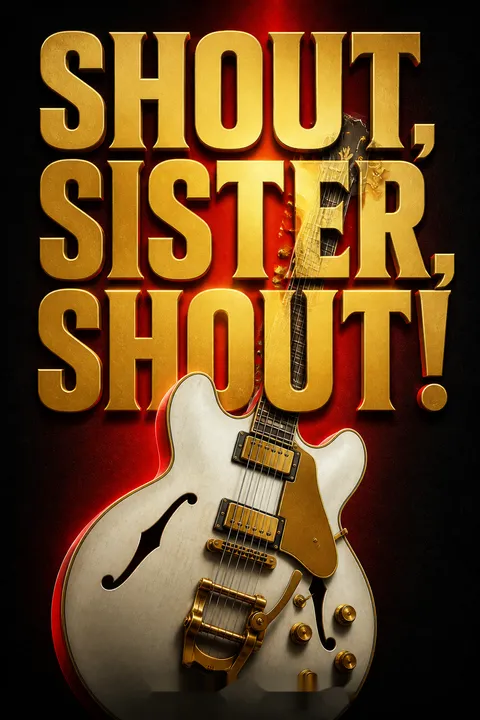


Key Takeaways
Treat sacred and secular music as neighboring languages, not opposing worlds
A porous boundary. Rosetta Tharpe grew up in the Church of God in Christ, where worship could include guitars, handclaps, dancing, and rhythms associated with blues. That tradition taught her that a lively beat could serve faith rather than betray it. In 1938, she carried gospel into the Cotton Club, Carnegie Hall, and other secular venues, singing spirituals with swing and blues inflection. Her choice unsettled people who believed church music should remain separate from popular entertainment.
A distinct musical identity. Tharpe did not simply trade gospel for pop. She moved between them, performing religious songs for secular crowds and bringing the energy of the stage into gospel. Her career shows how a genre boundary can be a site of invention, even when crossing it carries a social cost.
What's striking is that Tharpe's originality depended on a religious tradition already open to rhythmic mixture. Innovation did not arrive from outside the church to modernize it; it grew from practices the church had cultivated. This resembles linguistic code-switching, where speakers move between registers without becoming less authentic in either. Yet the freedom to cross categories was uneven: audiences could celebrate the sound while condemning the woman who carried it across. The story therefore complicates the familiar idea that artistic innovation is simply a matter of individual courage.
Give the guitar its own voice, then build a performance around it
More than accompaniment. Many singers of Tharpe's era used the guitar mainly to support their vocals. She treated it as a second lead, picking fast individual notes between sung phrases and giving the instrument musical space of its own. Traveling revival performances taught her to project over crowded, noisy rooms. The quick runs filled gaps in the singing, while their visual display gave audiences something to watch as well as hear.
The bridge becomes a climax. Tharpe's instrumental breaks could shift a song from a familiar hymn into a burst of surprise and release. Her electric guitar added sustain and volume, letting her stretch notes and shape them into a vocal-like solo. In performances such as Up Above My Head, the guitar did not decorate the song. It carried its emotional peak.
Tharpe's approach is a lesson in arrangement as much as virtuosity. A solo instrument can change a song's architecture by creating a second voice, a new point of view, and a place for tension to build. Performance research also emphasizes that music is embodied: movement, gesture, and sound influence one another. Tharpe made that relationship visible. Still, her impact depended on access to amplification and stages, not only innate talent. The image of a solitary genius can obscure the technical work and musical communities that helped her develop.
Train in the room that gives you permission to be loud
Church as a workshop. Tharpe's earliest musical education came through COGIC services and the traveling evangelism she began with her mother, Katie Bell Nubin. In worship, she encountered spirited singing, improvisation, and a broad range of instruments. Revival audiences also taught her practical skills: how to hold attention, pace a performance, and fit music around a preacher's words. Her education was not a formal conservatory path. She left school young to work on the religious circuit.
A calling became work. Churchgoers supported the child singer with offerings, and her musical ability became part of the family's livelihood. COGIC offered women respect as evangelists and music leaders, even though it barred them from ordination. The same community that shaped Tharpe's sound created an audience for it, while its strict expectations could constrain her choices.
The church in this account functions as both school and labor market. It provides a repertoire, mentors, audiences, and a reason to practice, resources that formal institutions often claim as their own. That is a useful corrective to stories of talent emerging fully formed. At the same time, community support is not automatically liberating. COGIC gave Tharpe a platform while maintaining gender rules and demanding forms of respectability. The important distinction is between a community's capacity to nurture skill and its authority to decide how that skill may be used.
Crossing over can widen an audience while making the artist a spectacle
Fame with conditions. At the Cotton Club, Tharpe performed for white patrons in a venue that generally barred Black customers. Its shows traded on plantation imagery and racial caricature. Later, some stages presented Pentecostal worship as a comic novelty, inviting audiences to laugh at the very religious culture that shaped her. Tharpe gained visibility, but visibility did not mean equal treatment or control over how she was represented.
A complicated reception. Her 1938 Carnegie Hall performance drew a standing response from listeners unfamiliar with Sanctified gospel. Meanwhile, church critics objected to spirituals being swung for entertainment. The same music could be heard as spiritual testimony, exciting novelty, or commercial product, depending on who was listening and what they believed it meant.
Tharpe's career helps separate inclusion from power. A performer may enter prestigious or popular spaces without gaining authority over the terms of entry. This resembles the distinction between representation and agency in media studies: appearing before an audience is not the same as shaping the image that audience receives. The mixed reactions also show that cultural meaning is not owned by the artist alone. Her music crossed boundaries, but listeners and promoters continually tried to classify it. That friction is part of the history, not a footnote to success.
Choose collaborators who amplify difference rather than flatten it
Contrast as chemistry. When Tharpe heard Marie Knight sing in 1946, she recognized how Knight's rich contralto could complement her own higher voice. Their duet Didn't It Rain paired distinct vocal styles with guitar, piano, bass, and percussion. Rather than blending into a uniform sound, the singers traded lines and sometimes blurred who was leading. The result felt conversational and rhythmically alive, unlike more tightly arranged gospel recordings of the period.
A partnership with limits. The pair toured widely and recorded hits including Up Above My Head. Their relationship also included care and mutual reliance: after Knight's mother and two children died in a house fire, Tharpe promised to stand by her. They eventually separated professionally. Their collaboration shows the creative power of complementary strengths, without pretending that artistic chemistry guarantees an uncomplicated or permanent partnership.
The duo illustrates a broader principle of collaboration: difference can create energy when each participant has room to be distinct. In organizational terms, this is not mere diversity of personnel, but interdependence in which contrasting contributions remain audible. Their call-and-response gives that idea a musical form. The account also resists turning partnership into a tidy success story. Grief, work, money, and personal attachment shaped the relationship, and the sources cannot reduce its ending to a single cause. Good collaboration can be consequential without being seamless.
When the market closes one door, rebuild the route to listeners
Changing audiences. Tharpe moved among solo gospel recordings, big-band work with Lucky Millinder, and later rhythm-and-blues material. Her 1944 recording Strange Things Happening Every Day spent eleven weeks on the race charts and reached number two. It is often described as an early rock-and-roll record, and young musicians including Elvis Presley, Jerry Lee Lewis, Johnny Cash, and Carl Perkins admired her work. But a later attempt to build a rhythm-and-blues career did not find a lasting audience.
A second stage abroad. In 1957, British bandleader Chris Barber brought Tharpe on tour in Europe. The enthusiastic reception restored her visibility and brought her electric guitar playing to younger listeners. European tours and festivals became an important part of her career, even as she continued working in the United States. Reinvention did not always mean changing the music. Sometimes it meant finding a new audience for it.
Tharpe's career resembles an ecosystem more than a straight climb: labels, venues, audiences, and musical fashions repeatedly changed the conditions of success. A failed release did not erase her ability, but it did affect access to attention and income. Her European reception demonstrates how cultural value can shift when a work enters a different listening community. There is a caution here, too. International acclaim offered real opportunity, but European fans sometimes romanticized Black music as untouched and timeless. A new audience can open doors while bringing its own distortions.
Make infrastructure part of artistic independence, especially under segregation
The stage can be invented. In 1951, Tharpe married Russell Morrison at Washington's Griffith Stadium as part of a concert promoted by Irvin and Israel Feld. Estimates put the crowd between 15,000 and 22,000. The event joined a wedding, a gospel program, and a fireworks display, turning a personal ceremony into a major public performance. Its scale showed how deliberately Tharpe and her promoters could shape an event instead of waiting for conventional venues to recognize her.
Mobility mattered. Tharpe also toured with a bus that provided sleeping and dressing space. Under Jim Crow, Black performers could be refused hotel rooms, meals, and basic services. The bus was not just a luxury or a publicity image. It offered a degree of shelter and practical independence for a touring company that could not count on equal access elsewhere.
This takeaway broadens artistic independence beyond creative control. A performer also needs transport, lodging, booking, money management, and safe places to work. The bus illustrates how material infrastructure can determine who is able to tour at all. The stadium wedding, meanwhile, turned spectacle into a strategy for gathering audiences and press attention. Such strategies were resourceful, not invulnerable: promoters and managers still controlled parts of the business, and Tharpe later lost her Richmond home after mortgage payments fell behind. Independence has a material foundation, and it can remain precarious.
Recognize how gendered credit rules hide women who change the sound
A woman with authority. Tharpe became a formidable electric guitarist in a musical culture that routinely treated guitar mastery as masculine. At Apollo performances, she challenged male players to match her technique, and audiences watched them struggle to keep up. Her musicianship was sometimes praised as unusually good for a woman, a compliment that also exposed the low expectations surrounding women instrumentalists.
Novelty is not the same as recognition. Tharpe could use the surprise of a woman guitarist to command attention, but that framing risked making her seem like an exception rather than a major innovator. She developed her style through practice, observation, and work in church and on tour. Her example helped show younger women that a gospel singer could also lead with an instrument, even as popular memory continued to favor male rock guitarists.
Gender bias often works through the standards used to describe achievement. Calling a woman exceptional can acknowledge her skill while quietly preserving the assumption that the skill belongs to men. Tharpe's story also challenges the familiar idea that musical authority must look or sound masculine. Her performance combined technical command, humor, glamour, and religious expressiveness without resolving into one acceptable image. Structural barriers still matter: an individual breakthrough does not by itself change who receives recording contracts, sustained coverage, or a place in the canon.
Remember pioneers as artists in their own right, not footnotes to rock
A career beyond influence. Tharpe's guitar playing helped shape musicians who became central to rock and roll, but her importance was not merely that she came first. She was a recording and touring artist with a distinctive body of work, a powerful stage presence, and a career spanning gospel, blues, jazz, country, and popular music. After diabetes led to a leg amputation, she kept performing when she could. She died in 1973 after a stroke.
Memory has its own history. Tharpe was buried in an unmarked grave, and her name faded from broad public awareness even as her musical innovations continued to circulate. The book argues that this disappearance reflects more than the passage of time: histories that center young white men have repeatedly pushed Black women to the margins. Restoring Tharpe means hearing her as a creator, not merely as an influence on better-remembered artists.
The distinction between influence and authorship is crucial. When a pioneer is remembered only as the origin point for someone else's achievement, history grants her importance while withholding the center of the story. This is a problem of archival selection as well as popular taste: records, photographs, and narratives do not preserve every career equally. The book also makes a compelling case without claiming that one artist single-handedly created rock. Tharpe's contribution matters precisely because it was substantial, collaborative, and filtered through a music industry that distributed recognition unevenly.
Analysis
This biography is built around a productive contradiction: Rosetta Tharpe's musical life cannot be separated into a sacred beginning and a secular departure. The Church of God in Christ gave her rhythmic vocabulary, performance practice, audiences, and a conviction that music was a divine gift. The popular stage gave her money, national reach, and new listeners, while exposing her to racial caricature and religious censure. Her achievement lies not in choosing one side, but in sustaining a career across boundaries that audiences and institutions repeatedly tried to police.
The book's most persuasive historical intervention is to make sound and performance central to the argument. Tharpe's guitar was not a colorful accessory to a singer's biography. Her picking, amplification, stage movement, and instrumental breaks changed what gospel could do in public and what an electric guitar could communicate. That framing challenges histories that treat rock as an abrupt invention by young men in the 1950s, while avoiding the simpler claim that Tharpe alone invented the genre. Influence travels through people, records, venues, and acts of listening, not through a single origin story.
The life also shows how innovation and security diverge. Tharpe could command large audiences and still encounter unstable bookings, exploitative arrangements, racial segregation, and financial vulnerability. Her European recognition revived her career, but it sometimes depended on romantic images of Black authenticity. Her late illness and limited public memorialization make the contrast especially sharp: cultural influence does not guarantee institutional care or remembrance.
The account is necessarily assembled from interviews, press coverage, recordings, and recollections made decades after events. The author carefully preserves uncertainty around some personal stories and conflicting memories rather than forcing a definitive version. That restraint matters. Tharpe's legacy is not a puzzle that becomes complete once every private detail is settled. It is a record of extraordinary artistry, bounded opportunity, and a culture that often heard the music more readily than it credited the woman who made it.
Review Summary
Shout, Sister, Shout! is praised for its detailed account of Sister Rosetta Tharpe's life and impact on music. Readers appreciate the book's historical context and insights into gospel music. Many were introduced to Tharpe's influential guitar playing and powerful vocals through the biography. While some found it dense, most enjoyed learning about this pioneering artist. The audiobook version is highly recommended for its inclusion of music clips. Overall, reviewers agree that the book sheds light on an often-overlooked figure in rock and roll history.
Glossary
Church of God in Christ
Black Pentecostal denominationA predominantly African American Pentecostal denomination founded by Charles Harrison Mason. Its worship emphasizes personal religious experience, including speaking in tongues, expressive singing, and movement. The church's broad acceptance of instruments and rhythmic styles helped shape Tharpe's musical foundations, while its Holiness standards and gender restrictions also formed part of the social world she negotiated.
Sanctified Church
Expressive Pentecostal traditionA term used for Pentecostal and Holiness congregations whose worship can include fervent singing, clapping, dancing, and speaking in tongues. In Tharpe's upbringing, this tradition treated bodily response and rhythmic music as forms of religious expression. Its musical openness helped connect spirituals and hymns with blues, ragtime, and other popular sounds.
gospel highway
Church and revival circuitThe informal network of churches, revivals, tent meetings, and religious convocations that gospel performers traveled to reach audiences and earn a living. It offered Tharpe early work and musical training outside conventional schools or concert institutions. The circuit could provide lodging and local support, but earnings and professional conditions were unpredictable.
gospel blues
Gospel shaped by bluesA style and musical approach that brings blues rhythms, phrasing, or expressive techniques into religious songs. In Tharpe's work, gospel blues did not simply make sacred music secular. It let her use the emotional directness and rhythmic freedom associated with blues while singing about faith, religious struggle, and spiritual hope.
soundies
Short jukebox music filmsBrief musical films, generally around three minutes long, shown on coin-operated machines called Panorams in bars and clubs during the 1940s. They let audiences see performers as well as hear them, anticipating the music-video format. Tharpe appeared in these films while working with Lucky Millinder's band.
jubilee quartets
Gospel harmony groupsSmall vocal ensembles, commonly called quartets even when they had more or fewer than four members, that sang close harmony in churches, schools, neighborhoods, and other community settings. They were especially prominent in Richmond, where Tharpe recruited the young women who became her backup group, the Rosettes.
Holy Dance
Movement in worshipA form of expressive bodily movement associated with Sanctified and Pentecostal worship. Congregants might dance or move in response to the Holy Spirit during a service. The practice reflects the tradition's view that the body can participate in religious experience, and helps explain the physical energy of Tharpe's stage performances.
Download PDF
Download EPUB
.epub digital book format is ideal for reading ebooks on phones, tablets, and e-readers.








