

Plot Summary
Prologue
Looking back on the day she met Heathan James, Ellis sees their bond as the beginning of a darkness neither child could understand. His fascination with death meets her longing for stories and escape; together they invent the names Dolly and Rabbit, then grow into a pair shaped by violence.
The prologue frames their story as an origin tale, but its first small disturbance is not destiny made glorious. It is a wounded creature in a child's hand, and the choices that follow.
The opening makes intimacy and danger inseparable before the narrative has shown how they become so. Ellis remembers Heathan through the image of a living creature rendered helpless, an early sign that his attention gravitates toward control, while her later attachment transforms that frightening impulse into a private mythology. The prologue's language of fate is emotionally sincere but not neutral: it anticipates the way the children will use story to make unbearable experiences legible. Its darkness is therefore both a bond and a warning. Their shared fantasy will offer refuge, but it will also teach them to translate suffering into ritual and revenge.
Dolly Meets Her Rabbit
Seven-year-old Ellis Earnshaw approaches Heathan James, a silent nine-year-old newly left in the care of the estate's groundskeeper. Her neighbor Eddie Smith warns her away, but Ellis offers Heathan friendship, shares her tea set and her mother's music, and asks him to read Alice in Wonderland.
He rejects her given name and calls her Dolly; she names him Rabbit after his broken pocket watch and waistcoat. Heathan accepts her hand despite his aversion to touch, and their private story begins. When Eddie protests that he does not belong in Wonderland, Ellis lets him go rather than alter her new bond. Heathan, who expects to be unwanted, has found a person who chooses him.
The friendship begins not through a rescue but through Ellis's deliberate attention to a child other people have already classified as dangerous. She does not deny Heathan's cruelty toward small creatures; instead, she meets his loneliness without demanding that he become ordinary first. Their nicknames turn observation into a shared language, and the book that comforts Ellis gives Heathan a role in her imagined world. The scene also plants a fault line: Heathan treats closeness as exclusive, while Ellis initially understands friendship as generous play. The tenderness is real, but so is the possessiveness that begins to gather around it.
A House Behind the Tea
Two years later, Heathan's father dies, and Ellis's father, Jacob Earnshaw, becomes his guardian. Heathan is kept close to Jacob's office and repeatedly made to drink whiskey with Jacob's business associates. He notices children arriving secretly at night and learns that the men exploit them. When Uncle Clive assaults him, Heathan dissociates by fixing on the pocket watch and its imagined ticking.
He escapes to Ellis, who dresses in color and tries to comfort him. Remembering that Jacob and the associates often demand that she dance for them, Heathan makes her promise to dance only for him. Ellis does not yet understand the danger surrounding her, but Heathan recognizes that the people controlling the house are also targeting her.
The estate's hospitality is a disguise for organized coercion: guardianship, family language, and social respectability are used to create access to children and isolate them from protection. Heathan's watch becomes a crude instrument of dissociation, allowing him to endure what his body cannot stop. His response to Ellis is loving and protective, yet the promise he demands also narrows her world around him. The novel shows how abuse can make exclusivity feel like safety. Heathan correctly sees the threat, but the only protection he can imagine is possession, a strategy that echoes the control the adults exert over both children.
A Birthday Becomes Blood
On Ellis's tenth birthday, Mrs. Jenkins gives her drugged tea, then leads her to Jacob and the associates, who expect her to dance and submit to them. Uncle John assaults her in another room. Heathan, also being held by the men, breaks free when he sees Ellis injured and attacks Uncle Eric with a letter opener, killing him.
Jacob and the others beat Heathan, separate the children, and send him away in a black van. Ellis is locked in her bedroom, where she keeps Heathan's watch and counts its movement while waiting for his promised return. She has lost her mother, her safety, and now her only friend, but the watch gives her a way to keep waiting.
The birthday ritual twists the familiar signs of childhood into instruments of abuse: new clothes and a favorite song become preparation for an assault. Heathan's killing of Eric is both an act of resistance and the point at which Jacob can remove him permanently. The violence saves Ellis in that moment, but it cannot prevent the separation that follows. The watch changes hands as a pledge of continuity, turning time into something Ellis can endure by counting rather than living through. The scene makes the children's private mythology a survival device, while showing how little power that mythology has against an adult system built to silence them.
Eleven Years Underground
Taken to a secret prison beneath a water tower, Heathan is placed in a cell with Chapel, a charming killer, and Henry, a psychologist who shares a body with the violent Hyde. The three protect him from guards and help him survive. Chapel teaches him practical subjects and planning; Hyde teaches him how to kill; Henry helps him understand the dissociation that may have swallowed Ellis.
Years later, Chapel draws a guard close enough to steal his keys. The cellmates kill their way out, murder the warden, and take his money and vehicle. Heathan uses the months afterward to study Jacob's associates, train, and plan his return. He has not stopped thinking about the girl he left behind.
The prison gives Heathan a brutal education in solidarity. Chapel, Henry, and Hyde are not models of recovery, but they provide what the Earnshaw estate denied him: instruction, protection, and a future he can plan toward. His purpose remains fixed on Ellis, so survival becomes less a desire than a condition of keeping his promise. That focus sustains him, yet it also makes revenge appear to be the only possible form of care. The escape does not erase the prison's violence; it converts the skills learned there into tools for a return that will reproduce violence elsewhere.
The White Rabbit Returns
Heathan reaches the decaying Earnshaw mansion and finds twenty-one-year-old Ellis sitting motionless, dressed in black and staring through a window. Mrs. Jenkins, still guarding her, cannot explain away the scars on Ellis's arms.
Heathan kills the nanny, then tries the objects Ellis loved as a child: her blue dress, her mother's perfume and lipstick, the old music, her Alice doll, and the broken watch. When the song and watch stir her, he cuts through the floor and lowers her into his arms, making the fall resemble entry into Wonderland.
Ellis wakes as Dolly, recognizes Rabbit, and believes the door has opened into a new world. He takes her beyond the estate gates, carrying her childhood objects and the money he found in Mrs. Jenkins's room.
Heathan's return is organized as an improvised attempt at psychological contact. Rather than ask Ellis to explain herself, he reconstructs a sensory environment she once associated with safety. Music, clothing, scent, and the watch become a bridge into awareness, though not a cure. The rabbit hole is both a physical exit and a story Ellis can tolerate: she can leave the house only by believing she has entered another world. Heathan's devotion enables that passage, but his killing of Mrs. Jenkins signals the violence that will define their new freedom. Rescue and revenge arrive together, already difficult to separate.
A Champion Learns Violence
At a secluded safehouse, Rabbit tells Dolly that Ellis, the girl she remembers trapped behind a door, needs rescuing from the men who hurt her. He shows her a deck of illustrated cards naming the remaining targets: the Caterpillar, Cheshire Cat, Tweedledum and Tweedledee, the Jabberwock, and the King of Hearts.
With knives and a blue gun engraved for her, Dolly practices on hanging pig carcasses while Rabbit teaches her to aim, strike, and keep going. She treats the weapons as part of her Alice-inspired adventure and asks him to make her a worthy champion. Rabbit watches her enthusiasm with pride, but he also directs it toward his own plan of killing the men who abused them.
The training sequence turns symbolic play into bodily rehearsal. Dolly's fantasy does not merely decorate the violence; it makes violence imaginable to someone whose earlier self had retreated from the world. The cards give revenge an ordered structure, assigning each target a storybook identity and a place in the sequence. Rabbit's role is ambivalent: he equips Dolly to act rather than remain helpless, yet he also scripts the purpose and language of her action. Her delight in competence is distinct from his hatred, but the two motives are fused by the mission he creates.
The Caterpillar's Last Tea
In Amarillo, Rabbit and Dolly break into Lester Knowles's home, where guards protect the man they knew as the Caterpillar. Dolly shoots one guard and demands a chance to face the next, while Rabbit prevents another from killing her. They find Lester armed and hiding near his hookah. He recognizes Heathan, and Rabbit binds him to a chair so Dolly can choose how to punish him.
When Lester smears Dolly's lipstick, she loses patience, stabs him repeatedly, and watches him die. She writes their misspelled name in lipstick on the wall, then Rabbit leaves the matching playing card on Lester's body. The first target is dead, and the pair have announced themselves to the other men.
Lester's death marks the shift from training to performance. Dolly's first kill is not only the execution of a target; it is an act she claims for herself, complete with a signature that turns an overlooked spelling mistake into a public identity. Her rage over the lipstick smear can look trivial beside Lester's crimes, but that disproportion exposes how abuse has reorganized the scale of her emotional triggers. The killers' ritual makes them visible, while also turning each victim into an audience for a revenge story. The act gives Dolly agency, but it does not yet tell her what agency might mean beyond punishment.
Eddie Finds the First Body
Eddie Smith, now training as a Texas Ranger, enters the Earnshaw estate after Ellis disappears. He finds Mrs. Jenkins dead and discovers that Ellis's chair and dark clothes are gone, with a hole cut through the floor and a rope leading below. In Amarillo, Eddie then sees Lester Knowles's body marked with the killers' lipstick signature.
He recognizes Lester as one of Jacob Earnshaw's associates and suspects the death is linked to Ellis's kidnapping. His uncle, a senior Ranger, orders a search for Jacob, the associates, and Ellis. Eddie believes Ellis is fragile and that Heathan has taken control of her, so he begins the investigation intent on bringing his childhood friend back safely.
Eddie enters the plot through absence: Ellis is missing, and the spaces she once inhabited have been emptied or sealed. His Ranger training gives him procedural tools, but his memories bias the case before evidence can settle it. He remembers Ellis as innocent and Heathan as the corrupting force, so the possibility that she has agency is initially almost unthinkable to him. This is not simple incompetence; it is the persistence of childhood attachment under professional pressure. The investigation makes visible a second story running alongside the revenge journey, one in which the people who once ignored danger are now trying to name it.
The Cheshire Cat's Smile
At Uncle Clive's cellar, Rabbit and Dolly find evidence of his abuse and rescue a young boy and a girl called Helena. Rabbit mutilates Clive and kills him, but the sight of the cellar and the assault's details drag him back into memories of his own abuse. Dolly steadies him by insisting that her touch replace the abusers' remembered presence.
Their closeness becomes a consensual ritual through which each tries to reclaim a body once controlled by others. In the aftermath, they exchange blood and make their bond explicit. The experience also begins to unlock Dolly's memories, including the scar and the medical violence she has attributed to the Ellis she imagines as separate from herself.
The cellar makes the past materially present: the children are not merely symbols of what happened to Rabbit and Dolly, but people in immediate danger whom the pair can release. Rabbit's loss of control reveals that revenge does not neutralize trauma; it can reactivate it. Dolly's response offers mutual recognition, although their chosen ritual remains shaped by the violence they are trying to overwrite. The emerging memory of her scar unsettles the boundary between Dolly and Ellis. What has functioned as a protective division in her mind begins to show its cost: one self has carried experiences the other could not bear to know.
The Scar Remembers
After the blood exchange, Dolly remembers a hospital-like room, drugged tea, and the Earnshaw men holding down a girl while a doctor removes her ability to bear children. She finds the same faint scar on her own abdomen and asks Rabbit about it. He recalls that she cut herself as a child when a teapot broke, but he accepts that her memories of the assault and operation belong to what she endured as Ellis.
Dolly's mind supplies the two men who held the girl down: Uncle Jeffrey and Uncle Samuel, the twins Rabbit calls Tweedledum and Tweedledee. Ellis appears within Dolly's thoughts and urges her to confront them. Rabbit gives Dolly their card, making her next target personal rather than merely assigned.
The scar functions as evidence that the mind's partitions cannot fully contain the body. Dolly has treated Ellis as a separate child in trouble, but the physical mark forces her to confront the possibility that Ellis's history is her own. Rabbit's answer carefully distinguishes the scar's childhood origin from the later memory, yet he cannot resolve the psychological division for her. The twins' card turns recovered knowledge into a new task, but the deeper change is that Dolly's grief now has an autobiographical source. Memory returns not as a neat explanation, but as a painful claim on the present.
Tea for Tweedledum
At the twins' hacienda, Dolly enters a gathering of abusers and their companions as if invited to a tea party. She shoots and stabs several guests when they interrupt or flee, then names Jeffrey and Samuel as the men who restrained Ellis during the operation. Their guests remain trapped as Dolly insists on manners and serves the tea.
When she tastes Darjeeling instead of her beloved Earl Grey, she erupts and kills another guest. She then forces the twins into a knife fight. Rabbit kills one; Dolly pins the other and cuts him repeatedly across the stomach, echoing the violence done to her. She spares the maid, who resembles a doll, and leaves the lipstick signature on the wall.
The tea party converts a domestic script into a trap, reversing the manners and hospitality the abusers used to hide behind. Dolly's attachment to Earl Grey is both comic rigidity and a boundary she can enforce when more profound boundaries were violated. The scene's grotesque excess is not equivalent to justice: the guests are punished through an improvised spectacle, and an uninvolved maid survives only because Dolly recognizes an image of herself in her. That moment of mercy complicates the claim that the couple kill only the guilty. Dolly's moral attention is damaged but not absent, and her choices remain unpredictable.
Eddie Reads the Buried Report
As the killings continue, Eddie's uncle uncovers an old complaint made by Simon Wells, a former foster child who said Jacob Earnshaw and his associates had abused children brought to the estate. The report was buried by a senior Ranger close to Jacob. Eddie interviews Wells and then Heathan's mother, who describes Heathan's early fixation on death, his discovery of his grandfather murdered for a pocket watch, and her fear of raising him.
Eddie can no longer treat the case as a simple kidnapping by a dangerous outsider. He also learns that Ellis and Heathan were both abused, though he still assumes Heathan controls her. His investigation follows the evidence, but his loyalty keeps distorting its meaning.
The buried complaint expands the crime from a private household horror into an institutional failure. The Ranger who suppressed Wells's report protected the reputation of the powerful, making official authority part of the abuse's infrastructure. Heathan's mother's account complicates Eddie's picture of him without excusing his violence: trauma, early cruelty, and neglect coexist rather than cancel one another out. Eddie gains information, but not yet a new interpretation of Ellis. His investigation's central limitation is emotional: he can accept that the system failed the children more easily than he can accept that his childhood friend has become an active participant in its punishment.
The Jabberwock's Locked Room
At Uncle John's house, Dolly charges ahead through the dark halls, kills guards, and falls through a hidden floor into a room of locked doors. John uses the room and her old memories to make her dissociate, then assaults her. Rabbit fights through the guards and finds her unresponsive.
Unable to reach her through the ordinary cues, he invokes their Wonderland story, uses the watch and her vial of his blood, and forces her back toward awareness through a near-drowning and resuscitation. Dolly returns, recognizes John as the man who hurt Ellis, and stabs him repeatedly until he dies. Shaken and exhausted, she clings to Rabbit. The Jabberwock is dead, but the attack has brought her closest yet to disappearing again.
The locked room literalizes the logic of dissociation: each door promises an exit, but the person inside cannot reach one while the abuser controls the space. Rabbit's rescue depends on the shared fantasy that once sheltered Dolly, yet his method is coercive and dangerously close to reproducing bodily control. The scene refuses a clean distinction between saving and violating when the rescuer uses force to break a survivor's paralysis. Dolly's return allows her to kill John herself, but the cost is visible in her collapse afterward. Survival here is not triumph without residue; it is a return made under extreme duress.
A Prom Beneath the Stars
After John's death, Rabbit takes Dolly to a field rather than straight to another motel. He wakes her with her mother's music, gives her a blue formal dress and silver shoes, and dances with her beneath the stars as if making the prom she never attended. He crowns her, then asks her to try the gentle kind of intimacy she once described after watching a film.
Both struggle against the touch and vulnerability their histories have made frightening, but they proceed slowly and with consent. Afterwards, Rabbit tells Dolly that he loves her. She returns the feeling and calls him by his birth name, Heathan, while remaining Dolly in their shared life. For the first time, their closeness is not organized around a kill.
The field scene answers Dolly's earlier envy of ordinary rites: a dress, a dance, a crown, and a night sky become experiences she was denied rather than ornaments for a fantasy. More importantly, Rabbit attempts a form of intimacy that does not reproduce their familiar cycle of aggression and blood. Neither character is suddenly healed, and their effort is awkward precisely because tenderness has no established script for them. The name Heathan briefly connects Rabbit to the child Dolly knew, without erasing the identity he built to survive. Their love becomes legible as more than shared appetite, though it remains entangled with danger and dependence.
The King Loses His Crown
Dolly and Rabbit confront Jacob Earnshaw in his isolated home. Dying of lung cancer, he admits that he arranged Heathan's father's death to gain guardianship, poisoned Ellis's mother to keep her daughter, and let his associates abuse children for his own pleasure. When Jacob reaches for his gun, Dolly shoots him and leaves the King of Hearts card beside his body.
Police arrive, but Eddie finds the pair in a cellar tunnel. Rather than arrest them, he calls Eddie the Mad Hatter, tells him to flee, and directs the searching Rangers down another passage. Rabbit and Dolly escape through a concealed route and leave Texas. The final card is played, but their freedom depends on the mercy of a man they once excluded from Wonderland.
Jacob's confession confirms that the household's evil was not an accidental failure of protection but a deliberate system built around money, power, and access to children. Dolly's shot ends his control, though it cannot restore what he took. The decisive moral complication comes from Eddie: he chooses to protect the fugitives rather than obey the institution that failed Ellis and Heathan before. His act does not absolve the killings, but it recognizes that arrest would return them to a system with compromised authorities. The story closes its revenge sequence through an unexpected act of recognition from the friend once told he did not belong.
Epilogue
In Mexico, Dolly and Rabbit live beside a beach, still bound by their rituals and her music. During tea, they see a man lead a frightened boy toward a car. Dolly recognizes the danger, and Rabbit uses the vehicle's registration to find the man.
They prepare their weapons and familiar clothes, then set off together on another rescue and hunt. Their flight from Texas has not ended their violence; instead, the pair have made the mission portable, following the signs of abuse wherever they encounter them.
The ending refuses the usual promise that safety means leaving violence behind. Mexico gives the couple privacy and a life together, but the beach scene immediately reactivates their vigilante identity. Their response is protective in intention, yet it reproduces the same private justice that has defined their journey. The boy's distress offers a reason to act, while their eagerness to return to killing suggests that revenge has become more than a temporary means of rescue. The final watch signal closes the book on movement rather than rest. Their world remains organized around the next threatened child and the next target.
Analysis
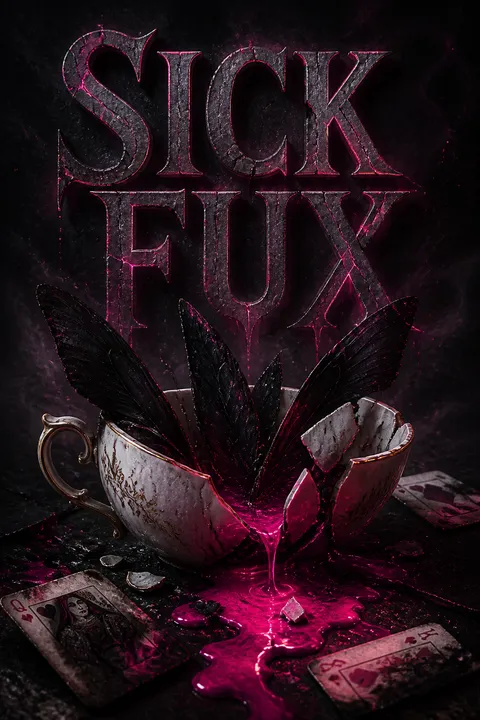
Sick Fux builds its plot around a difficult distinction: a survivor can regain agency without becoming safe, and retaliation can feel like power without becoming justice. The Earnshaw estate's abuse is sustained not only by Jacob's wealth but by a network of adults, caretakers, and officials who convert family authority into access and silence. The hidden prison extends that logic, showing that institutions can protect the powerful by removing inconvenient people rather than addressing harm.
Ellis's Wonderland is a psychological shelter. Its names, songs, costumes, and rituals let her approach experiences that her waking identity cannot hold. Rabbit understands how to use those familiar cues, but he also makes the fantasy a map for revenge. The story never cleanly separates rescue from control: his devotion gives Ellis a path back to awareness, while his possessiveness and methods reproduce forms of coercion. Their imagined world helps them survive and also narrows the kinds of futures they can picture.
The romance develops through a shared recognition of trauma, not through a conventional movement from danger to healing. Their violence and erotic rituals are presented as chosen forms of intimacy between adults, yet the novel makes clear how thoroughly those desires have been shaped by childhood violation. Tenderness beneath the stars matters because the characters attempt something they have no practiced script for. It does not undo their history, but it widens their relationship beyond blood and punishment.
Eddie's final decision offers a contrasting response. He does not resolve the crimes or repair the systems that enabled them; he chooses not to return Ellis and Heathan to authorities already shown to be compromised. The ending's ongoing hunt preserves the protagonists' shared purpose while refusing conventional closure. The book's most unsettling question is not whether violence can punish the guilty, but what happens when violence becomes the only language its survivors trust.
Review Summary
Sick Fux receives polarizing reviews, averaging 3.84 stars. Fans praise its extreme darkness, Alice in Wonderland themes, and the twisted yet tender romance between Rabbit and Dolly, comparing the couple to Joker and Harley Quinn on a revenge spree. Many applaud Tillie Cole's boldness in tackling graphic subject matter. However, numerous readers DNF'd due to deeply disturbing content, with several critics arguing the shock elements felt gratuitous. Most reviewers emphasize strong trigger warnings are essential before approaching this book.
People Also Read





Characters
Ellis Earnshaw / Dolly
The storybook survivorEllis is a sheltered Texas girl raised on an isolated estate, attached to her English mother's tea rituals, Alice in Wonderland, and a beloved music cassette. As a child, she responds to loneliness with imagination and an instinctive warmth that reaches toward Heathan when others avoid him. Dolly is the name and storybook identity he gives her, and that imaginative world becomes central to how she understands danger and attachment. She is curious, theatrical, and eager to please, but her longing for safety makes her vulnerable to other people's control. Her relationship with Heathan is the emotional center of the story, shaped by shared history, private symbols, and a fierce need to be recognized.
Heathan James / Rabbit
The watch-bound avengerHeathan is a withdrawn boy with a fascination for death, a strong aversion to touch, and a damaged pocket watch that becomes his private measure of time. He expects rejection and approaches relationships through vigilance and possession, yet Ellis's attention gives him a rare attachment he values above everything else. Rabbit is the identity he adopts within their Alice-inspired world, a guide who promises to lead Dolly away from danger. His intelligence, patience, and capacity for devotion coexist with a readiness to kill. His deepest motivation is to protect Ellis, though his idea of protection is shaped by the abuse and institutional cruelty he has survived.
Eddie Smith
The excluded childhood friendEddie is Ellis's neighbor and childhood friend, a sensible boy who hopes to become a Texas Ranger like his uncle. His orderly instincts make him distrust Heathan and misunderstand the kind of protection Ellis needs. As an adult investigator, Eddie brings persistence and professional skill to the case, but his memories of Ellis as innocent and fragile cloud his judgment. He remains loyal to her even when he cannot initially accept the person she has become.
Jacob Earnshaw
The estate's polished patriarchJacob is Ellis's wealthy father and the commanding host of the Earnshaw estate. He presents himself as a guardian and businessman, maintaining a close circle of associates who are treated as family by the children around him. His authority shapes the household, while his attention to appearances helps conceal the danger within it. To Ellis, he is the father whose rules define the boundaries of her world; to Heathan, he becomes the adult responsible for his new home. Jacob's influence makes the estate feel less like a family house than a private domain beyond ordinary scrutiny.
Mrs. Jenkins
The complicit caretakerMrs. Jenkins is Ellis's nanny and the adult who manages her daily routines, clothes, tea, and access to the house. Her long familiarity with Ellis gives her the appearance of a protector, while her obedience to Jacob places her inside the estate's hierarchy. She knows which rules Ellis must follow and helps maintain the narrow, controlled world in which the girl grows up. Her position shows how care can become an instrument of control when a child has no safer adult to turn to.
Chapel
The cultured cellmateChapel is an imprisoned killer with polished manners, artistic skill, and a talent for reading what other people desire. He helps Heathan survive the Water Tower by teaching him academic subjects, drawing, and strategic patience. His theatrical charm contrasts with the brutality of his crimes, making him both an unsettling mentor and a practical ally. Chapel's loyalty is expressed through instruction and planning rather than sentiment, and his network later helps Heathan prepare for the return to Texas.
Henry
The imprisoned psychologistHenry is a psychologist imprisoned despite being described as innocent. He shares his body with Hyde, an identity with radically different impulses, and his knowledge of dissociation informs Heathan's hopes for Ellis. Henry is reserved and analytical, often trying to understand behavior without reducing a person to a diagnosis. His own divided existence makes him a complicated source of guidance rather than an uncomplicated authority.
Hyde
The violent other selfHyde is the forceful, violent identity who shares Henry's body. Where Henry is quiet and measured, Hyde is direct, physically formidable, and capable of teaching Heathan how to fight and kill. Their relationship embodies a struggle for control within one person, though the novel presents Hyde as both a threat and a protector in the prison's brutal world.
Uncle Clive
The cellar's predatorClive is one of Jacob Earnshaw's business associates, a physically imposing man whose place in the household gives him access to the children. He is part of the adult circle Heathan learns to fear. His size and wheezing presence make him conspicuous, but the greater danger comes from the protection his association with Jacob affords him.
Uncle John
Ellis's familiar tormentorJohn is one of Jacob's associates and a man who has been given access to Ellis under the cover of family language. He is manipulative, possessive, and practiced at making coercion sound like affection. His familiarity with Ellis's habits and memories gives him a particular power over her, making him one of the most psychologically threatening adults in the story.
Lester Knowles
The hidden CaterpillarLester is one of Jacob's associates, a wealthy man who hides his appetite for hashish and abuse behind an affluent life. His distance from the estate does not loosen his ties to its circle. He represents the way the men disperse and conceal themselves while continuing to act with the confidence that money and connections will protect them.
Jeffrey
One half of the twinsJeffrey is one of Ellis's twin uncles by the household's informal naming, though he is not related to her by blood. He works in concert with his brother and belongs to Jacob's circle of trusted associates. His identity is difficult to separate from the twin's, a closeness that becomes part of the story's disturbing imagery.
Samuel
The other half of the twinsSamuel is Jeffrey's twin and another of Jacob Earnshaw's associates. Like his brother, he is embedded in the household's adult network and shares the authority that comes from being treated as family. His likeness to Jeffrey makes them a pair in both Ellis's memories and the revenge narrative that Rabbit constructs.
Uncle Eric
A member of the inner circleEric is one of Jacob's associates, present in the estate's private gatherings. His role illustrates how many adults participate in or enable the household's abuse, creating a crowded network of danger around Ellis and Heathan.
Derek James
Heathan's absent fatherDerek is Heathan's father and the groundskeeper who takes him in after Heathan's mother gives him up. Their relationship is distant, and Derek's death leaves Heathan legally and emotionally dependent on the Earnshaw household.
Mrs. James
The frightened motherHeathan's mother is a young single parent who struggles to understand and manage her son's frightening behavior. Her decision to leave him with his father reflects fear and isolation as much as rejection. Years later, her account gives Eddie a glimpse of Heathan's childhood before the Earnshaw estate.
The Warden
Keeper of the hidden prisonThe Water Tower warden administers a secret prison funded by wealthy people seeking to hide their crimes. He treats prisoners as property and presents the institution as a place from which no one will return. His authority reflects the same bargain of money and impunity that sustains the Earnshaw circle.
Simon Wells
The ignored complainantSimon Wells is a former foster child who reported abuse connected to the Earnshaw estate. His account is dismissed and buried by a senior official, leaving him as an early witness to a crime network that powerful people work to conceal.
Helena
The rescued childHelena is a young girl held in the Cheshire Cat's cellar. She is frightened and vulnerable, but she escapes when Dolly opens her cage and gives her and another child a chance to run.
The rescued boy
Helena's fellow captiveThe unnamed boy is a child held alongside Helena in the Cheshire Cat's cellar. He helps her leave the cage when Dolly opens it, giving the pair a brief but concrete image of children escaping the fate that shaped the protagonists.
Plot Devices
Alice in Wonderland
A refuge turned missionEllis's favorite book supplies the names and images through which she and Heathan interpret their childhood friendship. Rabbit, Dolly, the rabbit hole, and the story's shifting scale give Ellis a language for escape when she cannot face her surroundings directly. As an adult, Dolly continues to experience the world through this framework, and Rabbit uses familiar references to guide her out of periods of dissociation. The same fantasy also organizes their revenge, assigning storybook identities to the men they hunt. It therefore functions as comfort, communication, and a structure that can turn violence into an adventure. The device's protective value is inseparable from its capacity to obscure reality.
The Broken Pocket Watch
A rhythm for survivingHeathan carries a damaged pocket watch inherited from the violence surrounding his childhood. Although Ellis initially understands its ticking as pretend, the watch becomes his focus during traumatic experiences, helping him distance himself from immediate pain. It also becomes a promise between the children when Heathan is taken away, giving Ellis a way to count the time until his return. In adulthood, the watch continues to signal their shared history and helps Rabbit reach Dolly through familiar sensory cues. Its importance lies not in telling time accurately, but in turning time into something the characters can endure together.
The Playing Card Targets
A map for revengeRabbit uses hand-drawn playing cards to identify the men he intends to pursue and to mark the role each occupies in his Alice-inspired system. The cards make a dispersed network of abusers legible as a sequence, giving the revenge plot an escalating structure. They also allow Dolly to participate in decisions and to claim particular targets as her own. When a card is left with a victim, it turns the killers' private mythology into a public signature. The device ties together investigation, memory, and spectacle, while exposing how Rabbit's need for order organizes the chaos of his past.
Tea and the Mixtape
Sensory keys to memoryEarl Grey tea, the pink boombox, and Ellis's mother's cassette are ordinary childhood comforts that carry unusual emotional force. Rabbit uses the clothing, music, perfume, and tea Ellis associates with safety to reach her when she is unresponsive. Later, tea parties let Dolly perform a familiar version of herself even as the people around her become targets. The rituals offer recognition and continuity, but the wrong tea can also trigger rage, showing how delicate the boundary is between comfort and danger. These objects turn memory into something embodied, heard, smelled, tasted, and acted out.
The Water Tower
A prison beyond justiceThe secret prison beneath a water tower is a holding place for people whose crimes or knowledge inconvenience the wealthy. Its guards, hidden location, and lack of official oversight extend the book's central conflict beyond the Earnshaw estate: money can bury evidence as well as victims. Heathan's years there bring him into alliance with Chapel, Henry, and Hyde, and the escape provides the skills and resources for his return. The prison is both a consequence of the children's first resistance and the institution that prepares the next stage of their revenge.
About the Author







Download PDF
Download EPUB
.epub digital book format is ideal for reading ebooks on phones, tablets, and e-readers.








