

Key Takeaways
Keep life's verdict open: James answers despair with a practical maybe.
A life-saving question. William James came close to suicide in his twenties, overwhelmed by illness, uncertainty, and the fear that life had no meaning. Decades later, he still would not claim that life is always worth living. His answer was maybe: the value of a life depends on the particular life being lived, and its possibilities may not yet be exhausted. John Kaag, writing through his own periods of despair, presents James's philosophy not as a cure, but as a reason to remain open to what could still happen.
Hope without a guarantee. This is not forced cheerfulness. James asks readers to take seriously both suffering and the possibility of making something valuable before life ends. The question stays open, which can itself leave room for action.
What's striking is the refusal to offer easy reassurance to someone in pain. A claim that life is unconditionally good can make a distressed person feel unseen; James instead treats uncertainty as a real feature of human existence. That honesty can make hope more credible. Still, a philosophical argument is not a substitute for mental-health care, social support, or relief from immediate danger. Its value here is narrower but meaningful: it offers a way to think about possibility without pretending that suffering is trivial or that recovery is guaranteed.
Reject fatalism without denying how much lies beyond your control.
Causation is not a sentence. Determinism is the view that the state of the world at any moment fixes everything that follows. James encountered its force through Darwinian science and thinkers such as Thomas Huxley, who treated human beings as part of nature rather than exceptions to it. The idea unsettled him: if every action was inevitable, regret, responsibility, and the sense that things could improve seemed hollow.
Keep possibility in view. James did not deny that biology, illness, class, and circumstance shape a life. He resisted the further claim that those causes prove no genuine alternatives exist. If every choice is treated as meaningless in advance, there is little reason to try, repair, or judge. For James, the possibility of chance kept moral effort intelligible.
James's distinction remains useful even if free will cannot be settled by declaration. Explaining behavior through genes, upbringing, or social conditions does not by itself show that deliberation has no role; deliberation may be one of the causes through which people change. At the same time, belief in agency can become cruel if it implies that people simply choose their way out of poverty, disability, or depression. The stronger reading is neither total control nor total helplessness: locate the constraints accurately, then identify where meaningful influence remains.
Act on uncertain beliefs when action is what lets them become true.
Belief can begin as a choice. In 1870, after reading the French thinker Charles Renouvier, James decided to treat free will as something to practice, not merely debate. The decision did not prove that free will exists; it gave him a way to act despite uncertainty. He later applied a similar logic to love. A relationship cannot be fully verified before it begins, because trust and affection grow through what people do together.
A live hypothesis. James's term for such a belief is a live hypothesis: an idea that matters enough to guide action before all the evidence is available. James committed to pursuing Alice Gibbens, and their relationship developed through mutual effort. The lesson is to take reasonable risks, not to mistake confidence for proof or another person's consent.
This account connects belief to social feedback: warmth can invite warmth, and trust can make cooperation easier to risk. It also clarifies why James is not simply recommending positive thinking. A belief becomes more plausible through interaction with the world, not through repetition alone. The important limit is that one person cannot will another person into love or agreement. In relationships, faith is an invitation, not a license to override boundaries. The approach is most persuasive when commitment remains responsive to evidence and to the other person's freedom.
Move your body before demanding that your mood obey.
Feeling has a physical life. James challenged the assumption that emotion happens entirely inside the mind and then produces bodily action. In the James-Lange theory of emotion, bodily responses help constitute what a person feels: posture, facial expression, and movement can feed back into mood. Kaag describes reading James during a divorce, then trying yoga despite expecting to dislike it. Repeated movement did not solve every problem, but it shifted his emotional state enough to make further action possible.
Habit makes action easier. James described the mind as plastic: experience can shape it, though change does not happen all at once. Repeated behaviors become more automatic, for better or worse. Small physical practices can therefore become supports for a different way of feeling and responding.
The practical connection is to behavioral activation, an approach in which people begin manageable activities even when motivation is low, rather than waiting to feel ready. This can interrupt the loop in which withdrawal deepens low mood. James's emphasis on the body also counters the idea that emotional life is purely private and inaccessible. But bodily action is not a universal treatment. Depression can require clinical care, and exhortations to move can burden people whose illness limits movement. The insight is an additional lever, not a moral test.
Break routine's grip by noticing experience as it changes.
Attention restores difference. James's stream of consciousness is the continuous, changing flow of thought and experience, not a row of separate mental snapshots. Habit helps people function, but it can also make today seem identical to yesterday. James urged readers to notice transitions: the changing light, a shifting mood, or the unexpected detail that routine makes easy to miss. Kaag recalls his grandmother's reminder that a moment passes and cannot be repeated exactly. James gives that intuition a psychological account.
Wake up to the present. Practical goals and repeated routines keep life moving, but they can narrow what people notice. James's answer is not to abandon habit. It is to remain receptive enough that familiar surroundings can still surprise.
This emphasis resembles mindfulness, which trains attention toward present experience without immediately sorting it into useful and useless categories. The connection is important because attention is not merely passive: what a person notices can shape what seems possible or meaningful. James's account also resists reducing consciousness to measurable fragments, while still taking psychology seriously. Yet constant novelty is neither possible nor desirable. Routines conserve attention for other tasks. The challenge is to let habits support life without allowing them to dictate what counts as worth seeing.
Test beliefs against consequences, facts, and other people's experience.
Truth meets the world. For James, pragmatism is a way of judging ideas by how they work in experience, while remaining accountable to facts. An idea is not true merely because it comforts someone or serves their immediate interests. Its claims must survive practical tests over time and in contact with the world. James therefore treats truth as provisional: people need workable beliefs now, but must be willing to revise them when experience contradicts them.
Use common ground. Kaag illustrates the point through conflicting parenting advice. Books offered rigid rules, but the family had to see what actually helped their child. James's method also helps settle disputes: examine what each claim leads to in practice. If competing theories make no meaningful difference to lived outcomes, the disagreement may be less important than it sounds.
James's approach has a strong kinship with scientific fallibilism: knowledge grows through claims that can be tested, challenged, and improved, rather than through certainty declared in advance. It also makes philosophy answerable to ordinary life. A complication is that practical success can be defined narrowly. A policy may benefit one group while harming another, so usefulness needs a wider time horizon and a broader set of affected people. James's appeal to shared experience points toward that correction: consequences must be examined collectively, not only from the viewpoint of whoever benefits first.
Respect other people's sources of meaning, even when they look strange.
Meaning is personal, not uniform. James called the vivid, felt importance within a person's life zest. What gives one person purpose may seem dull or even baffling to another. In an essay on human blindness, James described traveling through a poor rural community and initially seeing nothing worth admiring. He then recognized that the residents might find meaning in their lives just as he did in his own, though their sources differed.
Resist easy judgment. James's point is not that every way of living is equally harmless or beyond criticism. It is that outsiders rarely know enough to declare another person's life meaningless simply because its values are unfamiliar. A humane response begins by taking seriously the possibility of an inner life one cannot directly see.
This is a demanding form of pluralism: it asks people to respect difference without pretending to understand it completely. The idea is especially useful when social status or cultural distance encourages observers to treat unfamiliar lives as deficient. It also sharpens moral judgment, since criticism should address concrete harms rather than mere strangeness. Respect, however, cannot require silence about abuse or coercion. James's insight is best used as a restraint on presumptuous judgment, not as a rule that every practice must be accepted.
Leave room for wonder without mistaking mystery for proof.
Experience exceeds description. James argued that objective science can explain many features of the mind without exhausting what consciousness feels like from within. His stream-of-consciousness account preserves this first-person dimension. He also studied unusual states, including reports of experiences near the return from nitrous-oxide anesthesia, and investigated claims of psychic phenomena. These inquiries reflected curiosity about what ordinary perception might miss, not conclusive proof of a supernatural realm.
Practice receptive attention. James valued moments of coming to, when familiar surroundings suddenly feel vivid or strange. Kaag connects these moments to grief, nature, and quiet observation. They can enlarge a person's sense of life without settling what caused them. Wonder matters as an experience; its intensity alone does not certify a theory about the universe.
The distinction between an experience and its interpretation is crucial. Awe can be psychologically real and ethically consequential even when competing explanations remain open. James's willingness to examine anomalous reports shows a useful tension between scientific caution and intellectual curiosity. The risk is that mystery can be treated as evidence for whatever a person already wants to believe. A disciplined openness asks two questions at once: what did the experience feel like, and what does it actually justify concluding? That balance protects wonder from both dismissal and credulity.
Choose meliorism: improvement remains possible, not inevitable.
Hope is a working position. Meliorism is James's view that the world can improve, though no law guarantees it will. Free will matters because it keeps open the possibility of novelty: the future need not repeat the past exactly. James applied this outlook beyond private life. He opposed imperialism, racism, lynching, and educational systems that reduced learning to bureaucracy and credentials. He also taught philosophy as a human exchange, encouraging students to think for themselves rather than become copies of their teacher.
Challenge what shrinks people. James distrusted bigness when institutions or grand theories treated individuals as interchangeable parts. His alternative was not to reject collective life, but to make it more responsive to particular people and their lived realities.
Meliorism avoids two familiar traps: optimism that treats progress as automatic, and pessimism that makes effort pointless. Its strength is practical: hope becomes a reason to participate in improving conditions, not a prediction that history will cooperate. James's criticism of large institutions also remains relevant wherever efficiency erases individual needs. Still, small-scale attention cannot replace structural change. Personal freedom depends partly on laws, resources, and institutions. The most faithful application joins local responsiveness with collective reform, while refusing to promise that either will succeed without sustained work.
Analysis
Kaag's book is both an intellectual biography and a personal argument for remaining engaged with life. Its narrative begins with James's early despair, then follows the experiences and ideas through which he rebuilt a sense of agency: Renouvier's account of free choice, the practical risks of love, the psychology of habit and emotion, and a growing attention to consciousness and religious possibility. Pragmatism gathers these strands into a method. Ideas matter because they shape action and must answer to experience, but their success is provisional rather than absolute.
The book's strongest contribution is its refusal to divide life into either control or helplessness. James recognizes that bodies, histories, and social conditions constrain people, while insisting that these facts do not settle every future possibility. That position is philosophically attractive and psychologically humane. It also clarifies why his optimism is not simple cheerleading: hope is valuable because outcomes remain uncertain, not because good outcomes are assured.
The narrative is especially effective when it makes abstract ideas concrete. James's decision to believe in freedom, his efforts to commit to Alice, and Kaag's account of using movement to shift his mood show philosophy as something enacted rather than merely defended. The same method carries risks. A belief can help create the conditions that support it, but it can also be mistaken, and action alone cannot overcome severe illness or unjust circumstances. The book is most persuasive when it treats agency as partial and revisable.
Its broader ethical message follows from this humility. If no one possesses a complete account of reality, then other people's sources of meaning deserve attention, and institutions should be judged by their effects on actual lives. James's meliorism is not a forecast of progress. It is a discipline of trying, testing, noticing, and revising. The central lesson is less that life is certainly worth living than that its worth cannot be responsibly declared settled in advance.
Review Summary
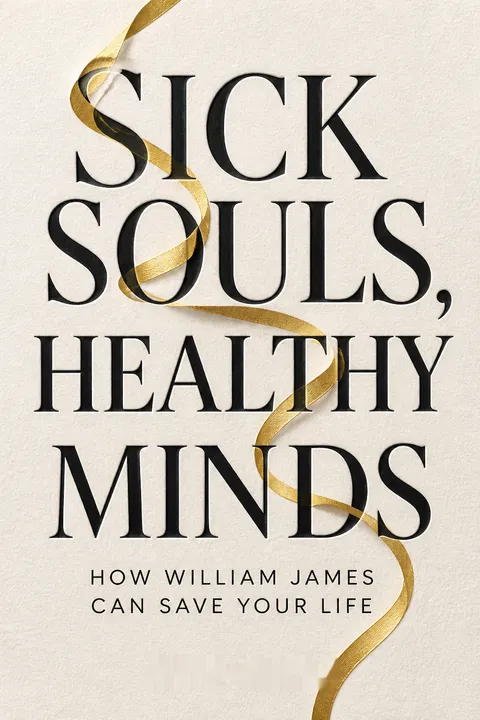
Sick Souls, Healthy Minds explores William James's philosophy and life, intertwining the author's personal experiences. Readers appreciate the biographical elements and James's pragmatic approach to life's challenges. Some find the book insightful and inspiring, while others feel it's too focused on the author's life or difficult to understand. The writing style and translation quality receive mixed reviews. Overall, the book is seen as a unique blend of philosophy, biography, and self-help, offering valuable perspectives on depression, free will, and finding meaning in life.
People Also Read


Glossary
sick-souled
people acutely aware of sufferingJames's term for people who experience life through recurring distress, conflict, or a sense that existence is fundamentally troubling. They may find easy optimism shallow because they notice suffering that others overlook. The category describes a psychological and existential temperament, not a formal medical diagnosis, and James uses it to show that despair is not an isolated experience.
twice born
renewed after profound despairJames's description of people who do not begin with an uncomplicated acceptance of life, but reach a renewed capacity to live after deep suffering or inner conflict. The change is not guaranteed, nor does it erase past pain. It names a possible transformation in outlook through which a person can again find life bearable or meaningful.
dilemma of determinism
the conflict between fate and freedomJames's name for the problem created when causal science appears to imply that every event, including human action, was fixed by prior conditions. If no alternative was possible, ideas of responsibility, regret, and moral improvement seem threatened. James argues that accepting natural causes does not require treating the future as completely closed.
live hypothesis
belief that guides actionA possibility that a person takes seriously enough to act on before decisive evidence is available. James uses the idea to explain choices such as trusting another person or committing to a relationship. Acting on a live hypothesis may help create conditions in which it can prove fruitful, but it does not guarantee success or justify ignoring contrary evidence.
stream of consciousness
the continuous flow of thoughtJames's account of conscious life as an ongoing, personal flow rather than a collection of isolated sensations or ideas. Experience changes as it unfolds, with transitions and variations that can be missed when attention is dominated by routine. The concept also emphasizes that a first-person experience cannot be fully captured by observing the mind from the outside.
pragmatism
ideas tested through consequencesJames's philosophical method for assessing ideas by tracing their practical consequences and testing them against experience. A belief is not true merely because it is comforting or useful to one person at one moment. Its claims must remain accountable to facts and may require revision as new evidence and consequences emerge.
meliorism
improvement is possibleJames's view that the world is neither guaranteed to improve nor fixed beyond repair. Human action can contribute to better outcomes, but success depends on choices and circumstances. Meliorism therefore supports hope without promising progress: it treats effort as meaningful precisely because the future is not fully settled.
zest
felt vitality and importanceJames's term for the vivid sense of engagement that makes an activity or a life feel significant to the person experiencing it. Zest can arise through movement, perception, imagination, or reflection, and its sources differ among people. Because it is inwardly felt, outsiders should be cautious about declaring another person's harmless pursuits meaningless.
subliminal
just below conscious awarenessJames uses subliminal for mental processes that occur beneath the threshold of ordinary awareness but may still influence thought or be faintly experienced. He distinguishes this territory from what is plainly conscious and investigates it as a possible source of unusual experiences. Its existence does not, by itself, prove supernatural explanations for those experiences.
pure experience
experience before interpretationA Jamesian idea for the immediacy of experience before it is fully organized into concepts, explanations, or familiar categories. Kaag uses it to describe moments when grief, nature, or disrupted routine makes ordinary perception feel newly vivid. Such moments can challenge habitual interpretations, though they do not automatically establish a particular metaphysical account of reality.
Download PDF
Download EPUB
.epub digital book format is ideal for reading ebooks on phones, tablets, and e-readers.








