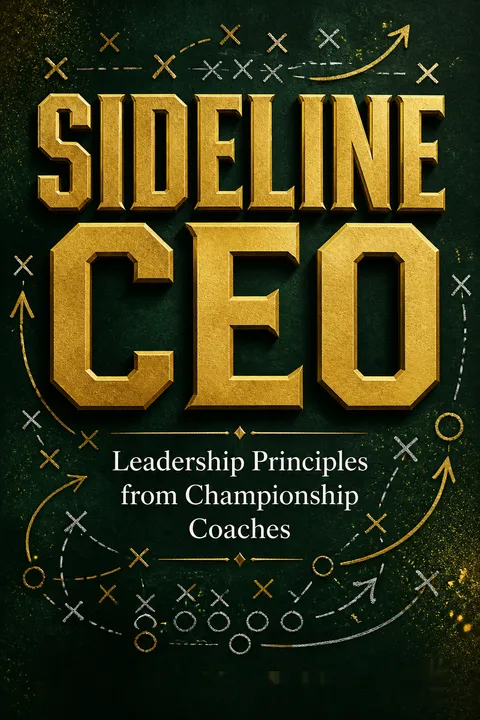


Key Takeaways
Lead from the sideline by making people stronger, not by owning every play.
Leadership is earned influence. The book gathers lessons from twenty championship coaches and executives, but their definitions converge: a leader helps others do what they could not yet manage alone. A title may grant authority, but it cannot guarantee that anyone wants to follow. That requires visible integrity, real investment in people, and a willingness to carry responsibility when things go wrong.
Make others more capable. Nick Saban describes helping players set goals, identify the behaviors those goals require, and practice those behaviors consistently. John Calipari and Tom Izzo stress bringing people toward ambitions they doubt they can reach. The point is not to imitate a coach's personality. Leadership changes with the people and moment, while its underlying commitments remain steady.
The sideline image captures a productive tension: leaders need enough distance to see the whole operation, yet enough closeness to understand the people doing the work. Organizational research similarly distinguishes formal authority from informal influence, which grows when colleagues regard a leader as both competent and trustworthy. The book also usefully rejects a single leadership temperament. A quiet listener and a fiery motivator can both lead. The caution is that influence alone is morally neutral. The foreword notes that manipulation can also move people. Durable leadership therefore needs a test beyond followership: whether people gain agency and capability, rather than merely serving the leader's ambitions.
Hold the standard constant, but tailor the route to each person.
Fair is not identical. Coaches describe maintaining clear team standards while changing how they teach, challenge, or support each player. Jimbo Fisher says people interpret direction differently, so a leader must discover how each person can meet the same expectation. Leonard Hamilton likewise emphasizes adapting instruction to different learning styles. This is not permission to lower the bar for people a leader favors. It is a way to make the bar reachable through appropriate coaching.
Know the person, not just the role. Patty Gasso wants athletes to feel safe bringing problems to her, without confusing care with friendship. Roy Williams makes room for a player's individual ambitions, even when advice that serves the player may complicate the team's goals. In both cases, personal knowledge helps a leader challenge someone without reducing that person to performance.
This distinction resembles the difference between equality of treatment and equity of support. In education, a common learning objective can require varied instruction; in management, a shared performance bar can require different tools, feedback, or accommodations. The approach is strongest when the standard is explicit and the adaptation is explainable. Without that transparency, individualized leadership can look like favoritism, especially to peers who see different treatment but not the context behind it. The book's coaches make fairness a promise, not sameness. Organizations can honor that promise by making expectations visible and allowing people to ask how decisions were reached.
Build trust through reliable work, honest promises, and demonstrated personal care.
Trust has several sources. Urban Meyer calls his framework the Triad of Trust: character trust comes from repeatedly doing what one says; competency trust comes from doing the job well; and connection trust comes from showing sustained care. A leader can be sincere yet lose confidence by being disorganized, or highly competent yet fail to connect. Trust requires all three, accumulated through everyday interactions rather than demanded on command.
Listen, then act. When Mack Brown returned to North Carolina, players complained about the food, lounge, and lockers. He asked for specifics, then worked to improve those conditions. His follow-through made later requests for discipline more credible. Another example comes from Roy Williams advising Coby White to pursue the NBA when that appeared best for White and his family, even though keeping him might have helped the team. Trust deepens when advice serves the other person's interests.
The framework is useful because it separates dimensions leaders often blur. A caring manager may still be unreliable; a technically brilliant one may be hard to approach. Trust research in teams likewise treats credibility as cumulative, built through repeated evidence rather than a single declaration. Brown's response to complaints illustrates a particularly practical loop: solicit precise information, make a visible change, and explain the standard that follows. Yet trust should not be mistaken for constant agreement. People can trust a leader who makes an unpopular decision if the process is candid, consistent, and free of hidden self-interest.
Listen before speaking, then repeat a clear message people can use.
Communication is reciprocal. The coaches argue that a leader who listens learns what people actually understand, fear, or need. That means attending not only to words, but also to behavior and mood. Mack Brown invites staff and players to offer views before he decides. He may reject a suggestion, but hearing it helps him understand what explanation or support will be needed for the decision to stick.
Make the message usable. Kirby Smart relies on concise, repeated language to focus his team, while Doc Rivers makes sure coaches and support staff reinforce the same central ideas. Tom Izzo offers a striking example: during a halftime break, he let veteran Mateen Cleaves address teammates who needed to hear the message from one of their own. Communication succeeds when the audience can understand it and act on it, not simply when the leader has delivered it.
Listening is not a ceremonial pause before the leader resumes talking. It is a way to gather information that changes the quality of a decision. This connects with psychological safety, the shared sense that people can raise concerns without being punished or humiliated. Repetition then helps reduce ambiguity, especially in complex groups where different roles receive different fragments of information. The limitation is that a polished mantra can become noise if daily behavior contradicts it. A useful test is whether the message helps a person make a concrete choice, and whether the leader's actions make that choice credible.
Delegate decisions clearly, then accept responsibility for the result.
Authority should travel downward. Delegation lets a leader focus on the larger organization while giving capable people room to contribute. It also signals confidence and creates opportunities for others to grow. Roy Williams learned under Dean Smith, who gradually trusted him with substantial coaching responsibilities, including running the junior varsity program. That experience helped prepare Williams to lead a program himself. Delegation works best when people receive genuine responsibility, not only a task list without decision-making power.
Clarify the boundaries. Frank Beamer documented each person's responsibilities and reviewed them with the full organization, reducing confusion about who owned what. The head leader still carries ultimate accountability. Nick Saban describes retaining the right to review and change game decisions, while expecting coordinators to own their roles. Delegation is neither abandonment nor micromanagement: define the outcome, give people room to work, and remain answerable for the system.
This is a practical account of distributed authority. Management theory often treats clear decision rights as essential to speed and accountability: people need to know what they may decide, when to consult, and who owns the consequences. Beamer's responsibility map addresses a common organizational failure, the assumption that somebody else is handling the task. The deeper challenge is tolerating a competent person's different method. If leaders reclaim control whenever an approach looks unfamiliar, delegation becomes theater and initiative dries up. Conversely, responsibility without resources or permission is merely blame shifted downward.
Build norms that survive when nobody in charge is watching.
Culture shows up in private. The book defines culture through the behaviors people choose when a coach is absent: whether teammates hold one another accountable, work carefully, and treat others with respect. A slogan is not a culture if daily conduct contradicts it. Leaders shape the environment through their own example, the people they hire, the standards they reinforce, and the habits they reward.
Make shared success tangible. Doc Rivers used Ubuntu, a South African idea of human interdependence, with the 2007-2008 Boston Celtics. The team's version emphasized that one person's development strengthens the whole group, and that a teammate's success need not threaten anyone else's. Urban Meyer's Ohio State team faced a major test when its star quarterback was injured shortly before the 2014 season. The team recovered and won the national championship, which Meyer credited partly to a culture of effort, hard work, and mutual commitment.
Culture is a form of distributed coordination. When norms are internalized, a group needs fewer reminders from its formal leader because members can correct drift themselves. The Celtics example gives that idea an emotional center: cooperation becomes easier when another person's success is understood as a shared gain. Still, strong cohesion is not automatically healthy. Groups can enforce belonging by silencing dissent or excluding outsiders. A durable culture needs both commitment and room to question whether its habits remain fair, useful, and aligned with the organization's stated purpose.
In a crisis, offer steadiness and presence before pretending to have answers.
There is no universal script. After a 2023 shooting at Michigan State killed three students and injured five, Tom Izzo struggled to find words for his basketball team before its first game back. Marty Smith later learned that Izzo had watched Smith's awkward live attempt to play hockey goalie. The comic segment briefly gave him relief and helped him see that the game could offer the grieving community a short escape. Sometimes support is not an eloquent speech; it is a moment of ordinary human connection.
Stay present and be clear. Patty Gasso describes accompanying a distressed athlete to a hospital and remaining nearby while the athlete's parents traveled to meet her. Gasso could not fix the crisis, but her presence mattered. During COVID, Greg Sankey asked colleagues to bring him a few workable options, not an avalanche of details. Calm, honest communication and appropriate help can make action possible under uncertainty.
The stories resist the fantasy that every crisis has a decisive leader with a ready-made answer. Acute stress can narrow attention and disrupt judgment, so calm, plain information is often more useful than confident performance. Gasso's example also points to a boundary: presence matters, but serious mental health or safety problems require qualified professional support, not a leader's compassion alone. The strongest response combines human attention with sound procedures, delegated expertise, and honesty about uncertainty. Smith's accidental contribution is a reminder that people under strain may need relief as well as solemnity.
Review evidence, invite hard feedback, and correct what is actually failing.
Make the performance visible. Smith describes reviewing recordings of a demanding live television show, despite disliking what he saw. Watching the footage exposed moments when he lost his place or looked uncertain, details that memory and self-defense could easily conceal. Coaches apply the same logic to game film and measurable performance. Tom Izzo asks whether a player can assess their own limits and then motivate themselves to improve; one without the other can lead to misplaced effort.
Use honest outside eyes. Mack Brown asks trusted, successful people to critique his leadership, even when their assessment is uncomfortable. Leonard Hamilton gives players specific measures, such as how often they executed a defensive assignment, instead of relying on vague commands to try harder. Evaluation should identify a changeable behavior, not turn a shortcoming into a verdict on someone's worth.
This practice resembles a feedback loop in engineering: compare intended performance with observable results, identify the gap, and adjust the system. Recording is valuable because people are poor at noticing some habits in real time, while a trusted critic can reveal blind spots. But more scrutiny is not always better. Smith notes that relentless self-criticism can damage confidence, and external feedback can be distorted by status, bias, or noisy online opinion. Useful evaluation is specific, proportionate, and linked to a next step. Evidence should sharpen learning, not become a permanent prosecution.
Keep your principles, but refresh your methods before success hardens into complacency.
Treat success as temporary. The coaches describe excellence as work that must be renewed, not a position that can be maintained automatically. Lane Kiffin recalls a strong season followed by an offseason in which his staff did too little to learn from others. The next season disappointed, and he concluded that a winning record should increase attention to new threats, because competitors are studying what worked. Dabo Swinney's Clemson staff revisits its foundations each year rather than assuming last season's habits still fit.
Change the approach, not the compass. Coaches adapt to new players, technology, rules, and pressures while holding on to standards such as discipline, care, and accountability. Swinney calls this a windshield mentality: learn from the past, but direct attention toward what is ahead. Adaptation is not novelty for its own sake. It is a continuing test of whether today's methods still serve the purpose.
The central distinction is between principles and procedures. Stable values can provide continuity while methods change in response to new evidence, new people, or new conditions. This is also the logic of organizational learning: a team that treats past success as proof that its current system is permanently correct risks becoming brittle. Yet constant reinvention can exhaust people and discard hard-won knowledge. Annual review is most valuable when it asks what remains effective, what no longer fits, and why. Adaptation should be disciplined inquiry, not motion mistaken for progress.
Analysis
Sideline CEO is a practical leadership book built from interviews rather than a single theory or a linear argument. Its eight subjects, from trust and delegation to crisis and evolution, recur through the same central premise: influence becomes durable when people experience a leader as capable, consistent, attentive, and willing to adapt. The coaches' varied personalities are part of the evidence. They do not prescribe one charisma style; they describe a set of responsibilities that can be carried out differently across people and situations.
The strongest contribution is its insistence that principles become credible through observable behavior. Trust follows kept promises, culture appears in unobserved conduct, and communication works when listeners can use it. The stories make these claims concrete: Brown improves conditions after asking players for specifics; Williams develops through responsibility from Dean Smith; Gasso stays with an athlete in distress. These examples show leadership as a repeated relationship, not a speech or title.
The book's interview form also limits its claims. Accounts from successful coaches can illuminate practice, but they do not establish which behaviors caused winning. Athletic programs have unusual power structures, high resources, and clear performance measures; a workplace or family cannot simply import their intensity, schedules, or disciplinary methods. Even the coaches disagree: Lane Kiffin argues that talent can sometimes compensate for weak trust, while others treat trust as foundational. That tension is valuable because it separates short-term performance from resilient cooperation.
The most useful synthesis is to treat leadership as a cycle: set a meaningful standard, learn what people need to meet it, communicate and delegate clearly, observe what happens, and revise the approach without abandoning the standard. The book's evidence is anecdotal, not experimental, but its recurring practices are concrete enough to test in ordinary teams. Its advice is strongest when translated with attention to context, power, and the well-being of the people being led.
Review Summary
Sideline CEO receives mostly positive reviews, with an average rating of 4.09 out of 5. Readers appreciate Marty Smith's inspiring writing style and the valuable leadership insights from sports coaches. The book covers topics like trust, communication, and crisis management. Many find it easy to read and full of wisdom. Some criticize the format as disjointed, while others praise its organization. Readers recommend it for aspiring leaders and sports enthusiasts. The book's unique compilation of quotes and perspectives is frequently highlighted as a strength.
People Also Read









Glossary
Triad of Trust
Three sources of trustA framework Urban Meyer attributes to leadership consultant Tim Kight. It separates trust into character, competence, and connection. Character is demonstrated by repeatedly doing what one promises; competence comes from reliably doing the work well; connection grows when people repeatedly experience genuine care. A leader may be strong in one dimension and weak in another.
The Process
Daily preparation toward standardsNick Saban's approach at Alabama focuses people on becoming prepared, accountable, and better at their work rather than fixating on the final score or title. Individual discipline is intended to strengthen the group: each person meeting a high standard makes it easier for teammates to meet theirs. The emphasis is on repeatable preparation and behavior.
Ubuntu
Interdependence within a groupA South African concept Doc Rivers brought to the 2007-2008 Boston Celtics as a shared team idea. In the book's explanation, a person becomes fully capable through other people, so one teammate's growth and success can strengthen the whole group. Rivers used it to challenge jealousy and encourage responsibility for one another.
ALL IN
A shared commitment acronymDabo Swinney's acronym for Attitude, Love, Learn, Invest, and Now. It condenses a commitment to doing one's best into a message players can remember and discuss. In Swinney's account, a shared purpose needs to be clearly stated, connected to daily choices, and continually reinforced throughout an organization.
windshield mentality
Focus on the next taskDabo Swinney's image for learning from the past without letting it dominate attention. The windshield represents what lies ahead, while the rearview mirror represents what has already happened. The idea is to use past results as information, then concentrate on the present work and the next opportunity.
prehab
Preparation that prevents crisisNancy Lieberman's term for anticipating needs and reducing the chance that a problem becomes a crisis. She illustrates it through small acts of inclusion and attention to an athlete's family, which can ease insecurity and strengthen relationships. The contrast is with rehabilitation, which responds after harm or breakdown has already occurred.
Download PDF
Download EPUB
.epub digital book format is ideal for reading ebooks on phones, tablets, and e-readers.








