

Key Takeaways
Replace gut-level trust with evidence about what people repeatedly do.
From shock to method. The book begins with September 11, 2001, when FBI agent Robin Dreeke could not predict how colleagues would respond to catastrophe. Some fled, some froze, and some ran toward danger. Seeing courage he had not known was there convinced him that closeness and intuition were not enough to understand people.
A practical lens. Dreeke’s personal system examines six signs: vesting, longevity, reliability, actions, language, and stability. The goal is not to label people good or bad, but to estimate what they are likely to do in a particular relationship or task. The publisher notes that this is Dreeke’s method, not an official FBI doctrine. The examples after the 9/11 account are fictionalized, with names and details changed.
The framework’s strength is that it turns a vague judgment, “Can this person be trusted?”, into smaller questions that can be checked. That resembles structured decision-making in medicine and aviation, where checklists help experts notice what stress or familiarity might hide. It is not a device for reading minds, however. The signs support provisional forecasts, not certainty, and a thoughtful user must keep updating those forecasts as circumstances change.
Predict self-interest, including generosity, rather than assuming virtue.
Start with their goals. Dreeke’s central premise is that people generally act according to what they believe serves their interests. Those interests may include money or status, but also family, loyalty, service, and another person’s success. Asking what someone wants, fears, or is trying to accomplish is more useful than deciding whether they are morally good.
Trust is forecastable. In this view, trust means expecting someone to behave consistently in a relevant situation, not believing they are virtuous in every part of life. The book reports that ordinary methods of judging trustworthiness succeed only about half the time. That figure supports the case for gathering evidence, though the text does not provide enough study detail to treat it as a universal scientific constant.
This is a useful bridge between moral judgment and practical cooperation. Organizational economics often treats people as pursuing incentives, while prosocial behavior shows that belonging, fairness, and care can also be genuine interests. The approach becomes cynical only if “self-interest” is reduced to selfishness. It also has a limit: people can misunderstand their own interests, especially under stress, so knowing what someone wants does not always make their behavior easy to predict.
Build alliances by making each other's success matter.
Look for mutual investment. Dreeke calls this sign vesting: a person sees your progress as connected to their own welfare, and acts accordingly. After a hostile first meeting with Leo, a Russian source, Dreeke learned that Leo’s grandson Viktor was ill and at risk of losing his visa. He helped with the visa and access to medical care. That practical support gave the two men a shared purpose and changed their relationship.
Watch what follows. Vesting shows up in voluntary help, credit shared generously, introductions, and genuine interest in another person’s goals. It is not a demand for loyalty or a reason to pressure someone. If the other person does not see a mutual benefit, the alliance is not real, however useful it might look from your side.
The idea fits the logic of reciprocal cooperation: durable partnerships form when each participant can see how the other’s success contributes to a shared outcome. It also reframes asking for help as an exchange of value rather than a test of affection. The caution is important. Mutual benefit can be unequal or temporary, so a helpful act should be read alongside consent, boundaries, and follow-through, not treated as proof of permanent allegiance.
Create a longer relationship horizon to make accountability real.
Time changes incentives. People who expect to deal with one another again have reasons to protect their reputation, share gains, and repair conflicts. Dreeke contrasts that with short encounters, where a person may see little cost to taking advantage. In his account, a mutual contact named Leo introduced him to Sergei, a Russian diplomat, and that transferred some trust before the two men knew each other well.
Make time feel substantial. Repeated traditions, shared experiences, and taking a sincere interest in someone’s priorities can deepen a relationship faster than routine contact alone. Dreeke also describes a high-stakes contact, Annan, who brought him information during a nuclear standoff. Their relationship grew through a shared mission and sustained cooperation. The lesson is to build continuity, not to manufacture intimacy or rush past verification.
A longer horizon can make cooperation more rational because today’s choices affect tomorrow’s relationship. Repeated interaction is central to many models of reciprocity, from workplace teams to community life. But duration is not automatically protective: long relationships can also entrench dependence or enable exploitation. The useful signal is not simply time served, but whether people keep honoring obligations, renegotiate fairly, and behave consistently as the relationship evolves.
Check both skill and follow-through before depending on someone.
Reliability has two parts. Competence is the ability to do the work; diligence is the effort to complete it responsibly. Dreeke’s drone task-force story makes the distinction vivid. George, the team leader, understood technology and had a strong reputation, but struggled to communicate, meet deadlines, and follow through on arranging expert speakers. His good intentions did not make him reliable for that role.
Match the person to the task. Look for specific evidence: relevant experience, clear explanations, questions that show learning, honest acknowledgment of mistakes, and completed work. Reliability is not a global quality. Someone may be an excellent technical specialist and a poor project manager. Dreeke eventually left the team rather than continue to depend on George for work he was not delivering.
Separating ability from effort is a practical advance over treating performance as a matter of character alone. It helps managers diagnose whether someone needs training, a different assignment, clearer incentives, or accountability. It also guards against charisma and résumés substituting for evidence. Still, punctuality, appearance, or note-taking can reflect workload, disability, culture, or circumstance. A fair assessment asks whether the behavior affects the task and checks for context before drawing conclusions.
Let recent, repeated actions outweigh polished claims and stale reputations.
Behavior leaves a record. Actions are more concrete than promises, but past conduct is not a guarantee of future conduct. Dreeke urges attention to patterns of transparency, responsibility, and consistency, especially in situations resembling the one at hand. He also warns that power, anonymity, and reduced consequences can change behavior. Someone’s reputation may describe how they acted under different conditions.
Check the pattern, not the performance. In the book’s account of Robert Hanssen, a colleague recalled that Hanssen isolated himself, resisted collaboration, and seemed concerned mainly with his own advancement. Those observations mattered more than a polished professional image. Yet one mistake or inconsistency is not enough to define a person. Verify claims, ask for relevant details, and give more weight to current evidence than to either a flattering résumé or an old accusation.
This resembles Bayesian reasoning: a forecast should shift as new, relevant evidence arrives, while a single data point rarely settles the question. Accountability matters because people respond to the consequences they expect, not just to their stated values. The method is strongest when evidence is specific and independently checked. It is weakest when vague impressions become character verdicts, or when observers mistake a changed situation for a permanent change in personality.
Listen for language that understands others, not language that performs.
Words reveal priorities. Dreeke’s “language of trust” is communication that seeks to understand the other person, speaks plainly, avoids needless judgment, and leaves room for choice. A good listener asks questions, checks assumptions, and talks about the other person’s concerns rather than constantly advertising their own. By contrast, bragging, gossip, defensiveness, absolute claims, and debate tactics can signal that a conversation is serving the speaker’s ego or agenda.
Notice the mismatch. During a corporate consulting visit, Dreeke edited scripted cold-call booklets to focus on the person receiving the call. The executive who hired him initially seemed receptive, but later revealed that he wanted an extremely brief, highly controlled script. That gap between presentation and intent led Dreeke to decline further work. Words matter, but should be compared with actions and context.
Conversation analysis offers a valuable, low-cost source of information: people disclose what they attend to, how they handle disagreement, and whether they make space for another person’s agency. A listener-centered style can also improve the interaction itself, not merely help assess it. Still, speech patterns are not lie detectors. Anxiety, culture, neurodivergence, or limited communication skills can produce awkwardness without deception. Treat language as evidence to investigate, not a verdict.
Judge emotional stability by patterns, while keeping your own fear in check.
Use a baseline. Dreeke’s final sign concerns emotional maturity, self-awareness, and consistency. He describes fear-driven reactions such as catastrophizing, volatility, helplessness, blame, and manipulation as making behavior harder to forecast. But he also stresses that stability exists on a continuum, and that temporary distress does not define a person. Compare someone’s behavior with their usual pattern and the pressures they face.
Support without surrendering judgment. Dreeke tells of Linda, a young agent overwhelmed by a dangerous assignment. Patient support and practical help helped her regain confidence and function more effectively. He calls the blend of empathy and stoic realism “stempathy.” The same discipline applies to the assessor: fear can make ordinary ambiguity look like danger, so pause, ask clear questions, and avoid turning a person into a diagnostic label.
This section usefully joins emotional regulation with interpersonal judgment: a frightened observer can misread others, while a distressed colleague may need support rather than suspicion. That aligns with research on stress impairing attention and decision quality. The framework needs care, though. Terms like volatility or helplessness can be weaponized against people experiencing trauma or illness. The practical question is whether a pattern affects a specific responsibility, and what support or boundary makes the situation safer.
Build a life around trusted people, not only missions or titles.
The human payoff. The book’s arc begins with Dreeke confronting the limits of what he knew about colleagues after 9/11. It ends after his retirement, when he realizes that his unease is not mainly about losing work, status, or purpose. He fears losing the people whose trust and shared effort had shaped his life: Leo, Annan, Jesse, and others.
Relationships outlast roles. The six-sign system is presented as a way to choose allies with clearer eyes, but the closing point is not merely strategic. Trust grows through practical help, shared risk, and repeated acts of care. Those bonds can remain important after a job ends or people move apart. Dreeke’s final measure of success is not perfect prediction, but the lasting influence of relationships built in difficult circumstances.
This ending gives the manual an emotional center. The tools are not offered to make every interaction transactional, but to reduce fear enough for meaningful cooperation and attachment. A useful distinction emerges between predicting someone and possessing certainty about them: good relationships still require vulnerability and revision. The framework can guide whom to rely on, while the story reminds readers that the value of trust is found in the bond itself, not just in what it produces.
Analysis
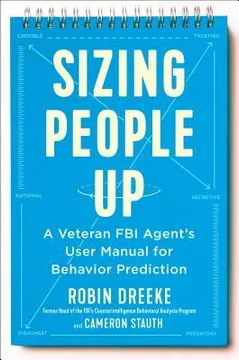
Sizing People Up combines memoir, workplace advice, and a behavioral checklist. Its narrative spine is Dreeke’s shift from post-9/11 disorientation to a method for evaluating trust, illustrated through relationships with informants, colleagues, and managers. The framework’s most valuable move is redefining trust as task-specific predictability rather than a verdict on someone’s goodness. That distinction permits calibrated reliance: a person may be dependable in one domain and unsuitable in another.
The six signs work best as prompts for disciplined observation. They encourage readers to ask what another person wants, whether interests overlap, whether promises are supported by capability and action, and whether behavior stays coherent under pressure. This is more useful than intuition alone, especially when affection, fear, status, or urgency distort judgment. The repeated emphasis on verification and context also resists the fantasy that a single charming interaction reveals character.
The method nevertheless risks turning ambiguous social behavior into evidence of hidden motives. Body language, punctuality, conversational style, and emotional composure vary across cultures, neurotypes, health conditions, and situations. Some listed indicators are much more diagnostic of reliability than others. A missed deadline tied to an important task deserves more weight than a folded arm or a tense smile. Readers should treat the signs as hypotheses, seek corroboration, and distinguish inability from unwillingness.
The author’s account of self-interest is most persuasive when it includes prosocial aims. People may pursue family welfare, loyalty, or service, and recognizing those motives can build genuinely reciprocal alliances. It becomes less reliable when it assumes that people understand what benefits them or behave consistently under changing incentives. The book acknowledges variability, but its confident tone can obscure the limits of prediction.
Ultimately, this is a practical framework for reducing avoidable surprises, not a scientific instrument that guarantees accurate forecasts. Its strongest ethical instruction is reciprocity: understand another person’s perspective, offer real value, and verify what matters. The closing narrative supplies the deeper purpose. Accurate judgment is not an end in itself; it creates room for durable relationships, shared work, and trust that can survive a change of role or circumstance.
Review Summary
Reviews for Sizing People Up are mixed, averaging 3.31 out of 5. Positive readers praise its practical framework for assessing trustworthiness through six principles: vesting, longevity, reliability, actions, language, and stability, appreciating the engaging FBI anecdotes. Critics argue the book is padded with personal stories, lacks academic credibility, and could have been condensed into a single article. Some found the content too obvious or overly business-focused, while others valued its actionable insights for evaluating relationships and building trust.
Glossary
Six Signs for Behavior Prediction
Six trust indicatorsDreeke’s framework for estimating how someone is likely to behave in a particular relationship or task. Its six signs are vesting, longevity, reliability, actions, language, and stability. The signs are meant to guide observation and adjustment of trust, not to determine whether a person is morally good or bad.
Vesting
Mutual stake in successA person is vested when they believe another person’s success benefits them too, and show that belief through helpful actions. Signs can include volunteering assistance, sharing credit, and looking for further common goals. Dreeke treats vesting as a strong basis for cooperation, while emphasizing that the other person must genuinely perceive the mutual benefit.
Code of Trust
Five trust-building principlesDreeke’s five-part approach to behaving in ways that invite trust: suspend the ego, validate others, avoid judging them, remain reasonable, and be generous. The method asks a person to consider how their conduct appears from someone else’s perspective. It is both a way to build rapport and a set of behaviors to look for in potential allies.
Primacy
Trust passed through a contactIn Dreeke’s usage, primacy is a transfer of trust from one person to another through a mutual acquaintance. A newcomer may be more willing to meet because someone they already trust has vouched for the intermediary. This can create an opening, but it does not replace checking the person’s own behavior and reliability.
Emotional hijacking
Emotion overriding evidenceDreeke’s term for a state in which fear or another intense emotion dominates judgment and drives action before the facts are clear. It can lead people to exaggerate threats, misread others, or act in ways that damage their own goals. His proposed counter is to pause, collect observable information, and reason before responding.
Stempathy
Empathy joined with stoicismA term Dreeke uses for combining empathy with stoic acceptance. It means trying to understand another person’s perspective without being swept into their distress or abandoning practical judgment. In his account, this combination can support someone who is struggling while preserving boundaries and a clear view of what the situation requires.
Quiet mind
Calm, reasoned attentionDreeke’s label for a state of mind governed by rationality, self-control, and a realistic view of other people. He contrasts it with the “noisy mind,” in which fear and contradictory emotions dominate judgment. The terms are his explanatory model, not clinical categories or a complete account of how emotion and cognition work.
3-P personality
Three patterns of pessimismDreeke uses this label for interpreting problems as permanent, pervasive, and personal. Permanence means expecting a difficulty to last indefinitely; pervasiveness means expecting it to spread across life; personalization means treating oneself as the cause of every setback. He presents the pattern as a warning sign, while allowing that temporary distress can have understandable causes.
Discovery questions
Questions that clarify choicesNonjudgmental questions intended to help someone examine a problem and reach a more realistic decision. They invite consideration of likely consequences, previous attempts, affected people, and the difference between immediate relief and a lasting goal. Dreeke contrasts them with rhetorical questions that push an agenda or make the other person defensive.
Trust at first sight
Early, cautious trustDreeke’s name for offering genuine consideration and a limited degree of trust early in a relationship, rather than waiting for complete certainty. The approach can help establish rapport and shared purpose, but is paired with verification and appropriate limits. It does not mean ignoring risk or treating an initial positive impression as proof.
Download PDF
Download EPUB
.epub digital book format is ideal for reading ebooks on phones, tablets, and e-readers.








