

Plot Summary
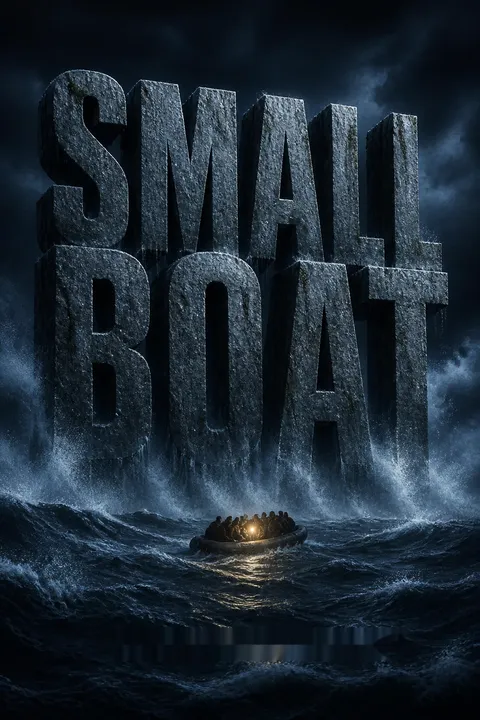
A Zodiac Leaves Dunkirk
On a November night, twenty-nine people board an overloaded inflatable boat on the French coast, hoping to reach England. Most are Iraqi Kurds; others have come from Afghanistan, Ethiopia, Somalia, Vietnam, Egypt, and elsewhere. Two women travel with a young girl. The passengers barely know one another, and the smugglers who send them off have little knowledge of the sea.
A young man takes the front of the boat, using his phone to check their direction, while another steers the outboard. The dinghy rides low, its overloaded tubes bearing the passengers’ weight unevenly. With no clear horizon or dependable route ahead, they leave the shore’s lights behind and push toward the cargo ships.
The crossing begins not with a grand declaration but with a practical gamble made under severe constraint. The passengers’ decision is real, yet the conditions around it narrow what choice can mean: smugglers abandon them, navigation is improvised, and the vessel is unfit for its load. By focusing on the boat’s physical imbalance and the passengers’ unfamiliarity with one another, the story resists reducing them to a faceless crowd while also showing how little control any individual can exert. Their hope is not presented as foolishness alone. It is the fragile calculation of people who see the dangers of staying as more pressing than the dangers of leaving.
The Engine Falls Silent
The outboard stalls, restarts briefly, then fails again. Without its thrust, the heavily loaded dinghy drifts in the dark, and the passengers realize they cannot reach England unaided. The young man first tries the British rescuers, but he cannot give them a reliable position.
They direct him to the French CROSS rescue centre, which asks him to send geolocation through WhatsApp so staff can establish whether the boat is still in French waters. The signal cuts in and out; phones lose charge, and the passengers crowd around the young man for news. He tells them help is coming, though he does not know when. They have reached shore only in the sense that a rescue service has answered.
The phone becomes both a lifeline and a narrow channel through which the passengers’ urgency must pass. Their danger is immediate, but the institution can act only on coordinates and jurisdiction, so human need is translated into technical information. The young man’s improvised role as navigator now expands into interpreter and intermediary. His reassurance is not a confident promise; it is a way to keep others from giving up while he waits for a system he cannot see. The scene exposes an asymmetry central to the novel: those in the boat experience the whole emergency at once, while the people coordinating help encounter it as partial data, intermittent calls, and a location on a screen.
Help Crosses a Border
At the CROSS, an unnamed female radio operator handles the calls while working alongside her colleague Julien. The boat’s location places it first in French waters, then near the boundary with Britain. The operator contacts Dover, passes on its changing position, and repeatedly tells the passengers that help is coming.
As the dinghy drifts across the maritime line, she tells the young caller to seek British assistance. Later, a French fishing vessel spots the boat and asks what to do. The operator does not direct it to intervene. During the investigation, she will also struggle to explain why she told the British that the nearby French patrol boat could not be sent, even though that account proves unreliable.
The sea border gives the operator a workable procedure and a moral escape route at the same time. Jurisdiction matters for coordinating rescue, but it can also make responsibility seem to move as cleanly as a dot crossing a line. The novel does not make the operator’s inner state fully transparent, even to herself. She can explain the sequence as professional sorting, resource management, and an assessment of where the boat will be. Yet the passenger’s danger does not change when the coordinates change. This gap between administrative categories and bodily reality becomes the story’s central pressure: the people in the water cannot divide their emergency into French and British portions.
The Boat Comes Apart
The dinghy’s inflatable sides begin to collapse under the passengers’ weight, and seawater spreads across its floor. A pump cannot keep the tubes firm; the heavy motor drags down the stern. People bail with their hands, then lose their footing and fall into the freezing Channel.
The young man keeps calling the CROSS, but the operator tells him the boat is now in British waters and directs him back to British rescue services. A cargo ship sounds its horn and sweeps the water with a searchlight, giving the scattered passengers a brief chance to believe they have been seen. The light never settles on them. The vessel moves away. By morning, twenty-seven people have drowned; two survive.
The catastrophe is built from repeated failures of contact rather than one spectacular blow. The dinghy weakens, the rescue message remains abstract, and the cargo ship’s light offers recognition without intervention. Each moment briefly renews the passengers’ hope, then strips it away. The operator’s procedural response contrasts with the young man’s escalating calls, but the novel also places the ship’s withdrawal inside a wider field of spectatorship. Seeing suffering does not automatically become acting on it. The two survivors prevent the ending from becoming total erasure, yet their survival cannot balance the dead or transform the rescue system’s failure into a success.
The Recording Plays Back
After the sinking, the operator drives to a police interview in Cherbourg, leaving her daughter Léa with her parents. The investigator plays recordings of the night, including the operator’s calm instructions and a disparaging remark made off-microphone to Julien.
The operator wants to hear her own voice rather than encounter it through news reports, but the playback makes her sound unfamiliar even to herself. The investigator, whose posture and features resemble the operator’s, asks her to account for what happened.
The operator insists that rescue workers must set aside personal opinions and emotion to act efficiently. Yet the recording makes that defense harder to sustain: her professional voice carried practical instructions, while her private words reveal irritation at the people asking for help.
The recording turns speech into evidence, but it cannot settle what the evidence means. It preserves tone and wording while leaving intention open to argument. The operator’s claim that emotion must be suspended contains a real insight about the demands of emergency work, yet it also shields her from imagining the passengers as particular people. The investigator’s resemblance to her sharpens the discomfort: accusation arrives as a possible version of the self, not simply an outside judgment. By making the operator listen to herself, the novel asks whether professional language can create useful distance without also making another person’s terror easier to dismiss.
The Patrol Boat Question
The investigator presses beyond the operator’s tone to the decisions behind it. British rescuers had requested French assistance because their vessel was farther away, while the French patrol boat was not as unavailable as the operator had claimed.
The investigator also raises the fishing vessel’s sighting and the operator’s failure to direct it toward the dinghy. She compares the twenty-seven deaths with the many people rescued elsewhere that night and asks whether the operator misjudged the emergency, acted with indifference, or deliberately withheld help.
The operator cannot recover her exact state of mind from that shift. She argues that responsibility stretches backward through policy, inadequate resources, and the conditions that drove people to leave, but the investigator keeps returning to the decisions made at the CROSS.
The inquiry refuses the comfort of a single explanation. A bad assessment, a lie about available resources, institutional scarcity, and moral indifference do not occupy separate compartments; they may overlap without becoming identical. The operator tries to widen the frame until her actions become one link in a chain of causes. The investigator narrows it again to decisions she could have made differently. Neither method fully resolves the matter. The tension is not a puzzle with a hidden answer so much as a conflict over scale: how much responsibility belongs to the person at the console, and how much to the systems and public assumptions that make abandonment seem administratively possible?
A Life Beyond the Console
Suspended from work, the operator runs along the beach each morning while Léa sleeps. The sea now follows her into ordinary life: she sees boats in her food and imagines naval aircraft above her daughter’s bed. She remembers loving the coast as a child, but can no longer separate that old attachment from the sea’s capacity to kill.
Her former partner Eric has long resented the work of rescuing migrants, while Julien’s philosophical detachment once made him seem protected from the distress calls. At family lunches, her father treats her job as a source of wonder, believing she saves lives. The operator now hears that praise as another story that cannot account for what happened.
Suspension removes the routines that once helped the operator contain her work, leaving her with time to see how far the disaster has entered her private world. Her daughter is not merely a symbol of innocence; Léa’s smallness makes the operator’s protective instincts vivid while exposing their limits. Eric’s hostility and her father’s admiration offer opposing moral scripts, but neither can explain the split between competent rescue work and the failed night. Julien’s detachment provides a third model, intellectual distance, which the operator distrusts even as she recognizes its appeal. The sea becomes less a backdrop than a force that unsettles every boundary between work, home, memory, and responsibility.
The Shore Has Witnesses
During her beachside reflections, the operator imagines two survivors walking toward her and considers whether the young caller might have escaped the water. Léa has offered him an elaborate second life, in which he reaches a distant island and is mistaken for its lost king.
The operator also imagines the drowned passengers continuing together along the seabed. These visions do not confirm what happened; they show how she and her daughter try to give the dead somewhere to go.
The operator rehearses explanations and resists turning herself into either a monster or an innocent functionary. She finally looks beyond the rescue station to the millions who watch such crossings from safety, insisting that spectators cannot simply declare themselves absent.
The ending keeps the question of responsibility open by refusing both a courtroom verdict and a consoling supernatural answer. Léa’s invented king gives the young caller a future shaped by welcome, while the procession beneath the sea grants the dead a community after the world has failed them. The operator’s imagination is no longer only the dangerous faculty she tried to suppress; it is also the means by which she can picture consequences beyond the screen. Yet her accusation against the watching public does not erase her own choices. The story closes on an unstable moral position: she is implicated, but so are the people who consume disaster as spectacle and leave action to someone else.
Analysis
Small Boat stages a collision between two forms of seeing. The radio operator sees through screens, coordinates, and voices stripped of biography because those abstractions help her coordinate emergencies. The investigator asks her to restore what that method excludes: the passengers’ reasons for leaving, the people beside them, and the difference between a drifting vessel and a life in immediate danger. Neither perspective is sufficient alone. Intimate attention can become paralysis, but procedural distance can make a preventable failure feel like a jurisdictional technicality.
The novel is especially alert to the moral usefulness and danger of language. The operator’s reassuring messages reach the boat even when rescue does not. Her private contempt matters not because words mechanically caused the deaths, but because they disclose how a person may defend distance while continuing to perform a public role. The recordings can verify speech, not conscience; the inquiry can examine decisions, not produce a complete account of a person’s soul.
The operator’s attempt to widen responsibility to migration policy, inadequate resources, smugglers, the sea, and the watching public is both perceptive and evasive. The novel does not allow systemic causes to erase individual choices, nor does it let individual culpability explain away a system that repeatedly places desperate people in unseaworthy boats. Its final accusation reaches beyond the control room to spectators who condemn failure after the fact while remaining distant from the work and danger of rescue. Yet the operator is not granted the innocence of a mere scapegoat. She too occupies the shore, sees the consequences, and must decide what her professional distance has protected her from seeing. The unresolved ending makes that discomfort the reader’s responsibility as well.
People Also Read





Characters
The radio operator
The divided rescuerAn unnamed coastguard radio operator at the French CROSS, she coordinates maritime emergencies from screens and phone lines. She is also Léa’s mother and Eric’s former partner. Her professional identity depends on sorting urgent information and suppressing distraction, a discipline that can make her effective but also estranged from the people represented by coordinates. She is articulate, defensive, and sharply alert to the ways institutions and the public distribute blame. Her attachment to the sea has changed with years of watching people cross it in danger. She resists simple labels, whether they cast her as a heartless machine or as a selfless rescuer, and her uncertainty about her own motives drives the novel’s moral inquiry.
The police investigator
The operator's mirrorThe investigator questioning the operator about the sinking, she resembles her in posture and appearance, a likeness that makes their exchanges feel like an argument within one divided mind. She pursues concrete decisions, including the handling of rescue requests and the availability of a patrol boat, but also challenges the operator to recognize the passengers’ circumstances. Her mix of procedural scrutiny and moral insistence unsettles the operator, who believes an investigation should remain within strict boundaries. The investigator functions as both an official examiner and a counterweight to the operator’s practiced abstractions.
Julien
The guarded colleagueJulien works night shifts with the operator at the CROSS. He reads during quiet spells and uses philosophical ideas to maintain distance from the emergencies visible on the screens. His composure can look like wisdom, but the operator suspects it also protects him from being drawn into the suffering he monitors. He is not presented as incompetent or openly cruel; his skill at the job coexists with an affectation of detachment. His presence gives the operator a nearby example of how people manage repeated exposure to distress, and of how intellectual distance can become a shield.
Léa
The operator's young daughterLéa is the operator’s young daughter, cared for by her grandparents during her mother’s night shifts. Her dependence gives the operator a daily, physical experience of protecting someone vulnerable, though it cannot neatly resolve her professional questions. Léa also responds to the tragedy through a child’s imaginative generosity, creating a possible future for a person whose fate she cannot know. Her presence reveals the strain between the operator’s need to contain painful material and the way that material enters family life.
Eric
The hostile former partnerEric is Léa’s father and the operator’s former partner. He opposes the rescue of migrants and voices resentment about the cost and purpose of helping them. His political certainty contrasts with the operator’s insistence that her job requires her to set opinions aside, although his views expose the hostility she encounters beyond the control room. He can also show concern for the operator and for Léa, but his care does not undo the hard judgments that shaped their separation.
The young caller
The boat's phone linkA young passenger on the dinghy, he takes the front of the boat and tries to guide it with his phone. When the engine fails, the others rely on him to contact British and French rescue services. He has limited English, an unreliable signal, and no certainty about which waters the boat has reached. His task grows from navigation into carrying the passengers’ distress across a communications system they cannot control.
The passengers
The crowded crossingThe passengers are a group of migrants, most of them Iraqi Kurds, with others from several African and Asian countries. Two women and a young girl are among them. Many have little experience of the sea, and their overloaded dinghy gives them few safe places to sit or move. The novel presents them through both the collective emergency and individual gestures of care, fear, and cooperation, resisting the idea that a crowded boat is merely a number on a screen.
The operator's father
The admiring parentThe operator’s father admires her maritime rescue work and treats it as a source of almost sacred wonder. His praise makes visible the distance between the reassuring public image of a rescuer and the operator’s own troubled understanding of her job.
The operator's mother
The family caregiverThe operator’s mother helps care for Léa when her daughter works night shifts. She appears within the family routines that support the operator’s demanding work, offering a quiet counterpoint to the public scrutiny surrounding the disaster.
Plot Devices
Geolocation and the maritime border
Turns danger into coordinatesThe young caller sends his location by WhatsApp so the CROSS can determine which rescue authority is responsible. As the dinghy drifts across the French and British boundary, the operator redirects the passengers to British services. Geolocation is practically necessary, but the border also becomes a device through which responsibility seems to pass from one institution to another. The passengers remain in the same freezing water while their official status changes. The contrast exposes how administrative precision can coexist with a failure to reach the people whose position has been precisely recorded.
Recorded calls
Makes the past audibleRecordings of the emergency allow the investigator to replay the operator’s instructions, the young caller’s repeated pleas, and remarks made outside the official exchanges. They establish a sequence of events while also making tone and word choice evidence in a moral dispute. The operator seeks to hear the recordings for herself, but hearing them does not restore a clear memory of her state of mind. Their function is therefore double: they document what was said, yet leave open how much those words reveal about intention, professional habit, or the operator’s character.
The sea
Embodies indifferent dangerThe sea is both the literal setting of the crossing and the operator’s recurring image for a danger no institution can fully master. She once loved the coast and its maritime life; after years at the rescue station, she sees the water as a force that can swallow passengers, boats, and the certainty of those watching from land. This image does not absolve her or replace the human causes of migration. Instead, it complicates blame: the sea is physically lethal, while human systems decide who is sent into it, who is summoned to help, and who remains safely on shore.
The investigator's resemblance
Makes judgment self-confrontationThe investigator’s resemblance to the operator turns the interview into more than an encounter between an official and a witness. Their similar posture, hair, and expressions make the investigator seem like a possible double who can ask questions the operator would rather avoid. The resemblance does not mean that the investigator is literally the operator’s conscience; she remains a person conducting an inquiry. But it gives the exchanges a psychological charge, as if the operator were trying to separate herself from a version of herself capable of judging her choices.
Léa's imagined survival
Offers an alternative after lossLéa imagines that the young caller survives the crossing and reaches a distant island, where its people mistake him for their missing king. Her story transforms an unknowable fate into a future of belonging and responsibility. The operator also imagines the drowned passengers walking together beneath the sea, granting them a community beyond the moment of their deaths. These visions do not alter what the inquiry can establish. They show how imagination can resist reducing the passengers to a disaster report, even while the operator remains unable to settle what she owes them.
Download PDF
Download EPUB
.epub digital book format is ideal for reading ebooks on phones, tablets, and e-readers.








