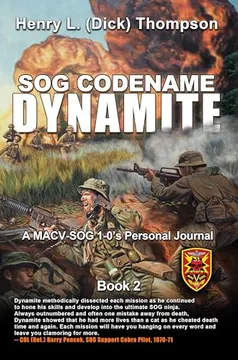


Key Takeaways
Build capabilities before you know where they will matter
A life takes shape early. Thompson’s journal follows his route from rural South Carolina to MACV-SOG, the highly classified US special operations group that sent small teams across borders during the Vietnam War. He traces that route through a military family, childhood exploration in the woods, a homemade army club, chemistry experiments, sports, and scuba diving. At the time, these interests did not form a career plan. In retrospect, he sees them as preparation for life as a soldier.
Practice became instinct. Tracking animals taught him to notice signs in the environment; chemistry fed a taste for experimentation; diving added another demanding skill. Thompson calls this sense of direction being “Born On the Path,” meaning a perceived fit between a person’s abilities and the life they pursue. The story is vivid, but its coherence comes partly from looking backward.
What's compelling is the way ordinary interests accumulate into useful capacities without anyone knowing their eventual purpose. This resembles skill transfer: repeated practice in one setting can strengthen attention, persistence, and comfort with uncertainty in another. The memoir also illustrates a common feature of life stories: hindsight turns scattered episodes into a line of destiny. That narrative can help people make sense of their choices, but it should not imply that one path was inevitable or that early signs reliably predict a future. Preparation matters, even when the destination remains unknown.
Demand clarity before accepting a mission framed as an honor
Secrecy shaped the choice. Before joining MACV-SOG, Thompson heard a friend’s blunt warning not to volunteer. He was then offered an assignment described as elite, secret, and open-ended. He was told he could be sent anywhere and asked to do anything, and signed an agreement for six months or six missions, whichever came first, plus a promise not to discuss the work for at least 20 years. He knew the risks were severe, but could not know the missions themselves.
The setting changed fast. SOG teams operated beyond South Vietnam, including in Laos and the Demilitarized Zone, with their presence officially deniable. Thompson arrived in a world where his family would not know his location or work. The book presents his decision as both an adventure and a step into isolation.
The recruitment scene shows how mission, identity, and prestige can make danger feel like a test of character. That framing can strengthen commitment, but it can also narrow deliberation: saying yes becomes proof of courage, while asking for detail risks seeming timid. The limits on what Thompson could know were part of the assignment, not a negotiable inconvenience. His account therefore raises a useful question about informed choice under secrecy. Respect for a volunteer’s agency does not remove an institution’s responsibility to describe foreseeable risks as plainly as security allows.
Train for degraded performance, not ideal conditions
Stress changes execution. Before Vietnam, Thompson practiced Quick Kill, a close-range shooting method that emphasized rapid pointing rather than carefully aligning sights. In his first SOG insertion, his team landed in an ambush. A teammate was hit, bullets struck the aircraft, and Thompson had to fire and reload while exposed. He later struggled to manipulate a magazine with blood-slick fingers, despite extensive training.
Repetition built options. Thompson concluded that practice had to resemble the conditions in which a skill would be used: darkness, noise, heavy equipment, fatigue, and sudden decisions. His load could approach 125 pounds, and a firefight brought sensory overload on top of that physical burden. Training could not remove uncertainty, but it could make some actions less dependent on calm, fine-motor control.
This account captures a central principle of human-factors design: performance depends on the match between practice and the environment, not merely on how well a skill looks in a controlled setting. Repetition can reduce the mental steps required for familiar actions, freeing attention for new threats. Yet realism has limits. Stress inoculation is not a guarantee of competence, and a highly rehearsed response can become dangerous if the situation differs from the scenario. The strongest training builds adaptable habits, not confidence that the body will behave exactly as planned.
Turn every after-action review into a changed procedure
Debriefing mattered. An After-Action Review, or AAR, was a structured account of what happened on a mission, what worked, and what needed to change. After Thompson’s first firefight, leaders pressed him for details about the enemy, terrain, and weapons. He resented questions that seemed remote from surviving the attack. Later, he understood how those details could help identify enemy strength and guide future decisions.
Lessons became practice. Thompson began recording environmental details and reviewing each mission with his team. Their findings fed into updated training and procedures. After a mission exposed a risk from CS gas, for example, his team added protective masks to its standard equipment. The point was not to produce a report for its own sake. A useful review changed what the team carried, rehearsed, or watched for next time.
The AAR is a practical learning loop: experience becomes useful only when it changes future behavior. This aligns with safety-critical fields such as aviation, where incident review is most valuable when it examines systems and conditions, not just individual mistakes. Thompson’s irritation also matters. A review can feel detached from the urgency of an event unless its purpose is clear and questions are asked with care. The best process preserves raw observations, connects them to decisions, and assigns follow-up. Otherwise, even a detailed report becomes a filing cabinet for lessons nobody uses.
Give authority to experience, then build trust across the team
Rank was not enough. A SOG team leader, called a 1-0, earned the role through experience and approval from a team leader, not simply through military rank. Thompson first joined RT Alabama as an assistant leader while a sergeant led the team. After four missions, he was recommended to lead his own team, RT Michigan.
Expertise crossed cultures. RT Michigan included Montagnard teammates who knew the jungle intimately, along with experienced Americans such as assistant leader Eldon Bargewell. Thompson observed the team before changing procedures, asked Bargewell and others for input, and trained with the group. Their combined knowledge mattered: no single leader could see, hear, navigate, and react to everything alone. The memoir describes trust as something built through demonstrated competence and attention to what each teammate knew.
The team is best understood as a distributed problem-solving system. In complex work, local expertise often sits with the people closest to the terrain, tools, or immediate task, while leaders coordinate rather than monopolize judgment. Thompson’s decision to assess the team before changing it supports that model. There is also a tension in the memoir’s language: affectionate descriptions of Indigenous teammates sometimes cast them as supporting figures, even as the narrative credits their skill and courage. Recognizing their expertise fully means seeing them as agents and partners, not merely as part of an American leader’s education.
Protect attention, sleep, and communication as combat equipment
Attention had limits. Helicopter noise temporarily dulled hearing; heat, rain, thirst, smoke, and fear competed for concentration. Thompson noticed that intense stress impaired fine motor skills and made it harder to think through several tasks at once. On one mission, he wrote call signs and directions on his hand and clothing rather than trust memory while information arrived quickly.
Communication reduced uncertainty. A headset gave him access to aircraft communications during a prisoner-snatch mission, helping him track support and coordinate with the team. He also treated sleep as operationally important. Teams sometimes stayed awake through the night, but he recognized that prolonged sleep loss could fog judgment, especially for leaders. His experiences show that attention depends on the body, the environment, and the quality of information available.
These episodes resemble cognitive ergonomics: people perform better when important information is visible, communication is reliable, and avoidable demands are reduced. Writing down details is not a lack of discipline; it is a way to keep working memory available for decisions. The headset likewise changed what Thompson could perceive and coordinate. But tools do not abolish overload. They can create new dependencies, and the memoir’s account does not establish that every technology or sleep strategy would work in every setting. The broader lesson is to design the task around human limits rather than pretend those limits disappear under pressure.
Plan contingencies because weather, enemies, and headquarters ignore scripts
The plan met reality. Thompson’s team was supporting a larger force when headquarters ordered a resupply despite the team’s warning that enemy forces were nearby. Supplies were dropped at the team’s last known location, revealing their presence. Enemy troops closed in, several teammates were wounded, and the group had to fight toward an extraction point before being lifted out on ropes through the jungle canopy.
Adaptation had a cost. Thompson repeatedly found that weather, terrain, and enemy action disrupted mission plans. A Prairie Fire Emergency was the team’s alert that it was in serious contact and needed urgent support. Calling one brought aircraft and other available assets toward the team, but did not guarantee a safe exit. In this instance, the team survived, but its flexibility could not undo the consequences of the resupply order.
This episode makes an important distinction between adaptability and preventable failure. The team’s ability to improvise helped it survive, but the need to improvise arose partly from a decision made outside the team despite its warning. Organizations often praise frontline resilience while overlooking the upstream choices that create emergencies. Contingency planning is valuable, but it should not become an excuse for weak coordination. A sound system gives people in the field a way to communicate risk, makes command decisions responsive to that information, and treats near-disasters as evidence about the whole chain of responsibility.
Treat the aftereffects as part of the mission, not an exception
Survival continued afterward. Thompson describes combat memories as persistent and difficult to escape. He recounts fear, deaths, injuries, and the sensory details that remained with him long after returning home. In the preface, he argues that SOG operators experienced post-traumatic stress and traumatic brain injury to varying degrees, even though such issues were rarely discussed at the time. He also describes the possibility that symptoms can resurface when something triggers a memory.
The costs were personal. His account does not stop at battlefield survival. It recognizes that a mission could alter a person’s life even if he came back alive, and that teammates and families carried consequences too. Thompson’s wider veteran-support material connects his experience to suicide prevention and stress resilience, making clear that remembrance and support are not separate from the story of combat.
The memoir’s willingness to describe lasting distress counters the familiar story in which returning alive means returning whole. That distinction matters for families, institutions, and veterans seeking help. At the same time, a firsthand account cannot establish that every operator experienced the same diagnosis or symptoms; clinical outcomes vary, and broad claims require careful evidence. The strongest reading holds both points: repeated exposure to lethal danger can leave serious psychological and neurological consequences, while individuals need not fit one template to deserve support. Acknowledging harm is not a retreat from courage. It is part of an honest account of its price.
Preserve the fallen as people, not battlefield statistics
A duffel held a life. Soon after arriving at FOB-1, Thompson was assigned to inspect personal effects from seven SOG members who had been killed or were missing. He saw family photographs, letters, children’s drawings, and plans for the future. One image of a teammate’s young son stayed with him. More than five decades later, that son contacted SOG veterans seeking information about his father, and Thompson formed a lasting connection with him.
Memory requires care. Thompson dedicates the book to fallen friends and teammates and says he speaks their names as part of his daily exercise. He also explains that he changed some names or supplied names when he could not identify individuals. That choice helps preserve stories, but it also signals that readers should distinguish personal testimony and memorial reconstruction from a complete archival record.
The inventory scene changes the scale of war. A missing soldier is not only a line in a report; he is also a parent, partner, friend, and person whose absence reaches people who were never near the battlefield. The later contact with the son shows how testimony can restore a relationship across a gap created by secrecy and loss. Memory is not the same as verification, however. The author’s transparency about altered or supplied names is essential, and readers can honor remembrance while remaining attentive to what a personal journal can and cannot establish.
Analysis
This is a combat memoir organized around a progression: a young man’s preparation, his entry into a secret unit, his first missions, and the changing lessons he draws from survival. Its strongest narrative device is the contrast between planning and exposure. Years of military preparation meet a first insertion in which the team is ambushed within seconds. The scene makes an abstract point about stress concrete: skill matters, but skill must survive noise, fear, injury, confusion, and limited information.
The recurring after-action reviews give the book more structure than a sequence of firefights. Each mission becomes a test of equipment, team communication, leadership, and assumptions. This makes the account useful beyond military history. It shows how groups learn when reflection changes practice, and how failures in coordination can impose risks on people who have little control over the decision. The memoir’s emphasis on trust is also more complex than a leader’s command. Thompson depends on veteran teammates, Indigenous fighters, interpreters, pilots, and controllers, each with knowledge he does not possess alone.
Its authority is experiential rather than comprehensive. Thompson explicitly centers what he saw and felt, and notes that some names were changed or supplied. That candor supports the book’s value as testimony, while also marking its limits as a stand-alone history of MACV-SOG or the war. The narrative largely follows American operators and their immediate adversaries; political context, civilian experience, and the wider consequences of covert operations receive less attention by design.
The book also resists a clean heroic ending. Its detail conveys courage and tactical competence, but its most consequential insight may be that survival does not end exposure to war. Memory, grief, and distress persist. Read carefully, the journal can honor those who served without treating secrecy, violence, or physical survival as proof that the costs were justified or easily contained.
Glossary
MACV-SOG
Secret special operations groupMilitary Assistance Command Vietnam-Studies and Observations Group was a highly classified, multi-service US special operations organization active during the Vietnam War. It conducted unconventional operations in Southeast Asia, including missions beyond South Vietnam. Thompson’s account focuses on small reconnaissance teams, their Indigenous members, and the air and ground support involved in their missions.
Born On the Path
A sense of life directionThompson’s phrase for the feeling that a person’s abilities and interests point toward a particular course in life. He applies it to his own childhood fascination with military life, the outdoors, science, and physical challenges. In his account, the path becomes visible through hindsight, as earlier experiences seem to prepare him for later service.
One-Zero (1-0)
Recon team leaderThe American leader of a MACV-SOG reconnaissance team. The position depended on demonstrated experience and approval, not simply rank. A new officer might first serve as an assistant or another team member, learning the team’s procedures before being cleared to lead. Thompson began as an assistant leader and was later recommended for the role.
RT (Reconnaissance Team)
Small cross-border patrol teamA MACV-SOG reconnaissance team, generally composed of a few American personnel and Indigenous fighters. RTs observed enemy activity, gathered intelligence, and carried out missions such as raids, searches, and prisoner captures. They operated in small numbers in hostile areas, relying on concealment, communication, local knowledge, and aircraft support.
After Action Review (AAR)
Structured mission debriefA review conducted after a mission to record what happened, identify what went well or poorly, and develop lessons for future operations. In Thompson’s account, the process included detailed questioning about the enemy, terrain, and events. Its value came when findings led to changes in training, equipment, or team procedures rather than remaining only in a report.
Prairie Fire Emergency
Urgent support requestA code used when a reconnaissance team was in serious contact with enemy forces and could not continue its mission safely. The alert made the team a priority for available military support, including aircraft with weapons. It could bring help quickly, but did not ensure that the team could break contact or be extracted without further danger.
Covey
Air support controllerThe call sign associated with an Air Force forward air controller working with a SOG team. The controller coordinated aircraft support, while an experienced SOG operator aboard provided ground perspective and communicated with the team. Thompson describes this link as essential for relaying information, requesting support, and coordinating extraction.
RON (Remain Overnight)
Overnight team positionA location where a reconnaissance team planned to spend the night during a mission. Choosing and occupying the position involved concealment, security, and preparation for possible enemy contact. Thompson’s teams established defensive measures, assigned watches, and tried to remain still and quiet until morning or until circumstances required them to move.
Invisibility
Avoiding detection by the sensesThompson’s term for reducing the signs that could reveal a team’s presence. It went beyond visual camouflage to include noise, smell, movement, and other detectable cues. His teams practiced quiet equipment handling, controlled movement, and attention to how the surrounding environment changed. The concept expresses his view that concealment was an active, multi-sensory discipline.
Project Eldest Son
Covert ammunition deceptionA MACV-SOG psychological operation involving altered enemy ammunition intended to explode when used. Teams placed the ammunition in enemy supply locations or along routes. Thompson describes one mission to contaminate an ammunition cache. The project was secret and designed to create fear and uncertainty among enemy forces, not simply to destroy a target in the moment.
Visual Reconnaissance (VR)
Aerial observation of mission terrainA brief flight over a proposed area of operations to observe and photograph terrain, possible landing zones, routes, and enemy activity. The flight was intended to resemble ordinary aircraft movement rather than draw attention to the target area. Thompson recounts that his visual reconnaissance attempts were sometimes cut short by rough weather or enemy fire.
Download PDF
Download EPUB
.epub digital book format is ideal for reading ebooks on phones, tablets, and e-readers.








