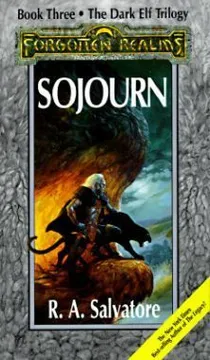


Plot Summary
Prologue
At sunrise, Drizzt Do’Urden sits through the pain of a world that is burning away his drow-made cloak and boots. He has left the Underdark because he could not live by the Spider Queen Lloth’s cruel laws, though the surface offers neither shelter nor welcome.
On another mountainside, Ulgulu, a barghest whelp sent from the plane of Gehenna, watches the same dawn for a different reason: each mortal life he consumes brings him closer to maturity and home. One exile hopes to learn how to live among others. The other grows by devouring them.
The opening makes exile a shared condition but refuses to make the two exiles morally equivalent. Drizzt has chosen hardship because remaining among his kin would mean surrendering his principles; Ulgulu has been displaced by circumstance and treats the living as fuel. The sun’s pain gives Drizzt’s ethical decision a physical cost, while Ulgulu’s growth turns violence into an efficient appetite. Their parallel dawns establish the novel’s central tension: being an outsider explains neither virtue nor evil. What matters is what each character does with the freedom, danger, and vulnerability that exile creates.
A Sun That Scorches
Having fled Menzoberranzan rather than obey Lloth’s brutal order, Drizzt tries to make a life in the mountains, though sunlight sears his eyes and strips magic from his equipment.
He is still learning the surface’s ordinary dangers when a skunk sprays him inside his cave, forcing him and Guenhwyvar, his summoned panther companion, to seek a new shelter. At a stream, five armed gnolls find Drizzt bathing and invite him to join their journey. He follows cautiously, hoping to understand them, until their leader reveals a plan to raid a nearby farmhouse, kill its men, abduct its women, and seize the children.
Drizzt recognizes that the attack would repeat the cruelty he once witnessed among drow. He draws his scimitars and kills the raiders, then sends Guenhwyvar after the fleeing survivor.
Drizzt’s first consequential act on the surface is not a bid for acceptance but a judgment made under uncertainty. He knows the gnolls only through his drow schooling, which taught him to distrust nearly every other people, yet he must decide whether their stated plan is enough to justify violence. His intervention protects children, but the dead bodies immediately trouble him because conscience does not grant him perfect knowledge. The skunk’s comic lesson and the gnolls’ lethal threat also establish the surface as a place where adaptation requires more than endurance. Drizzt must learn to read living intentions, not simply carry his inherited categories into a new world.
The Blueberry Patch
After the fight, Drizzt worries that he may have judged the gnolls too quickly, so he studies the farmhouse before deciding whether its people are worth defending. For three days he watches the Thistledown family divide its work and play, and sees the children quarrel without lasting malice.
When youngest son Liam slips into the mountains, Drizzt follows to keep him safe. Liam fakes distress at a gorge, then escapes when Drizzt approaches with his weapons sheathed.
The next day Liam’s siblings and eldest brother Connor help stage another trap, using Eleni as bait in a blueberry patch. Drizzt steps from hiding to reassure her, but Connor attacks. Drizzt disarms him without injury and offers a peaceful gesture. The terrified family runs home, leaving Drizzt alone once more.
Watching the Thistledowns gives Drizzt evidence that his moral instincts may be sound, but it does not give him a language or a shared history with them. He reads the family’s teasing as affection because he can recognize patterns of care, yet the humans read his dark skin and unusual gestures through inherited fear. The gulf is especially sharp when Drizzt deliberately returns Connor’s sword: an act meant to demonstrate restraint becomes, to the boy, proof of frightening superiority. Liam’s prank is not malicious, but it exposes how easily an attempt at protection can look like stalking. The scene makes acceptance depend not only on character, but on whether strangers can interpret one another accurately.
The Drow in the Barn
Tephanis, a sprite whose speed makes him nearly impossible to follow, sees Drizzt’s encounter with the children and reports the stranger to Ulgulu. Soon after, Tephanis steals one of Drizzt’s scimitars and cuts his wrist. Roddy McGristle, a scarred bounty hunter, arrives with snarling dogs and attacks the wounded drow.
Drizzt kills one dog while defending himself, brings down a tree on Roddy, then escapes rather than finish the fight. That night Ulgulu uses magic to take a drow’s appearance and enters the Thistledown farm carrying Drizzt’s stolen weapon.
He kills the family, including the children, then leaves the broken scimitar behind. The next evening, Drizzt finds the bodies. The village now has apparent evidence against him, and the children’s frightened nickname for him becomes a source of crushing guilt.
The massacre turns a misunderstanding into a forged identity. Ulgulu understands that the villagers already fear drow, so he uses Drizzt’s appearance and weapon to make prejudice do the work of evidence. Tephanis’s theft supplies the physical link, while Roddy’s attack helps make Drizzt’s presence around the farm seem threatening. Drizzt’s guilt is psychologically credible even though he did not commit the murders: he had entered the family’s orbit, failed to reach them, and believes his appearance may have made them targets. The word the children used for him collapses these distinctions into a single accusation. The novel shows how an imposed story can feel more powerful than fact, especially to someone already inclined to blame himself.
The Lair Beyond the Cliff
Unable to accept the deaths, Drizzt takes a heavy plowshare and follows the killer’s tracks with Guenhwyvar. Tephanis attacks again on a narrow cliff trail, but Drizzt uses the metal implement to knock the quickling unconscious.
He learns that Ulgulu, not the drow, killed the farmers, then kills Tephanis when the sprite wounds him and tries to escape. Drizzt enters Ulgulu’s cave and cuts down two goblin guards. Inside, Ulgulu and his brother Kempfana use a magical double to misdirect him.
Guenhwyvar helps Drizzt wound Ulgulu, while Drizzt’s darkness spell lets him attack Kempfana and finally kill him with a scimitar. Ulgulu changes into a huge wolf, but Drizzt and Guenhwyvar drive him over a cliff. Badly injured, Drizzt escapes a returning hill giant and kills it with a trap.
Drizzt’s revenge is also an attempt to recover the truth, but the cave offers no court, witness, or public correction of the story taking shape in Maldobar. He has to act as investigator and executioner at once. The fight forces him to use the lethal training he associates with the world he left, while the farmers’ deaths give that violence a purpose he can accept. Yet the victory does not erase his self-accusation or restore the family. His physical survival is purchased through choices that feel uncomfortably familiar: he kills because the threat is real, then carries the moral residue beyond the battle. Justice stops Ulgulu’s immediate violence, but it cannot make Drizzt feel innocent.
The Hunt Misreads Its Quarry
Dove Falconhand, a ranger summoned from Sundabar, examines the Thistledown farm with her companions. The tracks, the damaged barn, and the broken scimitar do not fit one killer, but Roddy insists that Drizzt murdered the family and accepts a bounty to pursue him.
Dove’s party follows the drow into the mountains. When they camp, Roddy’s cry sends an arrow into Guenhwyvar, and Drizzt flees rather than attack the pursuers. He later finds them trapped by stone giants. Though their elf scout, Kellindil, has already treated Drizzt as an enemy, Drizzt triggers a rockslide against the giants and helps the group escape.
The party defeats the remaining attackers. Dove recognizes that Drizzt was no enemy, and Kellindil leaves him a healing potion and the stolen dagger. Drizzt, still convinced danger follows him, leaves before he can accept their help.
Dove’s investigation and Roddy’s pursuit represent competing ways of handling uncertainty. Dove lets physical evidence complicate her first assumptions; Roddy turns injury and humiliation into certainty about Drizzt’s guilt. Drizzt, meanwhile, interprets even the party’s mistakes as confirmation that contact leads to danger. His rescue of the people pursuing him is a moral choice, but it does not immediately earn trust, nor does their eventual recognition reach him in time to change his flight. The healing potion and returned dagger are small, practical gestures rather than a grand reconciliation. Their importance lies in offering evidence that judgment can change, even when Drizzt’s shame makes him unable to stay and witness it.
A Cave Against Winter
Drizzt retreats to Dead Orc Pass, where he learns to fish the Rauvin River and discovers that winter can kill as surely as any enemy. A severe freeze nearly leaves him helpless until Guenhwyvar finds firewood and Drizzt manages to spark a fire.
He shares a cave with a hibernating bear, Bluster, after calming it with food instead of steel. When spring finally comes, Drizzt crosses the river into territory ruled by the orc chieftain Graul. Orcs ambush him with worgs and a stone giant. His old scimitars fail against the giant, and an unseen archer’s arrows turn the battle.
The archer is Montolio DeBrouchee, an elderly ranger who is blind but guided by his owl Hooter. Montolio offers Drizzt shelter from the orcs. Drizzt resists, fearing that his presence will bring another tragedy, until Guenhwyvar’s trust helps change his mind.
The pass makes survival a lesson in dependence rather than solitary mastery. Drizzt can fight, but he cannot command the seasons, and the firewood that saves him arrives through Guenhwyvar’s help. His encounter with Bluster extends the same lesson: he approaches a dangerous animal by responding to its needs instead of asserting control. Montolio’s arrival gives that instinct a human counterpart. The blind ranger is not helpless, and his competence unsettles Drizzt’s assumptions about disability just as Drizzt’s decency unsettles Montolio’s assumptions about drow. Their meeting begins as mutual risk, not instant trust. The sanctuary becomes possible because both men revise what they think they know about the other.
Lessons Under the Pines
Montolio brings Drizzt to his hidden woodland home, a network of dugouts, rope bridges, and defenses among the evergreens. He teaches Drizzt the common tongue, how to read weather and animal behavior, and how to understand the surface world without relying on drow teachings.
Their first sparring match ends with Montolio pinning Drizzt, who had mistaken blindness for weakness. As their friendship deepens, Drizzt tells the ranger about Menzoberranzan, his father Zaknafein, and the friends and enemies he left behind.
Montolio explains his own life as a ranger and argues that a person’s inner principles matter more than a god’s name. Drizzt resists the idea that he follows Mielikki, but he begins to see the natural empathy and restraint in himself that Montolio recognizes.
Montolio teaches Drizzt skills, but the deeper curriculum is reciprocal correction. Drizzt must learn to notice the animal world; Montolio must treat the drow as an individual rather than a representative of a hated people. Their sparring match condenses the problem: Drizzt’s respect for Montolio coexists with an unexamined assumption that the old man is impaired. Losing exposes the gap between admiration and genuine recognition. Their conversations about gods similarly shift authority inward. Montolio does not demand obedience to a new doctrine; he offers a name for the ethical life Drizzt already practices. The friendship gives Drizzt a witness who can challenge his self-condemnation without dismissing the painful history behind it.
The Past Comes Calling
Roddy reaches Montolio’s grove and repeats his claim that Drizzt killed the Thistledowns. Montolio pretends the drow has left the region, but Roddy’s account forces Drizzt to explain what happened. He recounts the gnoll raid, his failed effort to befriend the family, and the discovery of their bodies.
Montolio believes him and teaches him why his attack on the gnolls was justified. A letter from Dove later confirms that her investigation identified the barghests as the killers.
Meanwhile, Tephanis finds Roddy and directs him to Graul, who already wants revenge on Montolio and Drizzt. Roddy’s false story gives Graul and his superstitious shaman a pretext to gather an attack force. Montolio recognizes the threat and begins preparing the grove’s defenses.
This section turns private guilt into a question that can be examined with other people. Drizzt does not gain relief by insisting that he is good; he gives Montolio the sequence of choices and consequences that he has been replaying alone. Dove’s letter then supplies external evidence, separating responsibility from mere proximity. The correction matters because Drizzt’s conscience, normally a guide, has become a punishing authority that treats every disaster as his fault. At the same time, Roddy demonstrates how grievance can be weaponized: he does not need to prove his accusation if Graul can use it to mobilize enemies. Truth and power move on separate tracks, so the coming conflict cannot be settled by vindication alone.
The Grove Turns Weapon
Montolio bends trees into spring traps, hides iron jaws in the meadow, rigs crossbows along a rope bridge, and prepares a brandy-filled trough to ignite the eastern approach. Drizzt places a concealed ranseur where he can lure the stone giant.
Graul’s orcs attack from the west as worg-riders circle behind them, while Caroak, a winter wolf, leads another pack against Guenhwyvar. Montolio’s animal allies, including Bluster and other bears, scatter the northern attackers. Drizzt lights the brandy trap, then baits the giant into charging onto his hidden weapon.
Montolio fights from a globe of darkness that lets his senses, not sight, guide him. Their defenses break the assault, and Graul’s survivors flee. Roddy escapes the battlefield with Tephanis’s help, while Kellindil pursues and captures him.
The defense of the grove converts Montolio’s long attention to the landscape into a collective form of agency. Trees, traps, birds, and hidden sightlines matter because the defenders have studied how each can alter an enemy’s movement. Drizzt’s contribution is not merely superior swordsmanship; he draws the giant toward a prepared weapon and protects the flank. Montolio’s blindness becomes a source of tactical knowledge rather than a symbol of loss. Yet victory is not clean or final. Caroak and the orcs are driven away, but Roddy survives and Tephanis remains mobile. The scene values preparation and cooperation without pretending that a successful defense eliminates the human capacity for renewed hostility.
The Promise After Mooshie
After the battle, Tephanis frees Roddy and kills Kellindil, then disappears with the bounty hunter. Drizzt stays with Montolio, continuing to learn the ranger’s craft and finding that he can understand animal moods through careful observation.
As Montolio grows older, he asks Drizzt to promise that he will seek a life beyond the grove after the ranger is gone. The first snow arrives, and Drizzt returns to find Montolio dead in his shelter, peaceful in his final moments. Drizzt buries him beside the grove and remains through the winter.
In spring, he recognizes that the place belongs to his friend rather than to him. Keeping his promise, Drizzt packs a few books, his weapons, and his bow, then leaves with Guenhwyvar to continue searching for a place in the wider world.
Montolio’s death makes belonging more complicated than being welcomed into a safe place. Drizzt has found a rare relationship in which he is understood, but the grove cannot become a permanent substitute for the world he has been avoiding. The promise asks him to carry their friendship outward rather than preserve it by refusing further risk. His departure is therefore not a rejection of sanctuary; it is an act of loyalty to the mentor who taught him that safety without growth can become another form of retreat. The loss remains real, but the lessons survive as habits of attention, restraint, and courage. Drizzt leaves with grief and direction at once.
A Dragon's Vanity
For years, Drizzt travels with the Weeping Friars, a wandering order that claims to absorb the world’s suffering. Their leader, Mateus, is more practical than devout, and Drizzt eventually decides the group cannot be his home.
Before reaching Mirabar, however, Tephanis tricks them into a sealed mining tunnel leading toward Hephaestus, a venerable red dragon. Drizzt studies a dragon-lore book, then enters the lair and pretends to be a black dragon transformed into a drow.
By flattering Hephaestus’s pride and provoking a display of his fire, Drizzt creates the chance for the friars to escape. He survives the dragon’s retaliation and reunites with them outside. Roddy later learns Tephanis caused the trap and beats the sprite to death, then forces the friars to reveal Drizzt’s route west.
The dragon episode gives Drizzt a different kind of test from the battles that have defined his earlier survival. He cannot overpower Hephaestus, so he studies the dragon’s vanity and constructs a story the creature wants to believe. Deception here serves protection rather than domination: Drizzt risks himself to buy time for companions he does not consider true friends. That distinction complicates his moral code without dissolving it. The friars’ willingness to take treasure from the lair also contrasts their professed devotion to suffering with ordinary self-interest. Tephanis’s betrayal of the group and Roddy’s retaliation show how the pursuit continues through opportunism, even as Drizzt tries to choose a different road.
Kelvin's Cairn Opens
Drizzt follows the Spine of the World to Icewind Dale, where Spokesman Cassius refuses him entry to Bryn Shander but assigns him a dwelling on Kelvin’s Cairn. There he first startles Catti-brie, the human girl adopted by dwarf king Bruenor Battlehammer, when Guenhwyvar appears near her.
During a later thaw, Catti-brie returns alone and talks with Drizzt about Menzoberranzan and her life among the dwarves. Their friendship gives Drizzt a rare chance to be seen as himself, though Bruenor forbids her to visit.
She keeps meeting Drizzt from the valley when the weather permits. When Bruenor battles a remorhaz, Drizzt approaches with drawn scimitars, but the dwarf mistakes him for an attacker. Drizzt refuses to fight and walks away, preserving his principles while leaving Bruenor uncertain about what he intended.
Ten-Towns offers Drizzt neither full acceptance nor simple rejection. Cassius grants him a foothold only by assigning a useful role on the mountain, making conditional belonging explicit. Catti-brie’s openness creates a more intimate counterexample: she listens, asks questions, and responds to Drizzt’s conduct rather than his ancestry. Bruenor’s suspicion is not erased by her friendship, and his ban forces Catti-brie to negotiate between affection for her father and trust in her own judgment. The remorhaz encounter sharpens the conflict because Drizzt’s restraint can be mistaken for either weakness or threat. He chooses not to turn misunderstanding into combat, even though that choice costs him an opportunity to explain himself.
A Name for Home
Years after their first clash, Roddy arrives in Ten-Towns and tells Bruenor that Drizzt murdered the Thistledowns. Catti-brie warns Drizzt that the bounty hunter is hunting him, then faces Roddy herself when he grabs her and threatens her.
Drizzt intervenes and fights Roddy, trying first to disarm and exhaust him without killing him. When Roddy wounds Guenhwyvar, Drizzt’s restraint breaks into a furious assault, but he stops before delivering a fatal blow. Bruenor then confronts Roddy and sends him out of the valley.
Later, Drizzt prepares to leave, believing the renewed pursuit has proved he can never belong. Bruenor finds him on a rocky rise he has named Bruenor’s Climb, admits that names do not confer ownership, and makes room for Drizzt beside his people. The drow finally has a place to stay.
The resolution depends on three different forms of moral recognition. Catti-brie risks her safety because she trusts what she has observed; Drizzt refuses to let Roddy’s provocation decide whether a human life is expendable; Bruenor revises a worldview built from inherited warnings. None of these acts makes the past disappear. Instead, they interrupt the old pattern in which Drizzt’s appearance triggers fear, pursuit, and flight. Bruenor’s insight about naming a pile of rocks is especially apt: belonging cannot be secured by a label alone, but it can be offered through changed behavior. The ending grants Drizzt a home not as proof that prejudice has vanished, but because someone chooses to reconsider it.
Epilogue
Looking back, Drizzt considers how difficult it is to judge humans, whose conduct ranges from cruelty to extraordinary honor. He argues that a hero is not simply the person with the strongest arm, but the one who keeps faith with a moral code under pressure.
Zaknafein, Belwar, Clacker, Montolio, Bruenor, and especially Catti-brie embody different forms of that courage. Drizzt’s own skill with scimitars brings praise, but he remains uneasy about the violence that has shaped his life. He has found a home and a place among friends, yet he is young, the world remains dangerous, and his story is not finished.
The epilogue resists treating home as a cure or combat as the measure of a person. Drizzt can accept the security of belonging while continuing to question the violence that made his survival possible. His standard for heroism shifts from technical prowess to principled action, a distinction the novel has tested through his restraint with the Thistledowns, the gnolls, and Roddy. Catti-brie becomes his clearest measure of unspoiled decency, while the range of human behavior keeps his hope provisional rather than naïve. The final insistence that the story continues preserves the tension between hard-won peace and a world that will keep demanding judgment.
Analysis
Sojourn is a story about moral perception under conditions designed to distort it. Drizzt enters the surface carrying an ethical code formed in opposition to drow society, but he has little reliable knowledge of the people he meets. His first decision to kill the gnolls is defensible, yet it leaves him uneasy because he cannot know the whole history behind their hostility. The Thistledown massacre then exploits the exact weakness in his position: villagers already fear drow, and Ulgulu supplies a weapon and a disguise that make suspicion look like proof. The novel treats prejudice not simply as private hatred, but as a system that can be manipulated by anyone who understands what a community expects to see.
Drizzt’s response to this world is complicated by guilt. His conscience distinguishes him from the violence he rejects, but it also makes him claim responsibility for events beyond his control. Montolio’s role is not to absolve him cheaply. The ranger listens, tests his assumptions, and gives him evidence that can correct self-accusation. Their friendship models ethical knowledge as a shared practice: one person observes, another challenges, and both must revise their judgments. Montolio’s blindness sharpens this idea. What appears to be disability from the outside does not define the full range of his capacities, just as Drizzt’s appearance cannot establish his character.
The changing forms of refuge give the novel its emotional structure. Drizzt survives alone, finds temporary shelter with Montolio, then leaves because friendship cannot make the world disappear. The Weeping Friars offer company without the intimacy he wants. Ten-Towns finally offers a conditional place, and Catti-brie and Bruenor make acceptance depend on conduct rather than ancestry. The ending does not promise universal tolerance. Roddy remains proof that resentment can survive contrary evidence. Instead, the novel offers a smaller and more credible hope: people can interrupt inherited beliefs when they attend closely to the person before them. Drizzt’s home becomes possible because others revise their judgment, and because he continues to act according to principles even when recognition is uncertain.
Review Summary
Sojourn concludes the Dark Elf Trilogy with Drizzt Do'Urden emerging from the Underdark to navigate a surface world filled with prejudice and danger. Readers generally praised the emotional depth of Drizzt's journey and his heartwarming friendship with blind ranger Montolio, along with the introduction of beloved characters like Bruenor and Catti-brie. Common criticisms included pacing issues, with some finding the middle sections slow and the villains less compelling than those in previous installments. Overall, most considered it an enjoyable, fitting conclusion, averaging 4.22 stars.
People Also Read
Characters
Drizzt Do’Urden
Exiled drow rangerA dark elf who rejects the cruelty of his homeland, Drizzt enters the surface world with formidable weapons, little practical knowledge, and a conscience he cannot silence. He is vigilant and disciplined, but his habit of accepting blame makes him vulnerable to guilt even when he has acted to protect others. His longing for companionship competes with his fear that his presence will bring danger to anyone who welcomes him. As he learns the language and customs of the surface, he also learns that judging others requires attention rather than inherited assumptions. His defining struggle is not whether he can fight, but how to preserve compassion in a life that repeatedly demands violence.
Montolio DeBrouchee
Blind wilderness mentorAn elderly ranger who lives among the evergreens with animal allies, Montolio has lost his sight but not his independence, precision, or appetite for adventure. He uses heightened attention and practiced knowledge to read the world around him, and expects others to meet him as a capable person rather than a limitation. His humor makes his authority easier to approach, while his patience allows Drizzt to disclose painful parts of his past in his own time. Montolio teaches practical survival, but also models a form of faith grounded in conduct rather than coercion. He values honesty, self-knowledge, and the decision to keep moving despite adversity.
Catti-brie
Courageous human bridgeThe adopted human daughter of Bruenor Battlehammer, Catti-brie is curious, spirited, and accustomed to speaking up even when a dwarf king would prefer obedience. She loves the people who raised her, yet she is willing to test their assumptions when her own observations point elsewhere. Her interest in Drizzt begins with curiosity and grows through conversation, not through a romanticized belief that danger does not exist. She sees the mismatch between his feared reputation and his actual conduct, and she acts on that judgment even when it puts her at odds with her father. Her courage is social as well as physical: she risks disapproval to defend someone she believes is being misjudged.
Bruenor Battlehammer
Gruff dwarf kingBruenor leads Clan Battlehammer with blunt speech, a fighter’s confidence, and fierce devotion to the daughter he adopted. His gruffness conceals a deep sense of responsibility, but his protective instincts can harden into assumptions about people he has never met. He trusts family and custom because they have sustained his clan, and he is slow to accept evidence that challenges inherited beliefs. Catti-brie’s independence tests the difference between guarding her and respecting her judgment. Bruenor’s pride is genuine, but so is his capacity to reconsider when experience exposes the limits of what he thought he knew.
Guenhwyvar
Astral panther companionGuenhwyvar is Drizzt’s magical panther companion, summoned from the Astral Plane through an onyx figurine. Powerful, alert, and fiercely loyal, the cat is more than a weapon: its calm presence steadies Drizzt when guilt and loneliness threaten to overwhelm him. Guenhwyvar sometimes acts with judgment of its own, especially when it senses that Drizzt needs companionship more than another display of force. The panther’s ease with people and animals offers Drizzt a model of connection that does not depend on shared language. Its loyalty is constant, though its presence in the surface world must be balanced with time to rest.
Roddy McGristle
Scarred bounty hunterA battle-seasoned hunter with a scarred face, a beloved dog, and a volatile sense of pride, Roddy turns a brief fight with Drizzt into a personal pursuit. He treats injury and humiliation as debts that must be repaid, and his certainty often outruns the evidence. Although he presents himself as a protector of the Thistledowns’ memory, his fixation on Drizzt is also driven by wounded pride and the prospect of a bounty. Roddy is perceptive enough to follow a trail and exploit alliances, but his resentment narrows what he is willing to learn.
Tephanis
Restless quickling schemerTephanis is a quickling sprite whose extraordinary speed makes him an effective scout, thief, and saboteur. He attaches himself to powerful companions because he dislikes solitude and values protection, but loyalty rarely outweighs self-preservation. His rapid speech and restless movement conceal a sharp instinct for identifying what each person wants. Tephanis repeatedly tries to turn Drizzt and Roddy against one another, shifting alliances whenever circumstances change. He is small beside the monsters and warriors he serves, yet his choices can redirect events by supplying information or creating a trap.
Ulgulu
Predatory barghestA barghest whelp from Gehenna, Ulgulu grows stronger by consuming mortal life. He is enormous, magically capable, and accustomed to ruling through fear, with little patience for servants who bring bad news. His intelligence makes him more dangerous than a simple brute: he understands how to exploit the villagers’ fear of drow and can use disguise to redirect suspicion. Ulgulu sees the people around him as resources for his own advancement, a stark contrast to Drizzt’s tendency to accept risk on behalf of strangers.
Kempfana
Ambitious barghest brotherKempfana is Ulgulu’s smaller brother and a fellow barghest whelp, waiting for the chance to rule without his sibling’s dominance. He is calculating and attentive to shifts in power, preferring advantage and deception to a direct contest when possible. His ambition resembles Ulgulu’s hunger for advancement, but Kempfana’s patience makes him a quieter threat. The brothers’ alliance is shaped by competition as much as kinship.
Dove Falconhand
Evidence-minded rangerA capable ranger from Sundabar, Dove leads a small adventuring party to investigate the reports from Maldobar. She is decisive in the field but does not confuse confidence with certainty, and she notices where Roddy’s conclusions fail to match the physical evidence. Her responsibility to protect communities makes her cautious about the drow, yet she remains open to revising her judgment. Dove represents disciplined inquiry in a region where fear could easily dictate the story.
Kellindil
Suspicious elven archerKellindil is a skilled surface elf and archer who initially views Drizzt through the history of drow violence against elves. His anger is personal and inherited, but he is also capable of noticing behavior that complicates his first judgment. As a member of Dove’s party, he contributes sharp eyes and an archer’s discipline. His relationship with Drizzt tests whether a shared elven heritage can overcome old hostility.
Graul
Cautious orc chieftainGraul rules the orcs near Dead Orc Pass by avoiding unnecessary risks and protecting his position. He is less impulsive than many of his followers, but his caution serves domination rather than peace. Drizzt’s presence threatens his control, while Montolio’s animal scouts interfere with raids on passing caravans. Graul watches for a useful pretext before acting, showing that calculation can serve violent ends as readily as open aggression.
Cassius
Pragmatic town spokesmanCassius speaks for Bryn Shander and the Ten-Towns council. He sympathizes with Drizzt’s need for shelter but refuses to admit a feared stranger into the crowded city without regard for public reaction. His compromise gives Drizzt a place on Kelvin’s Cairn and turns the drow’s ranger skills into a service for the region. Cassius is practical rather than generous, but he recognizes that a conditional arrangement may be fairer than a simple rejection.
Brother Mateus
Practical friar leaderMateus leads the Weeping Friars and is more attentive to food, safety, and logistics than the order’s grand claims about suffering might suggest. He values Drizzt’s protection and treats him with a courtesy the drow rarely receives, even though their companionship is not enough to satisfy Drizzt’s deeper need for a home. Mateus’s pragmatism makes him a useful counterweight to the group’s more theatrical members.
Bluster
Territorial cave bearBluster is a large bear whose winter den becomes Drizzt’s temporary shelter. He is formidable and easily provoked, but Drizzt avoids a fight by respecting his space and sharing food. Their uneasy coexistence gives Drizzt a practical lesson in reading an animal’s needs rather than treating every unknown creature as an enemy.
Plot Devices
Onyx panther figurine
Summons a trusted allyThe onyx figurine allows Drizzt to summon Guenhwyvar from the Astral Plane for a limited time. It gives Drizzt a companion in dangerous encounters, a source of comfort during isolation, and a tactical partner whose strength can change the balance of a fight. Guenhwyvar’s need to rest also limits how often Drizzt can rely on the panther, preserving real vulnerability. The figurine is both a practical tool and a tangible link to a relationship that survives Drizzt’s exile.
Fading drow enchantments
Makes adaptation physicalThe surface sun gradually weakens Drizzt’s drow-made cloak, boots, armor, and weapons, while his ability to levitate also falters. The losses make his departure from the Underdark materially costly, not merely symbolic: equipment that once protected him can fail at the moment he needs it. His failing scimitars affect the fight against the stone giant, forcing him to depend on new weapons and tactics. The device keeps the conflict between his past and present visible in the tools he carries.
The stolen scimitar
Turns prejudice into evidenceTephanis steals one of Drizzt’s weapons, and Ulgulu uses it while disguised as a drow to murder the Thistledown family. The broken scimitar left at the farm persuades villagers that Drizzt is responsible, even though it cannot establish who wielded it. Later, investigators compare the weapon’s wounds with the bodies in the barghest lair and begin to uncover the truth. The weapon therefore links an actual crime to a false accusation, showing how an object can look conclusive while concealing the identity of its user.
Montolio's grove defenses
Makes terrain a weaponMontolio has spent years learning the shape of his woodland home and preparing it against a future attack. Bent trees, hidden jaw traps, crossbows, a concealed ranseur, animal allies, and an ignited brandy trough each influence how Graul’s force can advance. Drizzt adds his own knowledge of weapons and battle, while Montolio’s hearing and animal messengers help coordinate the defense. The preparations make the grove’s geography part of the conflict and reward observation, planning, and cooperation rather than strength alone.
Drizzt's burden of guilt
Tests moral judgmentDrizzt’s conscience follows him from the Underdark to the surface, where it troubles him after he kills the gnolls and overwhelms him when he finds the Thistledowns dead. His guilt is not always proportionate to his responsibility, so it can confuse moral reflection with self-punishment. Montolio and Dove provide different forms of correction: a trusted friend helps Drizzt examine his past, while physical evidence confirms that his actions did not cause the massacre. The recurring burden shapes his choices without making him morally infallible.

Download PDF
Download EPUB
.epub digital book format is ideal for reading ebooks on phones, tablets, and e-readers.








