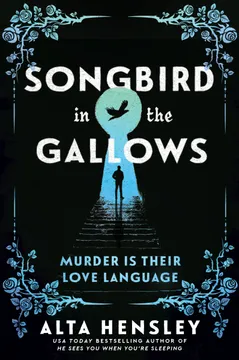


Plot Summary
The Singer Meets Blue
At the White Note, Saylor Mitchell1 sings jazz beneath a name she chose after fleeing Seattle. Her father’s compass rests at her throat, a small reminder of the life she left behind when she witnessed his murder at eighteen. She has made herself memorable onstage but unremarkable off it, always alert for the Crow, the killers who took her father.3
Then a blue-bearded stranger2 watches her as if he can see past her stage persona. Saylor1 approaches him anyway. She calls him Blue,2 follows him to her dressing room, and lets their mutual attraction outrun her caution. They part without knowing that his interest began with a five-year search for her, or that her father3 once entrusted him with her safety.
The meeting sets desire against Saylor’s survival habits. She has built a performance persona that gives her control of a room while concealing the frightened daughter underneath, yet Blue’s attention tempts her to abandon that control by choice. The father’s compass makes her past physically present, while her decision to approach Blue marks a first experiment in acting from appetite rather than fear. Their attraction is charged by dramatic irony: the man she treats as a dangerous stranger is already bound to her history, and neither understands the cost of their intimacy.
The Crows Find Sara
The next evening, information broker Tommy Vance14 identifies the singer1 as Sara Mitchell,1 now performing as Saylor,1 and tells Blue2 that she has been living openly in New York. Blue2 realizes he has been intimate with Peter’s daughter,1 the young woman1 he promised to protect, and orders Tommy14 to keep her location secret. But Saylor1 has already noticed a sedan following her.
At home, she finds her apartment stripped bare and a steamer trunk waiting in the empty room. Three Crow members confront her, name her as Peter’s daughter,1 and try to drug her for transport. She fights back, biting and clawing one captor before a syringe takes effect. Her years of hiding have ended, and the people who killed her father3 have her again.
The parallel discoveries turn a flirtation into a crisis. Blue’s shock is sharpened by guilt: he has found the person he failed to protect, but only after she has been exposed. Saylor’s capture answers her lifelong fear that visibility invites danger, yet her resistance shows how much she has changed since hiding in a closet during her father’s murder. The emptied apartment is more than a practical threat. It erases the modest life she built and makes clear that the Crow can reach her anywhere. Her new name could shelter her only while nobody knew to look.
A Rescue in Luggage
Blue2 and his loyal driver, Hans,4 trace the Crow to a wilderness safe house in Crowshaven. Blue2 refuses to kill, still trying to preserve the sobriety he began after a grief-fueled killing spree; Hans4 handles the three guards instead. Saylor1 wakes amid the bodies and refuses to trust either rescuer. She insists on her chosen name and recoils when Blue2 says he knew her father.3
With more Crow likely to arrive, Blue2 orders Hans4 to drug her and pack her into the trunk that brought her there. At Maison Rouge, Blue’s2 Gothic estate near Grimlock, housekeeper Wren5 helps Saylor1 out of the chest. Saylor1 bolts for the gate, but its high wall and iron spikes leave her trapped inside a lavish refuge she never agreed to enter.
Blue’s rescue reproduces the coercion it opposes. He saves Saylor from the Crow’s captivity, then deprives her of agency because he cannot tolerate the risk of letting her go. His distinction between protection and possession remains unresolved in action, however carefully he frames it. Saylor responds by asserting the name she chose, a refusal to let either the Crow or Blue define her identity. Maison Rouge’s beauty complicates the imprisonment: comfort is real, but it cannot substitute for consent. The trunk becomes an unusually blunt image of Blue’s central contradiction, a protector who keeps someone safe by placing her inside something closed.
A Vow Becomes a Bargain
At dinner, Blue2 explains that Peter3 secretly helped threatened witnesses disappear, while Blue2 handled the dangers official protection could not reach. The Crow killed Peter3 for interfering with their business, and his final request was that Blue2 keep Saylor1 safe. Blue2 plays the recording that confirms the promise, but Saylor1 does not accept protection as her only future.
She writes down the men she remembers from her father’s3 murder and asks Blue2 to teach her how to kill them. He warns that revenge will change her; she answers that the girl1 who watched her father3 die has already changed. The next morning, Blue2 agrees to train her on strict terms, including meals together, security outside the estate, and no access to the third floor.
The revelation gives Saylor a new interpretation of her father without erasing the hurt of having been kept ignorant. Peter’s secrecy was meant to protect her, but it also left her unprepared for the world that killed him. Saylor turns grief into a concrete demand for agency, while Blue tries to shape that demand into something he can supervise. Their agreement is therefore both alliance and negotiation: she gets instruction, he retains control over pace and access. The forbidden floor introduces another boundary, one that will test whether trust can survive curiosity and incomplete answers.
A Town Welcomes Its Own
Hans4 drives Saylor1 through Grimlock, a fogbound coastal town of artisans, old families, and people whose histories make ordinary society a poor fit. At Toil & Trouble, bartender Duffy Dunsin9 welcomes her and reveals that Blue2 has arranged a party to introduce her to the community.
Wren5 dresses Saylor1 for the gathering, where townspeople tell stories of Peter’s3 generosity and welcome his daughter1 in his stead. The warmth changes when dinner begins: a Crow informant, Samuel Crow, lies dead at the center of a flower arrangement.
Blue2 has turned his death into a public warning. Saylor1 studies the body without fleeing and tells Blue2 she wants the next target alive, so she can take responsibility for her own revenge. Ash Cupp,7 once connected to the Crow, offers Blue2 help.
Grimlock offers Saylor a social home before she knows whether she can trust its inhabitants. The residents remember Peter not as a secretive father but as a benefactor, allowing her to inherit a community she did not know he had built. Blue’s corpse centerpiece then makes welcome and threat inseparable: the town receives her while displaying the rules of its violent protection. Saylor’s reaction marks a psychological threshold. She does not simply accept Blue’s lethal power; she asks to participate in it. Ash’s offer also widens the conflict from a private revenge pact into a collective resistance.
The Accidental First Kill
Blue2 brings Julian Crow, one of the men involved in Peter’s3 murder, to the basement for Saylor’s1 first lesson. She cannot force herself to cut his throat cleanly. While panicking and gesturing with the knife, she accidentally opens it; Julian dies, and Saylor1 vomits before retreating to her room.
Blue2 takes her through a memorial garden where he remembers people harmed by his past, then shows her a greenhouse he built to prove to himself he can create as well as destroy. Saylor1 sees the tenderness beneath his control and chooses him anyway. They have sex among his rare flowers. The intimacy does not erase her distress or make killing easy, but it binds their desire to the dangerous world they are choosing to share.
Saylor’s first kill punctures the fantasy that resolve alone can make violence manageable. Her body refuses to cooperate with the revenge identity she has imagined, and the accidental manner of Julian’s death gives her no heroic mastery to hide behind. Blue’s greenhouse supplies a counterimage to the basement: cultivation takes patience, unlike the abrupt finality of killing. Yet he also uses intimacy to draw her closer to his life. Their relationship begins to offer genuine recognition, but its erotic charge is intertwined with violence, leaving both characters to negotiate whether their bond can hold more than shared darkness.
Dinner Turns to Blood
While Blue2 is away capturing three more Crow members, Saylor1 wanders upstairs and finds the forbidden third-floor corridor lined with hanging keys and locked doors. Blue2 catches her trying the handles, but postpones the argument to host his prisoners at dinner.
The captives include Leroy Crow, who boasts of being present when Peter3 died. Saylor1 takes the carving knife and pins Leroy’s hand to his chair. The sight of the blood overwhelms her, and she faints before she can do more.
After she wakes in Blue’s2 room, he explains that the captives remain below and punishes her for trespassing in a way they both willingly turn into sexual play. The night leaves Saylor1 with two unresolved questions: what Blue2 hides upstairs, and whether she can kill by choice.
The paired boundary crossings expose competing forms of control. Saylor violates Blue’s private space because she suspects that his silences conceal something dangerous; Blue responds by testing her obedience, then frames punishment through negotiated erotic play. At dinner, her attack on Leroy is deliberate, but her body’s reaction interrupts the action. The contrast matters: she can choose to hurt him, yet she cannot dictate what the sight of blood does to her. Blue’s methods blur instruction, protection, and desire, so the scene advances their intimacy while leaving the ethical problem of his authority unresolved.
Poison Finds Her Style
Unwilling to abandon revenge because knives make her faint, Saylor1 visits Duffy9 and asks for a method that will not require her to watch a wound open. Duffy9 gives her blue poison spheres that dissolve in liquid and warns her to use care. Blue2 collects Saylor1 afterward and takes her to Grimlock’s clock tower, where their attraction deepens into another intimate encounter.
He then brings Leroy back to the basement for her. Saylor1 forces a sphere down his throat and waits as it takes effect. The poison still makes him foam and convulse, and she nearly loses her composure, but she stays until he dies. For the first time, she has deliberately killed one of her father’s3 murderers, and the satisfaction survives the nausea.
Saylor’s method is an adaptation rather than a sudden transformation into a fearless killer. She recognizes a limit and seeks a tool that makes action possible within it. Poison gives her distance, but not moral or sensory escape: Leroy’s death remains visible, prolonged, and unpleasant. Her decision to stay beside him marks the real advance. Blue’s role shifts from demanding proof of toughness to helping her find a workable form of agency. The intimate clock-tower scene sits beside the killing, revealing how desire and danger have become entangled without making the violence itself romantic or effortless.
Blue’s Former Name
Blue2 takes Saylor1 to the Cavern, a cliffside restaurant whose owner disposes of bodies by feeding them to sea lions, then to mortician Vespera Nightshade,10 who also specializes in disguise. There Saylor1 learns that Blue2 once belonged to the Crow and worked under the name Blue Crow.2
He left after Peter3 persuaded him to help marked people escape instead of killing them, making the friendship that binds Blue2 to Saylor’s father3 part of a deeper break with the organization.
The disclosure unsettles Saylor,1 but it also explains Blue’s2 knowledge of their enemies. Back at Maison Rouge, she uses poison on Jack and Victor, two more captives, while Blue2 watches. Her steadier hands show progress, though her methods remain dependent on help holding the men down.
Blue’s revelation reframes his authority as compromised experience rather than simple expertise. He understands the Crow because he once helped them, and his alliance with Peter was an attempt to redirect the skills that made him dangerous. That history deepens his guilt but does not absolve him. Saylor’s response is to keep acting: knowledge of Blue’s past does not replace her own judgment or revenge. Her poisoning of Jack and Victor shows that adaptation can produce competence without making her self-sufficient. The scene’s tension lies in the gap between her increasing confidence and the coercive assistance still surrounding her violence.
The Dance Becomes an Ambush
At Grimlock’s midnight Dryad’s Dance, Saylor1 wears black wings while Blue2 appears as a plague doctor. Among the costumed revelers, she recognizes Cordelia,11 one of the women pictured in Blue’s2 house, though she cannot understand why the woman is alive. Cordelia11 warns Blue2 that Brutus6 is gathering an army and plans to strike Grimlock.
Ash7 confirms the threat, but Blue2 sends Saylor1 home rather than let her fight. The Crow attack before the town can fully escape. Blue,2 Ash,7 and Hans4 meet the assault in the forest, where the attackers outnumber them. The defenders kill many, but Brutus6 escapes after Hans4 is fatally struck. Blue2 returns to Maison Rouge covered in blood and tells Saylor1 that Hans4 is dead.
The festival turns Grimlock’s communal fantasy into an actual battlefield. Costumes and folklore briefly make danger feel theatrical, then the Crow’s attack collapses that distance. Cordelia’s appearance introduces an impossible contradiction Saylor cannot resolve before the violence begins. Blue’s decision to send her away repeats his protective instinct at the very moment she wants to share the risk. Hans’s death makes that instinct costly: Blue loses the man who helped him maintain a life beyond killing, while Saylor is left with grief and a crucial part of the truth withheld.
Seven Skulls, One Funeral
Before Blue2 can explain the battle, Saylor1 searches the forbidden floor and finds seven named skulls, including Cordelia’s,11 despite having seen Cordelia11 alive. Blue2 is too shattered by Hans’s4 death to answer. At the funeral, Grimlock honors Hans4 with a brass-band procession and communal dance; Saylor1 places her father’s compass in the grave, while Blue2 gives up his pocket watch.
He then withdraws from her. Trying to work through anger and grief, Saylor1 paints with the town muralist, Maya,15 and later stops at Duffy’s9 bar. There she learns Blue2 has told people she is moving away. The rumor turns his grief-driven plan into a fresh injury: he has decided her future without telling her.
Saylor’s discovery and Hans’s funeral place two kinds of loss side by side: the apparent evidence of Blue’s secret past and the undeniable absence of a friend. Because Blue cannot speak, suspicion fills the silence. The funeral’s public ritual offers a model of grief as shared action, yet Blue withdraws instead of accepting that community. Saylor’s painted anger briefly becomes communal, but the relocation rumor revives her central fear of having decisions made for her. The compass placed in Hans’s grave signals the depth of her bond with him, while also leaving her without the object that once helped her imagine a route home.
The Skulls Change Meaning
Saylor1 confronts Blue2 over the skulls, Cordelia,11 and his plan to send her away. He leads her upstairs and explains that the bones belong not to the women in his portraits, but to the men who hunted them. Peter3 helped those endangered women disappear under new identities; Blue2 kept the skulls as reminders of threats he stopped. Cordelia11 is alive because she escaped Brutus6 and came to warn him at the dance.
Saylor1 understands the portraits differently, but Blue2 still insists she leave because Hans4 is gone and Brutus6 remains a danger. Ash7 arrives with a way into the Crow compound. Saylor1 refuses exile and demands to join the assault. After Blue2 reluctantly agrees, she proposes an audacious plan built around both of them appearing dead.
The skull-room revelation converts apparent trophies of murdered women into a memorial of protection, but it does not make Blue’s secrecy harmless. Saylor’s suspicion was reasonable because he withheld the context that would let her interpret the objects. His explanation connects his private memorials to Peter’s rescue network, revealing that memory is the structure through which Blue judges his own violence. Still, he responds to danger by arranging Saylor’s disappearance, repeating the paternalistic logic she resists. Her refusal establishes that protection cannot be the sole measure of love; participation in risk is part of the agency she claims.
Scarlett Enters the Lodge
Vespera10 disguises Saylor1 as Scarlett Rose,1 a wealthy British arms dealer’s daughter, while Ash7 spreads word that Blue and his girlfriend died in a car bombing. The staged deaths give Saylor1 a credible reason to approach Brutus’s6 gathering without alerting the Crow to her identity.
Blue2 stays outside the lodge with the others, promising to intervene if the plan fails. Saylor1 enters alone carrying Duffy’s9 blue poison spheres. Twelve Crow members, including Brutus,6 welcome her as a potential business partner and toast what they believe is Blue’s death.
Saylor1 treats the wine bottles, keeps an untreated glass for herself, and waits while the men celebrate. Her disguise earns her a seat among her father’s3 killers, but it also leaves her isolated with the poison’s effect still to come.
The disguise makes Saylor’s performance skill serve a new purpose. At the White Note she hid her history to remain unnoticed; here she invents a false history to gain access to the people who made her hide. The false report of Blue’s death is the price of that access, turning their relationship into a tactical vulnerability as well as a private bond. Saylor’s discipline matters more than the costume: she separates her own drink, follows the plan, and must keep her face composed while the Crow praise a murder they believe has succeeded.
The Toast Turns Fatal
The poisoned wine begins to disable the Crow as the celebration continues. When Brutus6 realizes what is happening, Saylor1 drops her borrowed British identity and reveals herself as Sara Mitchell,1 Peter’s daughter.1 She tells him that the girl1 he hunted grew up and learned how to reach him.
Brutus6 tries to understand whether Blue2 is truly dead, but Saylor1 confirms he is alive and waiting beyond the lodge. Around her, the twelve men collapse, including Brutus,6 whose body convulses as the poison takes hold.
Saylor1 remains in the room until the last of them die, then sends Blue2 a message that the work is finished. The revenge she once could not enact without fainting has become a deliberate operation that eliminates the Crow leadership gathered there.
The climax completes Saylor’s shift from concealed survivor to author of the encounter. She uses her real name at the moment when the Crow can no longer control or silence her, making recognition part of the punishment. Yet the method remains deliberately indirect: she wins through timing, deception, and planning rather than becoming a mirror of Blue’s axe work. Her composure is not presented as innocence restored; it is a capacity she has built inside a morally altered life. The toast, once a ritual of the Crow’s confidence, becomes the instrument that undoes them.
The Monsters Come Home
Saylor1 and Blue2 return to Maison Rouge alive, and Grimlock celebrates their apparent resurrection with a crowded party. Blue2 takes Saylor1 to a tower balcony above the town and admits that he wants her to stay and build a life with him. He no longer asks her to see him as harmless or to separate his violent past from the person she loves.
Saylor1 tells him she loves him as he is. She also refuses the idea that his murder sobriety must define their future: if the Crow return, she wants to be ready. Blue2 welcomes the possibility of continuing as her teacher. Together, they choose Grimlock as home, not because it makes them ordinary, but because they can face their complicated selves there without pretending.
The ending resolves the opening question of who gets to be called a villain by replacing moral disguise with chosen witness. Saylor’s return to the name Sara at the lodge did not erase Saylor; it joined the identities she once kept apart. Blue likewise stops treating redemption as a demand to deny his capacity for violence. Their future remains ethically unsettled, since Saylor’s willingness to kill is not softened into a conventional cure. What changes is the basis of their bond: they choose one another with knowledge, and Grimlock becomes a place where belonging does not require innocence.
Analysis
The novel makes its central moral question concrete through Saylor’s1 changing relationship to violence. At first, her father’s3 murder leaves her with an unbearable split: the singer1 who can command a room and the daughter1 who survived by hiding. Revenge promises to reunite those selves through action, but her first attempts show that intention cannot simply erase bodily limits. She vomits, faints, and struggles to use a knife. Her eventual turn to poison is not a conversion into effortless cruelty; it is an adaptation that lets her claim responsibility without pretending she feels nothing.
Blue2 faces the inverse problem. He has the practical capacity for violence but wants to believe that directing others, or acting only to protect, keeps him outside the identity of a killer. Therapy, Peter’s3 influence, and Hans’s4 loyalty press against that convenient division. His protective instinct is sincere, yet it repeatedly becomes control: he kidnaps Saylor,1 restricts her movement, and plans her departure without consent. The romance becomes meaningful not because his possessiveness is automatically redeemed by love, but because Saylor1 keeps contesting the terms of protection and demands to be treated as a participant.
The book’s Gothic objects externalize these conflicts. Maison Rouge shelters its guests while also concealing a locked floor; portraits appear to memorialize victims, while the skulls seem to accuse their keeper; the compass promises direction but cannot decide where home should be. Grimlock offers a community where people with violent or wounded histories can belong, though its easy familiarity with murder also raises questions about whether acceptance can become permission without reflection. The ending chooses neither conventional innocence nor simple moral absolution. Saylor1 and Blue2 survive by joining their skills, then choose a shared future with their darkness acknowledged. Their happy ending rests on mutual recognition and ongoing choice, not on the claim that love has made their violence harmless.
Review Summary
Songbird in the Gallows receives mixed reviews, averaging 3.72 stars. Many readers praise its gothic atmosphere, dark humor, and chemistry between the morally gray leads, with comparisons to Butcher and Blackbird. The Bluebeard-inspired premise, quirky town of Grimlock, and "murder-sober serial killer" concept are widely celebrated. Critics note underdeveloped characters, inconsistent pacing, and a romance that feels rushed. The audiobook narration divides listeners. Side characters and world-building are frequently highlighted as strengths, with many hoping for a series continuation.
Characters
Saylor Mitchell
The avenging jazz singerSaylor is a jazz singer who rebuilt her life in New York after fleeing the violence that shattered her family. She uses a stage name and performance to control what others see, but her father’s compass and her vigilance keep her connected to the frightened young woman she once was. Quick-witted, stubborn, and drawn to danger, she resists being treated as a helpless person even when she needs help. Her desire for revenge is not simply bloodlust: she wants to act where she once could only hide. Saylor’s central struggle is learning what she can bear without letting other people define her limits. Her music, humor, and practical intelligence remain essential parts of her, even as she confronts darker capacities.
Blue
The reformed killerBlue is an older, impeccably dressed former hired killer with a blue-black beard, an antique sensibility, and a reputation that makes people wary. He is disciplined about threats and protective to the point of control, especially when a promise or a loved one is involved. His guilt over failing Peter3 has shaped years of searching and a difficult effort to stop killing. Blue’s care is expressed through elaborate gestures, resources, and acts of protection, but those habits can obscure what the person he protects actually wants. Beneath his menace is someone who longs to create, belong, and be understood without pretending his violence never existed. Saylor1 unsettles his carefully managed distance by meeting both his tenderness and his darkness.
Peter Mitchell
The secret rescuerPeter is Saylor’s father3, a warm and resourceful man whose quiet explanations conceal a dangerous second life. He helps people marked for death escape by arranging new identities and safe places, often spending his own money to protect strangers. Peter’s instinct is to see a person before seeing a problem, a quality that draws Blue2 toward a less destructive path. His secrecy is meant as love, but it leaves Saylor1 with unanswered questions about who he was. To the people of Grimlock, Peter is remembered for humor, loyalty, and practical acts of rescue, not only as a father.
Hans
Blue’s steadfast driverHans is Blue’s2 large, loyal German driver and trusted aide. He handles security and the practical work Blue2 cannot safely do himself, meeting danger with competence and an unexpectedly gentle manner. His blunt observations and occasional dark humor relieve tension without making him careless. Hans is devoted to Blue2, but his loyalty is not merely obedience; he has chosen a place beside someone who once helped him when he was injured and vulnerable. His steady presence gives Maison Rouge some of the feeling of a family home, even when its residents discuss matters most people would find unthinkable.
Wren
Maison Rouge’s guardianWren is the housekeeper and maternal anchor of Maison Rouge. Practical, composed, and difficult to rattle, she handles domestic life with the same calm efficiency that the others bring to dangerous work. She cares for Blue2 as someone who helped raise him, and extends that care to Saylor1 without pretending that the estate’s unusual rules are ordinary. Wren’s warmth comes with firm judgment: she understands that rage can be useful, but only when joined to patience, preparation, and allies. Her familiarity with the house and its people makes her a quiet source of continuity.
Brutus Crow
The Crow’s brutal leaderBrutus leads the Crow with a mixture of force, tactical discipline, and appetite for cruelty. He treats violence as both a business and a display of power, expecting loyalty from the people who work under him. His influence reaches beyond individual killings: the organization uses shared names and compartmentalized cells to make itself difficult to trace. Brutus’s history with Blue2 gives the conflict a personal dimension, while his pursuit of Saylor1 makes clear that the Crow regard witnesses and rescuers as threats to be erased. He represents the institution Blue2 and Peter3 once tried to undermine from within.
Ash Cupp
The wary former insiderAsh is a baker and protective brother whose quiet attentiveness conceals formidable experience. He watches rooms, notices shifting allegiances, and knows how criminal networks communicate because he once worked close to their operations. His loyalty is tied to family and to debts of care, particularly the responsibility he feels toward his brother Elliott12. Ash does not romanticize the danger around him, but he is willing to use his knowledge when people he values are threatened. In Grimlock, he is both a craftsman and a strategist, able to make hospitality and intelligence gathering coexist.
Dr. Jay Finch
Blue’s unorthodox therapistJay is Blue’s therapist8, a restless and eccentric clinician who treats violent impulses as something to examine rather than excuse. His office reflects his chaotic habits, but his questions are pointed and difficult to evade. Jay recognizes that Blue’s2 commitment to protection can become possession, and he pushes him to distinguish caring for someone from deciding for them. Humor and provocation are his tools, though he also knows when to speak with direct seriousness. His role is to challenge Blue’s2 self-justifications while making room for the possibility that change can be practiced.
Duffy Dunsin
The apothecary bartenderDuffy runs Toil & Trouble, an apothecary bar where botanical knowledge and cocktails share the same shelves. Curious and warm, she can welcome a newcomer while still assessing whether that person is safe to trust. Her easy humor makes difficult conversations possible, and her practical understanding of Grimlock’s shadow economy gives Saylor1 options when conventional methods fail. Duffy respects loyalty and asks what connects Saylor1 to Blue2 before offering help. She is not innocent about violence, but she treats knowledge as a responsibility that requires caution rather than mere spectacle.
Vespera Nightshade
The mortician and master of disguiseVespera is a theatrical mortician whose expertise extends from preparing bodies to transforming living people for undercover work. Her funeral home is both a professional workspace and a discreet resource for Grimlock’s residents. She approaches grim tasks with a blend of artistry, humor, and exacting skill, making her less shocked by violence than interested in how it is handled. Vespera understands that survival can depend on a convincing face and a carefully managed story. Her familiarity with Blue2 allows her to tease him while still taking his concerns seriously.
Cordelia
The woman who escaped BrutusCordelia is a woman whose past places her dangerously close to Brutus6 and the Crow. She sought help from Blue2 when leaving her former life became a matter of survival. Her connection to the people Blue2 has protected makes her presence significant to the larger network of secrets around Maison Rouge. Cordelia is not merely a figure from Blue’s2 history; she has made choices of her own and is capable of taking risks to warn others when danger returns. Her story reflects the precarious work of building a life after escape.
Elliott Cupp
The dreamlike bakerElliott is Ash’s brother12 and a gifted baker whose dreamy, associative manner often turns ordinary observations into strange little prophecies. He is deeply embedded in Grimlock’s social life and has a talent for noticing patterns in people and events. His baking gives the town one of its gentler forms of communal care, while his vulnerability helps explain Ash’s7 fierce protectiveness.
Axton Marrow
The chef with a dark tradeAxton runs the Cavern, an exclusive restaurant carved into the coastal cliffs. Before cooking became his public profession, he worked in a field that required meticulous handling of dangerous aftermaths. He brings the same precision to food, presentation, and privacy, making his restaurant a trusted gathering place for Grimlock’s more complicated residents.
Tommy Vance
The information brokerTommy is a nervous, opportunistic broker who sells information to people who would rather remain untraceable. He has the contacts to locate Saylor1 after years of evasion, but his instinct is to bargain before considering the danger his information may unleash. His brief role shows how fragile anonymity becomes once someone knows where to look.
Maya Delacroix
The town muralistMaya is Grimlock’s muralist and an informal source of emotional support. She invites Saylor1 to work with paint rather than demanding an explanation, giving anger a visible form that can be shared with the community. Maya’s practice treats art as a way to make private feelings inhabitable, not as a cure that erases them.
Plot Devices
The Compass Necklace
A keepsake that points homePeter’s3 antique compass accompanies Saylor1 from the night she witnessed his murder into her life as a singer in New York. Its weight at her throat makes her father’s3 love tangible even while she knows almost nothing about his hidden work. Saylor1 touches it for luck before performing, and it links her stage identity to the daughter who fled Seattle. The compass also helps frame her changing idea of home: first a place she must find alone, then a community she did not know her father3 had helped build. Its eventual burial with Hans4 marks how deeply her sense of family has widened.
The Steamer Trunk
A refuge that feels like a prisonThe antique trunk first appears in Saylor’s1 emptied apartment, where the Crow intend to use it to remove her without notice. Blue2 later uses the same chest to transport her away from the Crow, making his rescue echo her abduction. At Maison Rouge, Wren5 helps Saylor1 emerge from it in a room of extravagant Gothic luxury. The trunk’s repeated use compresses the story’s central conflict into one object: Saylor1 survives because others move her out of danger, but safety imposed without her agreement still feels like captivity.
The Portraits and Skulls
A misleading memorialPortraits of seven women line Maison Rouge, each holding one of Blue’s2 rare blue roses. Their polished presentation encourages Saylor1 to suspect that Blue2 has harmed the women and kept them as trophies. On the forbidden floor, she finds seven named skulls, apparently confirming her fear. Blue2 later explains that the bones belong to the men who hunted the women, while the portraits honor those he helped escape with Peter’s3 assistance. The paired displays turn memory into a visual puzzle about who is being remembered, who was endangered, and how protection can resemble possession when its history is hidden.
Blue Poison Spheres
A method fitted to SaylorDuffy9 supplies small blue spheres that dissolve in liquid, offering Saylor1 an alternative to knives after blood repeatedly overwhelms her. Their color echoes Blue’s2 beard and gives the tool a personal signature, but their chief function is practical: they let Saylor1 act without relying on the kind of close cutting she cannot yet manage. She uses them first against Leroy, then on the Crow gathered at Brutus’s6 lodge. Poison does not make killing clean or painless to witness. Saylor1 must still plan carefully, maintain her cover, and remain present through the consequences.
The False Deaths
Cover for the final infiltrationTo get Saylor1 into the Crow’s lodge, Ash7 spreads the story that Blue and his girlfriend died in a car bombing. Vespera10 transforms Saylor1 into Scarlett Rose1, a wealthy arms dealer’s daughter, and the supposed death gives her a plausible reason to seek business with Brutus6. The Crow’s celebration of Blue’s2 reported death makes their complacency part of the trap. The same false story later turns their return to Grimlock into a public resurrection, allowing the town to celebrate their survival while leaving the Crow’s assumptions in ruins.
Download PDF
Download EPUB
.epub digital book format is ideal for reading ebooks on phones, tablets, and e-readers.








