

Key Takeaways
Treat songwriting as discovery shaped by craft, not a gift you can command
Inspiration starts the search. Across these interviews, songwriters describe ideas arriving unexpectedly: Paul Simon waits for surprising lines, Rickie Lee Jones senses songs approaching, and Brian Wilson sometimes finds melodies flowing without effort. None presents this as a reliable button to press. The book’s central lesson is that creators can stay receptive, but cannot schedule the moment of arrival.
Craft makes it hold together. Once an idea appears, the work begins: shaping lyrics, choosing chords, adjusting a melody, and deciding what to remove. Van Dyke Parks described building songs through patient revision; Carole King distinguished inspiration from the craft that gives an idea its final shape. The source may be mysterious, but the finished song is not an accident.
What's striking is how these accounts resemble the incubation effect studied in creative problem-solving: stepping away can help, but only after sustained attention has loaded the mind with material. The interviews resist the fantasy that inspiration alone produces finished work. They also resist the opposite fantasy, that disciplined labor can guarantee a breakthrough. This balance is useful, though retrospective stories can make creation seem more mystical than it was. Memory naturally highlights the sudden spark and compresses the ordinary hours that prepared for it.
Build originality by reshaping old songs, not pretending to start from zero
Tradition is working material. Pete Seeger learned from Woody Guthrie to adapt existing songs rather than fear imitation. He built a conscription song on an older tune, drew the seed of another song from a Russian novel, and shaped a biblical passage into a new composition. He also noticed that songs change as people sing them. Seeger calls this the folk process: ordinary singers take up inherited songs, alter them, and make them their own.
Influence needs judgment. Seeger’s collaborator Guthrie once rejected a song because its Caribbean sound did not feel like his own tradition. That disagreement shows that borrowing is not automatic originality. The strongest writers study where a sound or form comes from, then decide what they can honestly do with it.
The folk process resembles cultural evolution: shared material is copied with variation, and versions that serve a community are retained. That model makes originality less about inventing from nothing and more about making a meaningful change. It also raises an ethical question. Learning from a tradition is different from treating it as an anonymous toolbox. Seeger’s account makes lineage visible, while Guthrie’s objection shows that influence can carry questions of belonging, credit, and power.
Keep drafting before your inner critic turns an unfinished song into silence
Quantity teaches the ear. Gerry Goffin and Carole King wrote many songs before their breakthrough, and Goffin urged writers not to fear producing weak drafts. Their first major hit followed years of practice, not a perfect first attempt. Mose Allison sometimes carried an idea for years before completing it. The routes differ, but both reveal that a song can need either repeated attempts or time to mature.
Separate making from judging. Janis Ian described how pressure to produce brilliance helped shut down her writing for a period. Rickie Lee Jones warned that criticizing a song before it is finished can stop it from developing. Drafting first does not mean keeping every line. It means giving an idea enough room to become something that can be evaluated.
This is a practical version of separating divergent thinking, which generates possibilities, from convergent thinking, which selects and refines them. Those modes compete when judgment arrives too early. The advice does not require endless drafting or romanticize bad work. Goffin’s many attempts matter because they were part of learning what held up, while Ian’s experience shows that public expectations can make experimentation feel dangerous. A useful question is not whether a draft is good, but whether it has been allowed to become complete enough to judge.
Let melody, rhythm, and words argue productively instead of merely matching
Contrast can create meaning. Randy Newman often paired bright, beautiful music with morally uneasy or sad lyrics. Los Lobos used lively major-key melodies to carry stories about violence, loss, and survival. The music does not cancel the darkness. Its brightness can make the subject more unsettling, or give a difficult story room to breathe.
Rhythm carries an argument too. Mose Allison resisted the heavy backbeat, preferring flexible time that left musicians room to respond. Frank Zappa described how a musical setting can alter the meaning of lyrics, much as a difference tone emerges from the interaction of notes. A song’s components are not separate decorations. Their friction can produce a meaning neither element carries alone.
This kind of contrast draws on a basic feature of perception: people interpret sound and language together, so emotional mismatch attracts attention and invites inference. The listener asks why a cheerful tune accompanies a bleak story, and that question becomes part of the song’s meaning. Yet contrast is not automatically depth. If the musical choice feels arbitrary, the effect can be confusion rather than productive tension. The strongest examples make the mismatch expressive, not merely surprising.
Give songs concrete places, objects, and voices to make feeling legible
Specific scenes invite recognition. Jimmy Webb pictured telephone poles fading into the flat Kansas landscape when he wrote about a lineman. In another song, childhood memories of homemade wooden planes gave shape to distance between siblings. Janis Ian’s song about a young person returning home depended on small domestic details that made the room and relationship tangible. These images do more than decorate an emotion. They let listeners enter it.
Observation is a craft. Paul Simon built songs from unexpected images and conversational fragments, then arranged them into a direction the listener could follow. The image need not be a literal diary entry. Webb’s imagined worker, Simon’s odd discoveries, and Ian’s personal recollections show different ways to make an abstract feeling feel inhabited.
Concrete imagery gives listeners perceptual footholds. Cognitive research on embodied language suggests that words about places, objects, and actions engage experience more directly than abstract labels alone. That helps explain why a single remembered room can carry a complicated relationship. Still, vividness is not the same as truth. Invented or composite details can be emotionally accurate, while autobiographical precision can become inert if it serves only the writer’s memory. Selection is what turns detail into meaning.
Treat collaborators as creative instruments, not just hired hands
A partner changes the song. Goffin and King developed a way of working in which lyrics and melodies could begin with either writer, then be reshaped together. Walter Becker and Donald Fagen became so attuned to one another that the boundary between their contributions blurred. Los Lobos members David Hidalgo and Louie Perez often exchanged musical sketches and lyrics, while producers helped songs find arrangements that the writers could not reach alone.
Different strengths create range. Madonna described her partnership with Pat Leonard as a meeting of instinct and musical training. Rickie Lee Jones emphasized that musicians bring ideas that may alter the sound she imagined. Collaboration can expand a song, but it also requires listening closely and accepting that the result may not match one person’s private version.
Creative collaboration works like a distributed system: different people hold different information, skills, and intuitions, and the work improves when those differences can interact. The interviews make clear that collaboration is not simply division of labor. It can generate options no single writer would have considered. There is a necessary caveat: collaboration can obscure credit or concentrate control in one partner. A productive partnership needs both creative openness and fair recognition of who contributed what.
A rejection is evidence about a gatekeeper, not the song's lasting worth
Prediction is unreliable. Livingston and Evans recalled that songs later embraced by audiences were initially dismissed by publishers, performers, or studio decision-makers. Their song from the film title To Each His Own was rejected as an unpromising idea, yet multiple recordings later occupied the Billboard Top Ten in the same week. Doris Day reportedly doubted the children’s-song quality of Que Sera Sera, which became a signature recording.
Distribution matters. Pete Seeger described how political pressure kept his antiwar song from reaching stores and radio. The work’s fate depended partly on who controlled access, not only on its artistic qualities. This does not mean every rejected song is secretly a classic. It means early approval and eventual value are different judgments, made by different people under different incentives.
The stories expose a selection problem: audiences can only respond to work that reaches them, while gatekeepers often judge under uncertainty and commercial pressure. A rejection therefore cannot reliably measure either quality or future appeal. The nuance matters, too. Failure to gain approval does not prove a work is misunderstood genius; revision and honest criticism remain valuable. The more useful response is to distinguish feedback about craft from a decision about market fit, timing, or distribution.
Make songs serve listeners, not only the songwriter's need for expression
A song can organize people. Pete Seeger wrote and performed music that helped workers coordinate, encouraged audiences to sing together, and connected public causes with shared feeling. He described music as a way to bring people into a group rather than leave them as spectators. His work ranged from union songs to songs that accompanied environmental and civil-rights efforts.
Meaning travels through use. Seeger also noted that audiences change songs by singing and reshaping them. Willie Dixon saw the blues as a record of lived facts, while Joan Baez used performance to draw attention to political struggles. A song’s public life may exceed its author’s intention: people sing it in new circumstances, finding meanings the writer did not plan.
Music’s ability to coordinate attention and emotion helps explain its force in movements and communal settings. Singing together can make a belief feel shared, not merely asserted. That power is not inherently virtuous: songs can unite people around exclusion as well as solidarity. Seeger’s emphasis on participation is strongest when the audience can respond, adapt, and disagree, rather than simply receive a message. The lesson is to consider what a song enables people to do together.
Persist through stalls without manufacturing pain or forcing inspiration
Stalls are part of the work. Steve Forbert continued writing through years of record-contract difficulties and drew some of his most personal material from that period. Carole King recommended leaving a blocked song alone rather than turning anxiety into another obstacle. Randy Newman described patience and persistence as necessary, but also admitted that effort does not guarantee a good result.
Suffering is not a method. Gerry Goffin wondered whether a settled life made writing harder, while Paul Simon argued that turmoil can provide material but is not worth creating deliberately. Rickie Lee Jones found that relaxed play could reopen a sense of possibility. Together, these accounts suggest two useful moves: return to the work, and vary the conditions when pressure has made it rigid.
Persistence is valuable because creative skill depends on repeated contact with the task, but it should not be confused with constant productivity. Research on creativity distinguishes sustained effort from fixation: breaks, play, and shifts in attention can help loosen a stuck approach. The interviews also challenge the familiar myth that artists need personal misery to make meaningful work. Difficult experiences can supply material, but deliberately seeking distress is neither necessary nor a reliable artistic strategy.
Analysis
Songwriters on Songwriting is an oral-history collection, not a single method manual. Its thirty-one interviews range across folk, blues, jazz, pop, rock, and country, so its strongest organizing idea is not a universal technique but a recurring tension: songs seem to arrive, yet making them durable requires choices. The writers disagree about nearly everything practical. Some write daily, some wait. Some begin with lyrics, others with musical tracks. Some believe ideas come from God or beyond the self; others describe memory, listening, and subconscious association. That disagreement is evidence of the book’s value, not a problem to solve.
A useful synthesis is to see songwriting as a four-part ecology. First comes intake: traditions, lived experience, books, overheard speech, and musical listening. Next comes emergence, which may be deliberate, collaborative, or apparently sudden. Then comes shaping: meter, melody, harmony, arrangement, revision, and performance. Finally comes circulation, where publishers, record companies, audiences, censorship, and communal use determine what a song becomes in public. The interviews repeatedly show that none of these stages is fully controlled by one writer.
The collection also makes the finished song seem more mysterious than the labor around it. That emphasis reflects the artists’ own experience, but it can understate routine practice and the role of technical skill. Conversely, commercial stories reveal that recognition is not a clean measure of quality. Rejected work may later succeed, but rejection alone is not proof of greatness. The interviews are retrospective and drawn from artists who achieved visibility, so they cannot represent the many talented writers whose songs were never recorded or heard.
The most lasting lesson is therefore pluralistic. Build a wide musical memory, pay attention to specific human details, protect early ideas from premature judgment, and learn enough craft to revise them. Treat tradition as inheritance, collaboration as a real creative force, and the marketplace as one influence rather than the final court of artistic value.
Review Summary
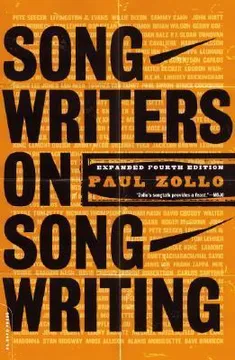
Readers widely praise this collection of songwriter interviews as essential reading for musicians and music lovers alike. The book's greatest strength lies in Zollo's ability to draw out candid discussions about the creative process from legendary artists. Recurring themes include varied approaches to inspiration, routine, and craft. Some readers note the repetitive questioning style and a lack of diversity among interviewees as weaknesses. Most recommend reading it as a dip-in reference rather than cover-to-cover. Songwriters On Songwriting holds an impressive 4.32 rating across nearly 800 reviews.
Glossary
folk process
Community reshaping of songsPete Seeger’s term for the way ordinary people take up existing songs, perform them, alter lyrics or music, and make them part of their own culture. It describes a continuing process rather than a fixed genre. A song’s identity can change through repeated use, with performers and audiences contributing to its evolution.
anti-time
Flexible rhythmic movementMose Allison’s description of a rhythmic feel that moves against a rigid, heavily emphasized pulse. Rather than relying on a drummer to mark the same accents continuously, the musicians keep time themselves and respond to one another. Allison favors this fluid approach because he believes an overbearing backbeat can restrict rhythmic freedom.
Mu chord
A major chord with added colorWalter Becker and Donald Fagen’s name for a chord shape they used in their songwriting. It adds a second to a major triad, often placing that note below the third. The added tone gives the chord a more open, suspended color while preserving a major-chord character. The name emerged as shorthand for a sound they repeatedly used.
eye music
Music valued as notationFrank Zappa used this term for notation that may look striking on the page but is not necessarily practical to play or satisfying to hear. He applied it to his early experiments drawing musical-looking scores before understanding how notation worked. The distinction is between music’s visual appearance and its realization as sound.
clustering
Associative word mappingA writing exercise Stan Ridgway used to generate lyrical material. The writer places one word on a page, then adds related words in bubbles connected by lines, following associations without judging them immediately. The expanding map can reveal unexpected combinations and directions. Ridgway uses it to move away from choosing a message in advance and toward discovering material through association.
difference tone
Meaning created by contrastFrank Zappa borrows the musical term metaphorically to describe the extra meaning created when lyrics and their musical setting interact. If the words and music seem to clash, their combination can communicate more than either part alone. The term comes from acoustics, where interacting tones can produce a perceived additional tone; here it describes an interpretive effect.
Download PDF
Download EPUB
.epub digital book format is ideal for reading ebooks on phones, tablets, and e-readers.








