

Key Takeaways
Pair inner spiritual discipline with service that changes shared conditions.
Two paths, one purpose. Wilson uses two television shows from his childhood to explain spirituality’s double task. In Kung Fu, a wandering monk practices self-mastery and responds to injustice with restraint and compassion. Star Trek imagines humanity overcoming racism, scarcity, and war through collective maturity. The first is a picture of personal transformation; the second, of social transformation. Baha’i teachings call their union a twofold moral purpose.
Neither path is enough alone. Inner peace matters, but it can become self-absorption if it never reaches beyond the individual. Service matters, too, but lasting service needs people able to resist ego, rage, and despair. The spiritual path, in this account, joins character-building to work for a more just world.
The distinction is useful because it exposes two common blind spots: treating wellness as a private achievement, or expecting social action to run indefinitely on anger. Personal practices can support patience and moral courage, while collective institutions translate those qualities into durable change. Yet spiritual motivation cannot replace policy, expertise, or accountability. Compassion may guide a response to injustice, but laws and material resources still determine who receives protection, care, and opportunity. The strongest reading is not that inner change solves structural problems by itself, but that better structures require people willing to build and sustain them.
Read mental distress, racism, inequality, and climate damage as connected crises.
A linked diagnosis. Wilson surveys what he calls humanity’s pandemics: mental illness and loneliness, racism, sexism, consumerism, extreme wealth inequality, nationalism, militarism, and climate change. His point is not that these problems are identical, but that they reinforce one another. For instance, consumer demand and the pursuit of endless growth intensify environmental damage, while inequality leaves poorer communities more exposed to its costs. He also cites figures from the period he wrote, including a pandemic-era estimate that depression among US adults rose from 8.5 percent to 27.8 percent in early 2020.
Look beneath the symptoms. Wilson traces recurring causes to selfishness, fear of outsiders, and disregard for other people and the planet. He argues that legislation and institutional reform are essential, yet incomplete without a change in the values that shape daily choices and public priorities.
Systems thinking helps explain why single-issue solutions often disappoint: housing, health, education, and environmental policy can affect one another in ways that are easy to miss when each is treated separately. Wilson’s moral vocabulary makes those connections vivid by asking what kind of human relationship a system rewards. The risk is overextending a spiritual diagnosis. Racism and climate change have identifiable histories, incentives, and power structures, not just failures of individual character. Spiritual reflection can strengthen the will to reform them, but should sharpen attention to those mechanisms rather than obscure them.
Let mortality clarify what deserves your time, then cultivate virtues for beyond the body.
Death changes the frame. When Wilson’s father died, Wilson helped prepare his body for burial in the Baha’i tradition. The ritual made the difference between a person and the body that had carried him feel immediate. He also recalls making My Last Days, a series about people facing terminal illness. Their reflections centered on love, gratitude, nature, and time, not on having worked more or spent longer online. Traditions from Buddhist death mindfulness to the Roman practice of remembering mortality use the same confrontation to focus attention on life.
Virtues are the lasting work. Wilson believes earthly life develops qualities such as patience, kindness, honesty, and compassion, which he imagines as capacities of the soul. The afterlife is a spiritual conviction, not a scientific conclusion, but the practical question remains: what kind of person is hardship shaping?
Mortality reflection can clarify priorities without requiring certainty about an afterlife. In psychology, contemplating finitude is often understood as a way to reorder goals, though its effects depend on context: it may deepen connection, or intensify fear and defensiveness. Wilson’s virtue metaphor gives hardship a possible direction, but it should not imply that suffering is automatically ennobling or deserved. Some pain damages people, and support matters. A humane application asks both what character can be developed through difficulty and what avoidable suffering should be prevented.
Seek God as mystery woven through reality, not a cosmic vending machine.
Beyond the sky-dweller. Wilson rejects the picture of God as a humanlike ruler who grants favors, punishes doubters, or plugs gaps in scientific knowledge. His Baha’i upbringing describes God as unknowable, yet close to human life. His encounter with Wakan Tanka, a Lakota term he presents as the Great Mystery, helped him imagine divinity as a creative force inseparable from nature rather than a being located somewhere above it.
Science and faith ask differently. Science investigates how the material world works; spiritual traditions address questions of value, purpose, and how to live. Wilson argues that these need not be enemies. His analogies to the internet, love, and art try to make the divine imaginable without claiming to prove it. He is drawn to mystery and consciousness, while acknowledging that he lacks scientific proof for a soul or God.
This approach avoids the familiar trap of using unexplained phenomena as evidence for a deity. It also recognizes that scientific description and human meaning are not interchangeable kinds of explanation. Still, a sense of awe or consciousness does not establish a divine source; the book’s case is existential and interpretive, not demonstrative. There is also a need for care when borrowing Indigenous concepts. Wakan Tanka belongs to a living Lakota tradition and should not be treated as a universal label for every culture’s idea of God. Respectful comparison requires preserving those differences.
Make sacredness a practiced attention, not property of buildings alone.
A pilgrimage trains attention. Wilson describes visiting Bahji in Israel, where Baha’u’llah is buried. The gardens, the quiet, the prayers, and the shared reverence among pilgrims made the visit feel set apart from ordinary time. He returned home noticing how much he missed that stillness. The experience led him to ask what makes a place sacred: its history, a ritual, a memory, or the quality of attention people bring to it.
The holy can travel. Wilson draws on the poet Basho, who treated travel, nature, poetry, and religious devotion as connected parts of a life. A family garden, a place of grief, or a meal that binds people together may also become sacred. The point is not that every place is automatically holy, but that reverence can change how ordinary places are experienced.
Ritual and place can act as technologies of attention: they slow movement, coordinate behavior, and make shared values tangible. That helps explain why pilgrimage can feel powerful even to visitors outside a faith. Sacredness also raises a question of access. A place may unite those who share its meaning while excluding others who do not. Extending reverence beyond formal shrines can widen belonging, especially when it includes people, ecosystems, and ordinary acts of care. The challenge is to preserve depth without declaring every preference sacred or beyond criticism.
Recover religion’s communal tools without inheriting its exclusions.
Faith as shared life. Wilson examines early Christianity, Buddhism, and Islam as movements that crossed tribal and social boundaries, organized communities, and encouraged care for people beyond one’s immediate group. He identifies recurring religious resources: a higher power, prayer, moral guidance, love, compassion, service to the poor, community, transcendence, and purpose. He does not deny religion’s record of violence or hypocrisy; he argues that abandoning organized religion can also mean losing structures for belonging and service.
More than self-care. The growing category of people who identify as spiritual but not religious often emphasizes private practices such as meditation. Wilson values those practices but warns that spirituality can become a personal wellness product if it never turns toward others. Prayer and meditation, in his view, belong alongside community, shared ethical commitments, and practical service.
The book’s strongest sociological insight is that religion can function as social infrastructure, not merely as a set of supernatural beliefs. Repeated gatherings, rituals, and obligations can create trust and mutual aid that isolated individuals may struggle to reproduce. But the same structures can enforce conformity or exclude minorities. The relevant question is therefore not simply whether religion is good or bad, but which practices build solidarity, how authority is checked, and who gets to define the community’s moral boundaries. Secular groups can also provide belonging, so religion is one possible vehicle, not the only one.
Design spiritual communities around inclusion, youth, service, and shared practice.
An imagined faith, not a new institution. Wilson invents SoulBoom as a thought experiment about what a modern religion might offer. Its outline combines familiar spiritual aims with practical choices: no clergy, inclusive membership, attention to the divine feminine, respect for science, time in nature, arts and music, service to the poor, and education in virtues such as patience and generosity. It centers young people as participants in social change rather than passive recipients of adult guidance.
Keep practice concrete. The proposal favors prayer and meditation, community service, and shared moral reflection. It also treats virtues as skills that can be practiced, not merely admired. In a youth group, for example, participants studied a virtue, looked for it in stories and daily life, then shared examples they had noticed. SoulBoom is deliberately fictional; its purpose is to test which communal functions people may need, whether or not they join a religion.
The thought experiment shifts the debate from defending inherited institutions to asking what social and ethical functions deserve to survive. Its best design choices are procedural: shared participation, practical service, and explicit attention to inclusion. Yet removing clergy does not automatically remove power. Informal leaders still shape norms, and a council or community can reproduce hierarchy without visible titles. Any community needs transparent decision-making, routes for dissent, and protections for vulnerable members. The model is most useful as a design prompt, not as proof that a single spiritual template fits everyone.
Replace contest with cooperation by building organized alternatives, not only protesting.
Change the model. Wilson argues that systems built around winning, rivalry, and self-interest tend to reproduce those values, even when the people inside them want justice. He points to Baha’i elections as a contrasting example: community members vote privately, without campaigning or party competition, for people they believe can serve. He also uses the organized civil rights movement to show that protest depended on preparation, training, mutual support, and a shared vision, not spontaneous outrage alone.
Build and invite. His proposed revolution combines a new, hopeful story about humanity with joy, grassroots organization, virtues education, and what he calls radical compassion: feeling another person’s suffering and acting to relieve it. Protest can expose harm, but durable change also requires alternatives people can join and maintain. That means local groups, service, consultation, and sustained work rather than a viral moment that fades.
The distinction between opposition and construction is valuable: movements need both the pressure that makes injustice visible and the institutions that can replace harmful arrangements. Cooperation is not automatically fair, however. A consensus process may silence disagreement or preserve existing privilege if participants do not share equal power. The Baha’i electoral example is best read as an experiment in reducing incentives for self-promotion, not a ready-made answer for every political setting. Effective alternatives require measurable goals, public accountability, and room for conflict handled without turning opponents into enemies.
See humanity as one body whose health depends on every part.
Interdependence is the destination. The book closes by comparing humanity to a body: diverse parts with distinct functions, yet dependent on one another for health. Wilson connects this image to the photograph of Earth known as the Blue Marble, which made the planet appear as one fragile home suspended in space. He describes history as a struggle between forces that integrate humanity and forces that break it apart. Unity, in this view, is not sameness but a recognition that human lives and social systems are interdependent.
Relationship is the test. Wilson cites the Grant Study, an eighty-year study of 268 men, and its lead researcher’s conclusion that relationships are central to a good life. The book’s spiritual revolution ultimately asks people to move beyond isolated self-interest toward cooperation, compassion, and responsibility for the whole.
The body metaphor makes interdependence intuitive: injury to one part can threaten the functioning of the whole, while difference is necessary to the organism’s complexity. It also gives ethical weight to distant suffering and ecological damage. Yet unity can become a dangerous slogan if it demands harmony before justice, or treats disagreement as a disease. Healthy interdependence requires attention to unequal power and the ability of distinct communities to speak for themselves. The useful lesson is not to dissolve individuality, but to understand autonomy as something sustained by relationships and shared conditions.
Analysis
Soul Boom is a hybrid of memoir, spiritual inquiry, social criticism, and speculative blueprint. Wilson’s personal history gives the argument its emotional warrant: he writes as someone who has used spiritual practice, therapy, and recovery to survive anxiety, depression, and addiction, not as a perfected guide. His childhood television pair, Kung Fu and Star Trek, supplies the book’s most memorable architecture. One story represents the discipline of the self; the other, the possibility of a more mature species. That distinction keeps spirituality from shrinking into private calm.
The book’s central strength is its insistence that character and institutions are connected. Compassion, humility, and service matter not only as personal virtues but as capacities needed to build communities and reform systems. The imagined SoulBoom religion makes this argument concrete through proposals about shared leadership, youth, nature, the arts, and practical service. Its more durable contribution may be this design question: which parts of religious life create belonging and public responsibility, and how can they be retained without reproducing exclusion or coercion?
The argument is less convincing when it treats society’s deepest problems as fundamentally spiritual and suggests a spiritual cure. Social crises also arise from material incentives, law, history, and concentrated power. A change of heart can motivate reform, but it does not substitute for redistribution, regulation, or institutional expertise. Likewise, the book’s universal account of religion is inspiring but risks smoothing over real differences among traditions. Its strongest form is not that every faith says the same thing, but that communities can learn across differences while holding one another accountable.
Wilson’s humor and pop-culture references make difficult subjects approachable, though the book’s wide reach sometimes trades precision for momentum. Its lasting proposition is nonetheless clear: inner growth should widen concern, and concern should become organized action. Unity is not a mood or a slogan. It is a demanding practice of making interdependence fairer, more compassionate, and more livable.
Review Summary
Soul Boom received mixed reviews, with an average rating of 3.82 out of 5. Many readers appreciated Wilson's thoughtful approach to spirituality and his interfaith perspective. They found the book inspiring, humorous, and thought-provoking. Some praised Wilson's ideas for a spiritual revolution and his exploration of common values across religions. However, critics felt the book was overly simplistic, preachy, or contradictory at times. Some readers struggled with Wilson's religious viewpoints, while others found the book's message hopeful and relevant to modern society's challenges.
People Also Read










Glossary
twofold moral purpose
Personal and collective transformationA Baha’i idea Wilson uses to describe two linked responsibilities: developing one’s own spiritual character and contributing to the advancement of society. Personal growth should strengthen service to others, while service can deepen personal understanding. Neither inner peace without social concern nor activism without self-reflection fulfills the purpose on its own.
Wakan Tanka
Lakota Great MysteryA Lakota term Wilson translates as the Great Mystery. In his account, it refers to a creative, sacred power present throughout nature and human life, not a humanlike deity separate from the world. The term belongs to Lakota tradition, and Wilson’s brief description should not be mistaken for a comprehensive account of Indigenous beliefs.
maranasati
Mindfulness of deathA Buddhist practice of remembering and contemplating mortality. Wilson describes it as a way to bring attention to the present by acknowledging that death is inevitable. Some forms examine the stages of bodily decay, a practice intended to confront impermanence rather than treat death as an abstract idea.
SoulBoom
Imagined inclusive religionWilson’s fictional model of a future-oriented spiritual community, created as a thought experiment rather than an actual faith. Its proposed features include shared leadership without clergy, inclusion across identities, spiritual practice, service, nature, arts, science, justice, and education in virtues. The model asks which religious functions might help people build connection and social change.
forces of integration and disintegration
Unifying and fragmenting forcesWilson’s description of two simultaneous movements shaping human society. Integrating forces bring people and institutions into closer cooperation, while disintegrating forces weaken old arrangements and intensify conflict. The framework interprets progress and crisis as happening together, with social disruption sometimes breaking down barriers but also creating serious risks.
radical compassion
Empathy that becomes actionWilson’s term for compassion that goes beyond understanding or sharing another person’s feelings. It includes a willingness to act to reduce suffering and, where necessary, to pursue justice. In the book’s proposed spiritual revolution, compassion is both an inner quality and a practical force for changing how people treat one another.
Grant Study
Long-term study of adult livesAn investigation begun at Harvard in 1938 that followed 268 men over roughly eighty years, examining health, psychology, relationships, and life experience. Wilson cites its lead researcher’s summary that relationships with other people are central to a good life. The study functions in the book as support for its emphasis on connection.
FAQ
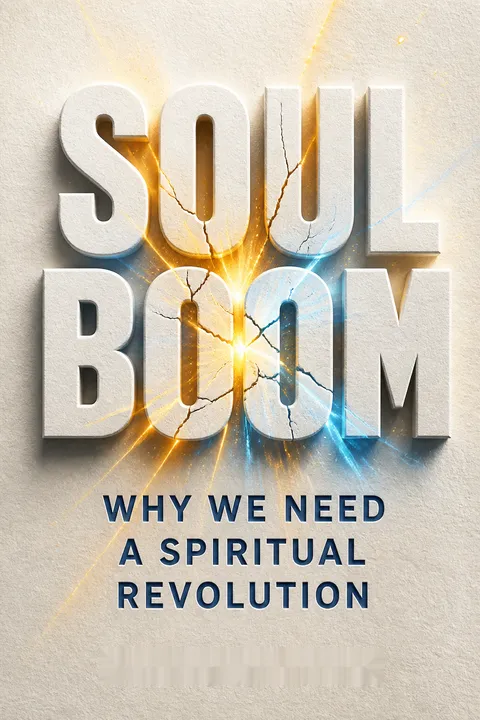
What is Soul Boom: Why We Need a Spiritual Revolution by Rainn Wilson about?
- Exploration of spirituality: The book examines spirituality as a concern for the human soul, distinct from material pursuits, and explores how this focus can address both personal and societal crises.
- Diagnosis of global issues: Wilson connects modern problems—mental health decline, polarization, environmental destruction, and social injustice—to spiritual roots, arguing for spiritual solutions.
- Personal and universal journey: Blending memoir, humor, and cultural analysis, Wilson shares his own spiritual search while inviting readers to reimagine spirituality for today’s world.
- Call for transformation: The book aims to spark a spiritual revolution, inspiring both individual growth and collective healing.
Why should I read Soul Boom: Why We Need a Spiritual Revolution by Rainn Wilson?
- Modern spiritual insight: The book bridges ancient wisdom and contemporary challenges, offering a relatable perspective for those disillusioned with organized religion but still seeking meaning.
- Practical and hopeful: Wilson provides actionable ideas, new spiritual practices, and a vision for joyful, compassionate community-building.
- Engaging and accessible: Written with humor and personal anecdotes, the book makes profound topics approachable and entertaining.
- Inspiration for change: Readers are encouraged to participate in a spiritual revolution that addresses both inner life and societal transformation.
What are the key takeaways from Soul Boom: Why We Need a Spiritual Revolution by Rainn Wilson?
- Spirituality is essential: True transformation—personal and societal—requires spiritual tools and perspectives, not just material or political solutions.
- Twofold moral purpose: The book emphasizes both personal enlightenment and collective service as intertwined goals for a better world.
- Compassion and community: Radical compassion, virtues education, and inclusive community are central to healing modern crises.
- New mythology and systems: Wilson advocates for creating new, hopeful stories and social structures rooted in spiritual principles.
How does Rainn Wilson define spirituality versus religion in Soul Boom?
- Spirituality as universal quest: Spirituality is described as a personal and collective journey toward meaning, connection, and the cultivation of divine qualities.
- Religion as institution: Religion is seen as organized practices, rituals, and dogma, which can both help and hinder spiritual growth.
- Inclusive approach: Wilson highlights the growing "spiritual but not religious" demographic, advocating for spiritual tools beyond institutional boundaries.
- Focus on transformation: The emphasis is on inner change and service to others, rather than adherence to rigid doctrines.
What are the "twofold moral purpose" and foundational principles of spirituality in Soul Boom?
- Personal transformation: Achieving inner peace, wisdom, and mastery over ego is the first path, fostering individual enlightenment.
- Collective evolution: The second path is about advancing humanity through justice, unity, and service, aiming for a more loving and equitable world.
- Interdependence: Personal and collective growth are mutually reinforcing, each deepening the other.
- Ten foundational principles: Wilson identifies core religious values—such as belief in a higher power, life after death, prayer, community, love, compassion, service, and purpose—as essential for spiritual revolution.
What global crises or "pandemics" does Rainn Wilson connect to spirituality in Soul Boom?
- Mental health crisis: Rising anxiety, depression, and loneliness are framed as spiritual pandemics needing more than medical solutions.
- Systemic injustice: Racism, sexism, and economic inequality are described as spiritual diseases rooted in "otherness" and materialism.
- Environmental and political dysfunction: Climate change and adversarial politics are linked to spiritual imbalances and a lack of collective consciousness.
- Need for new values: Wilson argues that only a shift in spiritual awareness can address these interconnected crises.
How does Rainn Wilson address the decline of organized religion and the rise of the "spiritual but not religious" in Soul Boom?
- Shift in identity: Many, especially young people, are leaving traditional religion but still seek spiritual meaning and mystical experience.
- Critique of institutions: Wilson discusses how judgmentalism, political entanglement, and outdated teachings have alienated many from organized faiths.
- Risks of individualism: He warns that self-centered spirituality can lead to narcissism and superficial practices without real transformation.
- Call for integration: The book suggests combining prayer, meditation, and community to create a more holistic spiritual practice.
What is the proposed new religion "SoulBoom" in Soul Boom and what are its core beliefs?
- Non-judgmental higher power: SoulBoom™ centers on a divine presence without dogma or eternal damnation, welcoming all seekers.
- Community and inclusivity: It values diversity, youth empowerment, and a lay-led, non-hierarchical structure.
- Moral and social focus: The faith emphasizes a fixed moral compass, radical compassion, and service to the disenfranchised.
- Harmony with science and joy: SoulBoom™ encourages cooperation with science, connection to nature, and celebrates joy, arts, and humility.
What are the seven pillars of a spiritual revolution according to Soul Boom?
- Create a new mythology: Develop a unifying, hopeful story for humanity that transcends divisive narratives.
- Celebrate joy and fight cynicism: Embrace joy as a tool for resilience and motivation.
- Destroy adversarial systems: Dismantle competitive, self-interested structures that perpetuate division.
- Build new models: Focus on creating spiritually grounded communities and systems rather than just protesting the old.
- Systematize grassroots movements: Organize local efforts for effective, lasting change.
- Invest in virtues education: Teach kindness, humility, and compassion as essential life skills.
- Harness radical compassion: Expand empathy into action for justice and healing.
How does Rainn Wilson in Soul Boom propose to reinvent political and social systems?
- Critique of adversarial politics: Wilson describes current systems as dysfunctional and divisive, driven by competition and money.
- Baha’i election model: He highlights prayerful, non-partisan, campaign-free elections as a model for cooperative governance.
- Build new structures: The book advocates for creating new, spiritually inspired systems that render old ones obsolete.
- Virtues and service: Political and social life should be rooted in humility, honesty, and service to the common good.
What practical spiritual tools and practices does Rainn Wilson recommend in Soul Boom?
- Integrated prayer and meditation: Wilson encourages combining speaking to and listening for the divine in daily practice.
- Virtues education: Teaching and cultivating character traits like kindness and patience are essential for transformation.
- Joy and service: Daily acts of joy and service to others are central spiritual disciplines.
- Arts, music, and nature: Creative expression and connection to the natural world are vital for healing and growth.
What are the best quotes from Soul Boom: Why We Need a Spiritual Revolution by Rainn Wilson and what do they mean?
- Mary Oliver: “Pay attention. Be astonished. Tell about it.” —A call to mindfulness, wonder, and sharing spiritual insights.
- Shoghi Effendi: “We need a change of heart... The inward life of man as well as his outward environment have to be reshaped if human salvation is to be secured.” —Emphasizes the need for both inner and outer transformation.
- Imam Ali: “Dost thou reckon thyself only a puny form / When within thee the universe is folded?” —A reminder of the vast spiritual potential within each person.
- Arnold Toynbee: “The ultimate work of civilization is the unfolding of ever-deeper spiritual understanding.” —Positions spiritual growth as central to human progress.
- Baha’u’llah: “Let your vision be world embracing rather than confined to your own selves.” —A call for a global, inclusive perspective rooted in love and unity.
Download PDF
Download EPUB
.epub digital book format is ideal for reading ebooks on phones, tablets, and e-readers.








