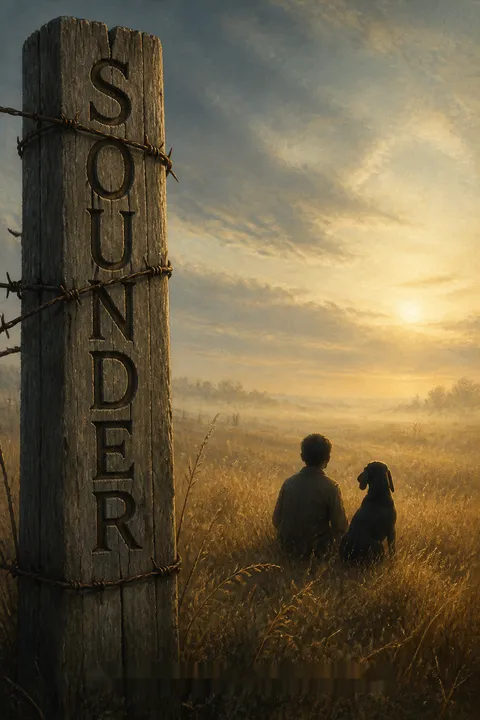


Plot Summary
Winter Hunger and Sounder
The unnamed boy lives with his parents and three younger children in an isolated sharecropper cabin, where winter food depends on day labor, his mother's walnut kernels, and whatever his father and Sounder can hunt.
Sounder, a powerful coonhound, brings home pelts worth flour and clothing; the boy treasures both the dog and the chance to accompany his father. School is eight miles away, and cold and illness have ended his attempts to attend, so he imagines learning to read as a way out of loneliness.
As game dwindles, the family eats mostly corn mush. One evening the father leaves alone after supper, without taking Sounder or the boy. The next morning, ham and sausage fill the cabin with rare abundance, though no one explains where they came from.
The family’s hardship is not abstract: it is measured in food, distance, and labor. Sounder’s hunting makes the dog part of the household economy as well as the boy’s closest companion, while school remains a desire he cannot yet reach. The boy reads the world through what it withholds, from books to warmth to reliable meals. The sudden feast shifts that fragile balance before he understands its cost. His father’s unexplained absence is the first break in the ordinary pattern, and the boy’s incomplete knowledge places the reader inside a child’s limited, practical understanding of adult danger.
A Shot in the Road
Three days later, the sheriff and two deputies push into the cabin and identify the meat as stolen from a smokehouse. A torn patch on the father's overalls matches cloth caught on the building's hook, and the men chain him to their wagon. Sounder charges from the fields, but the boy cannot hold him back.
One deputy fires at the dog as he leaps after the departing wagon. Sounder collapses in the road, then drags himself toward the cabin with a ruined head and shoulder. The boy follows his blood trail and finds no body under the porch. His mother calls the dog near death, yet the boy keeps a pan of food outside, still listening for movement beneath the floor.
The arrest converts household scarcity into criminal evidence: the same meat that briefly fed the family now helps justify the father’s removal. The sheriff’s men use physical traces, the torn cloth, to make a poor man’s need legible only as guilt. Sounder’s shooting repeats that violence on a smaller, intimate scale, leaving the boy unable to protect either father or dog. Yet he keeps feeding Sounder. This small act is not a solution, but it gives the boy something concrete to do when authority has taken away nearly every other form of agency.
No Body Under the Cabin
The next morning, the mother leaves with the ham and sausage to return them, carrying walnut kernels to sell at the store. She leaves the boy responsible for the younger children and warns him not to abandon them to search. He crawls beneath the cabin anyway, scraping his knees on debris, but Sounder is gone.
Staying close enough to return to the children, he searches the road, fields, and nearby thickets without finding the dog. His mother comes back with food bought from her walnut earnings and suggests that Sounder may have reached the oak woods, where leaves could protect his wounds. The boy goes into the woods and searches again. Days pass, then weeks, without Sounder returning.
The mother’s trip carries two forms of care at once: she tries to undo the danger attached to the stolen food, then turns her scarce earnings into provisions for the children. The boy’s search, by contrast, is governed by a child’s urgent need to locate what has vanished. His mother offers a folk explanation about oak leaves, not certainty, and the boy uses that possibility to keep moving. Their differing responses reveal a family managing uncertainty through separate tasks: she protects the living household, while he refuses to abandon the missing dog.
Christmas Cake at the Jail
At Christmas, the mother bakes a cake and sends the boy to the town jail, since women are not allowed to visit. The red-faced jailer searches the box, breaks the cake apart, and makes the boy gather the crumbs. Inside, the boy finds his father behind bars and tries to report on the family and Sounder, but grief disrupts what he had rehearsed.
The father asks him not to return and says he will send news through the visiting preacher. The boy leaves without asking the question he had meant to ask about how Sounder first came to their home. On the walk back, he imagines punishing the jailer, then reaches the cabin with no news of his father’s sentence and no sign of the dog.
The destroyed cake makes the jail’s suspicion tactile: even a homemade gift is treated as a possible weapon, and the boy is forced to handle the wreckage. His visit also exposes the limits of his practiced composure. He tries to protect his father from grief by reporting calmly, but the encounter leaves him unable to finish what he planned to say. The father’s request that he stay away creates a new kind of distance, enforced not by miles alone but by a child’s obedience and uncertainty. The imagined revenge against the jailer shows anger forming where the boy has no safe outlet for it.
Sounder Finds the Porch
Nearly two months after the shooting, the boy hears a faint whine and finds Sounder alive on the porch. The dog has lost an eye and part of an ear, and one front leg hangs uselessly; the oak leaves have helped close his wounds, but he cannot bark again. Sounder keeps his one eye turned toward the road his master traveled.
The mother sometimes feeds him herself, then returns to her work and the quiet cabin. Later, she learns from a newspaper read aloud at one of the houses where she does laundry that court has sentenced the father to hard labor. The notice gives no location. The boy understands that seeing his father again will require him to search.
Sounder’s return brings relief without restoring what the family had before. His survival is visible in the damaged body and in the missing bark, the sound that once carried across the countryside. The boy now has proof that endurance can preserve life while changing its shape. The father’s sentence extends the household’s uncertainty into an open-ended separation, and the lack of a named destination makes the boy’s next task almost impossible to plan. Loyalty becomes a practice of waiting and searching, shared by the dog’s gaze toward the road and the boy’s eventual journeys.
The Book in the Trash
Over the next years, the boy follows rumors from road camps to quarries and prison farms, but guards offer only taunts or tell him that prisoners are known by numbers. At one camp, a guard hurls scrap iron through the fence and crushes the boy's fingers; the father is not among the men he has been watching.
In a town, the boy finds a book by Montaigne in a trash barrel and tries to read it, though its unfamiliar words defeat him. A white-haired schoolteacher notices his injured hand and takes him home to wash and bandage it. The teacher recognizes the book, reads from it, and offers the boy a place to stay and a chance to attend school.
The search for the father repeatedly places the boy before institutions that deny him information and treat his presence as an offense. The guard’s attack turns that exclusion into bodily harm, but the boy does not answer violence with violence. Instead, he carries away a book he cannot yet understand. The teacher’s response provides a sharp contrast: he tends the boy’s injury and approaches his curiosity as something worth protecting. The encounter does not solve the father’s absence. It creates another route forward, one in which reading can enlarge the boy’s ability to interpret a world that has so far offered him commands and closed gates.
Two Lamps, One Door
The boy returns home with bandaged fingers and tells his mother about the teacher’s books, his bright cabin, and the invitation to study while helping with chores. She listens, then decides he should go, although she knows that school will take him away from home and from the search for his father.
The boy spends winters with the teacher and returns in summers to work the family fields, helping his mother pay the cabin rent. He learns to read from the book he once found in the trash, then reads stories to his younger siblings. Sounder meets him on each return, hobbling down the road and wagging his tail. The father remains at hard labor, his location uncertain.
The mother’s decision is an act of care that does not resemble rescue: she permits separation because education may give her son capacities the family cannot otherwise provide. The boy’s learning develops through an exchange of labor and attention, not a sudden escape from poverty. He works the fields in summer, then brings books and stories back to his siblings. Sounder’s repeated welcome joins these two homes without erasing their distance. Meanwhile, the father’s absence remains unresolved, so education does not replace the boy’s loyalty. It equips him to carry that loyalty alongside a wider intellectual life.
His Father Walks Home
One August afternoon, a limping figure approaches the cabin through the heat. Sounder recognizes the father first and races down the road, barking with the voice the family thought he had lost. The father has survived a dynamite blast at the quarry, where falling limestone crushed one side of his body.
He explains that the injury left him unable to work, so officials shortened his sentence. His speech and movement are impaired, but he has made it home. The boy asks the younger children to be gentle with him, and the family settles into a quieter routine. In September the boy returns to the teacher. By harvest, his father cleans the old hunting lantern and takes Sounder toward the woods.
The father’s return reverses years of absence, but the body that comes home bears the violence of the labor system that held him. His survival is neither triumph without cost nor a return to the old household. The boy responds by protecting his father from the younger children’s startled questions, taking on a new form of family responsibility. Sounder’s bark briefly links the returning man to the familiar rhythms of home and hunting. The lantern’s reappearance signals that the father is reaching for an old practice, even as age and injury have narrowed what he can do.
The Lantern Goes Missing
The boy watches the lantern move into the pines, but by dawn no light has returned. Sounder crosses the fields and keeps looking back until the boy follows him along an old logging road. Beneath a tree, they find the father seated beside the still-burning lantern, dead. The boy carries the news home, and his mother arranges a proper burial using the insurance she has paid for over the years.
The preacher buries the father in the lot behind the meeting house. Afterward, the boy tells his mother that Sounder has stopped joining him in the woods and no longer seems interested in living. He has prepared a grave beneath the jack oak, expecting the dog to die before he returns from school.
The lantern’s continuing flame makes the father’s final journey feel unfinished even as the boy discovers its end. Sounder’s leading the boy to the body gives their shared loyalty its last practical task: the dog can no longer hunt, but he can still guide the son. The mother’s burial insurance, accumulated through years of labor, provides a form of dignity the family could not take for granted. The boy’s preparation of a grave for Sounder shows that he has learned to anticipate loss without becoming indifferent to it. He names the dog’s decline plainly, a hard-won change from the child who once wished death away.
A Voice That Outlives Silence
Sounder crawls beneath the cabin and dies two weeks before the boy comes home for Christmas. His mother tells him what happened, and he is relieved that the dog was not dragged to the grave he had prepared in the field. By then, he can read more of the battered book he carried from the trash.
A passage about change and death, clarified by the teacher’s explanation of a flower continuing in the memory of those who saw it bloom, now makes sense to him. Years later, as a grown man, he remembers the father walking beneath the harvest moon and Sounder bounding beside him. In memory, the dog’s deep voice travels again through the woods.
The ending does not undo the family’s losses; it changes what the boy can make of them. His relief that Sounder died beneath the cabin rather than alone in the field gives grief a small, concrete mercy. The book that once resisted him now offers an idea he can test against lived experience: what has changed can persist through memory and influence. The recurring bark, once a hunting tool and a sign of the dog’s strength, becomes an inward sound carried by the adult narrator. Education does not erase suffering, but it gives the boy language with which to hold it.
Analysis
Sounder follows a child whose world is shaped by deprivation, racialized authority, and the slow accumulation of work. Its injustice is not delivered through grand political speeches. It arrives as a sheriff in a cabin, a chain on a father’s wrists, a jailer breaking a cake, and guards who refuse to identify prisoners by name. These concrete encounters show how institutions make the family’s poverty more dangerous while withholding the information and protection that might help them resist it.
The boy’s emotional development moves through several forms of helplessness. At first he believes that watching, waiting, and wishing may reverse what has happened to Sounder. Later, he searches roads and prison camps, learning that effort does not guarantee reunion. His anger becomes visible in fantasies of revenge, but his decisive action is to carry a discarded book and accept the teacher’s help. Education does not function as a simple escape from hardship. The boy still works the fields and remains bound to his family. Reading instead gives him a wider means of interpreting experience, including the difference between an inherited story of justice and the disorder he actually encounters.
The parents offer contrasting but complementary ways to endure. The father’s care is expressed through labor and physical competence; the mother’s through food, stories, and repeated acts of household maintenance. Neither can prevent the family’s losses. Their efforts nevertheless give the boy a structure from which to grow. Sounder makes that structure audible and bodily. His usefulness matters, but his bond with the boy exceeds his work as a hunting dog, allowing loyalty to be felt without explanation.
The final movement refuses to make suffering valuable merely because the boy learns from it. His father and Sounder are gone, and the story does not restore them. Instead, memory becomes a form of continuity: the boy can read the book more fully, understand its thought through experience, and carry the sound of Sounder’s voice into adulthood. The ending’s hope is therefore modest and earned. Loss remains real, but it no longer occupies the whole horizon.
Review Summary
Sounder is a powerful, heartbreaking story about a poor African-American sharecropping family and their loyal dog. Readers praise Armstrong's simple yet emotive prose, which explores themes of racism, poverty, and resilience. The book's nameless characters and universal messages resonate with many, though some find it overly depressing. While primarily considered a children's book, adults find depth and poignancy in the narrative. The story's emotional impact and exploration of injustice make it a memorable, thought-provoking read that has endured as a classic.
People Also Read

Characters
The boy
The inward young seekerThe unnamed boy is observant, practical, and intensely attached to his family and Sounder. He measures the world through work, weather, food, and the small sounds around the cabin, yet he also longs for books and the ability to read. His silence often comes from trying to spare others pain, especially his parents, rather than from a lack of feeling. As hardship pushes him beyond home, he learns to search, to withstand humiliation, and to accept help without abandoning his responsibilities. His growth is shaped by the tension between loyalty to those he loves and the possibility of an education that might widen his life.
The father
A proud sharecropperThe boy’s father is a strong, skilled laborer who hunts with Sounder and works the fields for a landowner. He speaks sparingly and shows care through practical acts: preparing food, teaching the boy about hunting, and providing what the family can use. His pride is bound to physical competence and the ability to support his household, which makes the family’s dependence on sharecropping especially precarious. He is not presented as a man who explains himself easily. The boy reads his feelings through his silences, his work, and the way he carries himself, learning that restraint can conceal tenderness as well as pain.
The mother
The household's steady keeperThe boy’s mother holds the household together through walnut picking, laundry, cooking, and care for the younger children. She notices danger before she names it, and when fear overtakes her, she often hums rather than speaking directly. Biblical stories and practical knowledge help her comfort the children, but she does not offer easy assurances. She is both protective and realistic, asking the boy to stay near home while recognizing the force of his devotion to his father and Sounder. Her care is expressed in ordinary details, clean bedding, saved food, and steady work, which give the family a measure of order in an unstable world.
Sounder
A gifted hunting companionSounder is the family’s coonhound, valued for his keen hunting ability and his unmistakable voice. He is both a working animal, helping the family obtain food and money, and the boy’s closest companion. His loyalty is physical and direct: he follows trails, waits for his master, and seeks the boy’s touch. The boy understands Sounder through habits most people might overlook, from the rhythm of his movements to the sounds he makes at night. Their bond gives the boy companionship beyond words and makes the dog an important part of the family’s daily life.
The teacher
A patient teacherThe elderly, white-haired teacher runs a small school and lives alone in a carefully tended cabin. When he finds the boy with an injured hand and a book he cannot yet read, he responds with practical kindness instead of suspicion. He offers a place to stay, introduces the boy to reading, and makes education part of daily work rather than a distant promise. His gentle attention does not demand that the boy explain everything at once. He represents a form of authority that protects curiosity and treats the child as someone capable of learning.
The sheriff
The law's armed faceThe sheriff leads the men who enter the sharecropper cabin and arrest the father after identifying the stolen meat and torn cloth as evidence. He carries the authority of the local legal system into the family’s home, where his presence turns a meal into an accusation. The sheriff is a functional but consequential figure: his actions set the father’s separation in motion and expose how little protection the family can expect from the law.
The jailer
A hostile gatekeeperThe red-faced jailer controls access to the prisoners and treats visitors with suspicion. He destroys the boy’s Christmas cake because he fears it may conceal a tool, then forces the child to gather the pieces. His brief role makes the prison’s rules personal: the boy meets not only locked doors but an adult who uses his authority without tenderness.
The younger children
The boy's dependent siblingsThe boy’s three younger siblings share the cabin and depend on their parents and older brother for food, warmth, and supervision. They respond to events with the direct questions of children, giving the boy responsibilities he is not old enough to have chosen. Their presence helps explain why he cannot simply leave when he wants to search, and why the mother’s practical instructions matter.
The visiting preacher
A possible messengerThe visiting preacher is the channel through which the father hopes to send news from confinement. His role reflects how few reliable means of communication the family has, and how much they depend on word passed from person to person.
Plot Devices
Sounder's hunting voice
A bond made audibleSounder’s bark first marks him as a remarkable hunting dog, able to carry his presence across the fields and into the foothills. For the boy, that voice is more than a tool for finding game: it is a familiar sound that breaks the loneliness of the cabin and signals the dog’s nearness. As the story changes, the voice also gives the family a way to register what injury and time have taken from Sounder. Its importance comes from the contrast between a sound once heard at a distance and the quiet that follows, making the dog’s relationship with the boy perceptible even when neither can explain it.
The damaged book
A door into learningThe boy’s book begins as a found object from a trash barrel, full of words beyond the reading he has taught himself from signs and newspapers. The teacher identifies its author and reads from it, turning the object into an invitation rather than a test. The boy keeps returning to the book as his skill grows, and one of its ideas eventually helps him make sense of change and memory. Its worn condition matters: education reaches him not as a polished gift from the powerful, but as something discarded that he chooses to carry and work to understand.
The hunting lantern
A light toward homeThe lantern belongs to the father’s night hunts and to the family’s ordinary rituals of preparing to go out into the fields. It hangs unused during the long absence, making the family’s lost routines visible without explanation. When it is cleaned and carried toward the woods again, it signals the father’s effort to resume a life that injury has altered. The lantern’s light also gives the boy a practical way to track his father’s movement, while its presence beside him in the forest becomes an image the grown narrator continues to remember.
The Christmas cake
A gift under suspicionThe cake gives the mother a way to send care to the father when she cannot visit him herself. Its journey makes the boy cross from the cabin’s familiar routines into the jail’s rules and indignities. The jailer’s suspicion destroys the gift before father and son can share it, turning an ordinary family gesture into a demonstration of how thoroughly confinement reaches beyond the prisoner. The cake also structures the boy’s attempt to reassure his father: he carries food, news, and the wish to appear strong, only to find that grief has made his careful preparation difficult to use.
Biblical stories
A language for enduranceThe mother’s stories of biblical figures give the boy a pattern for understanding journeys, captivity, danger, and hope. He remembers people such as Joseph and David when he travels alone, using familiar stories to make frightening roads feel less directionless. The stories do not erase the difference between scripture and his own circumstances; the boy even wonders whether his family’s life will end as neatly as the tales do. Their lasting function is psychological: they provide a shared language between mother and child, and a store of images he can carry when he is far from home.
Download PDF
Download EPUB
.epub digital book format is ideal for reading ebooks on phones, tablets, and e-readers.








