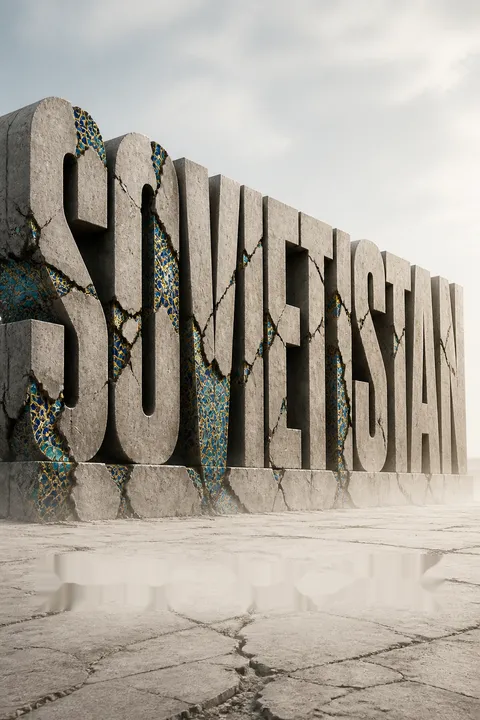


Key Takeaways
Treat the five Stans as distinct societies shaped by one Soviet inheritance
Five countries, one inheritance. Turkmenistan, Kazakhstan, Tajikistan, Kyrgyzstan, and Uzbekistan became independent in 1991 after decades inside the Soviet Union. They are not interchangeable: Kazakhstan is vast and resource-rich, Tajikistan is mountainous and poor, and Turkmenistan is mostly desert. Their shared history is the Soviet project that transformed alphabets, education, work, religion, and political power, often by force.
Differences matter on the ground. Turkmen reverence for horses, Kazakh kokpar, a horseback team sport played with a goat carcass, and Tajik Persian ancestry point to distinct histories and cultures. Yet all five inherited borders and institutions made under Soviet rule. The book's journey follows this tension: the countries are newly sovereign, but the past remains built into their streets, economies, and daily routines.
What's striking is how the book resists the convenient category of the Stans without denying their shared inheritance. That distinction resembles a useful principle in comparative politics: similar institutions can produce different outcomes when geography, language, and social organization differ. The Soviet past is a common starting point, not a complete explanation. The region also cautions against treating independence as a clean break. Flags can change overnight; the habits, infrastructure, and political arrangements that shape ordinary life usually cannot.
In Turkmenistan, marble and praise conceal a hollowed-out state
A capital built as theatre. Ashgabat's gleaming marble avenues, fountains, gold monuments, and portraits of the president project abundance. Yet the streets are nearly empty, ordinary shops are poorly stocked, and rural families live in mud-brick homes far from the spectacle. The state's cult of personality reached its peak under Saparmurat Niyazov, or Turkmenbashi, whose book, Ruhnama, became required reading in schools and even part of driving tests. Ruhnama was a government-promoted guide to Turkmen history and identity, written by the president.
The numbers tell another story. In 2004, the official unemployment rate was 2.6 percent, while a CIA estimate placed it near 60 percent. Free gas, electricity, and salt helped some citizens feel cared for, but services and public institutions deteriorated. Niyazov's successor restored some banned activities, yet maintained tight control over media and political life.
The contrast between monumental architecture and weakened public services is a study in political signalling. In political science, a regime's visible projects can help create legitimacy, especially when independent media cannot test official claims. But spectacle is not merely deception: free utilities and subsidized essentials mattered to households with little income. The more difficult question is what citizens receive in exchange for political silence. A state can provide real material benefits and still constrain people profoundly, so neither marble nor social assistance alone measures public welfare.
Stalin's borders turned overlapping peoples into rival national compartments
A map became a state. Before Soviet rule, Central Asia was a patchwork of khanates, clans, languages, and shared settlements. Soviet authorities divided the region into five republics, promoting separate national identities and drawing lines that often cut through mixed communities. In the Fergana Valley, where Uzbekistan, Kyrgyzstan, and Tajikistan meet, enclaves and irregular borders still complicate travel and trade. The Great Game was the nineteenth-century contest between Russia and Britain for influence in Central Asia, especially around access to India; its imperial boundary-making helped shape the region's outer limits.
Old connections became borders. Under Soviet rule, people could cross internal republic lines with few formal obstacles. Independence turned many of those lines into checkpoints and barriers. In 2010, ethnic violence in southern Kyrgyzstan killed more than 420 people, with Uzbeks making up most of the victims. The borders did not create every conflict, but they hardened distinctions and made disputes over land and belonging more consequential.
The book shows that borders are not just lines on maps. They shape paperwork, trade, identity, and the stories people tell about who belongs. This connects with the concept of path dependence: once institutions organize life around a division, changing the line becomes politically costly even if the boundary fits local reality poorly. Still, inherited borders do not make violence inevitable. The account of the 2010 clashes also points to political weakness, rumor, and impunity as immediate accelerants. History sets conditions; leaders and institutions influence what follows.
Soviet modernization educated millions while starving and uprooting others
Progress came with coercion. Soviet rule brought schools, roads, healthcare, and near-universal literacy to communities that had previously had few formal schools. It also imposed collectivization, suppressed religion, and reorganized traditional life. In Kazakhstan, nomads who resisted losing their livestock were labeled kulaks and dispossessed. The resulting famine in the early 1930s killed more than a million ethnic Kazakhs, roughly a quarter of the population. During Stalin's rule, millions of people from different ethnic groups were deported to Central Asia; many died in transit or soon after arrival.
Nostalgia has reasons. Older people recall subsidized travel, guaranteed work, nurseries, and a social system that provided basic services. That memory can coexist with the record of famine, forced labor, surveillance, and environmental ruin. A Ukrainian ornithologist in Kazakhstan remembers free childhood holidays; other families remember confiscated animals, prison, and hunger. Neither account cancels the other. The Soviet experience delivered genuine social gains while making individuals and whole communities pay a terrible price.
This balanced account helps explain why nostalgia need not be ignorance. Memory often works through household experience: a pension, a school place, or a secure job can remain vivid, while violence inflicted on other groups feels distant or politically inconvenient. That does not excuse repression, but it explains why simple verdicts fail to persuade. The book also invites a question about modernization: who defines progress, and who bears its costs? Roads and literacy are valuable, yet they do not justify coercion or make collective suffering a rounding error.
Cotton quotas and nuclear tests made landscapes absorb the state's costs
Nature became a production target. Soviet planners diverted the Amu Darya and Syr Darya to irrigate cotton fields, assuming rivers could be redirected without lasting consequences. Poorly built canals wasted much of their water, while the Aral Sea shrank to a fraction of its former size. Moynaq, once a fishing port, now sits far from the water beside rusting boats. Cotton production helped meet state targets, but the region inherited salt-blown soil, polluted drinking water, illness, and lost livelihoods.
Damage has uneven limits. Kazakhstan's North Aral Sea began to recover after a dam and canal repairs reduced water loss, while the southern sea remained in severe decline. In eastern Kazakhstan, the Soviet Union conducted 456 nuclear tests at Polygon near Semipalatinsk. The book reports that radioactive fallout affected more than two million people. These cases show both the reach of state engineering and its uneven aftermath: some damage can be partly reversed, but not simply wished away.
This is political ecology in concrete form: environmental harm follows decisions about power, production, and whose welfare counts. Cotton quotas and nuclear testing were not isolated technical errors. They reflected systems that rewarded output and secrecy while discounting local health and long-term costs. The North Aral recovery adds an important qualification: ecological decline is not always irreversible, but repair takes resources, governance, and sustained attention. The book's evidence also warns against treating restoration as a complete return to the past. Recovering water cannot by itself restore vanished jobs or undo decades of illness.
Remember Central Asia as a scientific crossroads, not a forgotten corridor
A region that made knowledge. Central Asia was not merely a passage between Europe and Asia. Cities such as Merv, Bukhara, and Samarkand became centers of trade, learning, and religious exchange. Merv had libraries and an observatory, and its silk reached western markets. The region produced scholars including al-Khwarizmi, whose work helped shape algebra, Ibn Sina, known in Europe as Avicenna, whose medical writing became influential, and Biruni, who studied mathematics, history, and religion.
Exchange left fragile traces. The Silk Road carried paper, ideas, and technologies as well as luxury goods. Yet cities were repeatedly conquered and destroyed. Merv's intellectual life was devastated by the Mongol invasion of 1221, and later political upheavals further disrupted the region. Khiva and Samarkand preserve remarkable architecture, but ruins and surviving texts cannot tell the whole story. Fatland's historical detours restore the region's place in world history without pretending that its past was one uninterrupted golden age.
The corrective here is important: regions described as peripheral are often peripheral only from the viewpoint of later powers. Trade routes made Central Asia a meeting place where knowledge traveled and changed form. The story also complicates any romantic account of a lost golden age. Intellectual vitality depended on political conditions and exchange, and those conditions could be shattered by conquest. A richer history holds both facts together: Central Asia generated scholarship and institutions, while its position between empires repeatedly exposed them to disruption.
Kyrgyzstan's revolutions opened politics, but left coercion and violence intact
Changing presidents was possible. Kyrgyzstan is the only Central Asian country in the book where mass protest twice removed a president. In 2005, demonstrators forced Askar Akayev into exile; in 2010, Kurmanbek Bakiyev fled after protests in which 87 people were killed. Kyrgyzstan adopted a parliamentary system and allowed more open criticism than its neighbors. But political competition did not prevent ethnic violence: clashes between Kyrgyz and Uzbeks in 2010 killed more than 420 people and left deep mistrust.
Tradition can conceal force. The Kyrgyz practice called ala kachuu, literally a snatching and running, is forced bride kidnapping when a woman is abducted against her will for marriage. A sociologist cited in the book estimated that roughly a third of marriages involved the practice, with a higher share in rural areas. Women describe intense family and community pressure to stay. Some do build loving marriages afterward, but that outcome does not make coercion consent.
The distinction between electoral freedom and freedom inside families is essential. Democratic institutions can widen public debate without dismantling gendered power or resolving ethnic inequality. The reported bride-kidnapping estimates should be treated as estimates, not as a precise census, but the personal accounts make the underlying coercion difficult to dismiss. The chapter's broader lesson is that reform has multiple arenas. Changing who governs may create room for organizing and criticism, yet private customs and local enforcement can preserve older hierarchies.
Protect minority languages before forced migration erases their living speakers
A language can outlast its state. The Yaghnobis of Tajikistan speak a language related to Sogdian, once important across the ancient Silk Road. Soviet authorities forced Yaghnobi families from their mountain villages in the 1970s to work on cotton farms in the lowlands. Some returned when the policy weakened; others stayed where roads, schools, and services were more accessible. One man, Mirzonazar, returned to his valley after three of his four children died soon after the move, and rebuilt his home.
Recognition is not guaranteed. The Soviet system registered Yaghnobis as Tajiks, and the independent state continued to use a population threshold that excluded them as a separate nationality. Fewer than 15,000 people speak Yaghnobi, and many younger people use Tajik instead. Some Yaghnobis stress their sameness with Tajiks, partly because official identity categories and social pressures have made distinctiveness costly. Language survival depends on families and communities, not merely on a label in government records.
Language preservation is often framed as cultural conservation, but the Yaghnobi story makes it a question of practical choice. A family may value its language and still prioritize schooling, healthcare, or a safer livelihood for children. That means preservation cannot rest on nostalgia or symbolic recognition alone. It requires conditions in which speaking a minority language does not restrict opportunity. The case also cautions against assuming that people must perform a distinct identity to prove that it exists. A community's self-description deserves attention, even when outsiders find it surprising.
Treat labor migration as economic infrastructure with intimate human costs
Remittances keep households afloat. The book describes one to two million Tajiks working in Russia at a given time, with money sent home accounting for about half of Tajikistan's gross domestic product. Kyrgyzstan also depends heavily on migrant earnings. These workers support families and national economies, but often live in crowded, unhealthy conditions and leave spouses and children behind. In Tajikistan, Sveta's husband left for Russia when she was pregnant, sent money at first, and then disappeared from her life.
The costs fall unevenly. Families manage separation through care work, borrowed money, and difficult choices. Some women wait for absent husbands; others raise children alone or hope a child can migrate in turn. In Uzbekistan, a propiska is a government document required to move to another region, and authorities used it to restrict movement by poorer residents. Migration is therefore not simply individual ambition. It is shaped by job scarcity, state controls, and unequal access to security at home.
Migration studies often treat remittances as a financial flow, but the book keeps the household visible behind the national accounts. Money crosses borders while care, risk, and emotional labor remain unevenly distributed. Calling migration infrastructure highlights its role in sustaining economies that offer too few jobs. It also raises a policy question: when a country relies on citizens working abroad, who carries the cost of that dependence? Not every migrant story is abandonment, and work abroad can create opportunity, but aggregate economic gains can conceal acute private losses.
A desert museum rescued art that censorship had pushed into hiding
One collector built a refuge. In Nukus, far from the Soviet cultural capitals, Igor Savitsky collected Karakalpak crafts and works by Russian and Uzbek artists whose experimental styles had been suppressed under Stalin. He sought paintings from artists' relatives and widows, sometimes buying work that had been hidden in attics or used to patch roofs. In 1966, he opened a museum. His collection eventually included tens of thousands of objects, among them a major body of Russian avant-garde art.
Preservation required persistence. Savitsky used the museum's remote location to protect works that would have attracted scrutiny elsewhere. He hid controversial pieces when inspectors arrived and kept acquiring art despite scarce funds. After his death, museum staff continued the work, often with little money and under official suspicion. The museum's survival depended not on a grand national plan, but on individual commitment, the trust of families, and local workers who treated the collection as a responsibility.
The Nukus museum shows how cultural memory can survive through institutions built at the margins, not only through official national museums. Savitsky's work resembles archival rescue: he preserved objects before their owners or governments could discard, destroy, or forget them. Yet one person's vision also creates vulnerability. A collection can depend on a founder's relationships, judgment, and unusual freedom to act. The episode therefore celebrates individual stewardship while pointing toward the need for durable public support, transparent collection practices, and protection from political interference.
Analysis
Fatland's travel narrative is also a study of how states make reality visible. Ashgabat's marble avenues, a president's face on a watch, a border guard's paperwork, and the empty shelves of a national library are not decorative details. They show how authority enters everyday life, from architecture and official memory to movement and speech. Against these displays, the book places the ordinary: a family sharing tea, a woman waiting for a migrant husband, a village trying to keep its language, and the remains of a fishing port far from the sea.
The central analytical tension is continuity without sameness. Soviet rule imposed shared institutions and borders, but the five republics inherited different ecologies, histories, languages, and social structures. Their post-independence governments range from Kyrgyzstan's unstable pluralism to the tightly managed regimes of Turkmenistan and Uzbekistan. Treating the region as one political unit would obscure those differences; treating each state as wholly new would conceal the institutional habits and economic dependencies they share.
The book's strongest method is juxtaposition. Soviet-era education sits beside famine and deportation; subsidized necessities beside repression; national monuments beside shuttered services. That structure explains nostalgia without endorsing it and documents harm without reducing the region to victimhood. It also makes environmental consequences legible as political history. The Aral Sea and Polygon are not simply disasters of nature or technology. They record whose goals counted and whose losses could be ignored.
A limitation follows from the same travel form that gives the book its immediacy. In closed states, the narrator often depends on approved guides, interpreters, and brief encounters, while other voices remain inaccessible for their safety. Her observations are vivid, but no single traveler can represent millions of lives. The book is best read as a map of questions and contrasts, not a final survey. Its durable insight is that independence changes sovereignty faster than it changes the structures through which people work, remember, and imagine a future.
Review Summary
Sovietistan is a travelogue through five Central Asian countries, offering insights into their history, culture, and politics post-Soviet era. Readers appreciate Fatland's observant eye, humor, and balanced perspective, though some criticize her Western bias. The book is praised for its engaging writing and informative content, blending personal experiences with historical context. Some reviewers found it lacking depth or overly focused on negative aspects. Overall, it's recommended for those interested in learning about this lesser-known region, despite occasional translation errors and outdated information.
Glossary
Sovietistan
Five post-Soviet Central Asian statesThe book's title for its account of Turkmenistan, Kazakhstan, Tajikistan, Kyrgyzstan, and Uzbekistan. It gathers five separate countries into a shared travel and historical frame, emphasizing their common Soviet past while tracing differences in geography, culture, political systems, and post-independence paths. It is a descriptive label, not the name of a formal political union.
Ruhnama
Turkmen president's state-promoted bookSaparmurat Niyazov's book of Turkmen history, customs, and political instruction, promoted as a foundational guide to national identity. Under Niyazov, students were required to study it, and it was used in settings ranging from school lessons to driving examinations. Its account of history also elevated the president and presented a state-approved version of Turkmen origins.
The Great Game
Russia-Britain rivalry in Central AsiaThe nineteenth-century competition between the Russian and British empires for influence in Central Asia, particularly over routes and strategic positions near British India. Explorers, diplomats, and military officers gathered information, negotiated with local rulers, and maneuvered over borders. The rivalry helped shape the region's outer boundaries, including the frontier along the Oxus River.
ala kachuu
Forced bride kidnappingA Kyrgyz term meaning roughly snatching and running. In the book, it refers specifically to abducting a woman against her will in order to force her into marriage. It is distinct from consensual elopement, though the practice is often defended as tradition. Social pressure, concerns about virginity and family reputation, and limited economic independence can make it difficult for abducted women to leave.
kokpar
Horseback contest with goat carcassA Central Asian team sport played on horseback, also known as buzkashi. Riders compete to seize a decapitated goat carcass and carry it into a scoring circle at the opposing end of the field. The game requires skilled riding and powerful horses, and is a public expression of the enduring place of horses in Kazakh and neighboring cultures.
propiska
Required regional movement documentA government registration document used in Uzbekistan to regulate a person's move from one region to another. The book describes it as a barrier that could prevent poorer residents from relocating to cities or seeking opportunities elsewhere. By restricting internal movement, the system also helped maintain a stable supply of labor for agricultural work, including cotton production.
FAQ
1. What’s Sovietistan by Erika Fatland about?
- Travelogue of Five Countries: Sovietistan is a travel narrative exploring Turkmenistan, Kazakhstan, Tajikistan, Kyrgyzstan, and Uzbekistan, focusing on their transformation since the Soviet Union’s collapse.
- Blend of History and Culture: The book weaves together personal journeys, historical context, and cultural observations to reveal the complexities of Central Asia.
- Post-Soviet Realities: Fatland investigates how Soviet legacies continue to shape politics, society, and identity in these nations.
- Personal Encounters: Through vivid storytelling, the author shares encounters with locals, officials, and activists, offering a ground-level view of life in the region.
2. Why should I read Sovietistan by Erika Fatland?
- Rare Perspective: The book provides an in-depth, firsthand look at Central Asia, a region often overlooked or misunderstood in Western media.
- Comprehensive Coverage: Fatland covers a wide range of topics—history, politics, culture, and environment—giving readers a holistic understanding.
- Engaging Storytelling: The author’s personal anecdotes and vivid descriptions make complex issues accessible and compelling.
- Global Relevance: Understanding Central Asia’s dynamics is crucial due to its strategic location and influence from global powers like Russia and China.
3. What are the key themes and takeaways from Sovietistan by Erika Fatland?
- Soviet Legacy: The book highlights how Soviet policies shaped borders, identities, economies, and left lasting scars, such as environmental disasters and authoritarian governance.
- Authoritarianism and Personality Cults: Fatland details the persistence of autocratic rule and personality cults, especially in Turkmenistan and Kazakhstan.
- Cultural Survival: Despite decades of suppression, local languages, traditions, and identities endure and sometimes revive in surprising ways.
- Environmental and Social Challenges: The narrative exposes the human and ecological costs of Soviet-era projects, such as the Aral Sea disaster and nuclear testing.
4. What are the most notable quotes from Sovietistan by Erika Fatland and what do they mean?
- On Uncertainty: “Almost anything could happen there now, and only a brave or foolish man would predict its future.” — Highlights the unpredictability of post-Soviet Central Asia.
- On Power: “Power corrupts and absolute power corrupts absolutely.” — Illustrates the dangers of unchecked authority, especially under dictatorships.
- On Soviet Nostalgia: “Being Russian is not a nationality, it’s a mentality, a state of mind!” — Reflects the enduring psychological and cultural legacy of the Soviet Union.
- On Memory and Travel: “Memory is not linear, it is more like a diagram full of points – high points – and the rest is empty.” — Explains the allure of travel and the selective nature of memory.
5. How does Erika Fatland in Sovietistan explore the Soviet legacy’s impact on Central Asia?
- Borders and Identities: The Soviet Union drew arbitrary borders, creating new national identities and ongoing ethnic tensions.
- Economic and Social Systems: Soviet policies introduced collectivized agriculture, industrialization, and education, but also repression and environmental harm.
- Nostalgia and Ambivalence: Many locals express nostalgia for Soviet stability and social services, despite acknowledging its authoritarianism.
- Continuing Influence: Post-Soviet regimes often mimic Soviet-style authoritarianism, and Russia remains a dominant force in the region.
6. What historical events and periods does Sovietistan by Erika Fatland cover?
- Ancient Civilizations and Silk Road: The book explores the history of cities like Merv and Gonur Depe, and the region’s role in the Silk Road.
- The Great Game: Fatland details the 19th-century rivalry between Russia and Britain over Central Asia.
- Soviet Era Policies: Collectivization, forced sedentarization, mass deportations, and nuclear testing are examined for their lasting effects.
- Post-Soviet Transitions: The narrative covers civil wars, the rise of authoritarian regimes, and ongoing struggles for democracy.
7. How does Sovietistan by Erika Fatland portray political regimes and governance in Central Asia?
- Authoritarian Rule: The book details the cults of personality and repression under leaders like Turkmenbashi in Turkmenistan and Nazarbayev in Kazakhstan.
- State Control: Media, education, and religion are tightly controlled, with widespread surveillance and fear of dissent.
- Kyrgyzstan’s Exception: Kyrgyzstan is depicted as relatively more open, with peaceful presidential transitions compared to its neighbors.
- Succession and Power Struggles: Fatland discusses the challenges of leadership transitions and internal family conflicts in the region.
8. What does Sovietistan by Erika Fatland reveal about cultural traditions and daily life in Central Asia?
- Wedding and Marriage Customs: The book describes traditional ceremonies, including bride kidnapping (ala kachuu) in Kyrgyzstan, highlighting gender dynamics.
- Religious Practices: Fatland explores the diversity of Islam—Sunni, Shia (Ismaili), and state-controlled expressions—and the suppression of fundamentalism.
- Art and Heritage: The narrative showcases silk production in Uzbekistan and the preservation of avant-garde art in Nukus, reflecting cultural resilience.
- Traditional Sports and Customs: Horse sports like kokpar and eagle hunting are depicted as symbols of nomadic heritage and pride.
9. How does Sovietistan by Erika Fatland describe economic conditions and environmental challenges in Central Asia?
- Migrant Labor Dependence: Many countries rely heavily on remittances from citizens working in Russia, which are vital to their economies.
- Agricultural and Environmental Issues: The book highlights the Aral Sea disaster, cotton monoculture, soil salinization, and health problems.
- Wealth Disparity and Corruption: Fatland exposes the stark contrast between the wealth of ruling elites and the poverty of ordinary citizens.
- Resource Wealth and Poverty: Despite oil and mineral riches, many people live modestly, especially in rural areas.
10. What are some of the most memorable personal stories and characters in Sovietistan by Erika Fatland?
- Bride Kidnapping Victims: The stories of Mariam and Roza illustrate the trauma and social pressures of forced marriage.
- The Eagle Men: Traditional hunters in Kyrgyzstan who train golden eagles, preserving ancient nomadic practices.
- Igor Savitsky and Nukus Museum: The tale of an artist who saved banned Soviet avant-garde art, highlighting cultural preservation.
- Encounters with Locals: Fatland’s interactions with guides, drivers, and villagers provide insight into everyday life and the effects of authoritarianism.
11. How does Sovietistan by Erika Fatland address ethnic, social, and border conflicts in Central Asia?
- Kyrgyz-Uzbek Clashes: The book details violent ethnic riots in southern Kyrgyzstan and their long-term impact on interethnic relations.
- Soviet-Era Borders: Arbitrary borders have created enclaves and divided communities, complicating governance and identity.
- Clan and Family Dynamics: Traditional loyalties and social structures continue to influence politics and daily life.
- Assimilation and Minority Survival: The Yaghnobi people and other minorities struggle to preserve their languages and customs amid assimilation pressures.
12. What future prospects and challenges for Central Asia does Erika Fatland discuss in Sovietistan?
- Leadership Transitions: The uncertainty surrounding the aging “eternal presidents” and succession is a major concern.
- Environmental Sustainability: Ongoing issues like water disputes, environmental degradation, and the need for economic diversification are highlighted.
- Geopolitical Balancing: Central Asia’s position between Russia, China, and the West presents both risks and opportunities for development.
- Social and Economic Resilience: Despite challenges, the region’s people display remarkable adaptability and cultural endurance.
Download PDF
Download EPUB
.epub digital book format is ideal for reading ebooks on phones, tablets, and e-readers.








