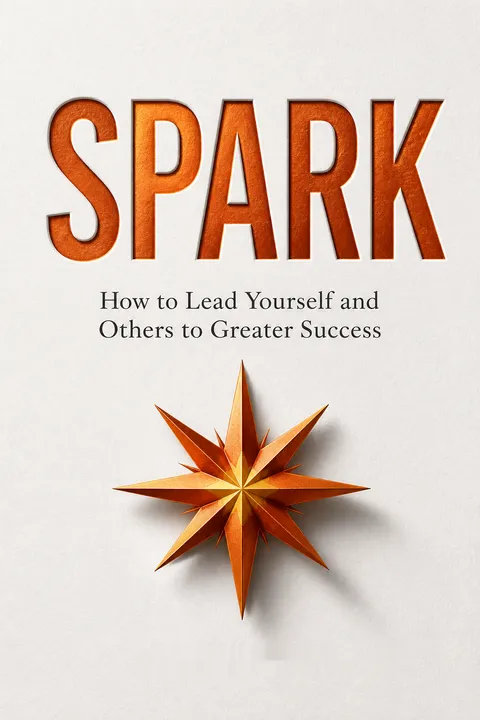


Key Takeaways
Lead through behavior before anyone hands you authority
Leadership is a choice. The book calls a person a Spark when they take responsibility, influence outcomes, and help others move toward a better result. A title may grant authority, but it does not guarantee leadership. The authors estimate that some leadership traits are partly innate, while much of effective leadership can be developed through practice. Their military training taught leadership to people at different ranks, including peers who had no authority over one another.
Start by seeing clearly. The Johari Window is a model for self-awareness that distinguishes what a person and others know, what the person keeps private, what others see as blind spots, and what remains undiscovered potential. Asking colleagues for specific feedback can make the blind-spot area smaller. The aim is not to become flawless, but to choose behaviors that others can trust.
What's powerful here is the separation of leadership from status. It makes influence a daily practice rather than a reward deferred until promotion, and it gives individual contributors a meaningful way to improve a workplace. The Johari Window also points to a useful tension: openness can increase trust, but disclosure should be selective and safe. In organizations with punitive feedback cultures, asking for candor may carry real risk. Leadership development works best when personal courage is matched by conditions that allow people to speak honestly.
Pause before reacting, especially when ego wants the microphone
Instinct is not always wisdom. Under pressure, people often avoid conflict, defend themselves, or freeze. The authors distinguish cognitive flexibility, the ability to shift approaches to solve a problem, from cognitive discipline, the ability to inhibit an automatic response and choose a more useful one. Both matter especially in relationships, where people can get stuck repeating a familiar pattern.
Buy time to think. One colleague repaired a tense working relationship by considering how her own blunt feedback and stubbornness looked to her coworker, then changing how she listened and responded. The authors also borrow an aviation reminder to stop and slow down during an emergency, rather than panic. In an office, that pause can mean asking what happened, what is known, and what response helps the team solve the problem.
This advice resembles a basic principle in cognitive science: a pause can interrupt automatic responses long enough for deliberate thought to engage. The important move is not suppressing emotion, but treating it as information rather than instruction. That distinction helps preserve useful instincts in familiar situations while reducing impulsive reactions in novel or high-stakes ones. Still, a pause alone cannot fix a hostile relationship. Flexible responses matter, but both parties need some willingness to change for the repair to last.
Make your values visible in choices people can observe
Values become character through action. The authors describe values as personal principles that guide choices, set limits, and help people decide what kind of life they want. They can shift with life circumstances, so reflection is needed to keep behavior aligned with current priorities. Sean, a fighter pilot, left full-time military service after becoming a father because family presence mattered more to him than continuing the career exactly as before. The decision cost him a cherished role, but it fit the person he wanted to be.
Pressure exposes the gap. In the Good Samaritan study discussed in the book, theology students were less likely to stop for a distressed stranger when they were hurried: the reported rate fell from nearly all unhurried students to 10 percent among those explicitly told to hurry. The Morning Morality Effect refers to research suggesting people are more prone to dishonest behavior later in the day than in the morning.
Values are most useful when they guide trade-offs, not when they decorate a mission statement. The study examples underscore how strongly context can shape conduct, even when people sincerely endorse helping or honesty. That is a valuable corrective to the idea that good intentions are enough. At the same time, values can conflict: family, service, ambition, and security may all matter at once. Reflection can clarify a choice, but it cannot always remove its cost. Organizations also shape behavior through workloads, incentives, and norms.
Earn credibility by aligning standards, promises, clarity, and accountability
Trust needs proof. The book treats credibility as a combination of sound character and dependable performance. Good intentions are not enough if work is unreliable, and strong results do not create trust if achieved through questionable conduct. A say-do gap is the difference between what someone commits to and what they actually deliver. Narrowing that gap means making realistic commitments and following through.
Make expectations workable. Credible behavior includes understanding what other people count on, defining what success looks like, and addressing missed standards directly. In research with radiation oncologists, nurses valued respect and accountability, patients wanted compassion and clear explanations, and staff needed complete documentation. Those differing expectations show why performance must be judged from the perspective of the people affected. Clear expectations and specific, private feedback help teams improve without turning correction into humiliation.
The account rightly expands performance beyond easily counted outputs. A physician's work, for example, affects patients, colleagues, and administrative staff in different ways, so one metric cannot capture the whole contribution. This stakeholder view is compatible with modern service design, which asks how an experience works for each person who depends on it. A caution follows: unspoken standards can reproduce bias or office politics. Leaders should make expectations discussable and relevant, rather than asking employees to guess which invisible rules matter.
Own your part in a failure before hunting for someone to blame
Responsibility creates options. Accountability means acknowledging one's contribution to a problem and moving toward a solution. It is not a hunt for a culprit, nor does it require accepting blame for factors outside one's control. The authors describe defensiveness as a predictable response to stress and ego threat, but argue that it blocks learning and damages trust.
The business had to look inward. During the 2008 downturn, Lead Star's third-quarter sales were about half their prior-year level. Rather than blame the salesperson or the economy, the founders examined their own sales model and realized clients wanted direct contact with the consultants doing the work. They changed course, and the firm ended 2008 with 6.2 percent growth over 2007, followed by 49.8 percent growth the next year. The point is to find the part of a problem that can be changed and act on it.
Accountability is most productive when it turns attention from personal defense toward useful control: what can be corrected, clarified, or redesigned? The business story shows that a disappointing outcome can reveal a flawed process rather than a deficient person. This fits a learning-oriented view of organizations, where mistakes are examined for system causes as well as individual choices. But accountability can be misused as a demand that employees absorb structural failures. Ownership should increase agency, not excuse poor leadership, impossible targets, or inadequate resources.
Choose a future, then build a calendar that can reach it
A vision can begin as a clue. After 23 years of flying, Sean felt stuck in a routine but could not picture another career. A conversation about Lead Star's training work helped him recognize that teaching pilots had already been a meaningful part of his experience. He tried facilitating a workshop, discovered new energy in the work, and eventually joined the firm. The lesson is not to quit impulsively, but to explore possible directions and test them with action.
Make room for change. The End of History Illusion is the mistaken belief that one's present self is close to finished, despite the likelihood of further change. The authors recommend looking for persistent interests, learning from people in other fields, writing ideas down, and seeking guidance. A plan turns a broad ambition into next steps. It also requires limits: one founder's five-month reduction in work hours helped her recover focus and reconnect with her priorities.
This approach joins future thinking with small experiments. Career change becomes less like a dramatic leap and more like a hypothesis tested through conversations, trial work, and reflection. That is especially useful when a person cannot yet name a complete new direction. The emphasis on calendars matters because intentions compete with existing routines. Yet a well-designed plan cannot guarantee opportunity, and not everyone has the financial or social flexibility to change paths. The most realistic vision accounts for constraints while still identifying meaningful choices within them.
Serve by noticing what people need to succeed, not by rescuing them
Service means helping others thrive. In the book, service-based leadership means acting for another person's success, not merely being pleasant or doing their work for them. The authors distinguish empowering someone with information, resources, and honest feedback from coddling or enabling them. Because needs change with circumstance, good service starts with listening and trying to understand what is actually useful.
Care can be practical. During Marine officer training, Angie learned that a demanding instructor could also show compassion. After her grandmother died, he arranged transportation home, coordinated her return to training, and urged her to stay with her family without rushing back. That response made care tangible. In a business example, trained mentors at Schlumberger helped new employees understand safety practices, workplace norms, and basic procedures, giving them support without taking away their responsibility.
Service is a strong counterweight to leadership built around status: it asks whether people have what they need to contribute, not whether the leader looks impressive. The distinction between empowering and rescuing is crucial because help should build another person's capacity. Still, service can become invisible labor, especially when some employees are repeatedly expected to provide emotional or practical support without recognition. Healthy service cultures distribute care fairly, set boundaries, and pair compassion with standards rather than treating self-sacrifice as proof of commitment.
Build confidence from remembered effort, honest self-talk, and candid allies
Confidence needs evidence. The authors describe confidence as a changeable belief in one's ability, not a permanent skill. They recommend recalling specific successes and recognizing the work behind them, rather than dismissing achievement as luck. During his transition from fighter jets to passenger aircraft, Sean struggled with simulator landings. Remembering how he had handled earlier challenges helped him focus on fundamentals, accept feedback, and continue training.
Correct the inner story. After Angie raised a proposal for greater board diversity and met silence, she assumed the room had rejected her. An experienced lawyer later told her the idea had mattered, which led to further conversations with senior military leaders. The episode illustrates how quickly self-doubt can turn ambiguity into imagined failure. The authors recommend replacing harsh self-appraisals with balanced ones and seeking people who offer honest guidance, not automatic praise.
The strongest version of confidence is calibrated: it draws on real evidence while remaining open to correction. Remembered accomplishments can counter the tendency to discount one's own contribution, while candid allies can challenge distorted interpretations. This connects to self-efficacy, the belief that one's actions can affect outcomes. But positive self-talk is not a substitute for skill, preparation, or fair evaluation. Encouragement is most credible when it names both capability and the next step needed to improve.
Protect consistency by practicing readiness and refusing needless busyness
Reliability is built before the crisis. The book defines readiness as being prepared mentally and practically to respond when circumstances change. Sean's Air Force squadron had practiced and coordinated so carefully that, when a U-2 aircraft went missing near the Korean border, the team could organize a search and rescue under severe pressure. The pilot was recovered, and the aircraft's black box later showed the loss was caused by mechanical failure, not an attack.
Protect the capacity to deliver. The authors argue that overcommitment undermines consistency. They suggest keeping open blocks of calendar time for important work, checking email at planned times, listing two or three essential tasks for the next day, and beginning with the hardest task. A backup plan helps when a routine is disrupted. Saying no is not a rejection of ambition; it can preserve the time and attention needed to keep important promises.
Readiness reframes consistency as a system, not a heroic burst of effort. Rehearsal, spare capacity, and contingency planning make steady performance more likely when surprises arrive. This is familiar in aviation and emergency operations, where coordination matters as much as individual competence. The transfer to ordinary work is persuasive, though workplace constraints are real: some roles cannot control email volume or protect uninterrupted time. In those settings, managers share responsibility for designing workloads that make reliable performance possible.
Analysis
Spark's central move is to make leadership ordinary without making it trivial. It relocates leadership from rank to repeatable conduct: respond thoughtfully, honor commitments, accept responsibility, notice others' needs, and prepare before pressure arrives. The military stories give these behaviors consequence and texture, while the civilian cases show how they can travel into businesses, professional firms, and family life. The result is a practical account of influence as something earned in interactions rather than conferred by an organization chart.
The book is strongest when it links individual behavior to observable team outcomes. Credibility depends on what stakeholders experience, service is defined by whether others can succeed, and accountability is valuable because it helps a group learn rather than remain stuck in blame. Its stories also reveal a useful paradox: disciplined standards and compassion are not opposites. A leader can demand performance while treating people as people.
The main limitation is the risk of individualizing problems that are partly structural. Employees can take ownership of their choices, but they cannot personally repair understaffing, unequal power, unsafe incentives, or unclear organizational priorities. Likewise, service can be exploited if care work is unevenly assigned, and consistency can become overwork if the only solution to missed commitments is more personal effort. The book's best ideas therefore need organizational counterparts: clear expectations, fair workload design, accessible feedback, and consequences for leaders who undermine trust. Taken together, the practical message is not to become endlessly available or to accept every burden. It is to notice where one's choices can change the situation, act there with integrity, and build enough support and structure to keep doing so. Leadership at every level becomes credible when agency is paired with humility about limits.
Review Summary
Spark received mostly positive reviews, with readers appreciating its practical leadership advice and real-world examples. Many found it helpful for developing leadership skills at all levels, regardless of job title. The book's emphasis on personal accountability, credibility, and consistency resonated with readers. Some criticized it for being repetitive or basic, while others praised its accessibility. The authors' military background provided unique insights, though some felt it limited the book's applicability. Overall, readers found it a solid introduction to leadership principles.
People Also Read










Glossary
Spark
Self-directed change-makerA Spark is someone who chooses to influence outcomes and help others move toward better results, regardless of job title. The term emphasizes observable actions such as taking initiative, following through, learning from mistakes, and making change possible. In the book, becoming a Spark is a choice and a practice, not a designation bestowed by an organization.
Johari Window
Map of self-awarenessA model developed by psychologists Joseph Luft and Harrington Ingham for thinking about what is known or unknown to oneself and to other people. Its four areas cover shared knowledge, private information, blind spots others can see, and undiscovered potential. The book uses it to encourage feedback, appropriate openness, and deliberate exploration of strengths.
Cognitive flexibility
Shift approaches to solveThe ability to change one's thinking or approach when the current method is not working. The book contrasts how readily people adapt to technical problems with how rigidly they may respond to interpersonal conflict. Considering another person's perspective and trying a different communication style are examples of applying cognitive flexibility.
Cognitive discipline
Replace automatic reactionsThe ability to inhibit an instinctive or habitual response and select a more effective one. It involves noticing emotional reactions, creating a brief pause, and choosing behavior that serves the situation rather than merely protecting the ego. The book presents it as a learnable foundation for accountability and constructive leadership under pressure.
say-do gap
Distance between promises and actionsThe difference between what a person says they will do and what they actually deliver. A small gap signals dependable follow-through; a large one weakens credibility because others cannot confidently plan around the person's commitments. The book recommends making realistic promises, communicating expectations clearly, and treating follow-through as a central part of performance.
Galatea Effect
Self-belief shaping behaviorThe idea that a person's beliefs and expectations about themselves influence their behavior and results. In the book, values can strengthen this effect: someone who sees honesty or dependability as part of their identity is more likely to act accordingly. The concept highlights how self-understanding can guide conduct, while not implying that belief alone guarantees success.
Morning Morality Effect
Ethical behavior varies by timeA finding discussed in the book that people may be more likely to behave dishonestly later in the day than earlier, as fatigue and depleted attention accumulate. The authors cite research reporting increased afternoon dishonesty and use it to argue that stress and tiredness can make values harder to enact. It is a situational risk, not a judgment of someone's character.
End of History Illusion
Underestimating future changeThe tendency to recognize how much one has changed in the past while assuming that one's present identity is nearly finished. The book uses this idea to challenge people who think they are too established to develop new interests or career directions. It encourages treating the future self as still capable of meaningful growth.
Readiness
Preparedness for changing conditionsA state of practical and mental preparedness that allows a person or team to respond effectively when circumstances change. In the book's military examples, readiness comes from regular training, rehearsal, coordination, and clear plans. Applied to everyday work, it means building habits and capacity before a crisis rather than relying on improvisation alone.
FAQ
1. What is "Spark: How to Lead Yourself and Others to Greater Success" by Angie Morgan about?
- Behavior-based leadership for all: The book presents a practical, behavior-based approach to leadership, emphasizing that anyone—regardless of title or position—can become a leader, or a "Spark," by adopting specific actions and mindsets.
- Military-inspired leadership lessons: Drawing from the authors’ military backgrounds, it translates proven leadership principles from the armed forces into actionable strategies for business and personal growth.
- Focus on self-leadership: The core message is that leadership starts with leading yourself—through self-awareness, accountability, and intentional action—before you can effectively lead others.
- Seven essential Spark behaviors: The book details seven key behaviors (character, credibility, accountability, intent, service, confidence, and consistency) that enable individuals to drive change and inspire those around them.
2. Why should I read "Spark" by Angie Morgan?
- Demystifies leadership: "Spark" dispels common myths about leadership, making it accessible to everyone, not just those in formal management roles.
- Actionable and relatable: The book is filled with real-life stories, practical exercises, and clear steps, making it easy to apply the concepts to your own life and work.
- Develops influence and impact: It teaches you how to build trust, credibility, and influence, which are essential for career advancement and effective teamwork.
- Prepares for change and challenge: In today’s fast-paced, uncertain environments, the Spark behaviors help you adapt, lead through ambiguity, and create positive change.
3. What are the key takeaways from "Spark" by Angie Morgan?
- Leadership is a choice: You are not born a leader; you become one through conscious decisions and consistent behaviors.
- Self-awareness is foundational: Understanding your values, strengths, and blind spots is critical for authentic leadership and personal growth.
- Accountability drives results: Taking ownership of mistakes and challenges, rather than blaming others, is essential for building trust and achieving goals.
- Service and consistency matter: Serving others and demonstrating reliability are key to building strong teams and lasting influence.
4. How does "Spark" by Angie Morgan define a "Spark" and what makes someone a Spark?
- Catalyst for change: A Spark is someone who recognizes opportunities for improvement and takes initiative to create positive change, regardless of their position.
- Defined by actions, not title: Sparks are identified by their behaviors—commitment, follow-through, and willingness to lead—rather than their job titles or formal authority.
- Influence and inspiration: Sparks influence outcomes and inspire others by modeling leadership behaviors and encouraging those around them to do the same.
- Resilient and proactive: They are proactive in facing challenges, resilient in the face of setbacks, and committed to continuous self-improvement.
5. What are the seven essential Spark behaviors described in "Spark" by Angie Morgan?
- Character: Aligning your actions with your core values to build trust and authenticity.
- Credibility: Consistently meeting or exceeding expectations, narrowing the gap between what you say and what you do.
- Accountability: Taking responsibility for your actions, learning from mistakes, and seeking solutions rather than placing blame.
- Intent: Acting with purpose and making decisions that align with your vision and goals.
- Service: Focusing on the needs of others, empowering teammates, and fostering a collaborative environment.
- Confidence: Managing your internal dialogue, building on past successes, and seeking positive role models to maintain self-belief.
- Consistency: Demonstrating reliability and perseverance, creating habits and routines that support your leadership goals.
6. How does "Spark" by Angie Morgan challenge common leadership myths?
- Leaders are not born: The book debunks the idea that leadership is an innate trait, emphasizing that it is developed through experience and conscious effort.
- Instincts aren’t always right: It warns against blindly trusting instincts, advocating for cognitive flexibility and discipline in responding to challenges.
- Titles don’t make leaders: Leadership is not conferred by a job title; it is earned through influence, credibility, and service to others.
- Growth mindset is essential: The authors stress the importance of adopting a growth mindset, believing that anyone can learn and improve as a leader.
7. What practical strategies does "Spark" by Angie Morgan offer for developing self-awareness and character?
- Johari Window model: The book introduces the Johari Window as a tool for understanding your known and unknown strengths, weaknesses, and blind spots.
- Values reflection: It encourages identifying your top five values and regularly assessing whether your actions align with them.
- Seeking feedback: The authors recommend actively soliciting feedback from peers, managers, and direct reports to uncover blind spots and areas for growth.
- Support networks: Building a circle of mentors, advisors, or mastermind groups helps maintain accountability and alignment with your values.
8. How does "Spark" by Angie Morgan explain the importance of credibility and how can you build it?
- Meet others’ standards: Understand and consistently meet both stated and unstated expectations of key stakeholders.
- Narrow your say-do gap: Ensure your actions match your commitments, following through on promises and deadlines.
- Communicate intent: Clearly articulate your goals and expectations to others, enabling initiative and reducing confusion.
- Hold others accountable: Provide constructive feedback and address performance issues directly, fostering a culture of trust and improvement.
9. What role does accountability play in "Spark" by Angie Morgan, and how can you practice it?
- Own your mistakes: Take responsibility for errors and missed expectations, focusing on solutions rather than excuses or blame.
- Model accountability: Demonstrate accountability in your own actions to inspire others to do the same.
- Promote open dialogue: Create opportunities for team debriefs and honest discussions about challenges and failures.
- Embrace discomfort: Recognize that accountability often requires courage and vulnerability, especially in difficult situations.
10. How does "Spark" by Angie Morgan address the concepts of intent, vision, and avoiding burnout?
- Act with purpose: Regularly reflect on your long-term vision and ensure your daily actions align with your goals.
- Plan for change: Develop concrete plans and structures to support your commitments, rather than relying on vague intentions.
- Recognize limits: Understand your capacity and learn to say "no" to prevent overcommitment and burnout.
- Balance and boundaries: Prioritize self-care, downtime, and strategic "white space" in your schedule to maintain energy and focus.
11. What does "Spark" by Angie Morgan teach about service-based leadership and building strong teams?
- Serve first, empower others: Focus on meeting the needs of colleagues, clients, and team members, anticipating their needs without waiting to be asked.
- Foster community and trust: Service-based leadership builds camaraderie, loyalty, and a sense of belonging within teams.
- Empower, don’t enable: True service is about empowering others to grow and succeed, not coddling or doing their work for them.
- Consistency in service: Make service a daily habit, not a one-time event, and avoid keeping score or expecting immediate returns.
12. What are the best quotes from "Spark" by Angie Morgan and what do they mean?
- "You’re not chosen to be a leader. You choose to lead." – Leadership is a proactive decision, not a status granted by others.
- "Leadership isn’t about authority. It’s about building credible influence with others." – True leadership is earned through trust and consistent behavior, not by position or power.
- "The more self-aware we are as Sparks, the greater our ability to own our shortcomings and correct them before they affect others." – Self-awareness is the foundation for personal growth and effective leadership.
- "Service is the essence of an unselfish act. And when you act selflessly, you can be the Spark who transforms a group of individuals into a team." – Serving others is key to building strong, high-performing teams.
- "Consistency and busyness are not the same thing. In fact, they are incompatible." – Being consistently effective requires focus and discipline, not simply being busy or overcommitted.
Download PDF
Download EPUB
.epub digital book format is ideal for reading ebooks on phones, tablets, and e-readers.








