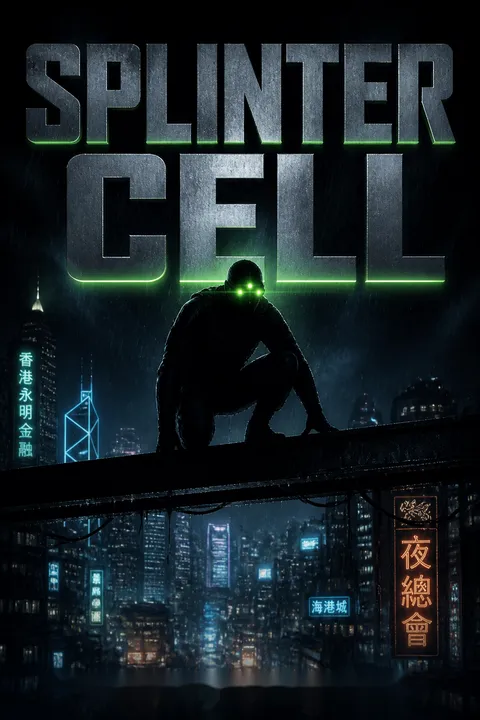


Plot Summary
Macau’s Hidden Ledger
Sam Fisher, Third Echelon’s solitary field operative, slips into Macau’s Tropical Casino to retrieve records linked to the Shop, an international arms-trafficking network. The trail began with Dan Lee, a fellow Splinter Cell murdered there while investigating the casino’s accounts. Sam copies evidence of secret payments, but Kim Wei Lo and his bodyguard Chen Wong enter the office before he can escape.
Wong spots him; Lo’s gun kills Wong in the ensuing struggle, and Sam kills Lo to avoid capture. Security guards chase Sam through the gaming floor, where he uses smoke and the casino’s furniture to break their line of sight. He hides beneath an SUV until the search ends, carrying proof that can expose one Shop pipeline.
Sam’s success is measurable in files copied, but its cost is immediate and human: Wong dies by his employer’s hand, and Sam kills Lo rather than risk capture. The casino makes espionage look like a contest of ingenious equipment and athletic skill, yet the operation depends on improvising inside other people’s workplaces and lives. Sam’s strict preference for invisibility cannot guarantee a clean result. The death of Dan Lee gives the mission its moral urgency, while the data Sam extracts turns private loss into a larger investigation.
Two Murders, One Signal
Back in Maryland, Sam tries to resume his quiet routine and reconnects with his daughter, Sarah, a Northwestern student planning a visit to Jerusalem with her Israeli friend Rivka Cohen. Their closeness is real, but Sam’s secret work keeps him distant and protective.
Colonel Lambert soon summons him: Splinter Cell Rick Benton and Belgian intelligence officer Dirk Verbaken have been murdered in Brussels, and the killers took a file concerning arms designer Gerard Bull. A suicide bombing at London’s National Theatre, claimed by the elusive Shadows, adds another urgent threat.
A recovered page from Verbaken’s file suggests that the Shadows buy weapons from the Shop. Lambert sends Sam to Iraq to continue Benton’s investigation, while Sarah leaves for Israel despite her father’s unease.
The plot brings two forms of vulnerability into the same frame. Sam’s professional world treats secrecy as protection, while his family life shows how secrecy also deprives him of ordinary trust. Sarah’s independent trip is not a rejection of her father so much as an attempt to live beyond his anxious perimeter. Meanwhile, the killings in Brussels and the London bombing connect a hidden commercial network to public violence. Sam’s assignment grows from a missing file into a race to understand who profits from terrorism, even as his personal attachments become newly exposed.
Arbil’s Stolen Arsenal
After arriving at a Baghdad base, Sam meets Lieutenant Colonel Dan Petlow, Benton’s army contact, and learns that weapons have been moving through Kurdish territory. A suicide driver then blows apart part of the base perimeter, killing two American soldiers and reinforcing the urgency of the arms trail.
Lambert redirects Sam to Arbil, where police have seized rifles and Stinger missiles. On the road, four men in stolen police uniforms try to take his Land Cruiser. Sam fights them off, but one escapes.
At the Arbil station, he finds the real officers murdered and their killer’s group preparing to reclaim the weapons. The men attack arriving police and soldiers, escape with a van, and kill more people. Petlow later uses a decoy arms story to capture the surviving gang, including the toothless attacker.
The apparent law-enforcement checkpoint becomes a test of Sam’s practiced suspicion: uniforms and authority prove worthless when the men wearing them have killed the real officers. His discovery arrives too late to prevent another attack, and his decision to observe rather than intervene leaves him questioning his orders. The stolen weapons are not an abstract inventory; they are the bait that draws violence back to Arbil. Petlow’s later deception succeeds where direct pursuit failed, showing how intelligence work depends on shaping an enemy’s choices as much as defeating them in combat.
Eli’s Tender Trap
In Jerusalem, Sarah reunites with Eli Horowitz, the former boyfriend she met at Northwestern, and mistakes his attention for a promise of a shared future. She does not know that Eli and Noel Brooks are working with the Shop. The men drug Sarah and Rivka during a night out; Eli takes Sarah to a warehouse, while Rivka is later found strangled.
Sarah wakes imprisoned, learns that her father is the real target, and refuses to help the captors contact him. Eli alternates threats with signs of regret, but his warnings cannot undo his betrayal. Sarah begins a hunger strike, holding back the one piece of information that might draw Sam into danger. Her captors keep her phone and address book, but she has memorized Sam’s emergency number.
Sarah’s vulnerability grows from recognizable human desires: intimacy, belonging, and the hope that a former relationship can resume. Eli exploits the trust built through those desires, making the betrayal more intimate than a simple kidnapping by strangers. Her refusal to give up Sam’s contact information is an effort to protect him, but it also leaves her with little control over what happens next. Rivka’s murder destroys the pair’s shared safety. Sarah’s hunger strike turns her body into the only leverage still available to her, though it steadily weakens the person trying to use it.
Tabriz to Lake Van
Sam crosses illegally into Iran and reaches Tabriz, where CIA informant Reza Hamadan warns him that the Shop may be hunting Splinter Cells. Reza shares Rick Benton’s abandoned notes and identifies Ahmed Mohammed as a Shadows operative, while the name Nasir Tarighian remains an uncertain lead.
Sam checks the Tabriz Container Company and finds shipping records linking its crates to Namik Basaran’s Turkish businesses and charity, Tirma. In Van, Basaran receives Sam as an Interpol investigator and admits knowing about Tarighian and Mohammed, but conceals what he knows about the Shop.
That night, gunmen try to kill Sam outside a restaurant. He escapes through Lake Van, then infiltrates Basaran’s compound and finds weapons, explosives, and blueprints bearing Albert Mertens’s name.
This leg of the investigation replaces a single suspect with a web of plausible fronts. Reza is useful because his local knowledge gives Sam direction, but even his information marks the limits of what can be verified. Basaran’s charitable reputation and polished hospitality contrast with the weapons hidden inside his enterprise. The restaurant ambush converts Sam’s suspicion into bodily danger, while the blueprints tie the seemingly respectable businessman to a past arms project. Sam has not yet solved the network, but each border crossed narrows the distance between public respectability and concealed violence.
Zdrok’s Locked Accounts
Shipping records lead Sam to Baku and the Swiss-Russian International Mercantile Bank. He recognizes its manager, Andrei Zdrok, from Benton’s photograph with Basaran. Sam breaks into the bank after hours, finds encrypted computer files, and discovers a concealed safe containing millions in transfers through numbered accounts.
One record shows Tirma paying eight million dollars for replacement arms. When the alarm sounds, Sam fights his way out through the back streets and escapes across the rooftops.
The evidence confirms that Basaran’s charity is financially entangled with the Shop, but Sam still cannot prove the men’s full relationship. He sends what he has to Washington, where Carly St. John can examine the accounts and Lambert can build a case against the network.
The safe gives the investigation a concrete financial spine: the Shop’s power rests not only on guns but on the ability to disguise who pays, who receives, and what a transaction supports. The Tirma transfer is especially damning because it turns public generosity into a possible channel for purchasing weapons. Yet Sam’s evidence is still partial, and Zdrok remains protected by encryption and distance. The escape from the bank marks a shift from covert observation to open exposure. Sam has found the network’s money, but the people behind it can still decide how violently to respond.
Diapers Over a Gunroom
At a Baku diaper factory named in Zdrok’s records, Sam discovers a concealed hangar beneath the warehouse and a cache of weapons supplied to the Shadows. He plants explosives, disguises the attack as a Tirma operation by scattering its pamphlets, and destroys the depot.
Carly also diverts an eight-million-dollar payment intended for Zdrok. Sam then receives Sarah’s emergency message: the Shop has her and demands that he come to Jerusalem.
In Washington, intelligence gathered from the Arbil prisoners identifies Basaran in an old photograph as Nasir Tarighian, the Shadows’ presumed-dead founder. Sam’s sabotage has struck the Shop’s business and deepened its conflict with the Shadows, but Sarah’s capture gives his enemies a direct way to force his hand.
The factory explosion is an act of tactical deception: Sam uses Tirma’s own public identity to make the blast look like a provocation from the Shadows. That choice exploits the Shop’s commercial self-interest and the distrust already growing between its partners and customers. The emotional cost arrives in Sarah’s message, which collapses the distance Sam normally maintains between work and home. Her danger is not incidental to the mission; it is the consequence of his identity becoming legible to his enemies. The revelation about Tarighian makes the public face and the hidden organization converge at precisely the moment Sam can least afford delay.
Basaran’s Buried Name
Lambert’s team confirms that Basaran is Nasir Tarighian, a wealthy Iranian whose family was killed in the Iran-Iraq War and who built the Shadows around revenge. Sam’s recordings, altered by Carly to sound as if Tarighian admits ordering the Baku attack, reach both men.
Zdrok believes the deception and orders a strike on Basaran’s compound in Van. A stolen Russian stealth fighter devastates Akdabar Enterprises, though Tarighian is away in Cyprus and survives. The attack damages his organization and confirms the Shop is willing to turn its weapons on its own customer.
Sam is ordered to Cyprus to find what Tarighian is preparing at the Famagusta mall. Before leaving, he must acknowledge the kidnappers’ deadline and accept that the mission and Sarah’s rescue now run on the same clock.
The false recording does not create the Shop’s distrust; it accelerates a fracture already opened by lost shipments, unpaid money, and competing ambitions. Sam’s technical deception therefore works because it gives existing suspicion a convincing form. Tarighian’s identity also changes the moral texture of the conflict: his terrorism grows from personal loss, but his grievance has become a justification for mass violence. The strike on Van punishes an organization rather than its leader, while Sam remains caught between a strategic objective and his daughter’s immediate peril. The clock gives those obligations a single, unforgiving measure.
The Mall Beneath the Mall
Sam reaches Northern Cyprus by swimming ashore near Famagusta and enters the unfinished shopping complex under the cover of construction traffic. Beneath its empty storefronts, he finds the Babylon Phoenix, a rebuilt version of Gerard Bull’s supergun, designed to launch a massive bomb across the Middle East.
He photographs the weapon and plants timed grenades around the upper level, hoping to delay its use until international forces arrive. Guards catch him before he can leave.
Tarighian identifies him as an American operative, explains that the weapon is meant to destroy Baghdad, and orders his men to execute him on camera. Sam is beaten and taken toward an incinerator room. The weapon is ready, the deadline is near, and Sam’s daughter remains held in Jerusalem.
The mall’s empty shops make the hidden weapon more than a surprise: the ordinary consumer setting is a deliberate shell around an instrument of indiscriminate destruction. The Phoenix also links the present conspiracy to Bull’s unfinished ambitions, turning old technical knowledge into a new political threat. Sam’s photographs and grenades are small interventions against a machine built to overwhelm ordinary resistance. Capture exposes the limits of his solitary method. For once, invisibility has failed, and the mission’s success depends on forces outside his control arriving before Tarighian can fire.
Ahmed Takes the Phoenix
As guards prepare to film Sam’s execution, gunfire erupts elsewhere in the complex. Ahmed Mohammed, the Shadows’ operational leader, has joined Albert Mertens and physicist Heinrich Eisler in rejecting Tarighian’s plan to destroy a Muslim city.
Mertens kills Tarighian, Eisler kills the bodyguard Farid, and Mohammed’s followers shoot Tarighian’s loyalists. The new leadership orders Mertens to redirect the Phoenix toward Jerusalem. In the confusion, Sam’s planted grenades explode and damage the balcony.
He knocks down the two guards in the incinerator room, frees his bound hands, retrieves his equipment, and runs outside. The revolt has removed the man who planned to fire on Baghdad, but it has shifted the weapon’s target toward the city where Sarah is held.
The coup is not a rescue engineered for Sam; it emerges from an internal dispute over what the Shadows are willing to do in the name of their cause. Ahmed and Mertens oppose Tarighian’s target, but their alternative still places a civilian city in danger. Removing a leader changes the chain of command without changing the weapon’s capacity for destruction. Sam’s escape depends on the explosions he planted earlier, a delayed consequence of his own planning rather than a sudden stroke of luck. The turn creates a cruel inversion: the rebellion saves Baghdad while threatening Sarah’s Jerusalem.
The Payload Over Water
Sam reaches high ground as American, British, and Turkish aircraft attack the Famagusta complex. Their missiles and bombs wreck the mall and the Phoenix, but the supergun fires before the strikes finish. Its payload, a massive airburst bomb, rises toward the Mediterranean.
Two American fighters pursue it and launch air-to-air missiles, destroying the bomb over the sea. Both aircraft are lost in the explosion. The remaining fighters continue their assault until the complex and supergun are reduced to burning wreckage.
Sam reports what happened to Lambert, then turns toward the Famagusta docks for transport to Israel. The weapon cannot reach Jerusalem, but the rescue remains unfinished, and every minute spent watching the strike has delayed his journey to Sarah.
The climax offers no clean victory. The allied attack destroys the weapon’s infrastructure, yet it arrives too late to prevent launch; only the pilots’ sacrifice stops the payload from reaching its target. The sea becomes the place where catastrophe is narrowly contained, not erased. Sam witnesses the cost from a distance, unable to intervene in the air battle, and then must leave the scene before grief can settle. The action resolves the global threat while preserving the novel’s personal urgency: Sarah is still missing, and military success has not yet restored Sam’s family.
Father Reaches Jerusalem
In Israel, Captain Abraham Weiss tells Sam that surveillance places Sarah in an abandoned warehouse near Jerusalem. Sam enters alone, finds her weak in a locked room, and then confronts Eli Horowitz and the two Russian enforcers. When Eli catches him at gunpoint, Sam throws him down the stairs as the Shin Bet team storms the building.
Sarah is carried to safety while the raid kills the Russian captors and captures Eli, who had hidden in the basement. Sarah rejects his apology. At the hospital, Sam learns that the kidnappers tortured her, though she survived by drinking water during her hunger strike. He and Sarah fly home together. The Shop’s banks are raided and the Shadows are crippled, but Zdrok escapes, leaving Sam’s work unfinished.
The rescue repairs physical proximity before it can repair trust. Sarah survives through stubborn resistance, but her recovery will require more than the arrival of her father; the bruises and betrayal remain part of her experience. Eli’s apology cannot restore the future he invited her to imagine, and Sarah’s refusal to accept it gives her a final act of agency. Sam, who has long treated attachment as a liability, returns to the relationship that his profession repeatedly interrupted. The ending offers tenderness without pretending that either the family’s hurt or the larger intelligence threat has vanished.
Analysis
The novel’s central conflict is built around two systems of secrecy. Third Echelon hides its agents from public view, while the Shop hides weapons and money behind banks, companies, charities, and international borders. Sam’s work exposes the second system by using the first: he photographs records, follows containers, and turns private data into pressure. Yet the book repeatedly shows the limits of information as control. Sam can locate a weapons cache, but the men carrying it escape; he can identify a terrorist network, but its leaders redirect a supergun before allied forces arrive.
The story also refuses to make terrorism a purely abstract political evil. Tarighian’s plan emerges from the deaths of his wife and daughters during the Iran-Iraq War. His grief is real, but he converts it into a claim on other people’s lives, treating Baghdad’s civilians as instruments of revenge. Mertens’s devotion to Gerard Bull’s work and Zdrok’s devotion to profit offer different routes to the same moral evasion: each man narrows responsibility until the consequences belong to someone else. Ahmed’s revolt changes the target but does not make the weapon harmless.
Against those vast structures, Sarah’s captivity makes the cost intimate. Sam has spent years protecting himself through distance, and his work has helped create the very information that makes Sarah a target. Her relationship with Eli demonstrates how easily trust can be engineered when a person longs for connection. Still, Sarah acts rather than merely suffers: she refuses to give up her father’s contact, and she survives by rationing what little control remains to her. Sam’s rescue cannot erase what happened, but it brings him back into a relationship he has habitually kept at arm’s length. The ending’s tenderness is therefore hard won, not a simple return to safety. The Shop’s leaders escape, the Shadows may regroup, and the emotional repair between father and daughter remains in progress.
Review Summary
Splinter Cell receives mixed reviews, with an average rating of 3.88/5. Fans of the video game series appreciate the expanded story and character development, particularly enjoying Sam Fisher's portrayal. Some readers find the action and espionage elements engaging, while others criticize the writing quality and overuse of technical jargon. The book's plot, involving terrorism and weapons dealing, is generally well-received. However, some reviewers note inconsistencies with the game lore and express disappointment in the book's portrayal of Middle Eastern characters.
Characters
Sam Fisher
The invisible operativeSam is Third Echelon’s first Splinter Cell, a highly trained agent sent alone into places where the United States cannot openly act. He prefers solitude, careful preparation, and the control of facts over the uncertainty of personal relationships. His years in espionage have made him skilled at reading danger, but they have also narrowed his private life. His daughter Sarah is the exception: he worries about her, wants a closer bond, and struggles to show affection without turning it into protection or warning. Sam’s tension between professional detachment and paternal attachment shapes his choices throughout the story.
Sarah Fisher
Sam’s independent daughterSarah is a Northwestern student, an English major, and Sam’s only child. Her mother died when Sarah was fifteen, after which Sam became her guardian, though his secretive work kept him from being a conventional parent. Sarah is bright, affectionate, and eager to make her own decisions, sometimes mistaking charm for honesty because she has been sheltered from danger. She loves her father but resents the distance created by his unexplained absences. Her wish for romance and independence exists alongside a fierce loyalty to the people she loves.
Irving Lambert
Sam’s mission chiefLambert directs Third Echelon and coordinates the analysts, hackers, and field support behind Sam’s missions. Experienced and politically connected, he understands that the agency’s secrecy protects its work while leaving its operatives exposed. He values Sam’s judgment but must balance concern for him against national security demands. Their relationship is professional, but its familiarity shows in Lambert’s candid briefings and his awareness of Sam’s private life. He is often the person who must turn incomplete intelligence into an order before the evidence is fully settled.
Namik Basaran
The celebrated benefactorBasaran is a wealthy Turkish businessman who presents himself as a successful entrepreneur and the head of Tirma, a charity for victims of terrorism. He is polished, generous in public, and skilled at discussing the region’s politics with apparent authority. His compound, corporate interests, and public reputation give him influence across borders. Sam notices that Basaran’s personal convictions are forceful and that his answers about the Shop are guarded. Basaran’s mixture of philanthropy, ambition, and political certainty makes him difficult to assess through appearances alone.
Andrei Zdrok
The banker behind the ShopZdrok is a wealthy financier who runs the Swiss-Russian International Mercantile Bank and values the private empire he has built. He treats arms sales as business and separates profit from the consequences of what his customers do with the weapons. His associates include former intelligence and military figures, and his banking structure helps hide the Shop’s transactions. Zdrok is calculating, proud of his success, and quick to regard interference as a threat to his enterprise. His appetite for control is matched by an instinct for preserving his own position.
Eli Horowitz
Sarah’s former boyfriendEli is an Israeli student of music who met Sarah at Northwestern and once dated her. Attractive, persuasive, and attentive to Sarah’s hopes, he gives her reason to imagine a future together. He has moved through several countries and carries a complicated history that he does not readily explain. Eli’s intelligence and capacity for affection coexist with a willingness to use people for his own purposes. His relationship with Sarah makes him central to the story’s examination of trust, not merely an obstacle in Sam’s mission.
Carly St. John
Third Echelon’s hackerCarly is Third Echelon’s technical director, a gifted programmer who can break into systems and analyze digital evidence from Washington. She hacks financial accounts, interprets files, and helps shape the information Sam gathers into useful intelligence. Her work often gives a remote team decisive influence over events unfolding thousands of miles away. Carly is intensely focused and private, and she takes pride in solving problems that others cannot even see.
Reza Hamadan
Sam’s Iranian contactReza is a carpet merchant in Tabriz and a long-standing CIA informant. His local connections allow him to give Sam leads that official channels cannot easily provide. He is hospitable, perceptive, and candid about the risks Sam faces, while keeping his own political choices grounded in practical experience. Reza offers both a safe place to rest and a bridge into the networks Sam must investigate.
Albert Mertens
The fugitive physicistMertens is a Belgian physicist once associated with arms designer Gerard Bull. He is brilliant, ideologically driven by loyalty to Bull’s work, and willing to pursue technical projects far beyond the bounds of lawful research. His past includes imprisonment and confinement in a mental institution, from which he later disappeared. Mertens’s expertise makes him valuable to powerful organizations, but his allegiance to a mentor’s legacy can conflict with the political aims of those who employ him.
Ahmed Mohammed
A Shadows field leaderAhmed is an Iranian operative associated with the Shadows’ political work and the execution of its plans. He is a committed organizer who understands the movement’s religious language and internal structure. His authority comes from turning directives into action, while his long association with the group gives him standing among its members. Ahmed’s judgments about strategy are shaped by his view of what the organization should represent.
Lieutenant Colonel Dan Petlow
Sam’s Iraq contactPetlow is an American army officer stationed in Iraq and Rick Benton’s former contact. He gives Sam local information, transport, and access to military resources while managing the dangers of working with a new Iraqi government. Practical and weary, Petlow understands that every operation is constrained by politics as well as firepower. His use of informants shows his willingness to adapt when direct action fails.
Rivka Cohen
Sarah’s closest friendRivka is Sarah’s best friend at Northwestern and the Israeli student who brings her to Jerusalem. She shares Sarah’s social world and introduces her to Eli and Noel. Her connection to her home country gives Sarah a trusted guide during the visit, but Rivka is also a young woman with her own relationships and plans. She represents the companionship Sarah relies on when her father is far away.
Noel Brooks
Eli’s longtime companionNoel is Eli’s former roommate and Rivka’s boyfriend. He is part of the social circle that brings the young women together with the men in Jerusalem. His easy humor helps make their evening feel safe, and his connection to Eli gives him access to Sarah and Rivka’s trust. Noel’s role in their lives is closely tied to Eli’s, though his own motives are not clear to the women.
Farid
Basaran’s silent bodyguardFarid is Basaran’s imposing bodyguard, driver, and assistant. A former prisoner of war, he lost his ability to speak after being tortured. His physical presence and loyalty make him a constant part of Basaran’s security, though he communicates without words.
Vlad
A Shop enforcerVlad is one of the Russian operatives assigned to guard Sarah and pursue Sam. He is physically threatening, enjoys intimidation, and treats captivity as a license to dominate others. His conduct makes the danger Sarah faces immediate and personal.
Yuri
A Shop enforcerYuri is Vlad’s partner, a disciplined Russian operative who handles weapons and security. He is less impulsive than Vlad but shares the same readiness to use force. Together they form part of the Shop’s effort to identify and capture Sam.
Plot Devices
The OPSAT
Fieldwork without a footprintSam’s wrist-worn Operational Satellite Uplink carries messages, maps, photographs, and mission data between him and Third Echelon. It allows Carly and Lambert to support him remotely without placing a visible team beside him. The device also records evidence that can turn a risky infiltration into a larger investigation. Its value depends on Sam remaining hidden and on the satellite connection working; it cannot protect him when he is captured or prevent enemies from exploiting information about his identity. It embodies the novel’s tension between solitary fieldwork and invisible institutional support.
The Shop’s bank network
Profit hidden in plain sightThe Shop uses the Swiss-Russian International Mercantile Bank and its Baku branch to disguise arms payments and launder profits. Numbered accounts and encrypted files keep customers and suppliers difficult to identify. Sam follows this financial trail from casino records in Macau, through shipping documents in Iran and Turkey, to Zdrok’s concealed safe. The network makes the Shop more than a collection of smugglers: it is a business with a supply chain, clients, logistics, and a financial infrastructure. When evidence and a diverted payment create mistrust between Zdrok and Tarighian, the same machinery that supports the operation becomes a source of internal conflict.
Tirma and the mall
Respectability as camouflageTirma presents itself as a charity aiding victims of terrorism, while Basaran’s Akdabar Enterprises appears to be a legitimate construction and industrial company. The Famagusta Center project likewise looks like an unfinished shopping mall. These public identities give the people behind the Shadows cover, access, and a reason to move goods and money. Sam turns the cover against the Shop when he scatters Tirma pamphlets at a hidden depot, encouraging Zdrok to suspect Tarighian. The device connects reputation to logistics: the more convincing the public face, the longer the covert operation can hide behind it.
The Babylon Phoenix
A city-sized threatBuilt by physicist Albert Mertens for Nasir Tarighian, the Babylon Phoenix revives Gerard Bull’s supergun design. Concealed beneath the Famagusta shopping complex, it can launch a massive payload roughly a thousand kilometers. Its scale forces the plot beyond ordinary arms smuggling: a weapon hidden inside a commercial building could alter the balance of power through one catastrophic strike. Tarighian intends to use it against Baghdad, but his organization’s internal conflict changes the target. Sam’s photographs and planted grenades buy time, while allied aircraft ultimately destroy the payload over the sea.
The doctored recording
Distrust turned into a weaponSam records Basaran discussing the Shop and its disputed payments. Carly edits the material so that it appears Tarighian admits to arranging the attack on the Shop’s Baku depot. The altered recording reaches Zdrok, who interprets it as proof that his customer has betrayed him and orders an air strike on Akdabar Enterprises. The deception works because the two organizations already distrust one another over lost weapons and unpaid money. It does not resolve the conflict; instead, it drives the Shop and the Shadows toward open retaliation and increases the pressure on Sam to understand Tarighian’s plans.
Download PDF
Download EPUB
.epub digital book format is ideal for reading ebooks on phones, tablets, and e-readers.








