

Plot Summary
The Frozen Serpent
Painter Mark Gurabardhi stops to inspect a snake found frozen in the street. The bystanders argue over whether to bury it again or warm it, while Mark remembers his absent friend Zef comparing Albania’s new confusions to an old tale.
In that tale, a young woman is forced to marry a real snake. Each night it becomes a handsome man, but she burns its snakeskin in the hope of keeping him human forever. He vanishes instead, leaving her grief-stricken and the village unable to explain what happened.
Mark’s lover arrives with news from Tirana, where political parties and new social groups are multiplying. She also reports a bank robbery. The snake’s uncertain state, neither quite alive nor dead, seems to Mark to belong to the same unsettled moment.
The street scene turns a commonplace curiosity into a test of how people interpret change. The crowd wants the frozen snake to be either harmless or dangerous, a creature to rescue or discard; Mark instead treats it as an emblem whose meaning cannot be fixed. The embedded marriage tale gives that uncertainty an intimate cost. The bride tries to abolish the boundary separating her husband’s human and animal forms, and her act destroys the life she hoped to secure. Mark’s relationship already carries a smaller version of that anxiety: his lover looks toward the future while he fears being left behind. The supernatural story does not explain Albania so much as make its competing explanations feel unstable.
Locks and Missing Lives
The robbery at the National Bank becomes the town’s consuming mystery: three masked men forced the safe, but no one knows how they entered or escaped. Mark asks after Zef and finds him missing, then hires locksmith Kol Koleci to reinforce his studio door.
Kol treats locks as a way to read both a thief and the person afraid of being robbed. His inspection stirs Mark’s buried wish to have joined the police instead of studying art. Mark remembers his father urging him toward the uniform and the state’s persecution of his painter friend Gentian.
As he broods over crime, he also imagines the ancient theft of immortality and the gods’ baffled investigation of Tantalus. The bank case is still unsolved, but Mark has begun to inhabit the investigator he never became.
Mark’s attention to the bank robbery is not simply a new hobby. The locksmith’s craft gives him a material vocabulary for the questions he cannot resolve about himself: who enters, what is hidden, and which side of a locked door a person belongs on. His father’s wish that he become a policeman remains a counterfactual identity, sharpened by memories of Gentian’s persecution. The myth of Tantalus expands this private conflict into a recurring problem of evidence: even divine authority cannot recover the whole story of a crime. Mark’s artist’s mind and imagined police mind therefore do not oppose one another cleanly. Both search for concealed causes, and both risk mistaking a compelling theory for proof.
Blood Debt Returns
When Mark’s lover returns from Tirana, she refuses his advances and tells him something is wrong at home. Her brother, Angelin, has become withdrawn, and the family is waiting for an elderly uncle from the mountains to explain a possible blood feud. Mark dismisses the revival of the Kanun, the customary law that once governed revenge, until she makes clear that her family takes the threat seriously.
At the café, a waiter describes the rumored Book of the Blood, a record of old claims and debts whose location has been lost. Some believe it lies in the mountains; others suspect the former regime hid it in a secret archive. Mark begins to wonder whether finding the book could prove the family has no debt to collect or repay.
The conversation makes political freedom feel less like a clean break than an opening through which suppressed institutions can return. Mark’s first response is rational skepticism, but it also protects him from the possibility that his lover is trapped by a law he cannot translate into modern terms. The Book of the Blood gives this fear a bureaucratic form: violence appears to have an archive, a ledger that could make obligation seem objective and inherited. Yet the book’s uncertain whereabouts make it impossible to tell whether it records a past that can be checked or a story people use to authorize present action. Mark’s curiosity grows precisely where his confidence fails.
Under the Secret Mountain
A Council of Europe delegation asks to visit a reopened convent and a highland Tower of Refuge. On the mountain road, the head of the music section tells Mark that the new head of state once traveled secretly to a buried archive and emerged shaken after hours inside its most restricted room.
The rumored archive may hold the Book of the Blood, or some other record capable of compromising the powerful. Later, Mark and his colleague enter a meeting where highland men argue over how to restrain the Kanun’s distorted revival.
One speaker insists its rules allowed a single shot, not modern weapons and indiscriminate killing. Mark thinks he recognizes Zef among the listeners, but cannot be sure. A note from his lover confirms that the awaited uncle has arrived.
The mountain visit brings two systems of authority into the same landscape. European visitors arrive to observe local custom, while the local assembly tries to decide which parts of that custom still command obedience. The secret archive complicates both encounters: state power may have preserved, exploited, or concealed the very history it claimed to abolish. Mark’s uncertain glimpse of Zef makes recognition itself another unstable record. He cannot tell whether his friend is physically present or only supplied by longing and suspicion. The assembly’s argument over the single shot shows that tradition is not a single, intact code. It is contested, revised, and vulnerable to being used as a respectable name for violence.
One Shot at Black Rock
A gunman shoots Marian Shkreli, Mark’s elegant, outward-looking director, as he leaves his home. Marian survives the first report only briefly, then dies in hospital. Mark hears that the killer is Angelin Ukaj, his lover’s brother, and recognizes the old formula naming the families as if the Kanun itself had issued the sentence.
The police search for Angelin, who has disappeared. Marian’s funeral travels to his mountain birthplace, Black Rock, where mourners perform old rites: men lament, and his bloodstained shirt is hung above the hearth.
The shooter obeyed the custom of firing once, but neither he nor Marian’s family completes the expected rituals of revenge and reconciliation. Mark watches the town argue over whether the Kanun has returned or merely been imitated.
The single shot makes the old law visible without making its authority legitimate. It is both a precise act by one young man and the opening of a communal sequence that could demand another death. Marian’s modern clothes and public role do not protect him from being absorbed into an older grammar of kinship. At the funeral, the bloodied shirt functions as evidence, but no one can agree on how to read it or whether the rite has been properly performed. The crowd’s uncertainty matters: the Kanun is not simply resurrected as a complete system. It survives in fragments, and those fragments are enough to organize fear while leaving responsibility unsettled.
An Iceberg's Hidden Body
A fever sends Mark into an imagined police station, where he questions suspects in the bank robbery and revisits the head of state’s unexplained search of the secret archive.
In the same fevered drift, an iceberg explains its collision with the Titanic, while the snake of the legend resists questions about its transformation. A counter-chapter places drowned migrants in the Strait of Otranto, joining the novel’s myths to contemporary flight and loss.
Once awake, Mark paints the iceberg’s hidden mass as a way to picture causes that remain beneath visible events. His lover returns after three weeks away, and their reunion restores their intimacy. She tells him Angelin is still hiding, while Mark confesses that he feared she would not come back.
Fever lets Mark act out the role he has only imagined: the investigator who can question history until it confesses. But each witness, from the iceberg to the snake, marks a limit rather than supplying a final answer. The submerged portion of the iceberg becomes his image for causation that is real yet inaccessible, a useful description of both Marian’s murder and the secret archive. The drowned people in the Otranto passage broaden the stakes beyond one town’s inherited law: movement toward a new life can also end in anonymous death. Mark’s reunion with his lover offers temporary bodily certainty, but it does not resolve the danger surrounding her family.
Angelin Comes at Midnight
Rumors place Judas, a suspected informer, near the secret archive, renewing Mark’s sense that old crimes and hidden records are converging. That night, his lover brings Angelin to the studio.
She explains that her brother had become disgusted by the new society’s fixation on money and had waited for the Young Idealists to give him a serious cause. Instead, their silence left him vulnerable to his uncle’s praise of the Kanun’s avengers and the revelation that their family owed a blood debt.
Angelin killed Marian, then understood that his act would keep the revenge cycle turning. He now wants to surrender and receive a death sentence, with the state named as the party settling the debt. Mark agrees to raise the proposal with the police chief.
Angelin’s account refuses the comfort of a single mastermind. His uncle supplies an inherited justification, but Angelin’s own hunger for meaningful action and the Idealists’ inaction also shape his choice. The murder is therefore neither merely ancient custom nor an inexplicable personal aberration. Angelin’s proposed solution is as radical as his crime: he wants the modern state to assume the role of the avenging clan, turning public punishment into a formal payment of blood. His sister’s presence makes the plan a shared attempt to limit the damage, though Mark’s suspicions about their intimacy remain his own and are never confirmed. By accepting the request, Mark steps into the police identity he once treated as an unrealized life.
Europe Refuses the Kanun
The police chief drives Mark into the mountains and listens as he presents Angelin’s proposal. While the chief rests, Mark looks through binoculars toward the rumored archive entrance.
He imagines a procession of former political leaders searching the same hidden place, then sees Oedipus, the blind king whose crimes Mark now reads as symbols of power rather than literal family acts. The vision gives no evidence about the archive, the leaders, or the murder.
A week later, Mark receives the authorities’ answer: the state will not alter its law to conform to the Kanun, citing European legal commitments. The decision leaves Angelin’s proposed settlement unavailable. Mark stares at the word Europe in the letter, then finds no answer in the empty sky.
The final refusal keeps the novel from offering a neat choice between ancient law and modern law. The state rejects the Kanun’s claim, but its authority is shadowed by Mark’s imagined procession of rulers seeking concealed records of their own guilt. His vision of Oedipus reframes inherited sin as a political mechanism: once power is seized, future crimes can be projected backward until the ruler appears guilty from the beginning. Yet vision cannot substitute for evidence, and neither the archive nor the murder’s deepest cause becomes fully knowable. The state’s letter is decisive only in a narrow sense. It closes Angelin’s requested route to settlement while leaving the human consequences and the historical mystery unresolved.
Analysis
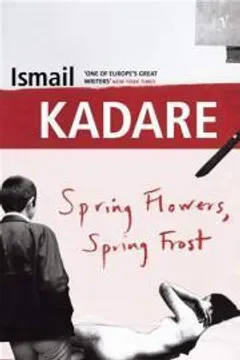
Spring Flowers, Spring Frost follows Mark through a society in which the collapse of dictatorship does not produce a clean, shared account of the past. Instead, old law, new political language, popular rumor, and European institutions compete to define what has happened and what should happen next. The Kanun returns not as an intact code but as disputed fragments: a single shot, a family debt, a bloodstained shirt. Those fragments can restrain action through ritual, yet they can also turn revenge into an obligation that outlives the people who began it.
Mark’s role as painter matters because he repeatedly tries to give hidden causes a visible shape. He paints an iceberg, studies locks, searches for signs in faces, and imagines himself as a policeman. Each method offers a different promise of knowledge, but none gives him a complete account. The iceberg’s unseen mass is not merely a symbol for secret guilt; it also captures how consequences can exceed anyone’s grasp of their causes. Mark’s theories are sometimes perceptive and sometimes projections born of jealousy, fear, or fever. The novel asks readers to remain alert to that difference without pretending that detached certainty is available.
The counter-chapters widen the novel’s scale. A snake bride’s private attempt to escape an imposed boundary, a mortal’s refusal of Death, and migrants’ bodies beneath the sea echo the town’s conflicts without reducing them to one allegorical answer. They make Albania’s recent history part of a broader human pattern in which people seek passage across borders and discover that the border may be inside the self, the state, or the story being told.
The ending offers no settlement between customary revenge and public justice. The state refuses to become an instrument of the Kanun, but that refusal does not undo the murder or reveal the archive’s secrets. Mark is left with a political answer and a moral remainder. The novel’s lasting insight is that institutions can decline a claim without erasing the history and fear that produced it.
Review Summary
Spring Flowers, Spring Frost is a complex novel set in post-communist Albania, exploring themes of tradition, modernity, and societal change. The story follows Mark, an artist navigating personal relationships and cultural shifts. Readers find the book's structure and symbolism challenging, with mixed opinions on its effectiveness. Some appreciate Kadare's unique narrative style and exploration of Albanian history and mythology, while others struggle with the disjointed plot and confusing elements. The novel's examination of Albania's transition from communism to democracy is seen as insightful, albeit sometimes difficult to fully grasp.
Characters
Mark Gurabardhi
Painter turned investigatorMark is a young painter working in a northern Albanian town during the unsettled years after dictatorship. He observes people and objects as if each might reveal a hidden history, yet he distrusts his own interpretations and often turns uncertainty into elaborate theories. His relationship with his lover exposes his fear that he belongs to the past while she belongs to a future he cannot enter. Memories of his father’s wish that he become a policeman give his artistic life a persistent counterfactual: Mark imagines the investigator he might have been. He is neither a detached observer nor a reliable guide to every event. His curiosity draws him toward danger, and his art gives him a way to hold mysteries without pretending to solve them.
Mark's girlfriend
Bridge to the futureMark’s lover is a young woman whose trips to Tirana bring news of changing fashions, politics, and social freedoms into his provincial life. She is affectionate and independent, but her family’s expectations place her inside a world Mark assumes is disappearing. Her care for her brother competes with her effort to build a life with Mark, and she does not always explain what she knows or fears. That reticence is not simple deception: it reflects how little control she has over the forces gathering around her family. Mark looks to her as a guide to the new era, even as she struggles with pressures rooted in the old one.
Angelin Ukaj
Restless younger brotherAngelin is the younger brother of Mark’s lover, a thoughtful and dissatisfied young man who finds the new society’s appetite for money and status difficult to accept. He is drawn to ideals of sacrifice and public purpose, but his desire for decisive action leaves him susceptible to inherited codes that promise honor through violence. His relationship with his sister is close, and she tries to understand his distress even when she cannot redirect it. Angelin embodies the danger of mistaking dramatic action for moral clarity: he wants his life to matter, but the available causes offer him no simple way to serve others.
Marian Shkreli
Modern-minded arts directorMarian directs the City Arts Center and carries himself with the polish of someone eager to belong to a wider European world. His bright clothes, professional courtesy, and delight in travel set him apart from the town’s suspicion and historical weight. He is not a political theorist; his importance lies in the ordinary signs of modern life he represents, from cultural work to the confidence of a changing Albania. Through Mark’s view of him, Marian becomes a measure of how little outward modernity can settle the older claims that still shape the town.
Zef
Missing friend and interpreterZef is Mark’s old friend, a sharp observer who reads Albania’s upheaval through myth and history. Before disappearing from Mark’s daily life, he compares the country’s shifting public faces to ancient stories of human and animal transformation. His absence gives Mark a personal mystery alongside the town’s public ones. Mark searches for him and repeatedly imagines where he might have gone, but those possibilities reveal as much about Mark’s fears as they do about Zef. Zef’s role is to sharpen Mark’s habit of seeing the present as an unfinished legend.
The uncle
Voice of inherited lawThe elderly uncle comes from the northern highlands and carries the authority of a family memory older than the Communist era. He believes customary law preserved courage and obligation when modern institutions failed, and he speaks of its enforcers with reverence. His worldview is shaped by disappointment in the present, but the confidence with which he invokes ancestral rules gives those rules fresh force among younger people. He represents tradition not as a relic in a museum, but as an argument that can still influence a family’s choices.
The head of the music section
Mark's curious colleagueMark’s colleague at the City Arts Center shares his appetite for rumor and unexplained history. He passes along an account of the new head of state’s secret journey to a mountain archive, helping turn local speculation into a larger mystery. Unlike Mark, he is comfortable voicing theories in conversation, and his companionship softens Mark’s isolation after Zef disappears. His role is that of a fellow witness: he can point toward a clue, but cannot establish what it means.
The police chief
Keeper of official powerThe newly appointed police chief operates between the demands of public order and the unsettled politics of the new era. He knows Mark’s interest in crime and eventually gives him room to present an unusual request. His manner can be genial, even playful, but his official position makes every conversation carry the weight of state authority. He embodies a government that is being asked to confront a form of violence it cannot simply treat as a private family matter.
Kol Koleci
Locksmith and amateur philosopherKol Koleci is the local locksmith Mark hires to strengthen his studio door after the bank robbery. He is absorbed by the mechanics of forced entry and treats locks as clues to a person’s character and an era’s fears. His trade gives him a practical authority that Mark both admires and finds unsettling. Kol’s musings about theft nudge Mark toward the idea that crime is not an interruption of history but one of its recurring engines.
Cuf Kertolla
Café regular and rumor sourceCuf Kertolla is a familiar presence at the Town Café, where political jokes and local speculation circulate. He gives voice to the town’s comic skepticism, especially as public life changes faster than people can make sense of it. His casual presence also helps Mark imagine how ordinary citizens might be connected to the bank robbery.
Palok Kuqi
Suspect in the bank robberyPalok Kuqi is one of the men Mark identifies in a feverish vision as a possible bank robber. The book offers him through the unstable border between investigation and hallucination, so his role contributes to Mark’s uncertainty rather than providing a dependable answer.
The snake's bride
Bride bound by a legendThe young bride in Mark’s remembered folktale is given in marriage to a real snake as payment for an offense her family will not clearly name. She meets a terrifying situation with a mix of obedience, endurance, and desire for an ordinary life. Her story is told through village rumor as well as her own hidden experience, so she remains difficult for others to understand. She connects the book’s mythic marriage to its questions about inherited obligation and the cost of trying to escape a role imposed by others.
Plot Devices
The Kanun
Inherited rules of revengeThe Kanun is the customary law that regulates blood debts, family obligation, and the rites surrounding revenge. After decades of suppression, rumors of its return spread through the northern town, and an assembly debates how its rules should apply in a world of automatic weapons and modern institutions. The law supplies a vocabulary for Angelin’s family crisis, but its revival is fragmented and disputed. People invoke its authority while disagreeing about which customs still count. It drives the novel’s central collision between kinship justice and the state, and it exposes how a tradition can be both a restraint on violence and a tool for renewing it.
The Book of the Blood
A ledger of old claimsThe Book of the Blood is rumored to record blood feuds and outstanding obligations across generations. No one in Mark’s town knows where it is, or whether it still exists. Some people associate it with the hidden archive in the mountains; others suspect it was concealed or used by the former regime. Its importance lies less in any verified contents than in the authority people imagine it could possess. Mark hopes it might clarify his lover’s family’s predicament, while the wider rumor turns the book into a possible instrument of judgment, blackmail, or historical reckoning.
Counter-chapter legends
Myth as parallel evidenceThe counter-chapters interrupt Mark’s contemporary story with tales of a woman married to a snake, a mortal who refuses Death, a Titanic iceberg, and migrants lost in the Strait of Otranto. These episodes do not explain the plot in a neat allegorical key. Instead, they repeat its problems in altered forms: boundaries between human and nonhuman, life and death, private guilt and public judgment. Mark’s thoughts often absorb these stories, blurring whether myth helps him interpret events or makes him more vulnerable to projection. Their changing points of view keep the reader aware that every account, including Mark’s, has limits.
Mark's police double
An unrealized second selfMark repeatedly imagines the life he might have led had he obeyed his father and joined the police. Under stress, that alternative self becomes vivid: he dreams of questioning suspects and confronting cases that reach from a local bank robbery to the secret archive and the ancient myths. The double is not a supernatural transformation with clear rules. It is a psychological structure that lets Mark rehearse authority while remaining uncertain of his actual power. When Angelin’s family brings him a proposal for the state, Mark’s imagined career suddenly becomes relevant to a real request.
The hidden archive
A vault of possible guiltThe secret mountain archive is linked to state records, the rumored Book of the Blood, and a mysterious visit by Albania’s new ruler soon after he took power. Its most restricted room is described only through fragments and testimony, while Mark’s fever and later visions supply images that cannot be verified. The archive functions as a place where the country’s buried past might have been preserved, concealed, or weaponized. Its physical obscurity mirrors the difficulty of assigning responsibility when political history is known chiefly through rumor, damaged memory, and fear.
Download PDF
Download EPUB
.epub digital book format is ideal for reading ebooks on phones, tablets, and e-readers.








