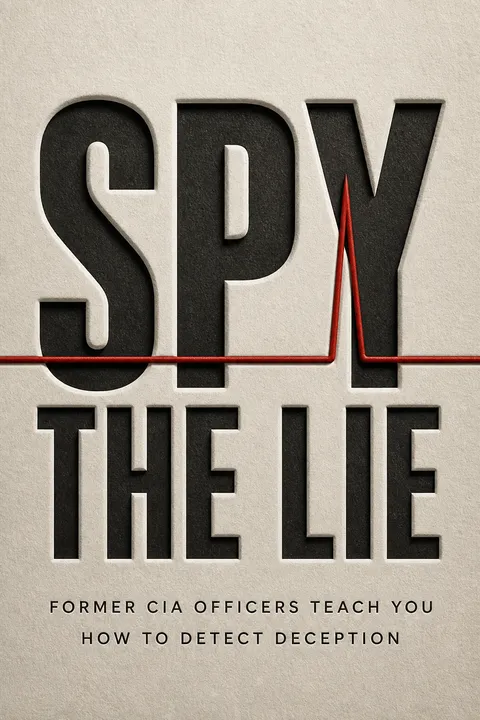


Key Takeaways
Treat a suspicious reaction as a lead, never as proof
A clue is not a verdict. The book opens with Omar, a trusted CIA source who had worked with the Agency for twenty years. When asked whether he had served another intelligence service, he behaved unexpectedly. His interviewer initially searched for innocent explanations, partly because he wanted Omar to be trustworthy. By returning to the question and following the resulting clues, he elicited Omar’s admission that he had spied for an adversary throughout their relationship.
Keep investigating. The interviewer still had to check whether Omar’s confession was true, then sought details that could corroborate it. The method is presented as a way to identify a question that deserves follow-up, not as a machine that reveals guilt. A person’s behavior can point toward a problem, but the facts must establish what happened.
The Omar story makes the method’s strongest point: a trusted reputation can become a reason to stop asking questions. In decision science, this resembles confirmation bias, the tendency to favor information that supports an existing belief. A structured procedure can interrupt that tendency. But suspicion is not evidence, and unusual behavior can have many causes. Treating a behavioral clue as a verdict risks harming innocent people, especially in high-stakes interviews. The soundest use is investigative humility: notice what changed, ask what might explain it, and seek independent confirmation before acting.
Judge the response to a question, not a person's whole demeanor
Connect behavior to its trigger. The authors build their method from a polygraph examiner’s habit of recording exactly when a question was asked and when a bodily response followed. In everyday interviews, they recommend the same discipline: pay attention to behavior that begins within five seconds of a question, then look for a cluster, meaning at least two possible indicators in the response. The indicators can be verbal, physical, or both.
Use the pattern carefully. A single gesture is too ambiguous to carry much weight. The authors argue that several indicators tied closely to one question make it more reasonable to investigate that subject. Even then, the cluster marks a possible problem area, not proof that the person lied. Their approach narrows attention instead of treating every movement or phrase as meaningful.
This is a useful shift from personality reading to event-based observation. It resembles experimental design: define the stimulus, observe the response, and avoid changing several conditions at once. That discipline reduces the temptation to invent a story about a person’s posture. Still, the five-second boundary is a practical rule from the authors’ method, not a universal law of cognition. Response timing varies with language processing, fatigue, disability, and the complexity of a question. The value lies less in the exact cutoff than in asking whether a behavior plausibly relates to the question just asked.
Separate relevant facts from truthful details that merely build a halo
Truth can distract. When a colleague accused Ronald of stealing cash, Ronald responded by emphasizing his church work and the Bibles in his car. The interviewer believed that account was true, but it did not answer whether Ronald took the money. He stayed focused on the allegation, and Ronald eventually confessed. In another case, a student accused of cheating showed an interviewer an impressive photo album of his home and acquaintances. The interviewer saw the display as an effort to shape his image, not as evidence about the exam.
Manage your own bias. The authors call this the convince-versus-convey distinction: a person may offer true or hard-to-disprove details to influence how an accusation is perceived. Filtering out irrelevant favorable information can help an interviewer resist personal sympathies. It does not mean ignoring relevant evidence that supports innocence.
The distinction is a sharp lesson in relevance: a true statement can still function as a distraction. It echoes courtroom reasoning, where evidence matters because of its connection to a claim, not because it makes a witness seem likable. The complication is that interviewers decide what counts as relevant, and that judgment can itself be biased. A person may mention religious service, hardship, or family because it genuinely explains context, not because it conceals wrongdoing. The safeguard is to keep the original question explicit and test whether each new detail answers it, rather than assuming that a favorable detail signals guilt.
Listen for evasion, not just an outright false denial
A lie can take several forms. The book sorts deception into lies that state something false, lies that leave out essential information, and lies that try to shape another person’s impression. A person may avoid a direct answer, repeat the question to gain time, attack the questioner, or offer a broad denial that never clearly addresses the allegation. These are possible indicators, not automatic proof.
Notice the answer’s shape. When asked about using profanity, Dick Cheney first said it was not language he usually used, then acknowledged that he probably had used it. The initial reply did not directly answer the question. Other examples include answers that are oddly narrow, buried in irrelevant detail, or padded with assurances about character and reputation. The interviewer’s task is to hear what was and was not answered, then follow up neutrally.
This approach usefully treats deception as communication strategy, not simply a false sentence. In pragmatics, meaning includes what speakers imply, omit, and presuppose, so attention to the structure of an answer can reveal more than a yes-or-no check. Yet these patterns are not unique to lying. A person may evade because of privacy, fear of consequences, poor comprehension, or distrust of the interviewer. The distinction among commission, omission, and influence helps organize observations, but it cannot tell an interviewer why someone is withholding information. Follow-up should clarify before it accuses.
A nervous gesture means little unless it follows a precise question
Context beats body-language folklore. The authors describe possible nonverbal indicators such as a delayed response, a mismatch between a spoken answer and a head movement, touching the face, swallowing before answering, shifting body anchor points, or grooming clothes and surroundings. They argue that these matter only when they appear in close response to a relevant question and as part of a cluster.
Ignore familiar myths. Poor eye contact, crossed arms, general nervousness, blushing, twitching, or clenched hands do not reliably establish deception. A person could be cold, anxious about being questioned, responding to cultural norms, or simply behaving habitually. Even a meaningful-looking gesture has to be interpreted in context. The authors’ warning is to avoid turning global body-language impressions into a verdict.
The caution against reading a whole personality from crossed arms or averted eyes is especially valuable. Anxiety is a broad signal produced by many conditions, and an interview itself can create stress for truthful people. This is a classic problem of measurement: an observable response may be real while its cause remains uncertain. Cultural differences and neurodivergence further complicate interpretation. The book’s solution, tying behavior to a question and requiring multiple clues, is more disciplined than pop body-language advice, but clusters can still reflect one underlying source of stress rather than several independent signs.
Ask questions that make a rehearsed story harder to use
Build the interview deliberately. The authors recommend short, clear questions with one meaning, delivered without obvious hostility. An open question can establish a person’s account; a focused question can test a specific detail. A presumptive question assumes the person may know something about the event, while a bait question raises a hypothetical possibility that may prompt a deceptive person to reconsider a prepared story. The book advises using each sparingly and neutrally.
Do not hand over the script. In its discussion of the O. J. Simpson interview, the book argues that asking about the person’s whereabouts can invite a rehearsed answer. A question about what happened at the victim’s home, followed by a hypothetical about what neighbors might report, could have produced more useful information. The authors also recommend follow-ups such as asking what else, requesting clarification, and using a catch-all question to surface omitted details.
Question design is the most operational part of the book. It recognizes that an interview is not passive observation: the interviewer shapes what can be learned. This connects to survey design, where ambiguous or leading wording changes responses and makes results hard to interpret. The authors’ emphasis on simplicity and neutrality is therefore sound. Their more strategic questions, however, can become manipulative if used carelessly. A hypothetical prompt is not a substitute for evidence, and an interviewer who treats hesitation as confirmation may push a person toward a false account. Clarity and fairness should govern the technique.
Keep the interview calm so a lie does not harden into a script
Avoid forcing repetition. The book calls psychological entrenchment the pressure to stick with a story after repeating it. Repeatedly challenging someone’s denial can make retreat feel more costly, even if the person is lying. Instead, the authors favor a nonconfrontational style: acknowledge a person’s reassuring statement without accepting it as an answer, then return to the topic. If a person admits one instance of misconduct, broaden the questions to find out whether there were others before drilling into details.
Lower the cost of disclosure. A question prologue briefly explains why a sensitive question matters and may offer a reasonable context for answering. The authors also suggest responding to a changed account with requests for clarification rather than accusations. These techniques aim to keep the person talking and preserve dignity, while still testing the information provided.
The emphasis on calm questioning has an important ethical dimension. When interviewers reduce humiliation and threat, they may make truthful disclosure easier and avoid turning an inquiry into a contest of wills. The idea also aligns with procedural justice: people are more likely to cooperate when they feel heard and treated fairly. But minimizing consequences or offering a rationale can cross into undue influence, particularly when the interviewer controls someone’s job, safety, or freedom. Respectful rapport should support accurate information gathering, not become a tool for pressuring a vulnerable person into saying what the interviewer expects.
Read literal wording for accidental admissions, not emotional performances
Listen for unintended messages. The authors describe a truthful statement that inadvertently reveals something its speaker may not intend to disclose. In an interview about alleged accounting fraud, a company executive described a new system for selling and counting revenue. The authors interpreted the wording as suggestive of the very accounting practices under scrutiny. In a separate threat investigation, a caller claimed to know less than the alleged conspirators had told him, an inconsistency that helped expose the story as fabricated.
Check the inference. The book also discusses asking a suspect what should happen to the person responsible for an act. An unusually lenient answer may warrant follow-up, but a harsh answer is not proof of innocence. The useful habit is to examine a person’s exact words and ask what they commit the speaker to, without mistaking an intriguing interpretation for established fact.
Literal listening can reveal contradictions that a dramatic show of emotion obscures. It is related to linguistic analysis, where small choices such as qualifiers and pronouns can carry pragmatic meaning. Yet interpreting an unintended message is inherently inferential. A phrase can sound incriminating after an outcome is known, especially when analysts select examples that fit the conclusion. The discipline is to record the wording, generate more than one plausible interpretation, and test each against independent facts. The method is strongest when it produces a question to investigate, not when it turns a clever reading into a claim of guilt.
Use behavioral clues to decide what to verify next, not whom to condemn
The method has limits at home, too. Near the end of the book, a CIA officer notices that his wife displays a cluster of possible indicators after a joking remark about a phone call. The observation unsettles him, but it does not establish that she is unfaithful. The authors’ advice is that he has more work to do, not that he should accuse her or assume the worst. They similarly warn readers not to announce that they are monitoring someone’s behavior, since that can make the person defensive and change the interaction.
Practice with restraint. The authors suggest practicing on interviews and news programs, using the method only for constructive purposes, and thinking carefully before asking questions whose answers may matter deeply. A clue should guide verification and decision-making, not replace them.
This ending makes the method’s personal cost visible: noticing a signal can create anxiety before it creates knowledge. In close relationships, suspicion can become self-reinforcing, because ambiguous behavior is interpreted through fear and then used to justify more scrutiny. The advice to pause and gather information protects both accuracy and trust. A further safeguard is to consider what evidence could disconfirm the suspicion, not just what would support it. Behavioral interpretation is most responsible when it widens inquiry while keeping judgment provisional.
Analysis
Spy the Lie is a practical guide to interviewing, built around a counterintuitive premise: the route to truth is not to read every twitch, but to constrain attention to behaviors that follow a specific question. Its most valuable contribution is procedural. It tells readers to separate observations from interpretations, notice whether an answer actually addresses the question, and treat suspicious patterns as prompts for further inquiry. The stories make that sequence memorable, particularly the trusted source who deceived his handlers for decades and the accused people who shifted attention toward irrelevant but favorable facts.
The book’s strongest claims deserve a careful boundary. The authors’ experience in intelligence, polygraph examination, and investigations is substantial, but professional experience and compelling case narratives do not establish a method’s accuracy in ordinary conversation. Many examples are interpreted after the outcome is known, which creates hindsight and selection risks. The proposed five-second window and behavior clusters offer structure, but the text does not provide controlled validation showing how often these rules distinguish lies from truthful discomfort. A behavior can be accurately observed and still be wrongly attributed to deception.
That distinction matters because the costs of error are asymmetric. In casual settings, a false suspicion can corrode trust; in employment or criminal inquiries, it can damage livelihoods and liberty. Anxiety, language processing, cultural norms, trauma, and neurodivergence can all shape responses. Nor does an interviewer’s calm demeanor guarantee that a question is fair or that a confession is reliable. The book’s nonconfrontational approach is a meaningful protection, but not a complete safeguard.
The soundest reading is therefore neither credulous nor dismissive. Use the method as an attention and questioning framework: identify unanswered questions, document what was actually said, seek corroboration, and remain open to innocent explanations. Its deepest lesson is not that people can be reliably decoded from behavior. It is that disciplined listening can reveal where understanding is incomplete, and where verification should begin.
Review Summary
Spy the Lie receives mixed reviews. Many readers find it insightful, offering practical techniques for detecting deception through behavioral analysis. The book is praised for its clear explanations and real-world examples. Some appreciate its application beyond law enforcement, finding it useful in everyday situations. However, critics argue that the content is common knowledge, overly simplistic, or lacks scientific backing. The writing style and anecdotes receive both praise and criticism. Overall, readers value the book's approach to understanding human behavior, though opinions on its effectiveness vary.
People Also Read





Glossary
the model
Question-linked behavior analysisThe book’s practical method for assessing possible deception during an interview. It focuses attention on verbal and nonverbal behavior that follows a particular question, rather than interpreting a person’s overall demeanor. The method is intended to identify topics that need follow-up, not to prove that someone is lying.
Timing
Link response to stimulusA guideline in the model that focuses on when a behavior begins after a question or statement. The authors use a five-second window for the first possible indicator, reasoning that behavior farther removed from the question may have another cause. Timing helps connect an observed response to a particular stimulus.
Cluster
Multiple possible indicatorsA combination of at least two possible deceptive indicators occurring in a response, with the first appearing within the model’s timing window. A cluster can include verbal behaviors, nonverbal behaviors, or both. The book treats clusters as reasons to investigate further, not as definitive evidence of deception.
L-squared mode
Look and listen togetherThe authors’ term for deliberately attending to verbal and nonverbal information at the same time. Rather than concentrating only on what a person says or only on visible movement, the interviewer tries to observe and hear both channels, especially during the response to a question.
Global behavior assessment
Reading overall demeanorAn approach that tries to collect and interpret a person’s full range of behavior, including posture, gestures, and general nervousness. The authors discourage it because it overloads attention and encourages guesses about what a behavior means. Their alternative is to focus on specific responses linked to clear questions.
Convincing statement
Impression-shaping responseA true, emotionally persuasive, or difficult-to-disprove statement offered to shape an interviewer’s view of the speaker instead of answering the issue at hand. Claims about good character, reputation, or devotion to family may function this way. The statement is a possible indicator only when considered in context and alongside other behavior.
Unintended message
Accidental disclosure in wordingInformation that a speaker may reveal without intending to while trying to conceal or deflect the truth. The authors examine the literal wording of statements for implications that conflict with the speaker’s apparent position. Such interpretations can guide follow-up, but require corroboration because wording can be ambiguous.
Presumptive question
Question that assumes relevant knowledgeA question framed as though the person may have information or involvement related to the subject under discussion. Unlike a leading question, it does not supply a specific answer. The authors use this question type to make a rehearsed denial less convenient and to observe how the person responds.
Bait question
Hypothetical prompt for responseA question that introduces a hypothetical possibility, often about what another person might report or what evidence might appear. The authors argue that it can prompt someone who is concealing information to reconsider a prepared account. It should be used sparingly, neutrally, and as a means of eliciting information, not as proof.
psychological entrenchment
Pressure to stick with a storyThe increased commitment that can arise when a person repeatedly states a denial or explanation. Once a story has been repeated, changing it may feel like an admission of lying, so further direct challenges can make disclosure harder. The authors recommend calm follow-up and question strategies that avoid forcing repeated denials.
Question prologue
Brief context before a questionA short explanation given before a sensitive question to clarify why the question matters and what information is needed. The authors suggest that it can reduce defensiveness and encourage cooperation. It may include a reason for asking, a socially understandable context, or a limited explanation of the concern.
FAQ
What's "Spy the Lie" about?
- Detecting Deception: "Spy the Lie" is a guide on how to detect deception, written by former CIA officers. It provides insights into identifying lies through verbal and nonverbal cues.
- Methodology: The book introduces a specific methodology developed within the CIA, which is now used by intelligence and law enforcement communities to detect deception.
- Practical Applications: It offers practical advice for everyday situations, such as interviews, negotiations, and personal interactions, where detecting deception can be beneficial.
Why should I read "Spy the Lie"?
- Expert Insights: The authors are former CIA officers with extensive experience in deception detection, providing credible and authoritative insights.
- Practical Techniques: The book offers practical techniques that can be applied in various personal and professional scenarios to identify deception.
- Improved Communication: Understanding deception can enhance your communication skills and help you make better-informed decisions.
What are the key takeaways of "Spy the Lie"?
- Focus on Clusters: Look for clusters of deceptive behaviors rather than isolated incidents to increase the likelihood of detecting deception.
- Ignore Truthful Behavior: To find deception, ignore truthful behavior that doesn't address the issue at hand, as it can be used to mislead.
- Use of Questions: The book emphasizes the importance of asking the right questions, such as presumptive and bait questions, to elicit truthful responses.
What is the deception-detection methodology in "Spy the Lie"?
- Strategic Principle: The methodology is based on ignoring truthful behavior to focus on detecting deception.
- Guidelines: It includes two main guidelines: timing (looking for deceptive behavior within five seconds of a stimulus) and clusters (identifying two or more deceptive indicators).
- Application: The methodology is applied through a systematic approach to analyzing verbal and nonverbal behaviors in response to questions.
How do the authors suggest managing deception?
- Avoid Entrenchment: Avoid asking negative questions that allow the person to entrench themselves in their lie.
- Use Prologues: Introduce key questions with prologues to prime the information pump and encourage openness.
- Overcome Alibis: Use strategies like bait questions and the possibility strategy to overcome psychological alibis and selective memory.
What are some key quotes from "Spy the Lie" and what do they mean?
- "No mask like open truth to cover lies." This quote emphasizes that sometimes the best way to hide a lie is to present it as an open truth, making it harder to detect.
- "People do not believe lies because they have to, but because they want to." This highlights the human tendency to believe what aligns with their desires or biases, even if it's a lie.
- "Truth fears no questions." This suggests that truth can withstand scrutiny and questioning, whereas lies often crumble under pressure.
What are the common deceptive behaviors identified in "Spy the Lie"?
- Failure to Answer: When a person doesn't directly answer a question, it can indicate deception.
- Convincing Statements: Statements made to convince rather than convey factual information are often deceptive.
- Nonverbal Cues: Behaviors like hiding the mouth or eyes, throat-clearing, and anchor-point movements can signal deception.
How does "Spy the Lie" suggest using questions to detect deception?
- Presumptive Questions: These questions presume something about the situation, prompting the person to reveal more information.
- Bait Questions: Hypothetical questions that create a "mind virus," causing the person to consider the implications of their actions.
- Catch-All Questions: Used to uncover lies of omission and ensure no important information is overlooked.
What role do biases play in deception detection according to "Spy the Lie"?
- Managing Biases: The book emphasizes the importance of managing personal biases to avoid being misled by deceptive behavior.
- Bias Influence: Biases can affect judgment and lead to incorrect conclusions about a person's truthfulness.
- Objective Assessment: A systematic approach helps mitigate the impact of biases on deception detection.
How does "Spy the Lie" address the use of nonverbal cues in detecting deception?
- Nonverbal Dominance: Nonverbal communication makes up a significant portion of human interaction, making it crucial in detecting deception.
- Specific Cues: The book identifies specific nonverbal behaviors, such as hand-to-face activity and grooming gestures, as potential indicators of deception.
- Avoiding Global Assessment: It advises against relying on global assessments of body language, focusing instead on specific cues in response to questions.
What are the limitations of deception detection as discussed in "Spy the Lie"?
- No Human Lie Detector: The book acknowledges that no one can detect lies with absolute certainty, emphasizing the need for a systematic approach.
- Behavioral Myths: It warns against relying on common myths, such as poor eye contact, as definitive signs of deception.
- Complexity of Communication: The book highlights the complexities of communication and the challenges they pose in accurately detecting deception.
How can "Spy the Lie" be applied in everyday life?
- Personal Relationships: Use the techniques to improve communication and trust in personal relationships by identifying potential deception.
- Professional Settings: Apply the methodology in interviews, negotiations, and other professional interactions to make better-informed decisions.
- Enhanced Awareness: The book helps develop a heightened awareness of verbal and nonverbal cues, improving overall communication skills.
About the Author
Other books by Philip Houston

Download PDF
Download EPUB
.epub digital book format is ideal for reading ebooks on phones, tablets, and e-readers.








