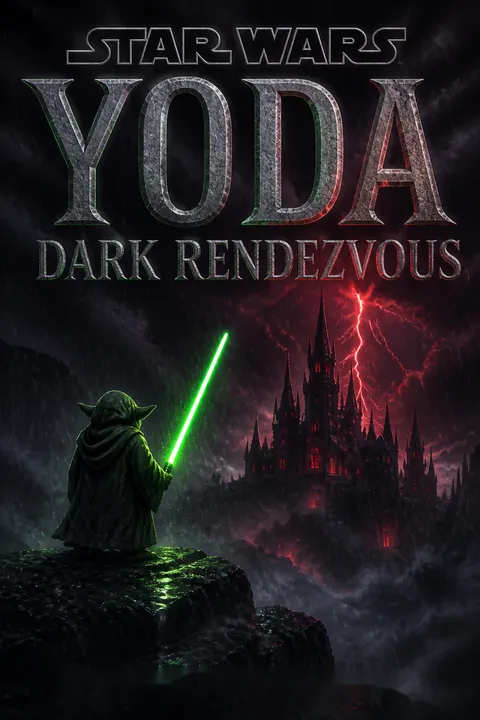


Plot Summary
The Shell from Vjun
Jedi Master Jai Maruk returns to Coruscant scorched and bloodied after following disguised Trade Federation transports to Vjun. There, Asajj Ventress defeated him, but Count Dooku spared his life to deliver a message to Yoda: he wants peace, and a plain shell is the clue to their shared past.
Decades earlier, the gifted young Dooku had confided to Yoda that he feared becoming too estranged from the Jedi Temple to return. He left a shell in the garden, and Yoda promised that home would remain open to him. Now the shell makes the offer painfully personal. Meanwhile, Ventress asks Dooku to make her his Sith apprentice. He refuses, warning that power would turn her ambition toward replacing him.
The shell turns diplomacy into an intimate test. Dooku is not merely asking an enemy to negotiate; he is reaching toward the teacher who once offered him a home. Yet the memory also exposes the wound beneath his pride: he has long understood belonging as something fragile, granted by others and easily withdrawn. Ventress’s demand sharpens the contrast. She wants status and power, while Dooku recognizes that apprenticeship in the Sith tradition carries its own machinery of betrayal. His refusal may be caution, affection, or control, but the scene makes clear that he understands the danger because he has lived inside it.
A Candle Across the War
Senator Padmé Amidala helps a Troxan delegation deliver a candle to Dooku, and a damaged lightsaber sent back through the Jedi Temple reveals his recorded invitation to Yoda. The former student warns that both sides are compromised and that the meeting must remain secret.
Yoda chooses to go, despite Mace Windu’s fears and the danger of trusting Dooku. Elsewhere, young Padawan Whie wakes from a prophetic dream of himself, fellow apprentice Scout, and a tattooed woman in a bloodied room.
He hides how frightened he is. The apparent death of Jedi Jang Li-Li, whose broken weapon carried Dooku’s message, deepens Yoda’s grief. At the same time, Chancellor Palpatine uses the crisis to press the Senate toward a new security force under his authority.
The invitation places hope under conditions designed to suffocate it: secrecy, suspicion, and a war that has trained institutions to treat every gesture as strategy. Yoda’s decision is not naïve faith in Dooku. It is a calculation that even a small chance of peace matters against the lives at stake. Whie’s vision introduces a different uncertainty: he can glimpse a future but cannot tell whether it is warning, temptation, or a fixed outcome. Palpatine’s political maneuvering supplies the public cost of the mission. While Yoda seeks private reconciliation, the Republic responds to fear by centralizing power.
Scout Wins Her Place
Tallisibeth Enwandung-Esterhazy, known as Scout, enters the Temple tournament convinced that another failure could send her to the Agricultural Corps. With little Force strength to rely on, she studies her opponents and builds her chances around timing, nerve, and close combat.
She beats Pax Chizzik by turning his friendly handshake into a wrist lock, then survives a darkened match against the more powerful Hanna Ding by grabbing Hanna’s live training blade and forcing a surrender.
In the chaotic dining-room final, Scout uses her knowledge of choke holds and her opponents’ blind spots to outlast the remaining apprentices, including Whie. Her victory earns her a place as Jai Maruk’s Padawan. Whie, whose own skill is effortless, is shaken by how strongly Scout’s presence affects him.
Scout’s tournament is a practical argument about what counts as ability. The Jedi can measure Force sensitivity, but Scout’s victories come from attention, preparation, and a willingness to endure pain without surrendering. Her methods are not always elegant, and Hanna’s criticism exposes the danger of treating any successful tactic as automatically virtuous. Yet Scout is not merely gaming rules for advancement. She studies other people closely because the institution has made her feel perpetually replaceable. Winning gives her a place, but it also reveals a more demanding truth: she has earned responsibility without erasing the insecurity that drove her to fight.
The False Yoda Takes Off
To hide Yoda’s departure, the Jedi send actor Palleus Chuff into space wearing a convincing Yoda disguise, while the real Master travels inside an R2 unit with Scout, Whie, Jai, and Jedi Master Maks Leem. Their passage through Coruscant’s crowded spaceport exposes how mistrusted the Jedi have become, even as sympathetic staff quietly help them.
On the liner, Whie meets Fidelis, a servant droid who recognizes him as Whie Malreaux, heir to a Vjun household. Whie rejects the identity but learns that Count Dooku now occupies his family’s estate. Ventress attacks Chuff’s decoy ship and lets the Republic believe Yoda has died. The false report shakes public confidence and gives Palpatine fresh leverage in the Senate.
The decoy makes identity itself a tactical instrument. Chuff performs the public image of Yoda while the real Master becomes nearly invisible, a reversal that allows the mission to proceed but gives the enemy a story the Republic cannot safely correct. Whie’s encounter with Fidelis complicates his own sense of self: the Jedi life he knows may have begun with a family’s desperate choice, but that history does not automatically reclaim him. The false death also shows how quickly political meaning can outrun fact. A convincing image is enough to shift public fear and institutional power before the truth can catch up.
Phindar Turns to Metal
At Phindar Spaceport, Solis, an unpainted servant droid traveling with Scout, secretly sells Ventress the Jedi’s location. Her custom assassin droids strike while the group is exposed among civilians. Jai and Maks fight back, but sound weapons and flechettes leave them badly wounded.
The droids pin down the R2 shell, believing Yoda is inside; he escapes through a hole cut in the floor. In the docking bay, Yoda frees Chuff and turns the actor’s improvised self-destruct plan against Ventress’s ship, hurling its droids into space.
On the concourse, Ventress kills Jai and Maks despite their resistance. Whie and Scout survive, but the mission has lost both Masters who were meant to guide them, and Ventress leaves them facing grief without protection.
The attack strips away the orderly fiction of an undercover mission. The Jedi cannot control the crowd, the security systems, or the moment when a civilian space becomes a battlefield. Solis’s betrayal makes the danger more intimate, but the decisive losses come from the mismatch between the Jedi’s protective responsibilities and the droids’ purpose-built violence. Jai and Maks keep fighting even when survival becomes unlikely; their deaths do not prove that compassion is useless, but they do leave the young apprentices to confront its cost directly. Yoda’s escape and Chuff’s courage prevent the assault from becoming a total defeat, without softening what it has taken.
Dinner for the Bereaved
Yoda gathers the surviving Padawans and Fidelis, then bargains for a battered freighter rather than spend the Republic’s money on a better ship. Before they set course for Vjun, he insists they eat a meal prepared by Fidelis in memory of Jai and Maks. Whie, furious and exhausted, accuses Yoda of treating loss too lightly and blames himself for failing to save his Master.
Yoda stops the food from crashing to the floor and admits that he, too, has loved, suffered, and lost. He refuses to promise that the universe is fair; instead, he insists that Whie still has choices. Meanwhile, Ventress’s costly failure strains her relationship with Dooku, and she proposes that they strike against Darth Sidious together.
The meal is not a cure for grief; it is a refusal to let grief dictate that the living must stop living. Whie’s anger is aimed partly at Yoda’s composure, which he mistakes for immunity. Yoda’s response matters because he does not defend himself with doctrine or claim certainty about cosmic justice. He shares vulnerability, then returns agency to the boy. The dinner also brings the droids into the community of mourning, making care something enacted through cooking and service. Across the story, power often means controlling others. Here, Yoda’s authority works differently: it gives the bereaved room to choose what their pain will make of them.
Vjun Calls Whie Home
The freighter reaches Vjun, where Yoda’s group uses caves to evade the troops and assassin droids waiting near the landing site. Yoda leaves the Padawans with instructions to protect Whie, whose connection to the planet is growing dangerously strong.
Whie moves through the caverns with unnatural ease and delights in manipulating bones, while Scout senses the dark pressure beneath his excitement. Fidelis explains that Vjun’s nobles once tried to increase their family’s Force sensitivity, a project that helped drive the population into madness.
Obi-Wan Kenobi and Anakin Skywalker arrive to help, but Anakin’s grenade collapses part of the cave system. Scout and Fidelis pull Whie through a sudden flood and escape into Château Malreaux, where Ventress is waiting.
Vjun makes Whie’s ancestry more than a question of inheritance. Its altered, unstable Force field amplifies his gifts while loosening the restraint that usually shapes their use. The bones are a small but telling experiment: he treats the dead as props because power makes the act easy, and Scout has to name its disrespect. The cave disaster then turns the planet’s history into a physical threat. Anakin’s intervention helps the rescue but also causes the collapse, showing how confidence and capability can become hazards when speed replaces judgment. Whie reaches his family home alive, but the familiar place has become the scene of his most dangerous test.
Two Masters, Two Temptations
Yoda reaches Dooku inside Château Malreaux and asks him to explain the dark side rather than hide behind political arguments. Dooku describes it as a way to use fear and desire to control others, while Yoda refuses to treat power as the answer to grief or insecurity.
Elsewhere, Ventress holds Whie and Scout in the house’s Crying Room and uses Whie’s attraction to Scout, his prophetic dreams, and his longing for a home to tempt him toward possession and revenge. Fidelis reveals that Whie’s mother helped arrange the meeting, then Ventress forces the droid to use a neural-net eraser on himself. Solis bursts in, destroys the assassin droids, and is struck by the same weapon. He has bought the children a chance, but he is dying.
The parallel confrontations expose two versions of the same temptation. Dooku offers Yoda power as protection from loss; Ventress offers Whie power as permission to take what he wants. Both convert real pain into an argument for domination. Yoda’s refusal is not based on believing pain can be avoided. Whie’s test is more personal: Ventress makes desire feel like proof that restraint is false, and folds his future vision into the trap. The droids complicate easy moral categories. Fidelis’s obedience and Solis’s late choice carry genuine cost, showing that loyalty and conscience are not simply properties of a species or a program.
The Rose and the Missile
Scout breaks Ventress’s hold on her and helps Whie recognize the choice in front of him; he rejects the promise of ownership and refuses to become like his captor. Solis’s attack has damaged Ventress, but she escapes when Obi-Wan and Anakin arrive. In the study, Yoda offers Dooku a way back to the Jedi, reminding him that he once promised to catch him when he fell.
Dooku instead attacks, then reveals a missile aimed at the château and jumps from the window. Yoda abandons pursuit, draws on Vjun’s living Force, and bends the missile out to sea. The explosion spares everyone in the house, but Dooku disappears into the gardens, still beyond Yoda’s reach.
The two conflicts turn on choices made under emotional pressure, not on the mere presence of anger or attachment. Whie can care deeply for Scout and still reject the belief that care grants him ownership. Yoda’s answer to Dooku follows the same logic: he offers connection without coercion, even after Dooku makes himself dangerous. The missile forces that principle into action. Yoda could pursue his former student, but doing so would abandon the people in immediate peril. His victory is therefore protective rather than punitive. Dooku’s escape leaves reconciliation unresolved, but Yoda’s choice prevents grief from dictating whom he saves.
A Candle in Coruscant
After the battle, Yoda reunites with Obi-Wan, Anakin, Scout, and Whie. Ventress escapes in their Chryya, while the survivors leave Vjun in captured craft and later trade them toward a serviceable ship. On the journey home, Whie admits that neither Château Malreaux nor the Jedi Temple feels like home anymore.
Yoda tells him that belonging is not a building but a relationship to the Force and to the choices one makes. Scout, no longer afraid she will be discarded, accepts that the Order is her family even when its members disagree. Dooku wanders alone by an alien sea, crushes the shell he finds there, and returns to his camp. At dawn, Padmé sees the Jedi ship land and welcomes them home.
The ending denies the comfort of a simple restoration. The Jedi return to Coruscant, but Jai and Maks are gone, the war continues, and Whie cannot recover his former certainty about where he belongs. Yoda’s answer does not erase that displacement; it gives it a livable form. Home becomes a practice of connection rather than a place one can possess. Dooku’s crushed shell offers a darker counterimage: he has reached the memory that once linked him to Yoda, but cannot make it speak again. Padmé’s dawn welcome brings the opening image full circle, while leaving the characters’ losses visible beneath the light.
Analysis
The novel’s central conflict is not simply whether the Jedi can defeat the Confederacy, but whether they can remain morally legible to themselves while serving a Republic at war. Its strongest contrast is between two responses to suffering. Ventress and Dooku treat pain as evidence that restraint is a lie and power is the only protection. Yoda does not deny that the universe can be indifferent or that the Jedi lose people they love. He asks instead what a person chooses to do in the absence of guarantees. That distinction makes the story’s ethics practical rather than sentimental: the Jedi are not proven good because they feel compassion, but because compassion continues to govern their decisions under pressure.
The younger characters give this argument its emotional force. Scout has been trained by exclusion to improvise, and her resourcefulness exposes how narrowly the Order measures talent. Whie has been trained by praise to confuse goodness with purity, so his fear of his own desire becomes a crisis of identity. Their friendship offers neither a cure nor a shortcut. Scout helps Whie recognize a choice; she does not make it for him. In this way, the novel treats moral development as relational without making responsibility transferable.
Dooku’s story gives the conflict its ache. His political critique of the Republic is not dismissed as baseless, but his insight into corruption has become inseparable from his willingness to exploit others. Yoda’s invitation offers belonging without absolution, yet Dooku cannot accept it while remaining subject to Sidious and his own pride. The shell’s final appearance makes that failure intimate: a shared past survives, but memory alone cannot restore a relationship. The dawn over Coruscant therefore promises return, not repair. The Jedi come home changed, carrying grief as part of their continuing work.
Review Summary
Yoda: Dark Rendezvous receives mostly positive reviews, with praise for its portrayal of Yoda and Count Dooku. Readers appreciate the character development, especially for Scout and Whie. The book is lauded for its exploration of Jedi philosophy and the relationship between Yoda and Dooku. Some criticisms include pacing issues and the inclusion of unnecessary characters. Many reviewers highlight the author's writing style and ability to capture Yoda's essence. Overall, the novel is considered a strong entry in the Star Wars Legends series, offering unique insights into beloved characters.
People Also Read

Characters
Yoda
The searching teacherGrand Master of the Jedi Order, Yoda bears the authority of a teacher who has watched generations of students leave home and face danger. His humor and odd habits make him approachable, but they do not soften his attention to fear, pride, and grief. He is willing to question the Order’s wartime role and to risk a secret meeting when peace, however unlikely, might save lives. Yoda’s central discipline is not emotional detachment but the ability to feel loss without letting it dictate cruelty. He expects students to make their own choices, and his care often appears as a difficult lesson rather than reassurance.
Whie Malreaux
The dreaming PadawanWhie is a gifted young Padawan whose unusual dreams place him in moments from the future. Quiet, accomplished, and accustomed to being regarded as exceptionally good, he struggles to distinguish moral character from a spotless record. His visions frighten him because they seem to show not only danger but desires he would rather deny. Whie is also drawn to Scout, whose bluntness unsettles his careful composure. His journey tests whether he can accept that being good is not an identity guaranteed by talent or upbringing, but a choice made while fear, anger, and longing are present.
Tallisibeth Enwandung-Esterhazy
The stubborn strategistKnown as Scout, Tallisibeth is a determined apprentice with comparatively little Force ability and an unusually sharp eye for tactics. She studies people, prepares for their habits, and uses physical skill where other students rely on instinctive power. Her ingenuity can look like rule-bending, but it grows from years of fearing that the Jedi will decide she is not worth keeping. Scout is fiercely loyal, quick to anger, and capable of noticing when someone else is hiding pain behind calm. She wants to become a Jedi not as an abstract honor, but because the Order is the only home and future she has ever been allowed to imagine.
Count Dooku
The estranged former studentOnce Yoda’s gifted student, Dooku is now a powerful leader of the Confederacy and a practitioner of the dark side. His wealth, education, and command of political strategy coexist with a deep sensitivity to betrayal and abandonment. He can read other people’s motives with unnerving precision, yet remains entangled in the choices that have made him feared. Dooku regards himself as clear-eyed where the Jedi are idealistic, but his memories of the Temple and his old teacher reveal a longing he cannot comfortably acknowledge. His relationship with Yoda gives the conflict a personal history that neither politics nor military power can erase.
Asajj Ventress
The relentless dark bladeVentress is Dooku’s lethal associate, a former Jedi-trained fighter whose hatred of the Order has become intensely personal. She is disciplined, ambitious, and alert to any imbalance of power, yet she also distrusts the grand causes that others use to justify war. Her desire to become Dooku’s apprentice is as much a demand for recognition as a bid for greater strength. Ventress understands how grief and desire can make people vulnerable, and she uses that knowledge to unsettle her opponents. Beneath her composure is a fierce insistence that life is brief and must not be surrendered to anyone else’s rules.
Jai Maruk
Scout’s battle-worn MasterJai Maruk is a direct, disciplined Jedi Knight whose failed mission to Vjun leaves him carrying the first warning of Dooku’s offer. He is a capable fighter but an uneasy teacher, wary of sending young Padawans into dangers he knows too well. His bluntness can sound like distrust, especially to Scout, whose unconventional methods challenge his assumptions about readiness. Jai has spent much of his life learning to act decisively in battle, while privately carrying grief for the many Jedi he has lost. He believes compassion must survive contact with danger, but he is not always sure how to teach that without hardening those in his care.
Maks Leem
The gentle Jedi mentorMaks Leem is a Gran Jedi Master and Whie’s mentor, known for her steady kindness and social warmth. She worries about the Temple’s young students, who are growing up amid military duties and repeated loss. Her concern is not abstract: she remembers the ordinary pleasures of Jedi life and sees how war is narrowing them. Maks is thoughtful about attachment and teaching, understanding that a teacher also learns from a student. Her gentleness should not be mistaken for passivity; she is trained, observant, and committed to protecting others.
Anakin Skywalker
The daring Jedi KnightAnakin is a remarkably gifted Jedi whose confidence and improvisational skill make him formidable in combat and piloting. He tends to move before caution has finished speaking, especially when the Force gives him a sense of effortless possibility. His bond with Obi-Wan remains close, though their exchanges mix affection with exasperation. Anakin is also troubled by the Order’s demands for nonattachment and by the gap between its principles and the Republic’s conduct. He trusts what he can feel directly, a strength that can make him compassionate and a weakness that can make him rash.
Obi-Wan Kenobi
The steady Jedi veteranObi-Wan is a seasoned Jedi Knight who balances patience, dry humor, and practical judgment. He knows Anakin’s gifts well enough to admire them without mistaking brilliance for infallibility. As a teacher, he warns that both love and hatred can distort judgment, yet he does not pretend that Jedi are free of human attachment. Obi-Wan’s calm is an active discipline, shaped by experience with missions that rarely go according to plan. He is comfortable questioning Anakin, but his loyalty to his former Padawan is evident in the risks he accepts on his behalf.
Padmé Amidala
The resolute senatorPadmé is a senator from Naboo who believes hope is a responsibility rather than a luxury. She watches the Republic continue its daily life under the pressure of war and works to keep diplomacy alive where possible. Her role in carrying a private message between Dooku and the Jedi shows her willingness to take quiet risks for a chance at peace. Padmé is politically astute and emotionally courageous, but she understands that public fear can be shaped by events before the truth is known. Her concern for the Jedi is personal as well as civic.
Mace Windu
The stern Jedi commanderMace Windu is a senior Jedi and a formidable military leader who views the war through its immediate costs and strategic dangers. He distrusts Dooku’s offer but recognizes that even a slight chance of peace must be weighed against mass casualties. His relationship with Yoda combines respect with blunt disagreement; he can challenge the Grand Master rather than merely defer to him. Mace is also asked to shoulder greater responsibility as the Jedi become more deeply entangled with the Republic’s political and security machinery.
Darth Sidious
The hidden Sith masterSidious is the concealed Sith authority behind Dooku, communicating through holograms and shaping the Confederacy’s strategy from the shadows. He values obedience and sees people as instruments whose usefulness can be measured and discarded. His calm, intimate knowledge of Dooku’s pride makes his influence more unsettling than a simple command structure. Sidious represents a form of power that does not merely defeat opponents; it seeks to make servants distrust their own judgment and depend on the master who controls them.
Fidelis
The Malreaux household droidFidelis is a highly capable servant droid sworn to House Malreaux, with the manners and bearing of a traditional household attendant. He regards Whie through the lens of family duty and inherited loyalty, often treating the boy as someone whose interests he can judge on his behalf. His polished courtesy masks formidable physical abilities and a stubborn sense of obligation. Fidelis complicates the boundary between programmed service and personal choice, especially when Whie’s wishes conflict with what the droid believes the household requires.
Solis
The independent droidSolis is an old, unpainted servant droid who has survived without an owner by adapting his skills to whatever work keeps him functioning. He is dry, resourceful, and skeptical of the idea that machines or organic beings are naturally loyal. His long experience has made him wary of risking himself for causes he considers sentimental. Yet he is curious about Scout, whose questions and moral certainty challenge his self-protective worldview. Solis treats survival as a hard-won craft rather than a matter of instinct.
Palleus Chuff
The unlikely Yoda doublePalleus Chuff is a short adult actor whose successful stage portrayal of Yoda earns him a dangerous assignment as a decoy. He loves performance more than the physical risks of heroism, and his nervousness about flying makes the mission particularly daunting. Chuff is observant and imaginative, able to borrow courage from the role he has practiced when events become real.
Whirry
Vjun’s broken caretakerWhirry is an elderly, unstable woman who haunts Château Malreaux in ragged finery and speaks through a private world of omens and domestic rituals. Her attachment to the house and its past makes her both unsettling and vulnerable. She reads meaning into broken objects and spills, trying to impose a pattern on a life shaped by loss.
Hanna Ding
Scout’s proud rivalHanna is an Arkanian apprentice with strong Force abilities, polished technique, and a high opinion of her own discipline. She sees Scout’s tricks as evidence of poor sportsmanship, partly because Scout’s success challenges the hierarchy Hanna trusts. Her composure can turn cutting when she feels someone has won by methods she considers beneath a Jedi.
Plot Devices
The shell and candle
A private peace signalDooku gives Jai Maruk a plain shell as a question only Yoda can understand, recalling a moment from their shared past in the Jedi gardens. Yoda answers by sending Dooku a candle, a small sign that he has understood the invitation and is willing to consider a meeting. The objects make a secret diplomatic channel out of personal memory. Their simplicity contrasts with the military machinery surrounding the war, while their emotional meaning keeps the negotiation from becoming a purely tactical exchange.
Whie’s future dreams
A warning without certaintyWhie sometimes experiences moments from the future as if he has fallen into his own older body. The visions show Scout, Ventress, blood, and Whie’s possible death, but they do not explain what the images mean or whether he can change them. This device gives the story suspense without making the future a reliable map. Whie must decide whether to trust the dream, fear it, or treat it as a test of the choices he makes in the present.
Vjun’s dark Force
Power that magnifies weaknessVjun’s unusually dark and turbulent Force shapes the atmosphere of the planet and intensifies the abilities and emotions of those sensitive to it. Whie feels an exhilarating increase in power, while Yoda recognizes the danger of using that strength carelessly. The planet’s history of misguided efforts to heighten Force sensitivity gives the setting a concrete connection to the madness that overtook its people. Vjun is therefore more than a hostile landscape: it presses each character toward the impulses they already struggle to master.
The Yoda decoy
A public death in disguiseThe Jedi send actor Palleus Chuff into space as a visible double while Yoda hides inside an R2 unit and travels with the others. Ventress destroys the decoy’s ship and allows the Republic to believe Yoda has died. The false report protects Yoda’s secret mission temporarily, but it also changes public opinion and gives Palpatine political leverage. The scheme turns performance, technology, and public perception into parts of the same battlefield.
Star Wars: A Clone Wars Novel Series Series
Download PDF
Download EPUB
.epub digital book format is ideal for reading ebooks on phones, tablets, and e-readers.








