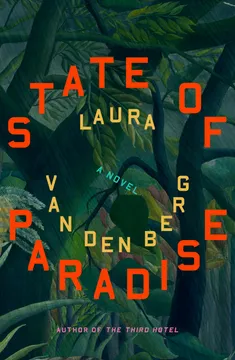


Plot Summary
Florida Calls Her Back
After her father’s death and the pandemic’s upheaval, the unnamed narrator and her Korean American husband are stranded at her mother’s old Florida house. She earns money ghostwriting formulaic thrillers, while her husband runs miles through a town where tents, missing-person notices, and storm damage are multiplying.
On one run, he sees a cyclist puncture the tire of a truck where its sleeping owner lies inside. The cyclist’s silent act becomes one more disturbing story neither man can explain.
The narrator’s sister lives next door, absorbed in MIND’S EYE, a virtual meditation device distributed during lockdown. The narrator, herself altered by a fever and haunted by past despair, senses that the state and her family are slipping into unfamiliar territory.
Florida is introduced as both a literal landscape and a pressure system: heat, unstable ground, poverty, and post-pandemic fear accumulate around the family before any single catastrophe can explain them. The narrator’s paid invisibility as a ghostwriter echoes her uncertain place in her own homecoming. Her husband turns the town into stories through his runs, while she doubts whether stories can preserve anything real. The tire-slashing incident establishes a world where violence is witnessed but not interpreted, and where silence can resemble complicity. MIND’S EYE enters this unsettled environment as comfort with an opaque cost.
The Wilderness Inside
The narrator recalls her adolescence in Florida, when heavy drinking and suicidal attempts led to ten months in a psychiatric institution. A night-shift orderly became her confidant through dictionary games, then exploited her trust by drugging her and trying to take her across the border.
She was rescued before they reached Mexico, later got sober, and left Florida for graduate study. In Boston she met the historian she married, while the friend she had left behind eventually died.
The narrator had assumed escape was possible simply by leaving; now she fears the wilderness followed her north and lives within her. Her childhood memories deepen that fear: her father once brought home a wolf, then gave it away without ever explaining what became of it.
The narrator’s past is not a detachable backstory but a model for how she reads present danger. Institutional care offered protection alongside coercion, and the orderly’s apparent tenderness made his abuse harder to name. Her friend’s death intensifies the guilt of having survived by leaving, while the wolf story supplies an early image of an animal displaced from its proper habitat and then erased from family memory. The narrator has learned to distrust neat endings, including her own sobriety and education. Her return to Florida therefore reopens not only grief but the question of whether departure ever truly breaks a bond.
A Father’s Last Night
The narrator’s father dies in hospital after tearing out his IVs and begging to go home; infection overtakes him before morning. Her sister, who resembles him, later uses MIND’S EYE and sees him in a virtual English garden, where he seems to demand that she do something.
The pandemic has left the sisters visibly changed in different ways, and the sister’s eyes have shifted from blue-green toward gold. Their mother adds another fracture to the family history: she once falsely claimed to have advanced cancer because she resented the attention their dying father received.
She also tells the daughters that a woman once called after their parents’ honeymoon, claiming to be pregnant with twins by their father. The sisters never learn what became of those children.
Grief becomes an unstable form of evidence. The sister’s experience of her father may be memory, technology, or something that exceeds either category, and the narrator cannot comfortably dismiss it without dismissing her sister. The family’s history makes certainty difficult: their mother’s invented diagnosis and their father’s hidden relationships have trained the daughters to expect important truths to arrive late or in distorted form. The unknown twins are more than a mystery; they expose how a family can be shaped by people it has never acknowledged. The altered eyes make private trauma visible on the body, though neither sister can explain what the change means.
The Sister Disappears
When the narrator’s brother-in-law calls to ask whether his wife is with her, the answer is no: her sister has vanished. At the same moment, rain begins falling across Florida without the shape of a recognizable hurricane.
The news calls it a major weather event as rivers, roads, and neighborhoods disappear underwater. The family files a missing-person report, but the police are overwhelmed and their station is flooding. The narrator, her husband, her mother, and later her brother-in-law shelter together while the water rises.
They search from a kayak, spotting cats stranded in trees and missing-person photographs floating on the surface, but find no sign of the sister. When the rain stops after four days, the town is left wrecked, stinking, and unnervingly quiet.
The disappearance personalizes a crisis that had previously appeared as scattered local oddities. The narrator is forced to experience the fear her sister once felt when the narrator herself ran away, turning old abandonment into immediate bodily dread. The flood also defeats the family’s usual tools of explanation: official reporting fails, roads vanish, and the landscape becomes unreadable. Familiar objects and faces drift past without restoring their context. By making the storm unnamed, the narrative resists the comfort of a known disaster category. The family can shelter and search, but cannot yet tell whether the missing sister is dead, lost, or somewhere else entirely.
The Garden Opens
During the search, the narrator puts on a stored MIND’S EYE headset and enters the English garden her sister described. Its convincing flowers and silence conceal an unsettling wall of trembling ivy. When she reaches into it, the device throws her back to the garden gate.
That night she finds her sister in their mother’s yard, muddy, exhausted, and wearing the headset. The sister says she followed her dead father’s instructions through a portal and appeared at Miami International Airport.
She had been trying to find the twins from their mother’s old story, but panicked after seeing her own face on a memorial billboard for pandemic victims. A photograph confirms the twins are real. The sister believes their father wants them rescued from another world.
The headset turns a private technology into a threshold, but the scene refuses to settle whether its sensations are wholly simulated. The narrator’s contact with the ivy is both an act of investigation and a surrender to forces she cannot name. Her sister’s return brings relief, yet the explanation deepens the danger: the missing period may have been a journey across realities, not a breakdown that can simply be treated and forgotten. The old family story now has a concrete consequence. The sisters are drawn toward the twins not only by curiosity but by their father’s apparent command, a demand that revives the family’s lifelong habit of following him into uncertainty.
The Author’s Other World
The narrator recognizes that a waterlogged early novel by her famous employer contains ELECTRA, the company behind MIND’S EYE, years before that company supposedly existed. She and her sister drive to the author’s Palm Beach mansion seeking an explanation.
A woman in a white pantsuit reveals that the famous author died more than a decade earlier and was cryogenically preserved; his former assistants now operate the publishing business as a collective, hiring invisible ghostwriters like the narrator.
The author’s childhood friend founded ELECTRA after imagining travel between versions of the world. In an underground command center, the sisters discover coders in black suits, including the identical twins they came to find. The twins trigger a fire alarm, open a hidden escape route, and lead the sisters out.
The revelation makes the narrator’s labor literal evidence of a manufactured reality: she has been writing for a dead author whose public identity survives through collective production. The mansion’s hierarchy disguises the workers who actually create its books, just as the narrator’s own name has been erased from the work she makes. ELECTRA extends this arrangement beyond authorship, selling access to worlds while treating users as experimental material. The twins’ appearance converts a family mystery into a corporate one, but their choice to help the sisters complicates any simple division between powerful manipulators and helpless subjects. Both institutions offer escape while quietly controlling its terms.
The Hospital Across Worlds
The twins explain that ELECTRA embedded portals in MIND’S EYE during lockdown, using isolated users to test travel between worlds. They had tried to reach the sisters through the headset, and their father’s image in the garden had served as a lure.
In this reality, the father is not dead but lies in a coma. At the hospital, the sisters see him and briefly glimpse another version of the narrator, a scholar reading to him. The twins say their father was an occasional presence in their lives and that they never understood why he wanted them found.
The sisters tell them that this world’s twins died during the pandemic, while the twins’ world faces a deadly flood. Together they decide to return to the sisters’ Florida, where the twins may survive.
The hospital turns the sisters’ supernatural-seeming mission into an encounter with competing versions of loss. Their father is present, but not available; the alternate narrator can sit beside him while the narrator herself remains outside the room’s life. The twins are neither simple victims nor idealized saviors. Their estrangement from their father resembles the sisters’ own damaged bond with him, though on a different scale. The choice to bring them across worlds is an act of care under impossible conditions, not a guaranteed rescue. The story leaves the sisters to act without the certainty their father’s supposed instructions seemed to promise.
Three Days Gone
At the Giant Orange, the sisters and twins use MIND’S EYE to cross back into their Florida. When they reach town, the narrator’s husband says they have been gone for three days. The twins move into the crowded family house, while the narrator’s mother gathers followers around a manifesto advocating human extinction.
The narrator recognizes that her work as a ghost has kept her from writing anything she believes in, so she resigns rather than join the author’s collective.
She begins a private Florida diary, recording local people, animals, weather, and memories instead of filling in thriller templates. Her father starts appearing in dreams, no longer issuing commands. The narrator cannot recover him through writing, but the act gives her a way to approach the grief she had long kept buried.
Returning does not restore the original world to its former stability. The three-day gap marks the cost of crossing, while the twins’ presence makes the alternate reality part of the family’s daily life. The narrator’s resignation is a concrete break with the economic arrangement that made her useful by making her invisible. Her diary rejects the polished plot machinery of her employer in favor of details that resist easy meaning. This is not presented as a cure for grief or a triumphant claim to authorship. It is a practice of attention, allowing the narrator to make a record without pretending that recording can close the distance between the living and the dead.
A House Becomes a Movement
The narrator’s mother reads her extinction manifesto to a small group in the living room, with Arizona assisting and distributing pages. After the twins expose MIND’S EYE as dangerous, Arizona helps collect headsets from neighbors, while the mother posts warnings online.
The household becomes crowded with followers in matching gray sweatsuits, though the twins challenge the mother’s argument that humanity itself is the root problem. They cook, read tarot, and form a bond with the family without sharing the movement’s certainty.
The narrator’s sister becomes pregnant, then leaves the news unannounced while struggling with severe sickness. Her eyes shift from gold to deep green. She also shows the narrator a video of their father in hospital, preserving a private moment from his final night.
The mother’s movement grows from a familiar impulse: when the world becomes intolerable, impose a total explanation on it. Her manifesto gives despair a structure, but the twins’ questions expose the limits of turning a complicated crisis into one moral verdict. The gray uniforms create belonging through sameness, even as the household remains full of disagreement and care. Pregnancy introduces a future that directly contradicts the movement’s wish for human disappearance, though the sister does not make it a public argument. The father’s recorded image functions as a family relic, a fragile piece of evidence that can be held without pretending it resolves the past.
Bodies Learn New Rules
Across Florida, people who had severe pandemic fevers report losing hair, sweat, and even fingernails. The narrator’s own belly button opens into a shallow pocket, allowing her to hide small objects inside her body.
When she tests herself in a community pool, she remains underwater for twenty-two minutes and breathes. Her sister suspects that her night vision has sharpened, while the baby she carries continues to make her violently ill. The changes arrive alongside strange animal signs: manatees appear in springs out of season, cats seem to move as one body, and a runaway wolf crosses a highway before being captured.
The narrator’s husband helps the cyclist find his missing white dog, and the reunion gives one small, ordinary kindness a place in a state increasingly difficult to recognize.
The pandemic’s aftermath shifts from psychological uncertainty to biological transformation. The characters cannot treat their bodies as stable witnesses: the narrator’s new anatomy is useful, uncanny, and potentially dangerous, while her sister’s changing vision offers no clear diagnosis. These changes resist a simple division between illness and adaptation. The animal episodes extend that uncertainty beyond the human body, making Florida feel less like a backdrop than an ecosystem responding on its own timetable. Yet the dog’s recovery matters precisely because it is small and practical. Care remains possible even when neither science nor family history can explain what is happening.
Florida Keeps Changing
The floodwaters may have vanished, but the town never returns to normal. Water begins forcing its way through storm drains, militias seize Florida landmarks, and people report further bodily changes.
The narrator’s sister, now visibly pregnant, shares a recording of their father singing in his hospital bed; she also keeps the cracked reading glasses from the alternate father’s bedside as a tangible relic. The twins leave to explore a revived utopian community, while the mother’s followers continue their work.
The narrator and her husband discuss leaving, then decide they cannot abandon the people they love. She tests her altered body in a pool and survives underwater far longer than a human should. The book ends with Florida’s future unresolved, but the narrator still writing and watching.
The resolution refuses the familiar promise that a crisis will culminate in either restoration or total ruin. Florida continues to change, and the characters make choices without being able to know whether those choices will be enough. The narrator’s underwater endurance suggests adaptation, but the book does not convert it into a heroic solution. Her decision to remain with her family is similarly provisional: loyalty binds her to a place that may no longer be safe or recognizable. The relics, diary, and family recordings offer ways to carry experience forward, not proof that it has been mastered. Survival becomes attention, relationship, and an unfinished act of writing.
Analysis
State of Paradise makes uncertainty structural. The narrator’s account moves among family memories, local reports, advice columns, virtual experiences, and bodily evidence without granting any single form the authority to settle what is real. This is not mere ambiguity for its own sake. Each form has a social function: ghostwriting turns stories into products, institutional treatment disciplines unruly feeling, technology sells escape, and family anecdotes preserve what official histories omit. The novel asks who controls these forms and whose experience disappears when they do.
Florida concentrates these questions because its environmental instability is both concrete and political. Sinkholes, flooding, heat, missing people, and failing infrastructure do not simply mirror the characters’ inner lives; they also arise from human decisions about land, resources, and power. The crisis becomes harder to interpret because its causes are cumulative rather than singular. A label such as disaster may describe the event while concealing the history that produced it.
The narrator’s movement from ghostwriting to keeping a diary is therefore an ethical change, not a simple career victory. She stops supplying ready-made plots and begins attending to details that resist resolution. Writing cannot retrieve her father or undo the sister’s lost time, but it can record the relationships among people, objects, and places before they vanish. The novel’s tentative hope rests there: not in mastery, but in sustained attention and reciprocal care. Its final transformations remain frightening, yet they also suggest that adaptation may be possible. To become someone new is not necessarily to escape the past; it may mean learning how to live with its unfinished claims.
Review Summary
Reviews of State of Paradise are mixed, averaging 3.37/5. Admirers praise van den Berg's uncanny, genre-blending prose, vivid Florida atmosphere, and bold exploration of pandemic trauma, technology addiction, and storytelling. Many highlight the surreal, fever-dream quality and the narrator's distinctive voice. Critics, however, find the narrative fragmented and plotless, with competing storylines that never cohere. The audiobook format divided listeners. Comparisons are frequently drawn to Alexandra Kleeman and Jenny Offill. The novel's strange details — particularly the narrator's transforming bellybutton — proved divisive, symbolizing the book's polarizing blend of literary ambition and deliberate weirdness.
People Also Read








Characters
The narrator
The reluctant ghostwriterAn unnamed Florida-born writer in her mid-thirties, she earns a living producing thrillers for a famous author while doubting that the work belongs to her. Her years of addiction, institutionalization, and recovery have taught her to distrust both easy reassurance and tidy accounts of the past. She left Florida for graduate study, married a historian, and built a life that seemed to keep old pain at a safe distance. Returning to her mother’s house forces her to face family secrets and memories she has tried to bury. She is observant, wry, and alert to the ways stories can conceal as well as reveal. Her growing desire to write in her own voice reflects a struggle to become visible without pretending she can explain everything.
The sister
The searching daughterThe narrator’s younger sister has stayed in their Florida hometown, building a household with her husband and daughter while working as an insurance claims adjuster. She prizes practical explanations and risk management, yet carries old injuries from their parents and from the narrator’s abrupt departure. Her anger is bound up with a longing to be recognized, especially by family members who have disappointed her. She turns to MIND’S EYE not simply to escape daily demands but to pursue experiences she cannot fit into ordinary language. Her attachment to their father’s memory complicates her skepticism and independence. She can be fiercely defensive, but her care for her sister and child is physical, immediate, and enduring.
The husband
The running historianThe narrator’s Korean American husband studies medieval pilgrimages and is trying to finish a book about them. His daily runs through town make him a familiar figure to strangers, and his habit of noticing local details gives the narrator a steady supply of stories. He is more cautious than she is about Florida’s unstable houses, storms, and wildlife, but his caution does not keep him from helping when people need him. He offers practical companionship rather than easy interpretations, even when the events around them exceed his historical or scholarly frameworks. His running suggests both discipline and a search for direction. He remains committed to the narrator and to the family, though he too must reconsider what home means.
The mother
The restless utopianA retired social worker, the narrator’s mother is resourceful, superstitious, and difficult to predict. She preserves old objects and stories, reads utopian writing, and often believes that a better social order might be found by looking beyond the present one. Her relationship with her daughters is shaped by old resentments and by her long, troubled marriage to their father. She can be generous in practical emergencies, yet she also makes choices that leave her children questioning what is true. Her attraction to absolute answers grows from a lifetime of witnessing suffering, but it can make her plans unsettling to those around her. She is both a source of family memory and one of its least reliable narrators.
The father
The charismatic family stormThe sisters’ father is a former lawyer with a brief military history, a taste for westerns, and a gift for persuading people to follow him. He could be funny, daring, and magnetic, but his family also remembers his infidelity, volatility, and capacity to wound. Stories about him circulate long after events themselves have become difficult to interpret, and his presence in the family is inseparable from its silences. He fascinates his children partly because he seems to inhabit his own legend, making it hard to distinguish charm from danger. His influence helps explain why the sisters continue to seek meaning in his choices, even when their memories of him disagree.
The half brother
The distant wilderness guideThe narrator’s much older half brother lives in Florida’s Panhandle and runs an ecotour business. He shares their father with the sisters but belongs to an earlier family chapter, giving him a distinct place in their complicated sibling structure. His work brings him into contact with remote landscapes and people seeking isolation. He appears through family memories, stories, and calls, helping widen the book’s view beyond the sisters’ town.
The brother-in-law
The worried night workerThe sister’s husband works night shifts at a factory that prints labels, where his job is to catch other people’s mistakes. His schedule leaves him isolated, and the factory’s missing workers make his anxiety about his wife’s absences more acute. He is loving and observant, but he wants explanations that can be tested against ordinary reality. His concern for his wife leads him to ask the narrator for help rather than dismiss what he sees.
The niece
The child with a ghostThe narrator’s four-year-old niece invents a pet ghost that eats dirt and talks to the grass. Her imagination gives shape to dangers the adults cannot explain, while her questions force them to describe a frightening world in terms a child can understand. She is playful, sensitive, and deeply attached to her mother, and the family’s efforts to protect her reveal their tenderness amid the surrounding instability.
The twins
The hidden half sistersThe identical twins are daughters of the narrator’s father and strangers to the sisters at the beginning of the story. They are skilled coders, intellectually confident, and accustomed to working together, though their closeness does not make them all-knowing. Their practical competence contrasts with the mystical language surrounding their search. They cook, read tarot, and challenge easy ideological claims, revealing a more skeptical and grounded side than their polished appearance suggests. Their history with their father is complicated and less intimate than the narrator and her sister might expect. They matter because their existence connects a buried family story to the larger experiment that has unsettled both worlds.
Arizona
The displaced truth-tellerA temporary visitor whose house swap leaves her in the flooded town, Arizona speaks bluntly and moves according to habits that seem to belong to a different rhythm of life. She helps the family during the emergency, joins searches, and takes an interest in the mother’s movement. Her willingness to state her own version of events can be comic or unsettling, but she is often more useful than the people who claim authority.
The night-shift orderly
The dangerous confidantAt the institution where the narrator is treated as a teenager, the orderly works overnight and shares dictionary games with her. His vocabulary and apparent attentiveness offer a rare human connection in a place governed by rules. The narrator is drawn to him partly because he seems to recognize her mind rather than only her diagnosis. His relationship with her is marked by a dangerous imbalance of power, making her memories of him difficult to separate from her need for escape.
The famous author
The absent thriller kingThe wealthy thriller writer employs the narrator through a network of assistants, sending plot templates while remaining personally unreachable. His public persona depends on privacy and fame, and his commercial success rests on books designed to be quickly consumed. The narrator imagines him as the source of the stories she writes, even as the work’s production system makes authorship difficult to locate.
The head assistant
The mansion’s gatekeeperA woman in a white pantsuit who represents the author’s operation, she controls access to the mansion and explains the system on its own terms. She is composed, strategic, and proud of the collective’s business, but her confidence also conceals how much power the enterprise exercises over its workers and users. Her polished authority contrasts with the laboring assistants around her.
The former best friend
The friend left behindThe narrator’s friend from outpatient therapy shared late-night conversations about death and plans for survival. The narrator left Florida without telling her she had applied to graduate school, and the friendship never recovered. She represents the painful cost of escaping alone.
The cyclist
The dog-loving drifterA local man who rides with a white dog, the cyclist is first seen committing a quiet act of violence near the lake. He is later revealed through the husband’s encounters as sober and deeply attached to his dog. His life complicates the narrator’s first impression of him.
Plot Devices
MIND’S EYE
A portal disguised as meditationELECTRA distributes the headset as a virtual meditation device during the pandemic. It reads a user’s eyes and responds to thought, creating individualized worlds that feel sensory and convincing. The sister uses it to visit an English garden and encounter what appears to be her father; the narrator later finds a trembling boundary hidden in the garden. The device was also used to test movement between alternate realities, with users serving as unwitting participants. Its central ambiguity is psychological as well as technological: a user’s memories and desires shape what the device presents, so a manufactured experience can still have emotional force.
The Ghostwriting Collective
Invisible labor behind a famous nameThe narrator writes thriller chapters from plot outlines provided by assistants, then revises them to match a market-tested style. The work gives her income and a route toward writing, but it requires her own voice to disappear. The author’s assistants are themselves part of a larger collective that controls the brand and hires ghostwriters. Once the narrator learns who actually writes the books, the arrangement becomes a mirror of the novel’s broader questions about identity, labor, and the stories people accept as authentic.
Pilgrimage
Movement without a guaranteed destinationThe husband’s research into medieval pilgrimage gives the story a language for journeys made in search of meaning. The sisters’ search for the twins, the drive to the author’s mansion, and the crossings between realities all take on the shape of pilgrimages, but none provides a simple spiritual answer. Pilgrimage links physical travel to grief and transformation: the travelers return changed, and the destination does not erase what they carried with them. The device also makes the husband’s academic work relevant to the family’s unfolding choices.
Sinkholes and Floods
A landscape that swallows certaintyFlorida’s porous limestone, unstable houses, sinkholes, storms, and sudden floods turn the setting into an active force. The ground tilts beneath the mother’s home; roads and familiar landmarks disappear; water uncovers objects and leaves others submerged. These events parallel the family’s missing histories without reducing the environmental crisis to a metaphor. The land remains materially dangerous, shaped by development and climate as well as by the story’s uncanny shifts. Its instability keeps the characters from treating home as fixed or safe.
The Florida Diary
A record outside the templateAfter leaving the thriller operation, the narrator begins collecting small observations and memories in a private diary. Instead of forcing events into a predetermined plot, she records animals, neighbors, family stories, bodily changes, and moments she cannot verify. The diary allows her to write without claiming that language can restore the dead or make a damaged world coherent. It also gives the ending its open form: the narrator continues recording as Florida and her own body change around her.
Download PDF
Download EPUB
.epub digital book format is ideal for reading ebooks on phones, tablets, and e-readers.








