

Key Takeaways
Use independent reporting to puncture official stories before they harden into truth
Katrina broke the script. When Hurricane Katrina struck in 2005, officials tried to restrict images of the dead and keep journalists away. Reporters on the ground showed abandoned residents, a failed response, and a president strumming a guitar while New Orleans flooded. Those images contradicted the administration’s assurances more forcefully than a press release could. The book argues that direct observation, especially of people most affected by policy, is a democratic safeguard.
Static can cut both ways. The title names both the distortion that obscures reality and the dissent that disrupts a polished official account. Iraq offered the contrast: restricted images of casualties and military-controlled reporting made the war easier to narrate from Washington. Independent journalism does not guarantee truth, but it can expose the gap between official claims and lived conditions.
What's striking is how rapidly visible evidence can change the terms of public debate. Images make abstractions concrete, and eyewitness reporting can reveal what distant institutions overlook. Yet vividness is not the same as completeness: a dramatic scene can mislead if it is unverified or shown without context. The strongest journalism pairs presence with corroboration, and follows an image with questions about causes, responsibility, and what remains outside the frame.
Treat access as a conflict of interest, not a journalist’s perk
Proximity has a price. The authors call the bargain between journalists and powerful sources the “access of evil”: reporters may soften scrutiny to preserve interviews, briefings, and insider status. Their examples range from television panels heavily weighted toward conservative guests to the New York Times delaying its report on warrantless NSA surveillance for about a year after White House objections. The story appeared after the 2004 election, though publication could have informed voters beforehand.
A watchdog must risk losing the leash. The book contrasts this deference with the press’s responsibility to test official explanations, including claims that government programs are legal or necessary. Access can help reporters discover facts, but it becomes a liability when officials control what can be asked, shown, or published. Journalism should make those constraints visible rather than letting proximity masquerade as independence.
This is a classic principal-agent problem: the public depends on journalists to scrutinize officials, while journalists depend on those same officials for information. The relationship can quietly reverse the direction of accountability. Disclosure of source relationships helps, but it cannot by itself undo dependence on access. Newsrooms also need independent documents, diverse sources, and editors willing to publish uncomfortable findings. The counterpoint is that not every delayed story is a favor to power; genuine verification and safety concerns matter, so the reasoning should be transparent.
Recognize propaganda when official messages wear journalism’s clothes
The format can deceive. The book describes government-produced video segments that local stations aired as news, sometimes with hired narrators and no clear notice of their origin. It reports that at least twenty federal agencies spent $250 million on hundreds of such segments. The Government Accountability Office called some covert propaganda, while the White House argued that the practice was longstanding. The same problem appeared in Iraq, where U.S. contractors paid newspapers to publish favorable stories as if they were independent reporting.
Influence has many disguises. The authors also recount a federal education contract paying commentator Armstrong Williams $240,000 to promote a policy, and a political effort to reshape public broadcasting under Corporation for Public Broadcasting chair Kenneth Tomlinson. These cases show how propaganda can travel through familiar outlets, not just state-owned media. Readers need to ask who produced a message, who paid for it, and whether the audience is being told.
The central insight is not simply that governments persuade; all administrations communicate. The democratic risk begins when persuasion is disguised as independent reporting, because audiences use the appearance of editorial judgment as a credibility signal. Media literacy therefore needs to include provenance, not just fact-checking. At the same time, government information is not automatically false, and public agencies sometimes provide useful material. Clear labeling, access to underlying evidence, and independent editorial control separate useful communication from covert influence.
Do not let fear turn suspicion into a substitute for evidence
A threat can become a verdict. The Wen Ho Lee case shows how suspicion and selective leaks can ruin a life before evidence is tested. The New York Times published claims that the Chinese-American scientist had compromised nuclear secrets. He was held in solitary confinement for 278 days, then pleaded guilty to one charge involving classified material, not espionage. A judge apologized for the government’s treatment of him. The newspaper later acknowledged shortcomings in its coverage.
Identity can magnify suspicion. Army chaplain James Yee, a Muslim officer at Guantánamo, was publicly accused of spying and aiding the enemy. The major charges collapsed; later allegations concerned unrelated conduct and were also dismissed. The authors connect these episodes to older American panics, from Salem to McCarthyism: a feared outsider, charged in a climate where accusation itself can look like proof. Security concerns require investigation, but not abandonment of due process.
Threat narratives exploit a cognitive shortcut: when danger feels severe, people often treat a plausible story as established fact. The Lee and Yee cases illustrate why procedural safeguards are not obstacles to security but tools for distinguishing real threats from institutional panic. A fair analysis must also allow that classified investigations can involve evidence unavailable to the public. That makes independent judicial review and careful reporting more important, not less, because secrecy otherwise shields both legitimate operations and avoidable error.
Surveillance can silence lawful dissent without making a single arrest
Watching changes behavior. In 1971, activists broke into an FBI office in Pennsylvania and sent stolen files to newspapers. The documents revealed COINTELPRO, the Bureau’s covert program to disrupt and discredit groups such as the Black Panthers and antiwar organizations. The exposure helped trigger congressional investigations. The book argues that similar habits returned after 9/11, when activists, peace groups, and environmental organizations appeared in FBI and Pentagon files despite no evidence of violent plots.
The chilling effect is the point. Students and organizers described avoiding protests after FBI questioning or surveillance. The Pentagon’s TALON database, intended to track suspicious activity, included legal antiwar meetings and demonstrations. The NSA programs described in the book also swept up communications data on a vast scale. A government need not prosecute everyone it watches; the possibility of being monitored can make ordinary people decide that public speech is not worth the risk.
The harm here is partly invisible: surveillance can reduce participation before any court case or arrest occurs. This resembles a chilling effect in constitutional law, where people avoid protected speech because the costs feel uncertain. The evidence in the book ranges from documented files to activists’ reports of changed behavior, which are different kinds of evidence and should not be conflated. Still, the democratic concern is substantial: oversight must examine not only whether data collection is legal, but whether its scope and retention rules make peaceful organizing appear suspect.
Torture destroys human dignity and the intelligence it claims to extract
A confession can be manufactured. Maher Arar, a Canadian citizen, was sent by U.S. officials to Syria, where he says he was beaten and imprisoned for more than a year. No charges were filed. Khaled El-Masri, a German citizen, was detained after being mistaken for someone else and held for months before officials recognized the error. These cases illustrate extraordinary rendition, the transfer of suspects to other countries for interrogation, often where torture is known to occur.
Pain rewards invention. The book recounts how a tortured detainee, Ibn al-Shaykh al-Libi, supplied false claims linking Iraq and al Qaeda. A former U.S. Army interrogator also said harsh methods produced little useful intelligence, while rapport sometimes did. The argument is both moral and practical: coerced answers may satisfy an interrogator’s expectations without describing reality. Secret detention and weak legal review make mistakes harder to detect and victims harder to hear.
Coercion creates a measurement problem: the interrogator cannot reliably tell whether an answer reflects knowledge, compliance, or desperation. That makes torture not only cruel but epistemically self-defeating. The cases also show how secrecy compounds error by insulating decisions from correction. A careful account should distinguish allegations, official denials, and findings by courts or inquiries; the book’s strongest point is that due process and humane treatment protect against both abuse and bad intelligence.
Ask who is missing when war coverage shows only the military’s side
Embedding narrows the view. During the 2004 siege of Fallujah, U.S. reporters embedded with troops described combat from the military’s position. Al Jazeera journalists Ahmed Mansour and Laith Mushtaq reported from inside the city, filming civilians fleeing and wounded people in hospitals. The U.S. military accused the network of spreading propaganda and demanded that it leave. The authors argue that removing independent witnesses makes it easier for official accounts to dominate.
Every vantage point has limits. The book says the U.S. military reported roughly 600 Iraqis killed during the April siege, while disputing civilian casualty accounts. It also describes the November offensive, when a U.S. spokesman confirmed use of white phosphorus. By mid-2006, more than 100 journalists and media assistants had been killed in Iraq. Reporting from a war zone is dangerous, but coverage that omits civilians, independent reporters, or contested evidence gives audiences a partial picture.
Embedding can provide access and protect journalists, but it also creates dependency on the force being covered. That is a structural constraint, not proof that every embedded report is false. A more reliable information ecology combines multiple vantage points, verification, and explicit uncertainty. Civilian testimony deserves attention, while vivid footage still needs corroboration and context. The key question is not which outlet is inherently trustworthy, but whether readers can see how each account was gathered and what it could not observe.
Follow money and alliances beneath official claims of democracy
Stated motives need testing. In Haiti, the authors describe a history of U.S. influence, an aid freeze, support for Aristide’s opponents, and the disputed circumstances of his removal in 2004. The administration said he resigned; Aristide and several witnesses said he was forced out. The book argues that a narrow focus on official statements obscured the interests and history shaping the crisis.
Strategic allies reveal the double standard. British ambassador Craig Murray criticized U.S. support for Uzbekistan’s authoritarian president, Islam Karimov, despite extensive abuses. He argued that access to military bases and energy interests mattered more than stated democratic principles. A similar question arises in the 2005 U.S. energy law, which the authors describe as delivering major benefits to oil, gas, coal, and nuclear industries. Tracing beneficiaries does not prove a hidden motive, but it identifies what claims deserve scrutiny.
This is a useful method of political analysis: compare public justifications with incentives, beneficiaries, and historical relationships. It resembles political economy, which asks how material interests shape institutions and policy choices. The method becomes too sweeping if every strategic partnership is reduced to greed or every disputed event is treated as settled. The book is most persuasive when it supplies documents, named actors, and competing accounts, allowing readers to distinguish evidence of influence from inference about motive.
Trace abuse up the chain before accepting the bad-apples story
Abuse travels with institutions. Charles Graner, one of the most visible guards in the Abu Ghraib photographs, had previously worked at a Pennsylvania prison where inmates and former prisoners described brutality. The book also profiles U.S. prison officials sent to advise Iraq’s detention system despite controversy and lawsuits connected to facilities they had overseen. These histories complicate the claim that abuse abroad appeared suddenly or involved only a few unusually cruel soldiers.
Orders shape what becomes normal. The authors describe interrogation techniques approved by senior officials, then carried out by lower-ranking personnel. Several soldiers were punished, while senior decision-makers faced little comparable accountability at the time of publication. Individual perpetrators remain responsible for their actions, but command decisions, training, and institutional incentives also matter. An inquiry that stops at the person in the photograph may miss the policies that made the scene possible.
Organizational research often finds that conduct is shaped by norms, incentives, supervision, and ambiguity about acceptable behavior. This does not erase individual responsibility; it explains why accountability must examine both action and authorization. The book’s prison examples are especially valuable because they challenge the idea that foreign settings alone produce abuse. A rigorous investigation should still separate documented misconduct from allegations and avoid treating a prior complaint as proof of later guilt.
Treat soldier dissent as evidence about a war’s legitimacy
Those who serve can see the gap. Iraq veteran Mike Hoffman founded Iraq Veterans Against the War after concluding that the public reasons for invading Iraq did not match what he saw. Other soldiers described doubts about the mission, inadequate equipment, and the treatment of detainees. In a 2006 poll cited by the authors, 72 percent of U.S. troops in Iraq favored leaving within a year, and one quarter favored immediate withdrawal.
Listening is not disloyalty. The book follows servicemembers who refused deployment or challenged the war, including Camilo Mejia, who said he witnessed abuse, and sailor Pablo Paredes, who refused to board a ship bound for the conflict. Some were punished or fled to Canada. Their testimony cannot settle every policy question, but it belongs in public debate alongside official briefings, especially when soldiers bear the consequences of decisions made far from the battlefield.
Firsthand experience is powerful but not automatically representative: a veteran’s account offers evidence about particular events and conditions, not necessarily a complete strategic assessment. The book’s contribution is to widen the pool of legitimate speakers, rather than treating dissent as betrayal. That is also a practical safeguard against groupthink. Institutions make better decisions when people closest to consequences can report failure without being dismissed for damaging morale.
Audit who is recruited before calling military service voluntary
Choice depends on the alternatives. The authors argue that economic hardship makes military enlistment especially attractive to young people with limited options. They describe recruitment pressure in schools, a Pentagon database containing information on roughly 30 million people ages 16 to 25, and a law requiring schools to provide student contact information to recruiters unless families opt out. Some recruiters, the book reports, encouraged a student journalist to obtain a fake diploma.
Privacy shapes consent. The database project, known as JAMRS, gathered student information from commercial and government sources for recruitment purposes. The authors also describe efforts to understand how to influence mothers who opposed enlistment. These practices raise questions beyond whether a recruit signs a contract: who receives personal data, what claims recruiters make, and whether young people have meaningful access to alternatives. Recruitment should be evaluated as a system, not only as an individual choice.
A formal yes can coexist with constrained options, information asymmetry, and targeted persuasion. That does not mean every enlistment is coerced or that military service offers no genuine opportunity. It does mean that consent is stronger when risks are clear, privacy is protected, and alternatives are real. The book’s account invites a broader ethical test: whether recruitment practices would withstand the same transparency and scrutiny expected in other consequential decisions involving young people.
Build independent media and public protest into democracy’s defenses
Resistance makes neglected facts visible. The book’s examples range from Democracy Now!’s broadcasts with dissidents and whistle-blowers to Cindy Sheehan’s roadside vigil near President Bush’s ranch. Sheehan asked why her son had died in Iraq; other military families joined her, forcing a question that official events had kept at the margins. The Yes Men used a fake Dow spokesperson to draw attention to the unresolved Bhopal disaster, briefly making corporate responsibility the news.
Interruption can open space. ACT UP activists disrupted broadcasts to demand attention to AIDS, while a 1971 break-in exposed FBI surveillance files and led newspapers to investigate. These actions differ in method and risk, but share a purpose: breaking through attention systems that routinely exclude inconvenient voices. Independent outlets and public protest do not replace verification or policy work. They can make ignored evidence impossible to ignore.
Public attention is a scarce resource, and institutions tend to allocate it according to power, access, and commercial value. Strategic interruption can correct that imbalance by making excluded claims legible. Yet tactics matter: the Yes Men’s hoax drew criticism for raising false hope among Bhopal survivors, a reminder that attention-seeking can impose costs on the people it aims to help. Strong activism couples disruption with accountability, sustained reporting, and a path from visibility to remedy.
Analysis
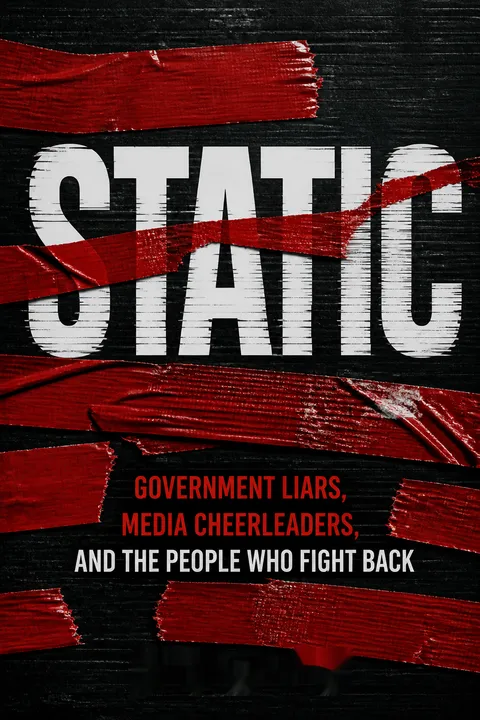
Static is an advocacy-driven account of the United States in the early 2000s, organized around a two-part argument: powerful institutions distort public understanding, and organized dissent can interrupt that distortion. Its range is impressive. Journalism, intelligence, war, prisons, oil policy, public broadcasting, and protest are presented not as isolated subjects but as interacting systems. The strongest narrative device is contrast: New Orleans reporting against Iraq’s managed imagery, the public language of human rights against secret detention, and the polished town hall against the removal of dissenters.
That structure makes a complicated political period legible, but it also creates a risk. A book built to expose institutional hypocrisy can imply a single, coordinated intention where bureaucratic incentives, partisan strategy, commercial pressures, and genuine security concerns may overlap without being identical. The most reliable way to use its argument is to separate what is documented, what is alleged, and what the authors infer. Their cases often contain concrete records, named witnesses, official denials, and outcomes that let readers test the claim. That evidentiary texture is more valuable than the broadest accusations.
The book’s enduring contribution is its account of information as infrastructure. Public judgment depends not only on whether citizens are free to speak, but on whether they can find credible accounts of what institutions do. Embedded access, paid commentary, opaque databases, and secret legal interpretations all shape what can be known before voters or courts respond. The answer is not to assume that independent media are automatically correct. It is to demand visible sourcing, correction, plural perspectives, and protection for whistle-blowers and critics. The practical lesson is democratic rather than merely journalistic: scrutiny must be organized, because power rarely yields the record on its own.
Review Summary
Static receives mostly positive reviews, with readers praising its informative content on government lies, media manipulation, and corporate influence. Many appreciate Goodman's investigative journalism and the book's relevance to current events. Critics note its one-sided perspective and repetitive content. Readers find it eye-opening but sometimes depressing. The book is commended for exposing political corruption and media complicity, though some find the writing style overly dramatic. Overall, it's seen as an important work for understanding media-government relationships and political accountability.
People Also Read




Glossary
Static
Distortion and dissentThe book uses static in two connected senses. It means the distortion, omissions, and half-truths that interfere with public understanding, and it means criticism or opposition that interrupts official narratives. The title’s central idea is that independent journalism should expose the first kind and create the second.
access of evil
Truth traded for accessThe authors’ term for journalists compromising scrutiny to preserve access to powerful sources. Interviews, background briefings, and insider status can help reporters gather information, but dependence on those privileges may encourage them to soften questions or delay publication. The phrase describes a structural conflict between serving sources and serving the public.
COINTELPRO
FBI disruption programThe FBI’s counterintelligence program, exposed after activists removed agency files in 1971. The documents showed efforts to surveil, discredit, provoke, and disrupt political organizations and individuals, including civil rights and antiwar groups. The book uses the program as a historical warning about government surveillance directed at lawful dissent.
extraordinary rendition
Transfer for interrogationThe transfer of a person suspected of terrorism to another country or secret detention site for interrogation outside ordinary legal protections. In the cases discussed, U.S. officials sent or transferred people to countries where torture was known to occur. The term is central to the book’s account of secrecy, mistaken identity, and outsourced abuse.
the Mighty Wurlitzer
Orchestrated propaganda networkA metaphor attributed in the book to CIA official Frank Wisner for the agency’s ability to coordinate media influence. From the 1950s through the 1970s, the CIA cultivated relationships with journalists and media organizations, and supported outlets abroad. The image captures propaganda as an organized system rather than a single planted story.
Torture Two-Step
Policy above, abuse belowThe authors’ description of how senior officials can authorize or normalize harsh interrogation practices while lower-ranking personnel carry them out and take the visible blame. The phrase points to a gap between policy creation and individual prosecution. It does not absolve the people who commit abuse; it argues that accountability must also examine command decisions.
JAMRS
Pentagon youth recruitment databaseThe Joint Advertising, Market Research and Studies project described in the book as a Pentagon effort to collect information on young people for military recruitment. The database reportedly included records on about 30 million people ages 16 to 25. The authors raise concerns about privacy, data sharing, and the targeting of potential recruits.
blowback
Unintended return effectsA term the book attributes to the CIA for consequences of covert operations or propaganda returning to affect the United States. A story planted abroad might circulate through international news channels and reach U.S. audiences, even when domestic propaganda was legally restricted. The concept highlights how information operations can escape their intended boundaries.
About the Author
Other books by Amy Goodman
Download PDF
Download EPUB
.epub digital book format is ideal for reading ebooks on phones, tablets, and e-readers.








