

Key Takeaways
Treat mortality as your deadline, not your fear
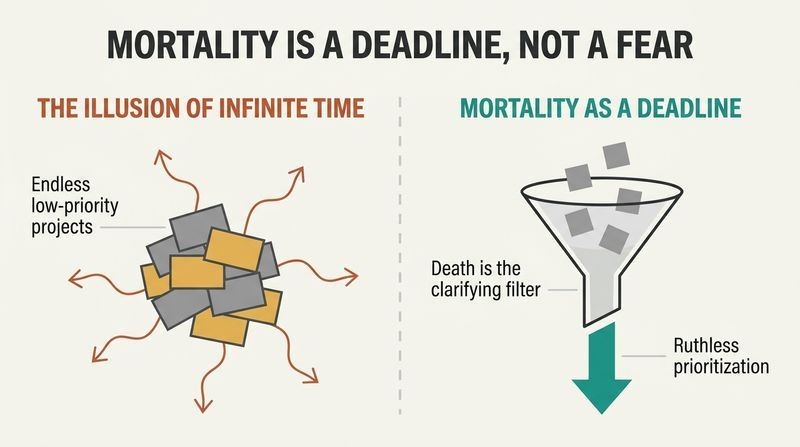
Jobs lived by memento mori (Latin for "remember you will die"). Since his twenties he told friends he expected to die young, and he squeezed each day like fruit for its juice. He lived only 20,984 days against a human average of roughly 30,000. The night before he died, he was still calling Tim Cook to discuss the next product.
Death was his clarifying filter. Jobs called it life's greatest invention, the thing that clears out the old to make room for the new, just as young companies displace old ones. Awareness that time cannot be bought back drove his ferocious focus. He cut Apple's bloated product lines to a handful, reasoning that a short window demands ruthless prioritization rather than the illusion of infinite tomorrows.
The framing echoes Stoic practice: Seneca argued we are not given a short life but waste much of it, and Marcus Aurelius (whom Jobs read) urged living each day as one's last. Modern psychology backs the mechanism. Terror management theory shows mortality salience sharpens values and priorities. There is a shadow side the book underplays: perpetual urgency can corrode patience with people, and Jobs's own relationships often paid that tax. Used well, the memento mori is not morbid but editorial, a tool for deleting the trivial. Used poorly, it becomes an excuse to sacrifice everyone around you to the work.
You can only connect life's dots looking backward

Foresight is unreliable; insight arrives late. Jobs's famous example: a calligraphy class he audited after dropping out of Reed College seemed useless at the time. A decade later it became the Macintosh's beautiful typography, the first personal computer with multiple proportional fonts. He could not have planned that link forward.
So he refused to over-plan. Jobs kept no life timeline, no goal-tracking organizer. Thinking like a Zen student, his plan was not to plan. He trusted that curiosity followed honestly would eventually cohere, like scattered puzzle pieces that reveal their picture only once enough are placed. This is less passivity than faith in process: pursue what genuinely pulls you, tolerate the ambiguity of not knowing why, and trust that meaning assembles itself in hindsight.
This is a genuinely useful heuristic against premature optimization. Careers built on rigid ten-year plans often collapse when the world changes; careers built on accumulating varied competencies tend to compound. Research on serendipity and "planned happenstance" (John Krumboltz) argues that curiosity and openness generate more opportunity than fixed goals. The caveat: survivorship bias. For every Jobs whose calligraphy detour paid off, countless people follow their curiosity into dead ends and connect no dots. The advice works best when paired with skill-building and a willingness to iterate, not as permission to drift without accountability.
Getting fired can be the best thing that happens to you

Jobs's public humiliation freed him. In 1985, after a power struggle with the CEO he had personally recruited, John Sculley, Jobs lost control of the Macintosh division and left the company he cofounded. He felt he was a very public failure and considered fleeing Silicon Valley. Instead he started over.
The wilderness years became his real education. During that exile he founded NeXT, whose UNIX-based operating system would later become the core of the modern Mac and his ticket back to Apple. He bought a struggling graphics outfit for $5 million and turned it into Pixar, sinking $55 million over a decade before Toy Story made him a billionaire. And he met Laurene Powell, his wife. Losing everything, he said, replaced the heaviness of success with the lightness of a beginner.
The reframe of failure as tuition is a staple of resilience research. Carol Dweck's growth mindset and the post-traumatic growth literature both suggest that setbacks, properly metabolized, can expand capacity. What is distinctive here is the compounding: the very assets Jobs built in exile (NeXT's software, a rehabilitated leadership style) were exactly what a floundering Apple needed in 1997. There is a caution against romanticizing firing, though. Jobs had a fortune, fame, and irreplaceable talent cushioning his fall. The lesson survives the caveat: identity anchored to a single title or company is fragile, and forced endings can force overdue reinvention.
Do work you love, or you will quietly waste your life
Jobs's core career advice was blunt: don't settle. He insisted the only path to great work is loving what you do, and if you have not found it, keep searching rather than compromising. He never chased money for its own sake. Asked what being rich felt like, he shrugged that it was never the point.
He borrowed the frame from mythologist Joseph Campbell, who warned that most people live "Waste Land" lives, doing what parents and peers expect instead of following their own zeal. Jobs's own zeal was electronics, dating to a childhood where a twelve-year-old cold-called Bill Hewlett for spare parts. Pixar proved his patience: he stayed committed to an unprofitable dream for ten uphill years because the short films were the only part of his work that felt like play.
The "follow your passion" gospel deserves a friendly interrogation. Cal Newport's So Good They Can't Ignore You argues the causality often runs backward: mastery breeds passion, not the reverse, and telling young people to chase a pre-existing passion can produce anxiety and job-hopping. Jobs is actually a hybrid case. His love of the work coexisted with obsessive craft and a decade of grinding at Pixar before payoff. The durable reading is not "quit until it feels magical" but "invest deeply enough in something meaningful that love and skill reinforce each other." Settling, in his sense, means abandoning quality, not enduring difficulty.
Great creators reinvent rather than invent, stealing brilliantly
Jobs was a reimagineer, not an inventor. He did not code, draw, or engineer circuit boards. His genius was seeing an existing idea's potential and perfecting it. He saw a graphical interface and mouse at Xerox's PARC lab and knew within ten minutes all computers would work that way. He took the clumsy MP3 player and made the iPod, the stylus tablet and made the iPad.
His curiosity was his raw material. Fascinated by Japan, he studied Sony's Akio Morita, took apart a gifted Walkman piece by piece, and absorbed Japanese values of simplicity, craftsmanship, and obsessive customer service. He fused technology with the liberal arts, staffing the Mac team with musicians, poets, and historians who happened to be brilliant engineers. Fond of a line attributed to Picasso, he believed great artists steal.
The claim that originality is recombination is well supported. Steven Johnson's "adjacent possible" and Austin Kleon's Steal Like an Artist both argue creativity is mostly connecting existing pieces in new ways. Jobs's edge was taste, the curatorial judgment of what to borrow and what to discard, plus the integration of aesthetics with engineering that most technologists ignore. One tension: the PARC story has fed a myth that Apple merely lifted Xerox's work, when Apple substantially reengineered the interface. The honest lesson is that execution and refinement, not the germ of the idea, create most of the value. Stealing well is far harder than stealing.
Finish the hidden back of the drawer nobody will see
Refusing to settle was Jobs's product religion. He compared it to a carpenter who uses beautiful wood on the back of a cabinet even though it faces the wall, because you know it is there. Quality had to run all the way through, even into parts no customer would inspect. The original Mac team even signed their names inside the case, an artist signing invisible work.
He proved it repeatedly, at real cost. Nine months before release, Pixar scrapped most of Toy Story 2 rather than ship something merely "okay." Returning to Apple, he killed profitable Mac-clone licenses that were cheapening the brand, and he spent six months prototyping Apple Stores, then restarted from scratch when a better customer-centric layout emerged. Critics predicted the stores would fail; today hundreds thrive.
This is craftsmanship as competitive strategy. The invisible-quality principle mirrors Japanese monozukuri and the Toyota obsession with details customers never notice, which Jobs absorbed directly from Sony. Behavioral economics adds nuance: consumers cannot consciously evaluate hidden quality, so the payoff is indirect, through reliability, brand trust, and the maker's own standards. The risk is perfectionism as pathology. Toy Story 2's rescue famously burned out staff, and "do it right or start over" can mean missed markets and human cost. The defensible version: hold a non-negotiable floor on quality, but distinguish the details that compound trust from gold-plating that merely flatters ego.
Partnerships collapse when two people stop sharing one vision
Jobs handpicked the man who ousted him. He courted John Sculley away from Pepsi to be Apple's CEO, famously asking whether he wanted to sell sugar water or change the world. For a honeymoon year they were inseparable. Then their visions diverged: Sculley saw computers as business tools and wanted centralized control; Jobs wanted decentralized teams running like startups. Neither trusted the other's grasp of the business.
The mismatch, not malice, sank them. In 1985 the board sided with Sculley, stripping Jobs of operational power. The lesson Jobs drew: find people whose values and vision genuinely align with yours, in work and in life, because shared enthusiasm cannot substitute for shared direction. Sculley himself later admitted hiring him was a mistake and that he should have found a way to bring Jobs back sooner.
This reframes a famous corporate feud as a diagnostic about alignment rather than villainy. Organizational research on founder-CEO transitions (Noam Wasserman's The Founder's Dilemmas) shows these ruptures are structural and common, not personal failings. Where the book is generous, a sharper reading notes Jobs's own contribution: his divisive favoritism toward the Mac team alienated the Apple II group that funded the company. Shared vision is necessary but not sufficient; the deeper issue was governance, an inexperienced founder with no operational training and no plan to develop him. The takeaway extends beyond business to any partnership: aligned values survive conflict, misaligned ones weaponize it.
Where you start doesn't matter; where you end up does
Apple began with two guys, a garage, and a circuit board. In 1976 Jobs and Steve Wozniak hand-assembled the Apple I in his adoptive parents' Los Altos garage, pricing it at $666.66 (double the manufacturing cost). Their first real order, fifty machines from a local shop, was a shock; they had expected to sell a handful to hobbyist friends.
Small starts scale if the vision is big. Wozniak was content selling to fellow geeks; Jobs intended to build a company. Within a decade Apple was a $2 billion enterprise with over four thousand employees. Jobs never found the garage embarrassing, noting Hewlett-Packard and later Google launched the same way. Today Apple builds a multibillion-dollar campus, yet the principle holds: humble origins are not a ceiling, they are simply a starting line.
The garage-myth has become Silicon Valley scripture, and it deserves both celebration and scrutiny. It usefully lowers the barrier to starting, echoing lean-startup logic: begin small, sell early, let real orders fund the next step. Jobs even stumbled into just-in-time manufacturing by buying parts on credit and building only against confirmed orders. The corrective: garages rarely tell the whole story. Apple needed Mike Markkula's $92,000 investment and a $250,000 credit line to become a real company. Origins are romantic, but capital, timing, and an unusually gifted partner mattered enormously. The honest version inspires action without pretending scrappiness alone explains the outcome.
You cannot buy back the years you don't spend with people
Jobs's deepest regret was time, not money. He initially denied paternity of his first daughter, Lisa, and was largely absent in her early years, even as he named a computer after her. He paid her Harvard tuition but was not present, and she did not invite him to her graduation. He acknowledged he should have been a better father.
The pattern repeated in reverse with his own father. His biological father, John Jandali, reached out repeatedly, hoping to share a single cup of coffee. Both men waited for the other to call. Neither did, and the chance died with Jobs. With his three younger children, Reed, Erin, and Eve, he tried harder, calling children hearts running outside your body, though work still claimed most of his hours.
This is the quiet counterweight to the whole seize-the-day ethos. The same intensity that built Apple starved his relationships, a tradeoff the achievement-worship of business books rarely names. Research on end-of-life regrets (Bronnie Ware's palliative-care work) finds the most common is wishing one had not worked so hard and had stayed connected to loved ones. Jobs embodies the paradox: the man who preached living each day fully still deferred the irreplaceable. The estrangement from Jandali, two proud men each waiting for the other, is a small tragedy about how pride disguises itself as principle. Reconciliation postponed is often reconciliation forfeited.
Stay hungry and foolish: keep the beginner's restless mind
Jobs's closing charge came from a 1960s counterculture bible. The Whole Earth Catalog, which he called Google in paperback thirty-five years early, championed giving ordinary people access to tools. Its farewell line, stay hungry stay foolish, became Jobs's own credo and the finale of his Stanford address.
Hungry meant appetite for knowledge; foolish meant fearless independence. As a broke Reed student he collected soda bottles for deposits and walked seven miles for a free Sunday meal at a Hare Krishna temple, yet loved the simplicity. He trekked to India seeking enlightenment and came back convinced intuition beats linear logic. To stay foolish is to reject dogma, think differently, and follow your own path rather than one mapped by others. The point of the Mac, like the Catalog, was to hand power to the individual.
The phrase endures because it resists the natural entropy of success: the tendency for winners to become cautious, credentialed, and conventional. Beginner's mind (shoshin) in Zen, which Jobs practiced, names the same idea, the expert's curse of assuming you already know. There is romantic mythologizing here worth flagging: Jobs's India trip delivered dysentery and disillusionment more than mystical breakthrough, and "stay foolish" is easier to preach from a billionaire's stage than to live in a mortgage-bound life. Still, the practical residue is sound. Institutions reward the hungry-and-foolish early, then punish it. Deliberately preserving that stance is a discipline, not a default.
Analysis
George Beahm's book is a hybrid: part biography, part self-help homily, structured entirely around Jobs's 2005 Stanford commencement address, the most-watched graduation speech in history (26 million views). Beahm takes Jobs's three-part structure (connecting the dots, love and loss, death) and expands each theme into short devotional chapters, each closing with an italicized aphorism. This makes the book easy to summarize thematically but analytically thin; it is hagiography more than critical biography, leaning heavily on Isaacson, Wozniak's memoir, Sculley's Odyssey, and Playboy interviews rather than original reporting.
The book's real value is not new facts but the distillation of a coherent life-philosophy from a famously incoherent personality. Its through-line is design: Jobs treated his own life the way he treated products, editing ruthlessly toward simplicity, urgency, and craft. The most useful ideas (mortality as an editing filter, connecting dots only backward, reinvention over invention, non-negotiable quality) are transferable well beyond technology.
What Beahm largely soft-pedals is the cost function. Jobs's cruelty, his abandonment of Lisa, his screaming matches, and his catastrophic decision to delay cancer surgery for alternative treatments are mentioned but rarely allowed to complicate the inspirational arc. A sharper book would treat these not as footnotes but as evidence that the same traits producing insanely great products also produced avoidable human wreckage. The reality distortion field that willed the Macintosh into existence also let him deny a treatable tumor.
For a modern reader, the honest lesson is dialectical: adopt Jobs's clarity about time, taste, and focus, but reject the false premise that greatness requires cruelty or self-neglect. His deathbed regret was not shipping fewer products; it was not growing old beside the people he loved. The book's most important sentence is the quietest one, that all you cannot buy back is time with your children.
Review Summary
Steve Jobs' Life By Design receives mixed reviews, averaging 3.83/5 stars. Many readers appreciate the book's insights into Jobs' life and philosophy, finding it inspirational and informative. Some praise its concise format and connection to Jobs' Stanford speech. However, critics argue it lacks depth compared to more comprehensive biographies and note the author's apparent bias towards Jobs. Several reviewers recommend watching Jobs' Stanford commencement address alongside reading the book for better context and understanding.
People Also Read




Glossary
Connecting the dots
Meaning becomes clear in hindsightJobs's idea that you cannot see how experiences link together while looking forward; the pattern only becomes visible in retrospect. His example was a calligraphy class he audited after dropping out of Reed College, which years later produced the Macintosh's typography. It implies pursuing genuine curiosity and trusting that seemingly unrelated interests will eventually cohere into something meaningful.
Reality distortion field
Jobs's persuasive willpower over othersA term coined by Apple engineers (from Star Trek) describing Jobs's ability to convince himself and others that nearly anything was possible. In his presence, deadlines, limits, and facts seemed malleable. It fueled breakthrough products and impossible schedules but also enabled denial, notably his initial refusal of cancer surgery in favor of alternative treatments.
Reimagineer
Perfecter of existing ideasBeahm's label for Jobs's real talent: not inventing from nothing but taking existing technologies (the graphical interface, the MP3 player, the tablet) and reimagining them into simpler, more beautiful, more usable products. Distinguished from an inventor, the reimagineer's genius lies in taste, integration, and relentless refinement rather than original discovery.
Make a dent in the universe
Jobs's ambition to change everythingJobs's frequently repeated phrase for his driving ambition: to do work significant enough to alter the course of technology and culture. It captured his impatience, his sense of limited time, and his preference for transformative products over incremental profit-chasing.
Stay Hungry. Stay Foolish.
Keep curiosity and fearless independenceThe farewell line from the final Whole Earth Catalog, adopted by Jobs as his credo and the closing words of his Stanford address. "Hungry" means an unending appetite for knowledge and enlightenment; "foolish" means rejecting dogma and authority to think independently and follow your own intuition and heart.
Whole Earth Catalog
1960s idealistic tools-access publicationAn influential counterculture publication founded by Stewart Brand in 1968, subtitled "access to tools." It curated books and products to empower ordinary individuals with knowledge, which Jobs described as Google in paperback form thirty-five years early. Its idealism, that information and tools should belong to everyone, deeply shaped Jobs's vision of the personal computer.
FAQ
What's "Steve Jobs' Life By Design" about?
- Focus on Steve Jobs' philosophy: The book explores the life and philosophy of Steve Jobs, particularly focusing on the lessons he imparted during his famous Stanford commencement address.
- Three key stories: It is structured around three pivotal stories from Jobs' life: "Connecting the Dots," "Love and Loss," and "Death," which he shared in his speech.
- Insights into his legacy: The book delves into how Jobs' personal experiences and beliefs shaped his approach to business and innovation, leaving a lasting impact on the world.
Why should I read "Steve Jobs' Life By Design"?
- Learn from a visionary: The book offers insights into the mind of one of the most influential figures in technology and business, providing valuable lessons for personal and professional growth.
- Understand his principles: It breaks down Jobs' core principles, such as passion, perseverance, and innovation, which can inspire readers to pursue their own dreams.
- Gain historical context: By understanding Jobs' journey, readers can appreciate the evolution of technology and the role Apple played in shaping the digital age.
What are the key takeaways of "Steve Jobs' Life By Design"?
- Passion drives change: Jobs believed that people with passion can change the world, a core value that drove Apple's success.
- Embrace failure and learn: The book emphasizes learning from failures and using them as stepping stones to success.
- Live with urgency: Jobs' awareness of mortality fueled his drive to make the most of his time, a lesson in living life to its fullest.
What are the best quotes from "Steve Jobs' Life By Design" and what do they mean?
- "Stay Hungry. Stay Foolish.": This quote encapsulates Jobs' philosophy of continuous learning and embracing risk, encouraging readers to remain curious and open-minded.
- "Connecting the Dots": Jobs spoke about trusting that life's events will connect in the future, highlighting the importance of faith in one's journey.
- "The only way to do great work is to love what you do.": This emphasizes the significance of passion in achieving excellence and fulfillment in one's career.
How does "Steve Jobs' Life By Design" explore the concept of "Connecting the Dots"?
- Retrospective understanding: Jobs believed that life's grand design can only be understood by looking back, trusting that experiences will connect in meaningful ways.
- Trust in the process: The book illustrates how Jobs' seemingly unrelated experiences, like studying calligraphy, later influenced Apple's product designs.
- Life's unpredictability: It encourages readers to embrace uncertainty and have faith that their paths will lead to valuable outcomes.
What lessons does "Steve Jobs' Life By Design" offer about "Love and Loss"?
- Find what you love: Jobs stressed the importance of pursuing work and relationships that one is passionate about, as they provide life's true meaning.
- Resilience in adversity: The book highlights how Jobs' experiences with love and loss, including being ousted from Apple, taught him resilience and the value of starting over.
- Cherish personal connections: Jobs' relationships with family and friends were central to his life, underscoring the importance of nurturing personal bonds.
How does "Steve Jobs' Life By Design" address the theme of "Death"?
- Acceptance of mortality: Jobs viewed death as a natural part of life, a change agent that clears the old to make way for the new.
- Living with urgency: His awareness of death motivated him to live each day fully, a lesson in prioritizing what truly matters.
- Legacy and impact: The book reflects on how Jobs' acceptance of mortality influenced his desire to leave a lasting legacy through his work.
What is the significance of the "Think Different" philosophy in "Steve Jobs' Life By Design"?
- Challenge the status quo: Jobs encouraged thinking differently to foster innovation and creativity, a principle that defined Apple's approach.
- Embrace individuality: The philosophy celebrates unique perspectives and ideas, empowering individuals to pursue unconventional paths.
- Cultural impact: "Think Different" became a cultural mantra, inspiring people worldwide to break free from traditional constraints.
How does "Steve Jobs' Life By Design" illustrate Jobs' approach to innovation?
- Intersection of technology and liberal arts: Jobs believed in combining technology with the humanities to create products that resonate emotionally with users.
- Attention to detail: The book highlights Jobs' obsession with perfection, ensuring that every product aspect met his high standards.
- User-centric design: Jobs prioritized the user experience, designing products that were intuitive and accessible to everyone.
What role does failure play in "Steve Jobs' Life By Design"?
- Learning opportunity: Jobs viewed failure as a chance to learn and grow, using setbacks as motivation to improve and innovate.
- Resilience and perseverance: The book showcases how Jobs' ability to bounce back from failures, like being fired from Apple, was crucial to his success.
- Iterative process: Failure was part of Jobs' iterative approach, refining ideas until they met his vision of excellence.
How does "Steve Jobs' Life By Design" portray Jobs' leadership style?
- Visionary leadership: Jobs led with a clear vision, inspiring his team to strive for greatness and push the boundaries of innovation.
- Demanding yet inspiring: While known for his demanding nature, Jobs motivated his team by setting high standards and leading by example.
- Focus on excellence: His leadership was characterized by an unwavering commitment to quality, ensuring that Apple's products were the best in the industry.
What impact did Steve Jobs' personal beliefs have on his business practices, according to "Steve Jobs' Life By Design"?
- Zen influence: Jobs' interest in Zen Buddhism influenced his minimalist design philosophy and focus on simplicity.
- Intuition over data: He often relied on intuition and gut feelings rather than market research, trusting his instincts to guide decisions.
- Holistic approach: Jobs integrated his personal values into Apple's culture, creating a company that reflected his ideals of innovation and excellence.
Download PDF
Download EPUB
.epub digital book format is ideal for reading ebooks on phones, tablets, and e-readers.








