

Key Takeaways
Treat Stoicism as response training, not a command to feel nothing.
A practice for real life. Stoicism began in Athens around 301 BC, where Zeno taught in a public colonnade. Its best-known Roman voices made philosophy practical: Marcus Aurelius wrote private reflections while emperor, Epictetus taught after being born enslaved, and Seneca advised a ruler who eventually ordered his death. Their circumstances differ, but the shared question is immediate: how can a person act well in a world they cannot fully control?
Strength includes feeling. The book distinguishes Stoic discipline from emotional numbness. It argues that a person can experience fear, sadness, or pain while still pausing to choose a response. That distinction matters especially in the book's stories of grief and trauma, where pretending to be unaffected can deepen isolation rather than build resilience.
What's useful here is the separation of emotional experience from behavioral control. Contemporary emotion-regulation approaches make a similar distinction: noticing a feeling is not the same as obeying it, and naming distress can create room for a deliberate response. The book is strongest when it treats Stoicism as a way to engage with life, not escape it. Its occasional language of toughness and indifference risks reviving the very stereotype it rejects, so readers should measure discipline by wiser conduct, not by how little they visibly feel.
Put your effort into choices, not outcomes the world can veto.
Separate influence from control. The book's central practical distinction is between what is up to a person, chiefly judgments and chosen actions, and what is not, including other people's behavior and the final outcome of a plan. Epictetus's advice is not to stop trying. It is to do one's best while recognizing that effort cannot guarantee success.
Plan with a condition. The reserve clause means pursuing an intention while allowing for obstacles beyond one's power. A person might prepare to travel, for instance, while accepting that illness or changed circumstances could prevent it. The distinction can redirect attention from rehearsing an uncontrollable result toward the next sound decision. It also discourages treating a failed outcome as proof that the effort was worthless.
This distinction resembles the difference between process goals and outcome goals. A student can control the hours spent studying and the quality of preparation, but not the exact exam questions or another candidate's performance. That shift can reduce futile rumination without surrendering ambition. The boundary is not always clean: money, health, and social conditions may be only partly influenceable, and the book's claim that judgments are fully controllable can overstate human agency. A useful application asks what remains influenceable, rather than blaming people for circumstances they did not choose.
Judge a life by wisdom, justice, courage, and self-command.
Virtue is the measure. The book presents four cardinal virtues as a practical guide to character: wisdom means sound judgment, justice means fair and benevolent treatment, courage means honesty and perseverance, and self-discipline means restraint and humility. Stoics regard these as the core goods because they describe how a person acts, rather than what fortune gives that person.
Outcomes are not character. Health, money, reputation, pleasure, and even pain are treated as indifferent to moral worth. Some may be preferred, such as health over sickness, but none guarantees a good life. The term eudaimonia names the flourishing life associated with living virtuously. The book describes virtue as an integrated standard: courage that turns into reckless indulgence is not the whole of excellence.
The four virtues offer a compact decision test: Is this choice clear-sighted, fair, brave, and appropriately restrained? Their value lies in how they correct one another. Courage without wisdom can become recklessness, while self-discipline without justice can become cold self-protection. The framework also resists the modern habit of judging a life by visible wins alone. Still, calling external conditions indifferent can sound detached from real deprivation. A better reading is that circumstances matter greatly to wellbeing, but they do not by themselves determine whether a person acts with integrity.
Question the judgment beneath an emotion before obeying it.
Pause between impression and response. The book argues that distress often grows not only from an event, but from the meaning assigned to it. A stranger's glare, for example, may be interpreted as a threat or as an unimportant moment. Stoic mindfulness means noticing thoughts and actions as they arise, then checking whether an immediate interpretation is accurate or useful.
Discipline is not denial. The book contrasts destructive reactions such as panic or anger with more deliberate responses, including caution, a considered wish, and joy in acting wisely. Its account of a person who tried to suppress the pain of a partner's infidelity shows the danger of confusing composure with silence: unacknowledged sorrow spilled into harshness toward family. Recognizing an emotion is part of choosing what to do next.
This is close to a basic move in cognitive behavioral therapy: distinguish an event from the interpretation attached to it, then examine the interpretation before acting. The example of the suspicious glance makes that move easy to grasp. The nuance is crucial, though. Reappraisal should not become a reflex to tell oneself that every painful situation is harmless or deserved. Some events are genuinely dangerous or unjust. A sound pause asks both whether the interpretation is exaggerated and whether the situation calls for protection, support, or change.
Rehearse hardship so surprise does not make your choices for you.
Prepare without wishing for pain. Negative visualization is the practice of briefly imagining the loss of something valued, such as a job, a relationship, or health. The purpose is to recognize vulnerability, appreciate what is present, and consider how to respond if circumstances change. Seneca's approach, as presented in the book, is to prepare for adversity without seeking it.
Train in small discomforts. The book also recommends voluntary discomfort, deliberately choosing manageable inconvenience, such as walking instead of driving or spending a day away from a phone. The idea is to learn that comfort is welcome but not essential to every good choice. These exercises are not meant to prove toughness or encourage needless suffering. They are rehearsal: modest practice can make an unexpected difficulty less disorienting.
Preparation can reduce the shock of uncertainty, and small voluntary challenges can reveal which discomforts are genuinely dangerous and which are merely inconvenient. The psychological value is less about becoming invulnerable than about learning, through experience, that discomfort can be tolerated. There is a necessary limit: imagining catastrophe can feed anxiety when it becomes repetitive or vivid rumination. The book itself advises against fixating on worst-case scenarios. A practical exercise should end with a plan or renewed appreciation, not leave a person circling through imagined disasters.
Widen the frame, accept facts, and then act where you can.
Change the scale. The view from above is an exercise in imagining a problem from progressively wider perspectives, from one's room to one's country and then the Earth. The book uses it to loosen the grip of a crisis that feels all-consuming. A missed call, for example, does not prove that a friend is rejecting someone; ordinary explanations may fit as well.
Acceptance is not approval. Amor fati, described as loving what happens, asks a person to stop fighting the fact that an event has already occurred. That acceptance can free attention for a useful next step. The book explicitly says this is not about pretending terrible events are good. Its strongest version is practical: acknowledge what cannot be undone, look for what can still be done, and avoid adding needless struggle to an already difficult reality.
Perspective-taking can interrupt catastrophizing, while acceptance can conserve energy for decisions that remain possible. Together, they are useful tools for separating an event's facts from the story that expands around them. Yet distance is not always the right first move. A person facing discrimination, illness, or danger may need to name the harm and seek practical change, not shrink it against the scale of the universe. Acceptance works best as a starting point for clear action, not a demand to approve injustice or endure preventable harm.
Let grief be witnessed instead of rushed, hidden, or replaced.
Loss is part of change. The book treats grief as a response not only to death, but also to divorce, job loss, illness, and life transitions. Its central counsel is to allow feelings without judging them, give adjustment time, and ask for professional help when pain becomes overwhelming or daily functioning is seriously disrupted.
Presence beats forced cheer. The book challenges familiar pressures to stay busy, replace what was lost, or appear strong for others. One account describes a spouse who tried to suppress sorrow after discovering infidelity; the denial made him rigid and angry until he recognized that he was grieving the relationship. The book argues that a trusted listener can help a grieving person feel acknowledged without trying to fix or hurry the process.
This section provides an important corrective to the idea that resilience means returning quickly to normal. Grief can alter routines, identity, and relationships, so a fixed timetable is a poor measure of recovery. Listening without prescribing a bright side also respects the grieving person's own experience. The book sometimes makes universal-sounding claims about what heals grief, but people differ in how they mourn and what support helps. Its most durable guidance is less prescriptive: make space for honest feeling, stay connected where possible, and seek qualified support when needed.
Build calm through repeated reflection, aligned values, and ordinary acts of care.
Peace is a practiced capacity. The book defines inner peace not as a life without stress or sadness, but as the ability to meet difficult experiences, regain steadiness, and respond with acceptance and creativity. It argues that peace is unlikely to arrive simply because a person reaches a goal, changes jobs, or acquires a particular body. A mismatch between personal values and daily choices can remain even after external success.
Make reflection routine. The Stoic week described in the book includes morning planning for likely challenges and evening review of what went well, what went poorly, and what could improve. The book also recommends meditation, quiet walks, service to others, and identifying obstacles to calm. These practices turn a philosophy into observable habits rather than a set of quotations to admire.
A brief review of intentions and actions creates a feedback loop: plans become more realistic when tested against the day's actual behavior. Connecting goals to values also helps distinguish meaningful effort from status chasing. The book's broad menu of calming practices is useful because no single routine suits everyone. Its more sweeping suggestions about inner harmony producing external outcomes are less convincing. Reflection can shape decisions and relationships, but it cannot guarantee that other people or circumstances will cooperate.
Give people ownership with clear choices, not only threats.
Responsibility grows through agency. In its discussion of teaching and leadership, the book contrasts imposed consequences with contingencies: a contingency makes a desired next step available after a responsibility is met. One school example describes a child who would not finish dinner under a parent's demand, then ate when an older sibling offered the chance to join an activity afterward. The book's point is that framing can change whether a person experiences a request as coercion or as a meaningful choice.
Invite ownership. The author, writing from school-administration experience, describes asking students what consequence would help repair misconduct rather than assigning one immediately. When students help determine the response, responsibility stays with them instead of turning the adult into the villain and the student into a victim. This approach still requires boundaries: a chosen consequence must be fair, relevant, and acceptable to those affected.
The distinction connects with motivational approaches that emphasize autonomy: people are often more engaged when they understand the purpose of a task and have some ownership over how to meet it. The dinner example shows how the same boundary can be presented with less conflict. But choice architecture is not a substitute for judgment. Children and employees do not always have equal power, and some rules protect safety or fairness. Good leadership combines clear limits with meaningful participation, rather than disguising a threat as a choice.
Use Stoicism as support, not a substitute for professional care.
Philosophy has a scope. The book applies Stoic ideas to trauma, chronic illness, anxiety, depression, and grief, and it advises seeking a therapist or other professional when needed. It also describes antidepressant treatment under medical supervision. These are important limits: reflection may help someone respond to hardship, but it does not diagnose a condition or replace medical care.
Separate useful practice from unsupported claims. Elsewhere, the book presents ideas about subliminal videos, sound vibrations, and the subconscious as routes to changing health or life circumstances, but it does not substantiate those claims in the text. Its more dependable advice is modest: reflect, notice beliefs, take constructive action, and consult qualified professionals for health concerns. Stoic acceptance should never be used to shame people for illness or discourage appropriate treatment.
The book brings together ancient ethics, personal advice, and claims about psychology and health that do not all have the same evidential footing. Keeping those categories separate preserves the useful core without treating every confident assertion as established fact. Reflection and perspective can complement therapy or medical treatment, but they are not universal remedies. In particular, severe depression, trauma symptoms, and chronic illness deserve individualized care. The strongest Stoic application here is intellectual as well as emotional: examine claims carefully, recognize limits, and choose the kind of help the situation requires.
Analysis
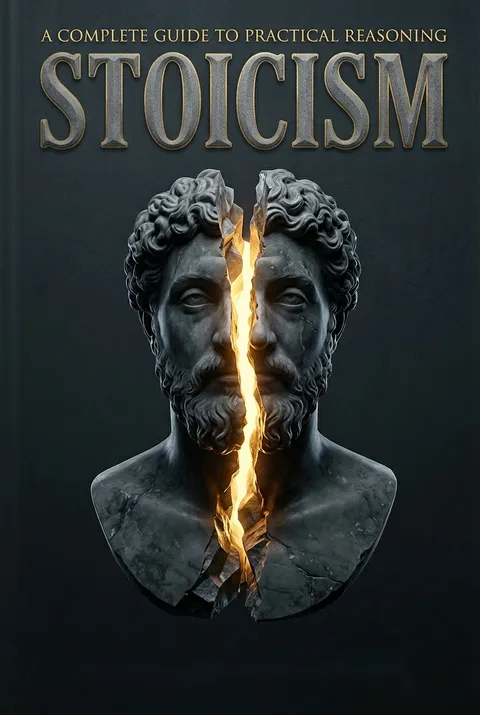
This book is best understood as a loosely assembled beginner's guide rather than a single, consistently argued account of Stoicism. Its most coherent through-line is practical: distinguish chosen judgments and actions from external outcomes, use virtue as a standard for conduct, and rehearse responses before hardship arrives. The portraits of Epictetus, Seneca, and Marcus Aurelius lend that advice human scale. They show philosophy being tested by enslavement, political power, and personal loss, rather than left as an abstract debate.
The compilation's breadth is both its appeal and its main weakness. It moves from ancient ethics to grief, parenting, optimism, antidepressants, meditation, sound therapy, and the subconscious. Some chapters reinforce one another, especially the warnings against emotional suppression and the recommendation to review conduct daily. Other sections conflict or make claims that are not developed with the same care. The book, for example, recommends acknowledging grief, but elsewhere repeats the familiar reassurance that time heals. It calls for reasoned inquiry, yet also presents claims about subliminal programming, vibration, and attraction without explaining their basis. Readers should not treat these sections as equally reliable.
The most valuable interpretation therefore preserves a distinction the text sometimes blurs: Stoic composure is not emotional absence, and acceptance is not passivity. The practical aim is to notice what is happening, judge it as carefully as possible, and take the action that remains ethically available. That aim accommodates grief, seeking help, and working to change unfair conditions. It also avoids the impossible standard of controlling every response perfectly. Stoicism is most useful here not as a promise of invulnerability, but as a discipline for recovering choice when circumstances are difficult. The virtues provide direction; reflection provides feedback; and realistic acceptance keeps effort aimed at what can still be changed.
Glossary
Dichotomy of control
Separating choice from circumstanceA Stoic distinction between what is up to a person, especially judgments and chosen actions, and what is not, such as other people's decisions and many external events. The distinction directs effort toward one's conduct while making room to accept outcomes that cannot be guaranteed.
Four Cardinal Virtues
Four standards for conductThe book's four categories of excellent character are wisdom, justice, courage, and self-discipline, also called temperance. Wisdom guides judgment, justice governs fair treatment, courage supports perseverance and honesty, and self-discipline regulates desire and behavior. The book treats them as an integrated guide to living well.
Eudaimonia
A flourishing, virtuous lifeA Greek term the book uses for the good or flourishing life. In its Stoic account, eudaimonia is not secured by wealth, reputation, or pleasure. It is pursued through reason and virtuous conduct, including wisdom, justice, courage, and self-discipline.
Reserve clause
Pursuing plans while allowing obstaclesA way of stating an intention while recognizing that circumstances may prevent its completion. A person commits to making a serious effort, but does not claim control over the final result. The book presents this as a practical expression of the difference between chosen action and external outcome.
Amor fati
Accepting what has happenedA Latin phrase used in the book for an attitude of embracing events as they occur, including unwanted ones. Its practical purpose is to stop struggling against facts that cannot be changed and redirect attention toward what can still be done. It is not presented as a reason to deny pain.
Negative visualization
Imagining possible lossesA Stoic exercise in which a person briefly imagines losing something valued, such as health, work, or a relationship. The book uses it to encourage gratitude, prepare for adversity, and reduce the shock of change. The exercise is meant to be considered without fixation or spiraling worry.
View from above
Seeing problems at wider scaleA perspective exercise associated in the book with Marcus Aurelius. A person mentally widens the view from an immediate setting to a broader region and ultimately the Earth, then considers a current difficulty in that larger context. The aim is to loosen an exaggerated sense that one problem occupies the whole world.
Voluntary discomfort
Practicing manageable inconvenienceA deliberate, limited encounter with discomfort, such as walking instead of driving or taking a break from a phone. The book presents it as a way to reduce dependence on constant convenience and practice responding calmly when conditions are less comfortable. It is not meant as a pursuit of pain for its own sake.
Download PDF
Download EPUB
.epub digital book format is ideal for reading ebooks on phones, tablets, and e-readers.








