

Key Takeaways
Let strategy emerge from local action instead of scripting every outcome
Start with the problem nearby. In 1974, economist Muhammad Yunus saw villagers in Bangladesh trapped by tiny debts that prevented them from earning a living. He lent $27 to 42 households so they could make goods for sale. That small response to an immediate need became the beginning of Grameen Bank, which by 2007 served more than 80,000 villages. Yunus had not set out to build a global institution. The authors call this strategy without design: a coherent pattern of action and results that forms without a master plan.
Let practice clarify direction. Local efforts can accumulate into a recognizable strategy as people respond to what is in front of them. The broad aim may become clearer through action, rather than being fully specified in advance. This does not mean that intention is absent from every decision, only that no single intention needs to explain the eventual result.
What's striking is the shift in where strategic intelligence resides. It is not only in executive foresight, but in people close enough to notice what is failing and try a workable response. This resembles learning systems in which feedback from action improves the next attempt. The case also complicates the familiar story of entrepreneurship as a lone visionary's plan. Still, emergence should not become an excuse to avoid responsibility: an outcome can be unplanned and still require deliberate oversight when people are harmed or excluded.
Small repairs can change systems more than spectacular campaigns
Repair the visible neglect. In the 1980s, New York subway director David Gunn focused on removing graffiti, even as colleagues wanted attention on serious crime and service failures. Graffiti-covered trains were removed from service or cleaned promptly. A later effort targeted fare evasion. The book reports that serious felonies fell by about 75 percent by the end of the decade. The proposed mechanism was indirect: visible neglect can suggest that nobody is in charge, inviting further disorder. The broken-window theory behind this approach was controversial, and the authors emphasize the sustained attention to small local problems more than a single dramatic crackdown.
Look for amplifying effects. Repeated minor actions can alter expectations and behavior across a larger system. In the book's analogy, water entering a small crack in rock can widen it over time, eventually changing what can grow there. Mundane interventions may matter because their effects compound through other people's responses.
The example directs attention to feedback rather than spectacle: a repaired environment can change what people believe is tolerated, and that belief can influence what they do next. This logic is useful well beyond policing, wherever small signals shape shared expectations. But the reported crime decline does not, by itself, prove graffiti removal caused it. Complex social outcomes usually have multiple influences. The strongest lesson is methodological: attend to local conditions and test whether small interventions are changing the system, rather than assuming that a bold announcement has done so.
A successful product can lose its meaning when managers define it too tightly
Protect room for reinterpretation. Dr Martens boots began as practical footwear, then were adopted by groups as different as workers, mods, punks, and students. The manufacturers did not plan each cultural use. The boots offered a durable object that wearers could make their own, and that openness helped build the product's appeal.
Expansion changed the relationship. In the 1990s, the company pursued rapid growth through branded shops and a wider range of products. By 1994 it employed 2,700 people, had sales of £170 million, and made 10 million pairs of boots and shoes a year. The book says the company lost £100 million over three years. Competition and other pressures mattered too, but the authors argue that turning an adaptable symbol into a tightly managed brand weakened what had made it distinctive.
This case highlights a tension between scaling an offering and preserving the conditions that made people care about it. In cultural markets, customers do not merely buy objects; they also use them to express identities the producer may not anticipate. The strategic mistake is not growth in itself, but assuming that a successful meaning can be packaged, multiplied, and controlled without changing it. That said, the story should not be read as proof that branding always destroys authenticity. It shows why growth plans need to ask what kind of openness they may be consuming.
Treat social order as something grown, not simply designed
Notice order without an author. The book traces spontaneous order through thinkers including Adam Ferguson, Adam Smith, Carl Menger, and Friedrich Hayek. The term describes patterns and institutions that arise from many people's actions without any one person intending or directing the whole. Language, money, markets, and legal practices are examples. Menger's account of money begins with people trading goods, then gradually favoring items that others will readily accept. Repeated choices can create a shared medium of exchange without anyone first designing money.
Use design with humility. Hayek emphasized that knowledge is dispersed: no planner can possess all the local information held by people acting in different circumstances. Prices can communicate some of that information, though they do not reveal everything. Spontaneous order is not automatically fair or beneficial, but it warns against assuming that central direction is the only source of coordination.
This perspective usefully distinguishes coordination from command. It helps explain how a large system can display regularity even when participants know only their own small part. The idea is especially powerful when a planner's model simplifies away local knowledge that people use in practice. Yet spontaneous order is descriptive, not a moral endorsement. Unplanned arrangements can preserve exclusion or concentrate power. The useful question is therefore not whether to design or leave alone, but which forms of deliberate intervention support local learning without pretending to control every consequence.
See yourself as part of the system whose outcomes you want to change
Widen the frame. Anthropologist Gregory Bateson argued that people, institutions, and natural environments are connected systems. Actions aimed at one immediate goal can disturb relationships that sustain other parts of the whole. The authors use the 2008 credit crisis to illustrate the danger of treating finance as a self-contained machine for generating returns.
UBS lost sight of its connections. The Swiss bank pursued investment-banking growth by copying competitors and using income from its wealth-management business to support riskier activity. Its managers admitted that they had focused on complicated transactions and processes while missing basic questions about the bank's overall exposure. By the second quarter of 2008, credit-crisis losses and write-downs attributed to UBS reached $42 billion. The book calls the needed awareness system wisdom: recognizing that one's actions affect, and depend on, wider systems.
A system perspective changes the unit of responsibility. It asks not just whether a decision works inside one division, but what it transfers to other divisions, institutions, or communities. That is a useful corrective to metrics that reward local gains while hiding costs elsewhere. The UBS account also suggests that more data do not guarantee better judgment: intricate models can deepen confidence without making relationships easier to understand. Systems thinking has its own danger, however. If every outcome is attributed to a vast web of causes, decision-makers may evade accountability for choices they could have made differently.
Cultivate practical judgment, not just technical competence
Know more than the rules. Aristotle's terms help distinguish abstract knowledge, technical skill, and phronesis, or practical wisdom: the ability to respond appropriately in a particular situation. The authors also distinguish purposeful action, which aims at a specified result, from purposive action, which grows from practiced dispositions without requiring a fully articulated end. Much effective work depends on such learned judgment, not on conscious calculation at every step.
Toyota made improvement habitual. Its production system encouraged workers to notice waste and make continual small improvements. The familiar practices included organizing tools, keeping work areas clean, standardizing tasks, and respecting procedures. The authors argue that these were not merely techniques to copy. Their effectiveness depended on a cultivated attitude of attention and self-criticism, built into everyday work over time.
The distinction between knowing a rule and knowing when it fits is central to expertise. A recipe can transmit procedures, but judgment develops through repeated encounters with materials, people, and consequences. This helps explain why copying Toyota's visible tools may not reproduce its results: routines depend on the culture that makes people use them attentively. Practical wisdom is not infallible, though. Habits can preserve blind spots as easily as skill. A strong organization needs both situated judgment and ways to question the assumptions that experience has made feel natural.
Wayfind through changing conditions instead of navigating by fixed maps
Learn as you move. Wayfinding is the book's alternative to treating strategy as navigation from a known starting point to a fixed destination. A navigator uses a map to locate and plot; a wayfinder develops understanding through movement, adjustment, and memory of earlier journeys. The setting is not a blank surface waiting to be crossed. It becomes intelligible as the traveller engages with it.
Obree improvised from what he had. Scottish cyclist Graeme Obree used bearings from a washing machine in his bicycle and designed unconventional riding positions that helped him break the world hour record twice. When cycling officials changed rules to restrict his designs, he adapted again. His progress came from practical experiments, not a comprehensive plan. Google offers a different example: a search tool and advertising model grew from technical experiments and user activity, rather than a fixed blueprint for a global company.
Wayfinding captures a kind of intelligence that plans often miss: a person can recognize opportunities only after entering a situation and seeing how it responds. It is a strong model for innovation when the terrain is changing too quickly for detailed forecasts. The concept also helps explain why improvisation is not random; Obree's experiments drew on deep familiarity with cycling and equipment. Still, wayfinding is not a universal replacement for navigation. In safety-critical settings, maps and advance coordination matter. The practical challenge is knowing when to plan tightly and when to leave room for discovery.
Use indirect action to preserve options and avoid provoking resistance
Work with the situation's momentum. The Greek term me¯tis names a form of cunning practical intelligence: alertness, timing, adaptation, and the ability to use circumstances rather than confront them head-on. In Homer's account of a chariot race, Antilochus sees an opportunity at a narrowed stretch of track and moves across his rival's path, turning a disadvantage into a win. His advantage comes from reading the moment, not from having the faster horses.
The indirect approach has limits. The book also describes T. E. Lawrence's account of Arab forces in World War I, who used mobility and attacks on supply lines rather than trying to defeat a larger opponent in direct battle. Such tactics can conserve effort and unsettle an adversary. But indirectness can also become deception or self-serving opportunism, as Lawrence's experience of political betrayal suggests.
Indirect action is most persuasive when it is understood as responsiveness, not as a license to manipulate. It can reduce the resistance that direct confrontation provokes and make use of an opponent's commitments or a situation's existing momentum. This resembles strategic patience: wait for a favorable opening instead of forcing one. The ethical test is whether the tactic respects the people affected and the conditions that sustain cooperation. A clever move may win a local contest while damaging trust, which is often the very resource a longer effort depends on.
Stay with uncertainty before forcing strategy into a neat plan
Delay premature closure. The epilogue draws on John Keats's phrase negative capability, which the authors use for the capacity to remain with uncertainty, ambiguity, and unanswered questions without rushing to a tidy explanation. This does not mean rejecting facts or refusing decisions. It means noticing when a confident plan rests on assumptions that have not yet been tested.
Keep strategy open to revision. The authors call for a kind of strategic blandness: an unshowy, flexible orientation that avoids becoming trapped by fixed positions, ambitions, or identities. They also cite the Japanese management idea of sunao, an open-mindedness that helps people see changing circumstances more clearly. These ideas temper the urge to make every result spectacular and every direction permanent. The aim is not passivity, but a willingness to adjust while remaining attentive to what matters.
The value of staying uncertain is not uncertainty for its own sake. It is the ability to keep multiple explanations and responses available long enough to learn from reality. This is particularly important when a polished strategy creates social pressure to defend the original plan even as conditions change. Yet delay also has costs: in emergencies, hesitation can be dangerous, and ambiguity can shelter indecision. Negative capability is best understood as disciplined openness, paired with clear thresholds for action and accountability once evidence or urgency requires a choice.
Analysis
The book's central move is to relocate strategy from a plan held by an executive to a pattern emerging through situated action. Its examples make the argument memorable because they span scales: a small loan grows into a bank, subway maintenance coincides with falling crime, a boot acquires meanings its makers did not prescribe, and a bank's planned expansion becomes a systemic liability. The underlying proposition is epistemological as much as managerial. People do not first stand outside a complete world, map it accurately, and then act. They learn what is possible while participating in systems they only partly understand.
That argument challenges the fantasy of total control, but its strongest form is not anti-planning. Plans coordinate action, clarify responsibility, and can prevent foreseeable harms. The warning is against mistaking a model for the living situation it abstracts, or treating a successful local intervention as a general formula. Grameen Bank's trajectory and Google's growth are not reproducible recipes. Their significance lies in how attention, local adjustment, and accumulated practice can produce outcomes no central designer could specify in advance.
The book's use of spontaneous order also needs a political qualification. Unplanned systems can coordinate dispersed knowledge, but they can also reproduce unequal power, harmful norms, or externalized costs. Emergence does not guarantee justice. Similarly, indirect tactics may be adaptive, yet evasiveness can undermine trust. These limits suggest a practical synthesis: design institutions that set safeguards and clarify accountability, while preserving room for people closest to a problem to experiment and respond. Evaluate not only intended outcomes, but also what a strategy makes visible, what it excludes, and which other systems bear its costs.
The distinctive contribution is its insistence that strategy includes a way of being attentive. Wayfinding, practical wisdom, and negative capability are not simply tools in a managerial kit. They describe capacities to notice, adapt, and refrain from premature certainty. The result is a richer account of effectiveness: not only reaching a target, but sustaining the relationships and conditions that make future action possible.
Review Summary
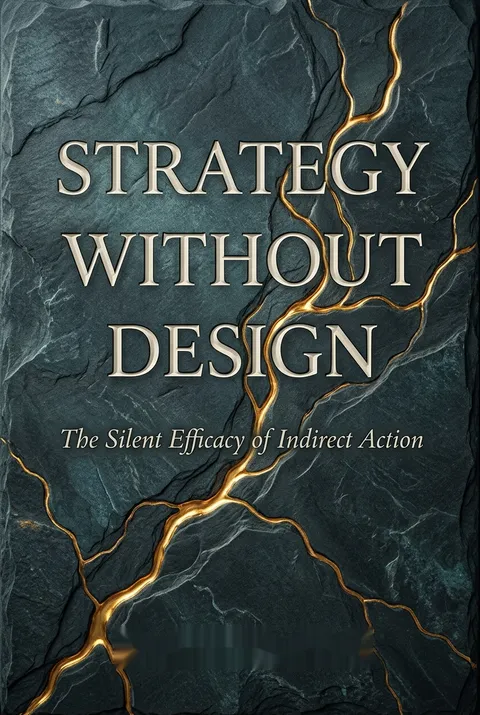
Strategy without Design challenges traditional views of organizational strategy, arguing for a more spontaneous and relational approach. The book suggests strategy emerges from complex social interactions rather than deliberate planning. Reviewers praise its philosophical depth and mind-expanding ideas, though some find the writing style oblique. It draws on diverse fields including sociology, cybernetics, and philosophy to propose a "wayfinding" metaphor for strategy. The book is seen as ambitious and thought-provoking, offering a fresh perspective on business strategy and management.
Glossary
Strategy without design
Emergent strategic consistencyA pattern of coordinated or consistent outcomes that develops through local actions without being deliberately planned in advance. The pattern may become recognizable only retrospectively. The concept does not deny that people make intentional decisions; it questions whether a single prior design is needed to explain collective achievement.
Spontaneous order
Order without central designA social or economic pattern that arises from many interactions without a central authority designing the whole. Language, money, markets, and customs are discussed as examples. Such order can coordinate dispersed knowledge, but its emergence alone does not establish that it is fair, efficient, or beneficial.
Habitus
Internalized dispositions for actionA durable set of socially and historically shaped dispositions that influences how people perceive situations and act within them. Habitus is acquired through experience and practice, often without conscious instruction. It can produce consistent action without requiring people to follow an explicit plan or formulate a strategic intention.
Phronesis
Situated practical wisdomAristotle's term for practical wisdom: the ability to respond appropriately to particular circumstances rather than merely apply a general rule. In this book, phronesis is closely connected to experience, cultivated judgment, and action among others. It contrasts with abstract knowledge and technical competence, while remaining difficult to reduce to a manual.
Purposive action
Action without fixed endsAction that expresses a person's acquired dispositions and practical engagement without necessarily aiming at a clearly specified outcome. It differs from purposeful action, which begins with an articulated goal and selects means to reach it. Purposive actions can still contribute to coherent results when many such actions accumulate.
Wayfinding
Learning through movementA mode of moving through an environment in which understanding develops through ongoing perception, adjustment, and remembered experience. Unlike navigation, it does not depend on first locating oneself on a complete map and plotting a route to a fixed destination. The environment is disclosed as the person moves through it.
me¯tis
Cunning practical intelligenceA Greek term for a flexible intelligence that combines alertness, timing, foresight, and adaptability. It works with changing circumstances rather than relying on direct force or a fixed plan. The book presents it as an often tacit capacity, useful in strategy but ethically ambiguous when it becomes deception or opportunism.
Strategic blandness
Flexible, unobtrusive strategyAn understated approach to strategy that avoids fixation on public positions, grand ambitions, and sharply defined outcomes. It emphasizes attentiveness, flexibility, and the ability to move among changing possibilities. Blandness is not simply moderation or passivity; it is a way of resisting premature commitment while remaining engaged.
Negative capability
Capacity to endure uncertaintyA term from poet John Keats, used in the book for the ability to remain with uncertainty, mystery, and doubt without urgently forcing a final explanation. In strategic settings, it means keeping judgment open while circumstances are still revealing themselves. It does not mean avoiding decisions when evidence or urgency calls for action.
Download PDF
Download EPUB
.epub digital book format is ideal for reading ebooks on phones, tablets, and e-readers.








