

Key Takeaways
Use streetlight rules for routine work, but adapt in the shadows.
Two kinds of thinking matter. Gary Klein contrasts stable situations, where procedures and analysis work well, with ambiguous situations, where causes, goals, and outcomes are uncertain. The book's opening example is Air Canada Flight 143, the Gimli Glider. A fuel conversion mistake and communication failures left the Boeing 767 without power at 41,000 feet. Captain Bob Pearson had no checklist for the emergency. He used his glider experience to improvise a landing that saved everyone aboard.
The point is not that improvisation is always wiser. The crew's earlier assumptions helped create the crisis. Rather, reliable performance needs both routine methods and the ability to change course when reality stops matching the plan.
What's striking is how the opening story refuses a simple hero narrative. Pearson's skill mattered, but so did a chain of maintenance, measurement, and communication failures. That combination echoes safety engineering's distinction between individual actions and system conditions: resilient performance depends on both capable people and reliable processes. The streetlight metaphor is useful because it makes context central, though the boundary between orderly and complex work is rarely clean. A familiar task can turn shadowy in an instant, so even routine procedures need room for scrutiny.
Use procedures as scaffolding, not as a substitute for skill.
Standardize the repeatable. Procedures are valuable when people must reliably perform known steps, especially under stress or interruption. A hospital checklist for inserting catheter lines helped reduce infections from an 11 percent baseline to zero for a year; a larger Michigan program reduced infections by 66 percent. Such checklists preserve basic safeguards, but they do not replace skilled clinicians.
In unfamiliar conditions, procedures may be incomplete, outdated, or dangerous when followed mechanically. An offshore oil-rig manager hesitated to use the standard response to a gas bubble. His unease led the crew to discover that the prescribed action could overload equipment and cause an explosion. Procedures work best when organizations clarify whether they are requirements, recommendations, or starting points for judgment.
The strongest case for procedures is not that they make workers interchangeable. It is that they protect attention from predictable omissions, freeing expertise for harder judgments. This resembles the distinction in aviation between a checklist and the pilot's broader understanding of the aircraft. The danger appears when compliance becomes the measure of competence. A useful organization therefore asks not only whether a step was followed, but whether the procedure still fits the situation and whether workers can safely raise concerns.
Train people to notice patterns that manuals cannot fully describe.
Expertise lives partly below words. Tacit knowledge is the ability to recognize or do something without being able to explain every cue and step. Drivers use it to judge when a gap in traffic is safe; experienced clinicians notice risks that a general checklist may miss. These skills grow through experience, not simply by memorizing more rules.
A landmine detector initially found only 10 to 20 percent of low-metal mines in tests. An experienced de-miner, Rocky Rockwell, succeeded by moving slowly, keeping the detector close to the ground, and recognizing patterns in how mines were planted. Researchers observed his work and built training exercises around those cues. Trainees' detection rates rose above 90 percent. Expertise can be made more teachable when trainers study what experts attend to.
This account connects naturally to apprenticeship: novices gain more from guided participation in real patterns than from abstract rules alone. It also challenges the assumption that an expert's inability to explain a skill means the skill is mysterious or unteachable. Observation, scenarios, and careful questioning can expose parts of tacit performance. Still, expertise is domain-specific. A detector specialist's perceptual habits do not automatically transfer to another task, and familiar patterns can mislead when conditions change.
Let experience suggest an action, then mentally test whether it can work.
Recognition can be rapid. Klein's Recognition-Primed Decision model describes how experienced people often identify a plausible action from a familiar pattern, then evaluate it by imagining how it would unfold. Fire commanders interviewed in the original research rarely compared long lists of options. Their experience made the first workable response worth testing. Across later naturalistic studies, this pattern appeared in roughly 90 percent of difficult decisions.
When both engines failed on US Airways Flight 1549, pilot Chesley Sullenberger considered returning to LaGuardia, then reaching Teterboro, then concluded that neither would work and chose the Hudson River. He evaluated options sequentially, not with a spreadsheet. This approach joins intuitive recognition with deliberate mental simulation. It is not a shortcut novices can safely copy without building the relevant experience.
This model offers a more realistic account of expertise than the idea that good decisions always begin with an exhaustive option list. It also makes intuition testable: a hunch proposes a course, and mental rehearsal checks for obvious failure points. That is a valuable middle ground between blind instinct and analysis paralysis. Its limit is equally important: recognition is reliable only when experience has taught useful patterns. In novel or deceptive settings, a first impression deserves more challenge, not more deference.
When uncertainty grows, improve interpretation before collecting more data.
More data can add noise. A puzzle has a missing fact that could resolve it; a mystery remains difficult because the causes or future outcomes are unclear. Gathering information can solve puzzles, but may deepen mysteries by adding conflicting details. In studies of severe-weather forecasting, some meteorologists became less accurate when given extra information, apparently because it was harder to integrate.
Before Pearl Harbor, US officials had numerous clues to a possible Japanese attack, including unusual messages and approaching aircraft. Many signals were scattered across agencies or explained away because they clashed with prevailing assumptions. Klein's Data/Frame Theory of Sensemaking describes the two-way process: people fit cues into a story, while that story guides which cues they notice. More information cannot repair a frame that makes important evidence invisible.
This is a useful corrective to the modern instinct to treat every uncertainty as a search problem. In data science, additional variables can improve a model, but only when they are relevant and interpreted in a sound structure. Pearl Harbor illustrates an institutional version of that challenge: information existed, yet no shared account made it actionable. The caution should not become an excuse to stop investigating. The practical test is whether new data can change a decision or clarify a causal story, rather than merely make the briefing thicker.
Form an early hypothesis, then actively test what could prove it wrong.
Speculation can guide attention. In a simulated operating-room crisis, anesthesiologists faced a patient whose breathing tube had become blocked by hardened mucus. Those who fixated on the obvious diagnosis failed, but so did physicians who kept every explanation tentative and drifted among possibilities. Seven of nine adaptive problem solvers found the blockage by using an initial diagnosis to guide tests, then changing their minds when treatment failed. This is a speculate-and-test strategy, not a license to settle prematurely.
Experts also anticipate where trouble might emerge. In a driving study, experienced drivers noticed potential hazards 66 percent of the time, compared with 36 percent for novices. They scanned likely danger points rather than staring only at the road ahead. Active hypotheses help people decide what to inspect and what evidence deserves attention.
The approach resembles scientific inquiry when science is working well: explanations organize observation, but observations can revise explanations. It is more productive than demanding an impossible blank mind. A disciplined test asks what result would weaken the favored story, not just what would confirm it. The challenge is social as well as cognitive. Teams need to make it safe to voice uncertain suspicions, since a plausible early hypothesis can otherwise become the group's unquestioned explanation.
Make feedback understandable, and be willing to replace the mental model behind failure.
Results do not explain themselves. Outcome feedback says whether an action succeeded; process feedback helps explain what to change. Navy pilot Doug Harrington repeatedly failed to line up an A-6 for an aircraft-carrier landing, despite clear warnings from the landing signal officer. The officer asked Harrington to show how he aligned the plane. A simple demonstration revealed that the side-by-side cockpit shifted his viewpoint compared with the F-4 he had previously flown. Once Harrington understood the cause, he corrected his approach.
Cognitive rigidity is the tendency to preserve an explanation despite contrary evidence. Learning may require more than adding facts: people sometimes need to loosen or abandon a mental model. Scenarios that expose a model's failure, followed by a clear explanation, can make that revision possible.
The landing example shows why feedback is not a message delivered but a meaning constructed by the learner. Learning research likewise distinguishes information about outcomes from guidance that helps someone diagnose a process. A coach who explains too much can also prevent learners from developing their own capacity to notice and correct errors. Effective feedback therefore begins with inquiry: what does the learner believe is happening, and what experience would make the mismatch visible?
Revise the goal when experience reveals that the original target is wrong.
Some goals emerge through work. Management by Discovery is an approach for complex projects in which objectives may need to change as the team learns. Xerox's 914 copier illustrates the shift. Its chief executive first sought a company to license the technology, then tried manufacturing and leasing the machines. Neither approach fit. Xerox finally charged customers for copies, making the machine inexpensive to try. By 1967, an average copier produced more than 100,000 copies a year.
This flexibility differs from changing tactics while keeping the same goal. Management by Discovery allows the goal itself to be redefined. That matters because multiple objectives often conflict, and the work may reveal what customers, partners, or the organization actually need. A plan that cannot be revised can turn early assumptions into permanent constraints.
The Xerox story resembles iterative design: a product's business model becomes clearer through contact with users, not through perfect planning at the outset. This is especially relevant when a project involves uncertain demand or unsettled definitions of success. Yet flexible goals need governance. Without explicit discussion of why objectives changed, discovery can look like moving the goalposts and weaken accountability. Teams should record what they learned, what tradeoffs shifted, and who agrees that the new target is more valuable.
Build the capacity to recover from surprises that risk calculations miss.
Prediction has a boundary. Formal risk analysis works best when past experience gives a stable basis for estimating likelihood and impact. In complex settings, major threats may be novel, interconnected, or hard to recognize. Risk plans can also create false confidence if people assume safeguards have made the system safe.
When a fire destroyed the sole factory producing a valve used in Toyota vehicles, the company had only three days of inventory. Toyota had no prepared recovery plan. Instead, more than 2,000 firms reorganized their work and developed several production methods. Valve production resumed in three days, and within a week it returned to previous levels. Resilience engineering focuses on this capacity to adapt under disruption, rather than assuming every future danger can be listed and eliminated.
The Toyota response resembles resilience in ecology and infrastructure: a system survives not because it never experiences disturbance, but because it can reorganize without losing its essential function. The example also shows that informal relationships and distributed knowledge can be operational assets, not soft extras. Resilience does not make prevention obsolete. Routine hazards still deserve controls. The important distinction is between reducing known dangers and preserving the flexibility needed when the next disruption does not resemble the last.
Keep repairing shared understanding, especially during handoffs and crises.
Coordination is never finished. Common ground is the knowledge and assumptions people share well enough to predict one another's actions. A briefing can establish some of it, but changing conditions quickly erode it. During one airline reroute, a new air-traffic controller restored the original flight path without knowing that the crew and dispatcher had changed it to avoid thunderstorms. The pilot assumed the controller knew about the weather, and the plane was pushed into the storm line.
Teams need to notice and correct such mismatches as work unfolds. On Apollo 13, controllers formed a temporary Tiger Team to solve the spacecraft's emergency, changing roles instead of clinging to the original organization chart. Planning should also prepare people to recover their bearings when a route fails, not only to follow the planned route.
This insight aligns with distributed cognition: a team's effective understanding is spread across people, tools, and communication, so a breakdown can occur even when each person holds accurate local information. Handoffs deserve special attention because context is easily lost between shifts, departments, or software systems. Continuous checking is not the same as endless meetings. Short confirmations of assumptions, priorities, and changed roles can make coordination more reliable while preserving the flexibility that crises require.
Analysis
Klein's central argument is not that analysis, checklists, planning, or risk assessment are misguided. It is that each works only within conditions that support it. Stable tasks allow people to define steps, identify relevant variables, and measure outcomes. Complex tasks frustrate those assumptions: causes interact, evidence arrives unevenly, goals shift, and useful knowledge often exists as practiced perception rather than explicit rules. The book's most valuable move is therefore to replace universal advice with boundary questions: How predictable is this setting? Can people learn from consequences? Are the objectives stable? Does the tool preserve the expert's ability to notice and interpret?
That framework also exposes a tension. Expertise is indispensable, yet experience can harden into a misleading frame. Klein's answer is not simply to trust intuition, but to pair recognition with simulation, testing, and willingness to revise. This is compelling because it treats judgment as skilled activity rather than mysterious instinct. It also leaves a practical challenge: organizations need ways to question an expert without humiliating or silencing that person, and ways to question a procedure without making every action discretionary.
The book's critique of numerical tools is strongest when aimed at false precision, such as risk models that ignore systemic change. It is less persuasive if read as a general case against quantification. Statistics can expose patterns human attention misses, and procedures can protect people from predictable memory failures. Conversely, tacit expertise can be biased, unevenly distributed, or impossible to audit. The productive synthesis is not a balance by slogan, but a designed relationship: use formal methods where the world is stable, expert interpretation where context matters, and feedback channels that let each correct the other. The lasting lesson is to treat plans and models as provisional maps. Their value lies not only in guiding action, but in helping people recognize when the terrain has changed.
Review Summary
Streetlights and Shadows receives high praise for its insights on decision-making in complex situations. Readers appreciate Klein's challenge to conventional wisdom and his emphasis on intuition and expertise. The book is lauded for its practical applications, especially in leadership and coaching. Many find it more relevant and applicable than similar works. Some criticisms include verbosity and repetition. Overall, reviewers find the book thought-provoking and valuable for understanding real-world decision-making processes.
People Also Read







Glossary
Tacit knowledge
Hard-to-articulate practical skillKnowledge expressed through perception, judgment, and action that a person may not be able to fully explain as rules. It helps people recognize patterns, apply procedures to context, and notice subtle cues. Tacit knowledge develops through experience and is central to expertise, but it can be difficult to teach or evaluate using ordinary tests.
Recognition-Primed Decision (RPD) model
Recognize, then mentally testA model of how experienced people often decide under pressure. They recognize a situation as familiar, which suggests a plausible course of action, then mentally simulate that action to see whether it is likely to work. If the imagined result is unacceptable, they revise the action or consider another. The model combines experience-based recognition with deliberate evaluation.
Data/Frame Theory of Sensemaking
Frames and cues shape each otherA model describing how people make sense of uncertain situations. People interpret cues by fitting them into a frame, such as a story or mental model. At the same time, that frame directs attention toward some cues and away from others. New or conflicting information may lead people to revise the frame, seek different cues, or reconsider what counts as relevant data.
Speculate-and-test strategy
Hypothesize, then investigateA way to reason in ambiguous situations by forming a provisional explanation and using it to guide active tests. The explanation is not treated as settled fact. If a test fails or new evidence conflicts with it, the person revises the explanation or tries another. This approach avoids both rigid fixation and passive waiting for complete information.
Management by Discovery
Revise goals through learningAn approach to complex work that begins by clarifying objectives but expects them to change as people learn more. It differs from simply changing tactics to reach a fixed target: the target itself may need revision. Teams track discoveries, reconsider tradeoffs, and adapt plans as the problem becomes clearer.
Resilience engineering
Design for adaptive recoveryAn approach to safety and performance that emphasizes an organization's ability to adjust when disturbances exceed what plans anticipated. Rather than relying only on lists of known hazards and preventive safeguards, it examines how systems respond to pressure, change, and near misses. The aim is to preserve essential functions and support recovery when unexpected events occur.
Common ground
Shared assumptions for coordinationThe knowledge, beliefs, and shared history that allow people to coordinate and anticipate one another's actions. Teams can establish some common ground through briefings and procedures, but it changes as circumstances, roles, and information change. Members need to monitor and repair misunderstandings throughout the work, especially during handoffs and crises.
Cognitive rigidity
Holding an explanation too tightlyA tendency to preserve an initial explanation even when contrary evidence appears. People may ignore anomalies, question the evidence, or reinterpret it to protect their existing mental model. This tendency is not always harmful, since ideas can require time and evidence to develop, but it becomes dangerous when contradictions accumulate and no evidence is allowed to change the conclusion.
FAQ
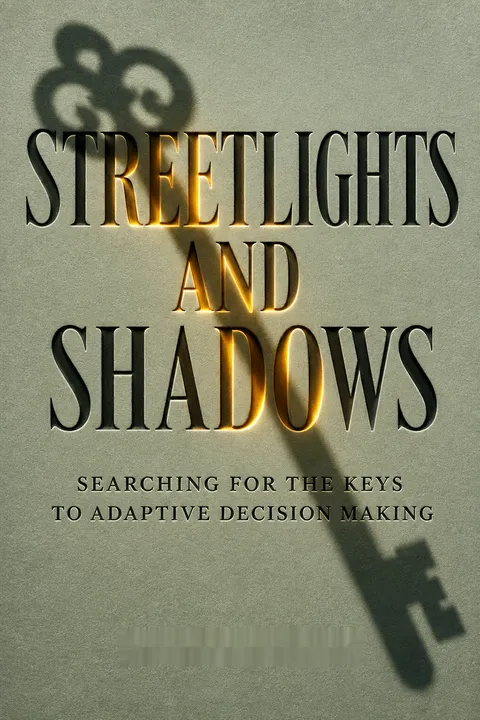
What is Streetlights and Shadows: Searching for the Keys to Adaptive Decision Making by Gary Klein about?
- Explores real-world decision making: The book investigates how people make decisions in complex, ambiguous, and unpredictable situations, contrasting these with well-ordered, clear conditions.
- Challenges conventional wisdom: Gary Klein critiques ten widely accepted claims about decision making, showing their limitations in real-world, complex environments.
- Focuses on adaptive thinking: The book emphasizes sensemaking, tacit knowledge, emergent goals, and resilience as keys to navigating uncertainty and complexity.
Why should I read Streetlights and Shadows by Gary Klein?
- Understand real decision making: The book reveals how people actually think and act under pressure and uncertainty, moving beyond textbook models.
- Improve adaptation and learning: It offers insights into how individuals and organizations can better learn, unlearn, and adapt mental models to handle complex problems.
- Balance intuition and analysis: Readers gain a nuanced view of when to trust experience and when to apply structured analysis, which is valuable for leaders and professionals.
What are the key takeaways from Streetlights and Shadows by Gary Klein?
- Procedures and feedback have limits: Rigid procedures and feedback can hinder learning and flexibility in complex situations; expertise often requires improvisation.
- Tacit knowledge is essential: Much expert decision making relies on unspoken, experience-based skills that can’t be fully captured by rules or analysis.
- Resilience over risk elimination: Organizations should focus on building resilience and adaptability rather than trying to eliminate all risks through rigid plans.
- Emergent goals and sensemaking: Goals often evolve in complex projects, and effective sensemaking is more important than simply collecting more data.
What are the ten common claims about decision making that Gary Klein challenges in Streetlights and Shadows?
- Conventional wisdom questioned: Klein identifies ten widely accepted claims, such as "teaching procedures improves skill" and "decision biases distort thinking," which he argues are misleading in complex, ambiguous situations.
- Context matters: These claims generally hold in well-ordered, stable domains but often fail or backfire in unpredictable environments.
- Encourages flexible thinking: Klein urges readers to understand the limitations of these claims and to adopt a more adaptive approach to decision making.
How does Gary Klein define and explain sensemaking in Streetlights and Shadows?
- Active process: Sensemaking involves fitting data into frames (like stories) and using those frames to determine what data to consider, not just passively drawing inferences.
- Identifying relevant cues: In complex situations, deciding what counts as a data point is challenging, and experts use intuition to recognize meaningful cues.
- Stories evolve: Effective sensemaking requires questioning and revising stories when anomalies arise, rather than forcing all data to fit a preconceived narrative.
What is the Recognition-Primed Decision (RPD) model in Streetlights and Shadows by Gary Klein?
- Decision by recognition: The RPD model describes how experienced decision makers recognize a plausible course of action based on patterns from past experience, rather than generating and comparing multiple options.
- Mental simulation: After recognizing an option, decision makers mentally simulate how it might play out to evaluate its feasibility and adjust as needed.
- Efficiency under pressure: Research shows that most expert decisions follow this model, enabling rapid and effective choices in high-stakes environments.
How does Streetlights and Shadows by Gary Klein address the role of intuition versus analysis in decision making?
- Both are necessary: Klein argues that intuition (based on tacit knowledge) and analysis (based on logic and statistics) each have strengths and limitations.
- Limits of analysis: Overreliance on analysis can lead to overthinking and ignoring context, especially in complex situations.
- Limits of intuition: Intuition can be biased or misled, particularly in unfamiliar or unstable situations, but is essential for rapid, context-sensitive judgments.
- Blending approaches: Effective decision making involves knowing when to trust intuition and when to apply analysis, often using mental simulation to evaluate options.
What does Gary Klein say about the limitations of procedures and checklists in Streetlights and Shadows?
- Helpful for novices: Procedures and checklists help beginners learn tasks and reduce errors in routine, well-ordered situations.
- Can hinder experts: Overreliance on procedures can erode expertise, reduce motivation to develop skills, and lead to mindless compliance that ignores context.
- Incomplete in complexity: In complex, changing environments, procedures often lag behind actual practice and may mislead or trap workers.
- Expert judgment is vital: Skilled workers use tacit knowledge to adapt, override, or depart from procedures when necessary.
How does Streetlights and Shadows by Gary Klein critique traditional risk management?
- Limits of risk identification: In complex situations, it’s impossible to foresee all major risks, especially rare "black swan" events.
- False confidence in numbers: Quantitative risk assessments may provide misleading confidence and fail to capture systemic or novel risks.
- Flexibility over rigid plans: Overreliance on risk mitigation plans can create complacency and hinder adaptability.
- Resilience engineering: Klein advocates for building organizational resilience to adapt and recover from unexpected disturbances.
What does Gary Klein say about feedback and learning in Streetlights and Shadows?
- Feedback is often ambiguous: In complex tasks, feedback is delayed, ambiguous, or distorted, making it hard to connect actions to outcomes.
- Learners must interpret feedback: Simply giving feedback is insufficient; it must be understandable and aligned with the learner’s mental models.
- Rapid feedback can hinder: Continuous, concurrent feedback may improve immediate performance but reduce long-term skill retention by preventing self-monitoring.
- Feedback’s role varies: Feedback is crucial for learning skills and procedures but less relevant for acquiring facts or insights.
How does Streetlights and Shadows by Gary Klein address teamwork and common ground?
- Common ground enables coordination: Shared knowledge and beliefs allow team members to predict each other’s actions and work smoothly.
- Fragility of common ground: It erodes over time, especially in dynamic, complex situations, and cannot be fully established by initial role assignments.
- Continuous repair needed: All team members must actively monitor and repair breakdowns in common ground to maintain effective coordination.
- Misunderstandings cause failures: Many team failures stem from assumptions about what others know, highlighting the need for active communication.
What strategies for unlearning and adapting mental models does Gary Klein propose in Streetlights and Shadows?
- Recognize fixation: Be aware when you or others resist changing beliefs despite contradictory evidence; ask what evidence would change your mind.
- Use experience and exercises: Simulations and real-world practice can expose flaws in current mental models and encourage new learning.
- Employ analogies and metaphors: These help bridge old and new understandings, facilitating conceptual change.
- Encourage curiosity: Question anomalies, consider alternative explanations, and bring in fresh perspectives to challenge existing assumptions.
About the Author



Download PDF
Download EPUB
.epub digital book format is ideal for reading ebooks on phones, tablets, and e-readers.








